
Internal hiring only saves money and time if you run it with clear rules, one route to apply, and tight ownership.
If you do that, you can fill roles in 10 to 20 days instead of about 42 days externally, cut hiring spend from roughly $4,683 to $1,094 per role, and get people productive in about 32 days instead of 92. If you do not, internal hiring slips into manager gatekeeping, slow approvals, patchy visibility, and missed talent.
Here’s the short version of what matters most:
- Set a written internal hiring policy with eligibility, posting windows, and feedback SLAs
- Post every role in one internal channel before going external
- Keep applications light and private until shortlist stage
- Use structured scorecards so decisions are based on evidence, not manager preference
- Track fill rate, time-to-fill, cost-per-hire, and time-to-productivity
- Add extra hiring capacity with Rent a Recruiter or an embedded recruiter when demand outgrows your team
For CEOs, CFOs, HR leaders, and Talent leaders, the point is simple: internal hiring is not just a people move, it is a cost and speed lever. The tips below show how I would tighten the process without adding more drag.
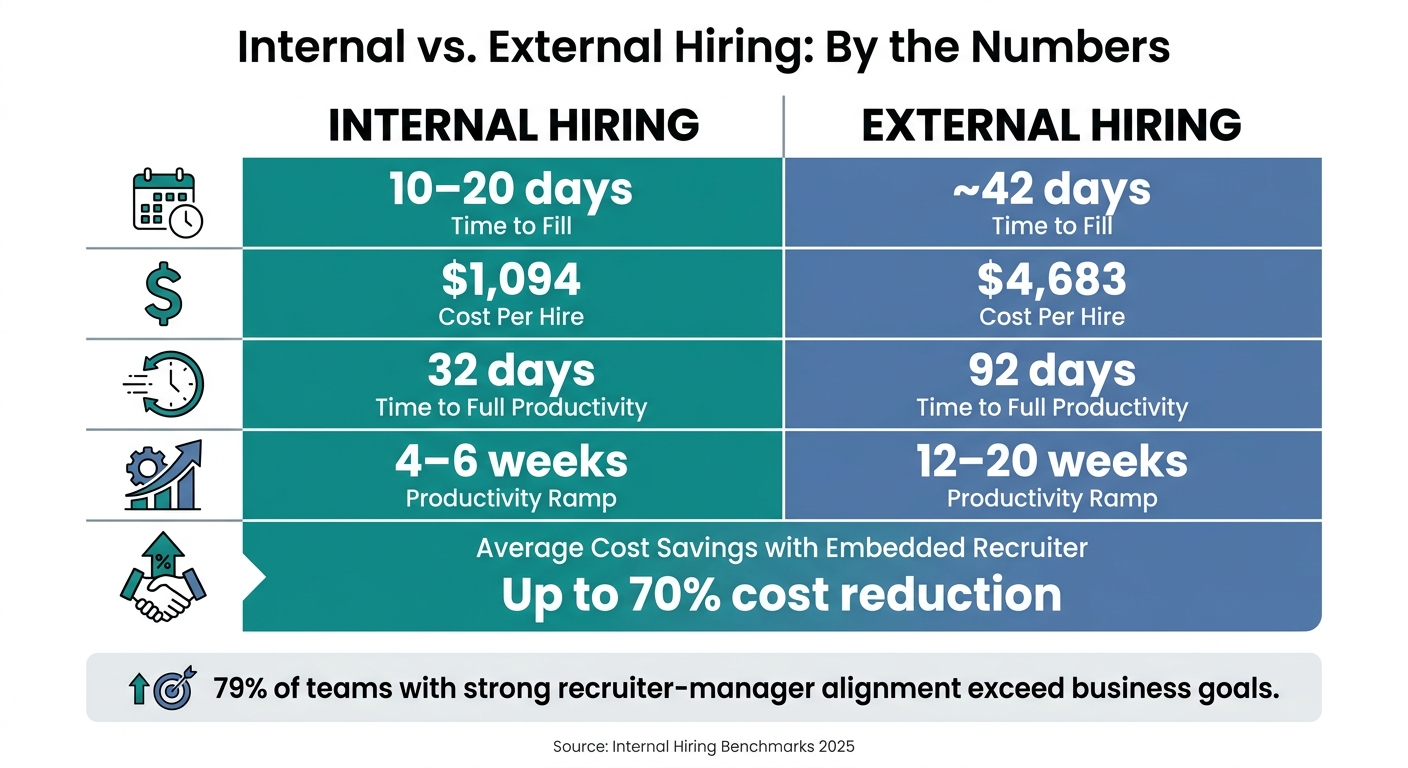
Internal vs External Hiring: Key Metrics Compared
Why Internal Hiring Breaks Down in Growing Companies
Most internal hiring processes were never built with intent. They just grew bit by bit as the company scaled.
That works for a while. Then hiring volume climbs, teams get stretched, and the cracks start to show.
The first issue is manager resistance. If a manager is judged on team output, they have a clear reason to keep their best people where they are. That creates a hidden veto. A high-potential employee might never even hear about an open role. The hardest part is manager resistance: strong performers are often quietly blocked from moving.
There’s another problem. Open roles often stay inside informal manager networks instead of being seen by the full employee base. So the people with the right relationships hear first, not always the people who are best for the role.
In fast-growing SMEs, internal hiring often has no clear owner. And when no one owns it, no one drives it. You end up with slower decisions, uneven evaluation, and a process that stalls when speed matters most.
This has a direct business cost. Delays drag out time-to-fill. Mixed decision-making leads to poor hiring calls. And when internal moves depend on who knows who, you lose trust in the process.
Alignment is where this starts to change. Teams with strong alignment between recruiting and hiring management are 79% more likely to exceed business goals [1]. Without that alignment, internal hiring becomes reactive, inconsistent, and easy to bypass.
The next tips fix these breakdowns with clearer rules, better visibility, and simpler workflows.
sbb-itb-a23bd6a
1. Augment Hiring Capacity With Rent a Recruiter
When hiring demand climbs faster than your internal team can handle, bottlenecks show up fast. Roles stay open longer. Hiring managers start making rushed calls. Strong candidates drop out before your team gets to them. When your hiring team is stretched, an embedded recruiter helps you move faster without adding permanent headcount.
Rent a Recruiter does this by placing an experienced recruiter inside your team to run sourcing, screening, scheduling, hiring manager coordination, and candidate communication. For internal hiring, that means open roles are less likely to stall while your team juggles day-to-day work.
There’s also a process win here. Embedded support keeps internal candidates on the same scorecards and rubrics as external applicants, so decisions stay more consistent and easier to track.
The business impact is simple: less admin, faster hiring progress, and more control over the process. Companies also typically cut hiring costs by up to 70%. So instead of overloading your internal team or rushing into permanent hiring, you get extra hiring capacity when you need it most.
2. Build a Clear Internal Hiring Policy
Once you have capacity in place, the next step is clear internal rules. If nothing is written down, internal hiring tends to drift. One team moves fast, another stalls, and decisions change depending on the manager.
That creates drag you do not need.
A clear policy helps you cut delays, reduce manager bottlenecks, and keep decisions consistent. It should spell out who can apply, where roles are posted, when managers are told, and how long each stage should take. You also need clear eligibility rules, an internal-only posting window, and a set feedback timeline.
For eligibility, many companies require employees to have 6 to 12 months in their current role. They may also require that the employee is not on an active Performance Improvement Plan and is no longer in their initial probation period [4][7]. These rules help you avoid edge cases that slow hiring down later.
Roles should be posted in one internal channel before any external search begins. Each post should include compensation ranges, core responsibilities, and success metrics [4][7]. If the post is vague, managers waste time answering basic questions, and employees are less likely to apply.
To reduce talent hoarding and drive more internal applications, it often makes sense to notify the current manager only when the employee reaches the shortlist [4][7]. That keeps early interest from being blocked too soon.
Speed matters here as well. Set a clear SLA for feedback, for example 48 hours after an interview, and define a handoff period of 2 to 4 weeks once an offer is accepted [4][7]. Without these timelines, internal moves can drag on and hurt both team planning and candidate experience.
Ownership should be simple. The CHRO or VP of HR owns the policy, while Talent Acquisition or HR Operations runs the process day to day [2].
With the rules set, the next step is aligning internal hiring with workforce planning.
3. Align Internal Hiring With Workforce and Succession Planning
Once the policy is set, tie internal hiring to workforce planning so you’re not scrambling when someone leaves. The goal is simple: see gaps early, line up internal talent, and cut the time it takes to fill key roles.
Start with a regular HR gap analysis. Compare the skills you have today with the capabilities you’ll need in the next 6 to 12 months. Then use talent mapping to spot high-potential employees [2]. That gives you a clearer view of who could move, where your gaps sit, and which roles should stay internal first versus which ones need external sourcing.
Not every role should begin with an internal search. A simple rule by role type keeps this practical:
- Leadership, specialist, and lateral moves: internal scan first. For leadership and specialist roles, use a 5- to 10-day internal-only posting window before external search begins [8][1].
- Entry-level and skills not currently in-house: external sourcing first [2][1].
It also helps to split internal talent into two groups: ready now and ready in about 6 months. That way, managers can make faster decisions on current openings while also building the next layer of talent. Use stretch projects or interim assignments to close the gap for those who are close but not there yet [1].
The business case is hard to ignore. Internal hires typically reach full productivity in 4 to 6 weeks, compared with 12 to 20 weeks for external hires, and they cost 41% less on average [8][4]. For scaling teams, that turns succession planning into a hiring speed and cost lever, not just a fallback plan.
4. Standardize Internal Job Descriptions and Postings
Once workforce planning points to internal moves, the format of the job post starts to matter. A lot. If the post is hard to scan, vague, or inconsistent, people miss roles they might have applied for.
Use one standard format for every internal opening. That makes roles easier to compare, easier to understand, and easier to act on.
A strong internal post should include:
- Job title, department, reporting line, and location
- The team’s mission, current projects, and how the role fits into the department, not generic boilerplate [9]
- A clear reason for the employee to apply, such as new skills, career growth, or broader scope [9]
Be clear on eligibility from the start. Spell out who can apply, any minimum time in role, performance requirements, and whether employees need to tell their manager before applying. You should also list the selection steps, including interview rounds and any skills exercise, or rate your recruitment process to find gaps [9][7]. Clear rules cut confusion, save manager time, and reduce last-minute issues.
Standard templates also save admin time. Recruiters and hiring managers don’t have to build each post from scratch, and that matters when hiring volume climbs.
To cut friction even more, keep the internal application process simple. A pre-filled profile or short statement of interest often works better than asking employees to upload a full resume again [9][8].
Research shows that 47% of organizations still require internal candidates to complete the same lengthy forms as external applicants [8]
That kind of process creates avoidable drag. And when internal hiring feels harder than it should, people opt out.
Post every role in one company-wide channel using the same template so all employees get the same information [1][7]. That builds trust in the process, supports broad access, and makes talent data easier to manage in the next step.
5. Centralize Internal Talent Data
Once your job postings are standardised, the next bottleneck is simple: knowing who is ready to move, and when.
If that data sits in different spreadsheets, inboxes, or manager notes, internal hiring slows down fast. Managers can’t compare people properly. HR spends time chasing updates. TA ends up screening with half the picture.
The fix is one searchable source for internal talent data, held in your ATS, HRIS, or a shared skills database.
That data should include:
- Skills rated 1 to 4 for proficiency
- Recent project experience
- Manager feedback
- Career interests
- A clear split between people who want a move and people who are available now
Keep it updated weekly, with ownership sitting with HR or TA. For teams without the internal capacity to manage this, flexible embedded recruitment can provide the necessary oversight. If no one owns it, it slips. And once it slips, internal hiring turns into guesswork.
Only 31% of HR teams maintain a skills inventory that has been updated within the past 12 months [8]. That’s a problem. It means many businesses are still making internal hiring calls based on stale or incomplete data.
For SMEs with fewer than 200 employees, you don’t need a complex system to get started. A shared skills sheet and a weekly opportunities digest can do the job. The point isn’t the tool. It’s the discipline. One place. Regular updates. Clear ownership.
When your talent data is clean and current, internal screening gets faster and more objective. You spend less time searching, less time second-guessing, and more time moving the right people into the right roles.
6. Simplify Internal Applications and Screening
Once your talent data sits in one place, the next slowdown is usually the application process itself.
This is where internal mobility often falls apart. If applying feels awkward, slow, or risky, people drop off. Long forms, vague steps, and worry that their manager might find out too soon can be enough to stop an application before it starts.
Keep the application light. Ask for a short statement of interest and a clear note on role fit. You already hold the employee’s background, performance history, and internal records. There’s no need to make people repeat information you already have.
This does two things fast. It keeps more employees in the process, and it cuts time from first review.
A short internal-only application window helps as well. Run it for 5 to 7 business days before you post the role outside the business. A smaller applicant pool in a tighter window makes decisions easier to move. That matters because internal hiring already has a clear speed edge, with an average time-to-fill of 10 to 15 days compared to 42 days for external hires [3].
Once applications are in, use the same criteria for everyone. A structured scorecard gives hiring teams a clear way to assess fit and keeps decisions tied to process, not gut feel. Focus on transferable skills and growth potential, not just direct role match.
Confidentiality matters just as much as speed. People are far more likely to apply when early interest stays private. Make that explicit in the posting. State that confidentiality is guaranteed until the shortlist for interview stage.
That one line can remove a major block to internal movement, and help you surface more of the talent you already pay for.
7. Use Structured, Skills-Based Interviews
After a simple application process, keep the interview stage just as structured. Once applications are easy, interviews need the same discipline. Without a clear format, internal interviews can drift into casual chats that reward familiarity instead of fit.
Bring the scorecard into the interview stage and use the same questions for every internal candidate, no matter how well the hiring manager knows them. Your decision should rest on evidence, not tenure or personal relationships.
Companies that use a structured internal interview track make hiring decisions 41% faster than those that put internal staff through the same loop used for external hires [8]. Structured scorecards can also cut debrief time from about 45 minutes to 15 minutes because interviewers arrive with evidence logged against a rubric, not loose impressions [6].
Use the interview to test what screening cannot prove:
- Skills
- Behaviours
- Growth potential
Judge capability and future fit, not time served. If a strong internal candidate has a gap, document it and map a 90-day development plan instead of ruling them out straight away [1].
Book the debrief at the same time as the final interview. That simple step helps you avoid decision delays and stops internal applicants from being left waiting [6]. It also makes interview data much easier to automate and track.
8. Automate Admin With Hiring Technology
Structured interviews give you clean data. Automation keeps that data moving.
Once scorecards are in place, the next bottleneck is usually admin. Scheduling, status updates, internal approvals, and offer letters all need to happen. But they do not need to be manual. Every hour your team spends chasing calendars is an hour not spent making hiring decisions.
Start with scheduling. Automated scheduling tools let candidates book from open time slots and manage reschedules on their own. That can save about 2 to 3 hours per week per coordinator [6]. In fast-moving teams, that time adds up quickly, especially when internal candidates need prompt updates and hiring managers want clear shortlist visibility.
AI note-takers can also cut admin in a big way. They save about 20 minutes per interview by drafting summaries and mapping answers back to the scorecard. That means feedback can move from 48 hours to 10 to 20 minutes [6]. For scaling teams, that shortens delays, keeps momentum up, and gives hiring managers what they need while interviews are still fresh.
AI-powered recruitment tools help at the front end too. They can reduce first-pass review time by 50% [6]. That keeps employee status visible, pushes approvals forward, and cuts the back-and-forth that slows internal movement.
If you want the biggest time win first, focus on:
- Scheduling
- Note-taking
- First-pass screening
Each step removes friction from the next one. The result is simple: less admin, faster decisions, and more recruiter time spent where it counts, on judgment, alignment, and hiring outcomes.
9. Promote Internal Mobility Through Clear Communication
Even the best process falls flat if people never see it.
Internal roles need to be easy to find and easy to act on. Use one internal channel so employees can see openings the same day they go live, and keep a five-business-day internal window before external sourcing starts [4]. That gives your whole employee base access to roles, not just the people who happen to have the right manager relationship.
Just as important, employees need to know they can explore internal moves without hurting their standing. A written no-penalty policy helps make that clear. Employees notify their manager at the final-round stage, not when they first apply [4]. That gives people space to look at new roles without stress, while still giving managers enough time to plan backfill.
Done well, internal mobility can lower turnover and improve engagement [4][5].
Managers need clear signals too. If you want internal hiring to work, you can’t reward managers only for holding on to people. Tie manager reviews to how often they help employees move into bigger roles [4]. That cuts down on talent hoarding and keeps managers working as part of the internal hiring system.
10. Track Metrics and Improve the Process Over Time
Once the process is streamlined, you need to check if it’s working.
If you’re not measuring internal hiring, you’re guessing. And guessing makes it hard to see where things stall, where managers create drag, and where employees drop out of the process. The goal here is simple: track whether the earlier fixes around visibility, screening, approvals, and speed are changing hiring outcomes.
Start with internal fill rate, the share of open roles filled by existing employees. The median sits at about 22%, while top performers hit 35% to 45%[8]. If you’re below that band, the problem usually starts earlier in the process. Poor role visibility, manager resistance, or too much friction in the application flow can all hold that number down.
Then look at internal time to fill. Internal hires should close in 10 to 20 days, while the external average is 42 days[3]. If internal moves are taking just as long as external hires, that’s a red flag. In most cases, approval steps are too slow or no one owns the process end-to-end.
Cost per hire is another metric worth watching closely. In 2025, the average cost to fill a professional role was $1,094 internally versus $4,683 externally[8]. That gap matters. For CFOs and hiring leaders, it gives you a clear way to tie internal mobility back to cost control.
You should also track time to productivity. Internal hires reach full productivity in an average of 32 days, compared with 92 days for external hires[8]. That’s not just a speed win. It shows internal mobility can improve output sooner while cutting the ramp time that often comes with outside hires.
Taken together, these numbers help you prove whether internal mobility is faster, lower-cost, and better for retention.
Review the data monthly with recruiting leadership and quarterly with executives to track business impact[6][8]. Publish a short annual internal mobility dashboard for leadership to build accountability and show that internal hiring is being treated as a serious business priority[8].
Use the numbers to fix the biggest bottleneck first.
What to Prioritize First
Start with the biggest bottleneck. Don’t try to rebuild your full hiring process in one go. That usually creates more noise than progress.
Use the metrics above to spot where things are slowing down, then fix the easiest high-impact step first. This keeps the work focused and gives you a faster path to better hiring output.
| Phase | Timeframe | Focus | Key Actions |
|---|---|---|---|
| Short-Term | 0 to 6 months | Policy and process friction | Set an internal-first rule for priority roles; standardise postings; use a 5 to 10 day internal-only window before posting externally [8] |
| Mid-Term | 6 to 12 months | Data & Workflow | Build a searchable skills inventory; centralise talent data; track fill rate and time-to-productivity [8] |
| Long-Term | 12 to 18+ months | Culture & Capacity | Tie manager incentives to talent development; formalise succession planning; add embedded recruiting support for hiring spikes |
This gives you a simple way to sequence change.
In the short term, remove friction that slows decisions and blocks internal mobility. In the mid term, clean up your data and workflow so you can see what’s working and where hiring stalls. Over the longer term, build manager accountability and add extra recruiting capacity when demand jumps.
The workflow snapshot below turns these priorities into a simple operating model.
Internal Hiring Process at a Glance
Use the workflow below to turn the earlier tips into one clear internal hiring process.
The aim is simple: one route from requisition to ramp-up, with one clear owner at each stage. That cuts confusion, saves time, and makes handoffs far less messy.
| Stage | Key Action | Primary Owner | Handoff |
|---|---|---|---|
| 1. Requisition | Define whether the role is for growth or backfill and confirm budget | Hiring Manager & Finance | Approved job description and budget |
| 2. Internal Posting | Post in one internal channel for 5–7 business days [7] | Recruiter / HR | Link to internal application portal |
| 3. Screening | Verify tenure (6+ months) and good standing; no active PIPs [7] | Recruiter / HR | Shortlist of eligible candidates |
| 4. Interviews | Run structured interviews with one rubric [7] | Hiring Panel | Completed scorecards and notes |
| 5. Selection | Make a data-led decision; send feedback to unsuccessful candidates within 48 hours [7] | Hiring Manager | Decision shared with HR and candidate |
| 6. Offer | Finalize compensation and start date [7] | HR / Recruiter | Signed internal transfer agreement |
| 7. Transition | Execute a 30-day knowledge handoff and set 30/60/90-day ramp goals [7] | Sending and receiving managers | Handoff plan and backfill plan |
A process like this helps you avoid the usual bottlenecks. Teams know who owns what. Finance gets budget clarity early. HR and hiring managers can move faster without making the process feel loose or inconsistent.
One point matters more than it might seem: manager notification. Let employees apply privately first, then notify their current manager only once they reach the shortlist stage [7]. That gives people room to explore an internal move without early pushback, and it helps keep the process fair.
Conclusion
When every role is posted openly, every person is assessed against the same standards, and each stage has a clear owner, hiring tends to move faster and land better outcomes. But that does not happen by accident. Someone has to own the process and keep it on track.
For U.S. SMEs, the biggest gains usually come from simple fixes that remove delay and confusion:
- Clear approval steps
- Defined internal posting windows
- Fast, fair decisions
Add automation, centralised data, and structured evaluation, and the process becomes much easier to run as hiring volume grows.
The data supports that approach. Internal hires reach full productivity in 32 days on average, compared with 92 days for external hires [8].
If hiring demand starts to outpace your internal team, extra embedded support can help you keep momentum without losing control. Rent a Recruiter places experienced recruiters directly into your team within days, adding structure, visibility, and consistency to hiring.
Companies that get internal hiring right tend to keep more people, grow faster, and spend less.
FAQs
How do we stop manager gatekeeping?
Shift incentives away from talent hoarding and toward talent development.
That means rewarding managers who help strong people move internally, not punishing them for "losing" a top performer. If you want internal mobility to work, managers need to see that the business backs it, and that helping talent move is part of good leadership.
Put formal move plans in place. Include backfill commitments and protected time for knowledge transfer so teams are not left carrying the cost of the move on their own. This cuts disruption, protects delivery, and makes internal moves far easier to approve.
Leadership support also needs to be visible. If even one high-profile move gets blocked, people notice. And when that happens, the message is clear: internal mobility is not a real priority.
What should an internal hiring policy include?
An internal hiring policy needs clear eligibility rules from the start. That means spelling out things like minimum tenure and performance standards, so people know where they stand. When those rules are clear, you reduce bias, cut down on favouritism, and make internal moves easier to defend.
It should also set out the process in plain terms. Cover where roles are posted, how employees apply, whether there’s an internal-first window, how candidates are assessed, when current managers are notified, how fast unsuccessful applicants get feedback, and what happens during a transfer.
That kind of structure matters more than most teams expect. It cuts admin drag, keeps hiring moving, and gives you a process that managers can follow without second-guessing each step.
Which internal hiring metrics matter most?
Focus on three core metrics: time-to-hire, time-to-fill, and cost-per-hire.
Time-to-hire shows how long it takes a person to move from entering your pipeline to offer acceptance. Time-to-fill looks at the full hiring cycle, from job approval to acceptance. That difference matters. If time-to-hire is tight but time-to-fill is slow, your issue may sit upstream, often in approvals, intake, or role scoping.
You should also track quality-of-hire, response times, and drop-off rates. These numbers help you spot friction in the process before it turns into lost hires, stalled teams, or extra agency spend.
For internal mobility, keep an eye on internal fill rate, time-to-productivity, and long-term retention. Those metrics show whether internal moves are helping you fill roles faster, cut hiring costs, and get people delivering sooner.