
Recruitment costs can make or break your hiring strategy. For scaling companies, the choice between in-house and outsourced recruitment impacts not just budgets but also speed, flexibility, and hiring outcomes.
Key takeaways:
- In-house recruitment works best for consistent, high-volume hiring (over 25 roles annually), but it comes with fixed costs like salaries and tools, even during slow periods.
- Outsourced recruitment, including agencies and embedded recruiters, offers pay-as-you-go models that scale with demand, making it ideal for irregular or specialized hiring.
- Embedded recruitment provides a middle ground, combining cost predictability with the ability to scale up or down, often saving up to 70% compared to traditional agencies, which you can verify with our recruitment savings calculator.
Quick overview:
- In-house teams cost $175,000–$250,000 annually but become cost-effective with 10+ hires per year.
- Agencies charge 15–30% of first-year salaries, ideal for fewer than 10 hires annually.
- Embedded recruitment offers fixed monthly fees, lowering costs across all hiring volumes and reducing admin by 80+ hours per month.
The right recruitment model depends on your hiring volume, growth plans, and need for cost control. For scaling businesses hiring 10–24 roles annually, embedded recruitment is often the smartest choice.
The True Cost of In-House Recruitment
Fixed Costs of In-House Recruitment
Hiring an in-house recruiter comes with a hefty price tag. A fully loaded recruiter – factoring in base salary, benefits, payroll taxes, and equipment – typically costs $150,000–$250,000 per year [7]. On top of that, you’ll need to budget for tools like an Applicant Tracking System (ranging from $6,000 to $25,000 annually), LinkedIn Recruiter Lite (around $1,788 per seat each year), and job board postings ($3,000–$15,000 annually) [6].
For small to mid-sized businesses, these fixed costs pose a particular challenge. Whether your company hires 20 people this quarter or none, the recruiter’s salary and tool subscriptions remain constant. Adding more recruiters or software licenses only increases overhead, which can be especially painful during hiring slowdowns [4]. And that’s before considering the variable and hidden costs that come with every new hire.
Variable and Hidden Costs
Each new hire brings additional expenses. Background checks and pre-employment assessments typically cost between $200 and $600 per candidate [6]. Then there’s the time investment from hiring managers. A mid-level manager, costing $85–$110 per hour fully loaded, usually spends 15 to 20 hours per hire. That adds up to $1,275 to $2,200 in hidden labor costs for each role [6].
The cost of leaving a position unfilled is another critical factor. On average, an open role costs about $98 per day in lost productivity [1]. For instance, a vacant senior software engineer position left open for 60 days could lead to $18,000 in lost output and disruption – and that’s before even considering recruitment expenses [6].
"Nobody counts the $500-a-day revenue hit from leaving a senior developer seat empty for 60 days while your internal team worked through the pipeline." – Tom Kenaley, Senior Partner and President, KORE1 [6]
And if the hire doesn’t work out? The U.S. Department of Labor estimates that a bad hire costs around 30% of the employee’s first-year salary [6]. These missteps can quickly add up, turning recruitment into a high-stakes game.
When In-House Recruitment Makes Financial Sense
With all these costs in mind, in-house recruitment only makes sense when your hiring volume justifies the overhead. The break-even point is typically 10 or more hires per year. Below that, the fixed costs of maintaining an internal team can outweigh the benefits compared to external recruitment support [6]. Here’s a cost comparison to illustrate:
| Annual Hires | In-House Total Cost (Est.) | Agency Cost (at 20% of $120K avg. salary) | Financial Winner |
|---|---|---|---|
| 3 hires | $155,000+ | $72,000 | Agency |
| 7 hires | $175,000+ | $168,000 | Roughly even |
| 12 hires | $200,000+ | $288,000 | In-house |
| 25 hires | $310,000+ | $600,000 | In-house |
(Source: KORE1 [6])
Beyond direct costs, in-house teams offer added benefits. They develop a deep understanding of your company’s needs, learning which candidate profiles succeed and which roles are hardest to fill. By owning your talent pipeline, you can also re-engage strong candidates who narrowly missed out on previous roles. For businesses with consistent hiring needs and repeatable roles, this institutional knowledge can provide long-term advantages.
sbb-itb-a23bd6a
The True Cost of Outsourced Recruitment
Common Pricing Models Explained
Outsourced recruitment comes with various pricing models, each influencing cost predictability, especially during growth phases or hiring surges. For many SMEs, the contingency fee model is the go-to starting point. Under this approach, agencies charge 15% to 30% of a candidate’s first-year base salary, payable only when a hire is made [1]. This "pay-as-you-go" setup works well for businesses with sporadic hiring needs. For executive or hard-to-fill positions, retained search firms typically charge 25% to 33% of first-year compensation, splitting fees into stages (kickoff, shortlist delivery, and placement) [9]. While this ensures dedicated effort, it requires an upfront financial commitment.
For scaling SMEs, the benefits of embedded recruitment offer a more predictable option. With a flat monthly fee ranging from $5,000 to $20,000, you get a recruiter embedded directly into your team [1]. Unlike percentage-based fees, this model stabilizes costs even as hiring volume rises. Similarly, Recruitment-as-a-Service (RaaS) operates on a subscription basis, with fees between $3,000 and $25,000 per month. These often include dedicated sourcing teams and advanced recruitment tools [8]. Both models provide clarity on costs while covering a broad range of services.
"The model that got you your first ten hires will actively work against you at fifty." – Paraform [1]
What Outsourced Providers Include in Their Fees
Beyond pricing, outsourced recruitment providers typically bundle a variety of services into their fees. These often include sourcing candidates, job advertising, initial screening, and managing interview coordination. Recruitment technology is another major inclusion – tools like ATS licenses, LinkedIn Recruiter, and AI-driven sourcing platforms. Individually, these tools could cost an SME $30,000 to $50,000 annually [8]. By consolidating these expenses into their service fees, outsourced providers can lower overall recruitment costs in ways that might not be immediately obvious.
When Outsourcing Is the More Cost-Effective Choice
Outsourcing recruitment makes the most sense when hiring needs are irregular, highly specialized, or time-sensitive. For businesses hiring fewer than 10 roles annually, contingency agencies eliminate the fixed costs of maintaining an internal recruiter, as fees are only charged upon successful placements [1]. However, for SMEs with plans to hire between 10 and 24 employees per year, embedded or monthly retainer models spread costs more evenly, often outperforming per-placement fees [1].
Vacancies come with their own hidden costs. Every unfilled role costs an average of $98 per day in lost productivity [1]. If an outsourced recruiter can fill a position in 14 days compared to 60 days internally, the savings in reduced vacancy costs can significantly offset recruitment fees. For niche or senior roles – like specialized engineers or C-suite positions – outsourced providers often outperform internal teams due to their extensive market networks and expertise [7].
"The true cost of recruiter fees in 2026 is 40 to 55 percent of first-year compensation once hidden costs are added in, not the 20 to 30 percent on the invoice." – Shreyash Gupta, Data Scientist, Cadence [7]
For SMEs facing fluctuating hiring demands, services like Rent a Recruiter offer an embedded recruitment model that adapts to your needs. By integrating experienced recruiters into your team within days, this approach eliminates the overhead of permanent hires, reduces recruitment costs by up to 70%, and saves over 80 hours of internal admin each month.
In-house vs Outsourced
In-House vs. Outsourced: A Direct Cost Comparison
In-House vs. Agency vs. Embedded Recruitment Costs by Hiring Volume
Cost Per Hire: How the Numbers Compare
When comparing in-house and outsourced recruitment, the real difference isn’t just in the headline numbers – it’s in how costs behave when hiring slows down. For in-house recruitment, fully loaded costs, including salary and tools, typically range between $175,000 and $190,000 annually. These costs remain constant, regardless of whether one hire or ten hires are made.
Outsourced agency fees, on the other hand, are only triggered when a hire is successfully placed. At a 20% contingency fee on an average salary of $120,000, this works out to $24,000 per hire. While this may seem steep, it avoids the fixed overhead of an in-house team, making it more attractive for low-volume hiring. However, as hiring needs increase, in-house recruitment quickly becomes more cost-effective.
"A full-time recruiter becomes cost-effective around 6–8 hires per year. Below that threshold, you’re paying for unused capacity." – Dover [2]
This comparison highlights how hiring volume directly impacts the cost-efficiency of each model.
Budget Predictability and Cash Flow
Cost predictability and cash flow management are critical factors when choosing a recruitment model. In-house recruitment offers predictable expenses, with salaries and software costs easy to forecast. However, this predictability comes at a cost – fixed expenses remain unchanged even during hiring slowdowns [1].
Agency fees, by contrast, bring a “pay-as-you-go” dynamic. While this protects cash flow during quiet periods, it can lead to cash flow spikes during hiring surges. For instance, a single senior hire could result in a $37,500 invoice. For smaller businesses, such sudden expenses can be difficult to manage [2][6].
Embedded recruitment models strike a balance. With fixed monthly retainers, they offer the predictability of in-house recruitment while remaining flexible enough to adjust to hiring needs. This makes them an attractive option for companies looking to manage costs without sacrificing scalability.
Annual Cost Scenarios by Hiring Volume
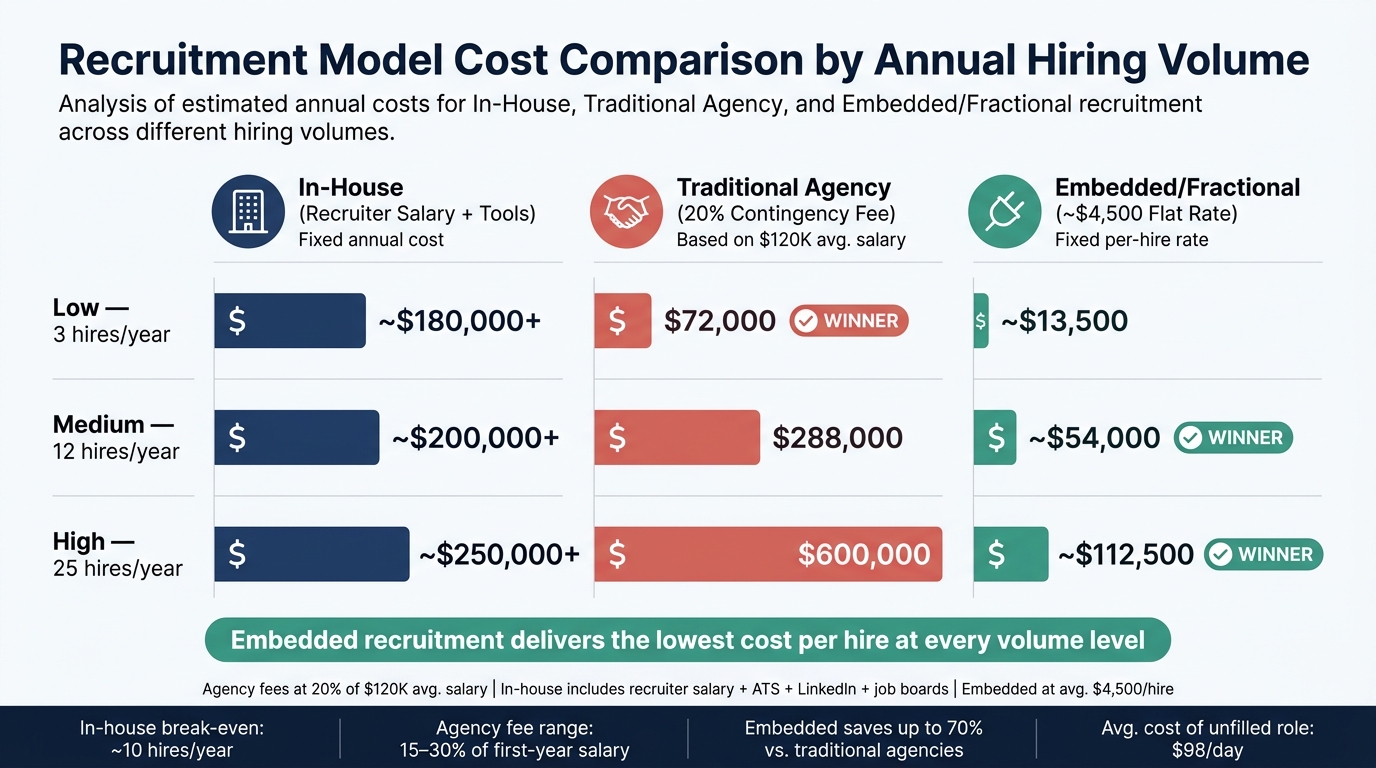
To understand the financial impact of each model, let’s look at annual costs across different hiring volumes. The table below compares in-house, traditional agency, and embedded recruitment models. In-house costs include one recruiter plus tools; agency fees are calculated at 20% of a $120,000 average salary; embedded recruitment costs are based on an average of $4,500 per hire [1][2][6].
| Annual Hires | In-House (Recruiter + Tools) | Agency (20% Fee) | Embedded/Fractional |
|---|---|---|---|
| Low (3 hires) | ~$180,000+ | $72,000 | ~$13,500 |
| Medium (12 hires) | ~$200,000+ | $288,000 | ~$54,000 |
| High (25 hires) | ~$250,000+ | $600,000 | ~$112,500 |
For companies with low hiring volumes, agencies are the clear winner, saving over $100,000 compared to maintaining an in-house recruiter. However, as hiring needs grow, the financial balance shifts. At 25 hires per year, in-house recruitment becomes far more economical, saving over $350,000 compared to agency fees.
The embedded recruitment model consistently provides the lowest cost across all hiring volumes. This makes it particularly appealing for SMEs that need dedicated recruitment support but can’t justify the overhead of a full-time hire or the unpredictability of per-placement fees.
"The model that saves you money today can bleed you dry at scale if you don’t adjust your approach as volume grows." – Paraform [1]
For high-growth SMEs managing 10 to 24 hires per year, Rent a Recruiter‘s embedded model offers a practical middle ground. It keeps costs predictable while maintaining a low per-hire expense, making it an ideal solution for scaling businesses without overcommitting to a permanent in-house team.
Efficiency and Scalability: The Costs Beyond the Invoice
Recruitment costs go far beyond what’s listed on the invoice. Unfilled roles, delayed scaling, and poor retention create hidden financial burdens. Let’s explore how time-to-hire and scalability directly impact your business.
How Time-to-Hire Affects Your Bottom Line
Every unfilled role represents a growing cost. For instance, an unfilled position costs around $98 per day in lost productivity. Over 60 days, that’s nearly $6,000 in missed output [1]. For revenue-generating roles, the stakes are even higher. A vacant sales role with a $150,000 annual salary can result in over $80,000 in delayed revenue per month [2].
The recruitment model you choose has a major impact on speed. In-house teams often take 60 to 90 days to fill senior roles. Traditional agencies average 42 days, while embedded recruiters can shrink that timeline to 12 to 34 days [1][4]. This difference isn’t just about filling seats – it directly affects productivity, team morale, and revenue.
"If that seat sits empty for three months while your in-house team runs a thorough search, you’ve ‘saved’ 15% on fees and lost $250K in unrealized value." – Paraform [1]
Scaling Up or Down: Which Model Keeps Up
Scalability is another key factor. In-house recruitment teams scale in fixed steps, requiring new hires as demand grows. But when hiring slows, those costs remain. Outsourced and embedded models offer more flexibility, adapting to demand so you only pay for what you need. This is especially useful for SMEs facing unpredictable growth – like post-funding hiring surges, product launches, or seasonal spikes.
With Rent a Recruiter‘s embedded recruitment model, experienced recruiters integrate into your team in just days. You can scale support up or down on a monthly basis – no long-term commitments required.
"The model that got you your first ten hires will actively work against you at fifty." – Paraform [1]
Quality of Hire and the Cost of Getting It Wrong
A bad hire doesn’t just sting – it can cost up to five times the employee’s annual salary. For an $80,000 role, that’s a staggering $400,000 when you factor in training, severance, and lost productivity [2].
Your recruitment model plays a key role in avoiding these pitfalls. In-house teams know your company best, but they can struggle with speed and capacity. Traditional agencies often prioritize speed, which can compromise long-term fit. Embedded recruiters offer a middle ground, working within your systems and building familiarity with your team. This approach strengthens candidate matching and improves retention. For example, RPO models have been shown to reduce probation failure rates from the market average of 20% to as low as 4% [4].
"If your competitor can source talent and hire them in 30 days, and it takes you 90, the cost of delay isn’t just salary – it’s market share." – Fiona-Sophie Grube, Chief Development Officer, Serendi [4]
These hidden costs highlight why choosing the right recruitment model is essential for balancing speed, quality, and cost effectively.
How to Choose the Right Recruitment Model for Your SME
Choosing the right recruitment model isn’t just about cost – it’s about aligning your hiring needs with your growth stage and ensuring your recruitment spend delivers real value.
Understand Your Hiring Volume and Growth Plans
The size and pace of your hiring needs are key factors in selecting the right model. Here’s a quick breakdown:
- Fewer than 10 hires per year: A contingency agency might make the most sense since you only pay for successful placements.
- 10 to 24 hires annually: An embedded or fractional recruitment model can help spread costs across multiple hires, offering better value.
- 25 or more hires annually: At this level, an in-house team may justify its fixed costs due to the steady hiring demand [1][2].
Your company’s growth stage also plays a role. Early-stage startups should aim for $2,000–$3,000 per hire, while Series A companies may budget $5,000–$7,000 per hire, and Series B businesses might expect $8,000–$12,000 per hire as roles become more complex [2]. For businesses with fluctuating hiring needs, a flexible fractional recruitment model avoids paying for unused resources [1][5].
Calculate Your Cost Per Hire
Before you can compare recruitment models effectively, you need to know your current cost per hire. This isn’t just about direct costs like recruiter fees – it should also include operational and risk-related expenses. To calculate it, divide your total annual recruitment spend (including tools, salaries, and time spent by managers and HR) by the number of hires made in a year.
If your HR team spends more than 20% of their time on sourcing, it’s a sign your current setup isn’t scaling well [3]. Similarly, technical roles can eat up over 60 hours of a hiring manager’s time, while mid-level roles typically require 16–20 hours [4]. Knowing these figures gives you a clear baseline to evaluate whether a new recruitment model could save you time and money.
Choose the Model That Fits Your Business Needs
Once you’ve established your cost per hire and considered your growth plans, the next step is to assess whether a different model could improve both speed and cost efficiency. For high-growth SMEs, an embedded recruitment model often delivers better results by combining flexibility, control, and predictable costs. If your cost per hire is higher than what an embedded model would cost at your hiring volume, it’s time to consider making the switch [4].
Rent a Recruiter offers embedded recruiters who integrate into your team within days, handling end-to-end hiring at a fixed monthly cost. Clients have reported cutting hiring costs by up to 70% compared to traditional agencies and saving over 80 hours per month on internal recruitment tasks.
"The companies that win on talent don’t optimize for the cheapest recruiter. They optimize for the fastest path to the right hire." – Paraform [1]
Conclusion and Next Steps
The findings here are clear: there’s no one-size-fits-all recruitment model. The right choice depends entirely on your hiring needs, budget, and growth plans. If you’re hiring over 25 people annually, building an in-house team might be the most cost-effective route. For occasional hiring, contingency agencies can fill the gaps. But for SMEs hiring 10–24 roles a year, embedded recruitment offers the perfect balance of cost efficiency and scalability.
What many don’t see upfront are the hidden costs. Open roles, slow hiring processes, and poor-fit hires can quietly drain resources, only becoming obvious when they hit your bottom line. These costs often surpass the more visible fees.
If you’re unsure about committing, consider testing the waters. A 3–6 month trial with an embedded recruiter can give you measurable results like reduced time-to-fill and lower cost per hire. It’s a low-risk way to evaluate the impact before making a long-term decision.
Rent a Recruiter offers a seamless solution by embedding skilled recruiters into your team – often within days. They manage the entire hiring process for a fixed monthly cost. The results? Clients save up to 70% on hiring expenses and reclaim over 80 hours each month from recruitment tasks. Take a moment to assess your current hiring strategy and see how much you could save.
FAQs
How do I calculate my true cost per hire?
To figure out your actual cost per hire, use this formula:
(Internal Costs + External Costs) / Total Hires
Internal costs include recruiter salaries, HR admin overhead, and the time hiring managers spend on recruitment.
External costs cover expenses like job board fees, agency commissions, background checks, and assessment tools.
Make sure to account for labor hours accurately – this is often overlooked but plays a big role in understanding the full picture.
What hiring volume justifies an in-house recruiter?
In-house recruitment can make financial sense for companies aiming to fill 25 or more roles each year. In some cases, businesses with a steady and predictable hiring volume may find the break-even point starts at 6–10 hires annually.
However, it’s important to consider the fixed costs tied to this model. Expenses such as recruiter salaries, benefits, and software licenses can total between $175,000 and $190,000 per year. This setup works best for organizations with consistent, stable hiring needs, as it becomes less practical for companies with fluctuating or low hiring volumes.
How fast can an embedded recruiter start and scale?
An embedded recruiter from Rent a Recruiter can integrate into your team in as little as five days. This setup gives you the flexibility to ramp up quickly during hiring spikes or scale back when demand slows, all without being tied to long-term contracts.
By working as part of your team, they simplify your recruitment process, help reduce hiring costs by up to 70%, and can cut your time-to-fill by up to 50%.