If your hiring plan changes month to month, fixed recruiter payroll can cost you more than the hiring itself.
I’d sum it up like this: in-house recruiters fit steady hiring, while embedded recruitment fits spikes, specialist roles, and post-funding growth. The business question is simple: do you need permanent capacity, or do you need hiring support you can turn on and off without adding full-time headcount?
Here’s the short version for CEOs, CFOs, HR leaders, and Talent Leaders:
- In-house usually starts to make sense at around 15 to 20 hires per year
- A fully loaded in-house recruiter can cost $146,000 to $200,000 per year
- Internal recruiters often take 3 to 6 months to hit full output
- An embedded recruiter can often start within days
- Companies using this model can cut hiring costs by up to 70% versus agency fees and save 80+ hours per month in hiring admin
AGENCY VS IN-HOUSE RECRUITMENT | What is a BETTER option for you? (2021)
sbb-itb-a23bd6a
Quick Comparison
| Model | Best fit | Cost shape | Ramp time | Hiring control | Best commercial use |
|---|---|---|---|---|---|
| In-House Recruiter | Steady hiring volume | Fixed annual cost | 3 to 6 months | High internal ownership | Long-term recurring hiring |
| Embedded Recruitment | Spiky, urgent, or specialist hiring | Flat monthly fee | Live in days | High visibility inside your tools | Hiring surges without payroll growth |
If you are hiring as you scale in SaaS, Technology, IT, Fintech, Engineering, Security, Insurance, or Professional Services, this comes down to cost, time, and control. I’ll break down which model fits which stage, and where Rent a Recruiter fits if you need extra hiring capacity without fixed payroll.
How In-House Recruitment Teams Are Structured
In-house recruitment starts to make sense when hiring demand is steady enough to justify full-time headcount.
At seed stage, founders often run hiring themselves, or they lean on a People + Talent Lead until volume picks up. The move to a dedicated in-house team usually happens around Series A, when headcount reaches 40 to 50 employees and annual hiring plans hit 12 to 15+ roles. That’s the point where structure starts to beat improvisation.
For hiring leaders, this is a business call as much as a talent one. If demand is consistent, internal capacity can give you more control and lower cost per hire over time. If demand is patchy, fixed payroll can become a drag.
Typical Roles, Ownership, and Internal Workload
In a mature in-house TA team, you’ll usually see four core functions.
- A full-cycle recruiter who owns hiring end-to-end
- A sourcer focused on building pipeline
- A recruiting coordinator handling scheduling and candidate logistics
- A TA lead running the hiring playbook, ATS, and employer brand strategy
Early on, one generalist often covers all of this until hiring volume is high enough to justify split ownership.
That sounds efficient on paper. In practice, it means one person is juggling sourcing, screening, stakeholder management, scheduling, reporting, and process design at the same time. For a scaling company, that can work for a while. Then hiring ramps, and cracks start to show.
Where In-House Teams Add Value and Where They Fall Short
Internal teams bring deep company knowledge, closer alignment with hiring managers, and a more consistent candidate experience. Over time, that pays off in stronger pipelines and a clearer employer brand.
But there’s a cost to that depth. A fully loaded in-house recruiter costs between $146,000 and $200,000 per year once you include salary, benefits, tools like LinkedIn Recruiter, and ATS licensing [2]. Even during a hiring freeze, a recruiter on payroll still costs $14,000+ per month [2].
That’s the tradeoff. In-house capacity gives you control, but it’s fixed whether demand is there or not.
| Area | In-House Advantage | In-House Constraint |
|---|---|---|
| Cost | Fixed cost; ROI improves with high hiring volume | High fixed overhead even during hiring freezes [2] |
| Culture & Brand | Deep company fluency; acts as a true brand ambassador | May struggle to reach niche talent outside their existing network |
| Process Control | Direct ownership of candidate experience and long-term hiring playbooks | Slower to ramp up, typically 3 to 6 months to full productivity [2] |
| Specialization | Builds deep internal relationships and talent pipelines over time | Generalists often struggle with senior engineering or highly specialised roles |
For CEOs and CFOs, this is where the model gets tested. If hiring stays high, the fixed cost can pay back. If roles come in waves, or if you suddenly need niche talent in SaaS, Engineering, Security, or Fintech, internal teams can hit a wall.
When hiring demand becomes uneven or spikes fast, embedded recruitment fills that gap.
When an In-House Team Makes Sense
This model works best when hiring volume is steady and easy to forecast. Internal recruitment generally breaks even against agency fees at 15 to 20 hires per year [2]. A single recruiter can handle roughly 25 hires annually, though non-recruiting work, like writing job descriptions, coaching hiring managers, and managing employer brand strategies, cuts into that capacity in a big way [2].
If your headcount plan is stable for the next 6 to 12 months and you can keep a recruiter fully utilised, an in-house team starts to make financial and operational sense. Below that level, the fixed cost is harder to justify.
What happens when demand is spiky, fast, or short-term?
How Embedded Recruiters Fit Into a Scaling Company
When hiring demand jumps faster than you can build an internal team, embedded recruiters add extra hiring capacity without adding permanent headcount[3]. That matters most when the recruiter can work inside your existing setup, not beside it.
How Embedded Recruiters Work Inside Your Team
An embedded recruiter works inside your operation, using your ATS, joining hiring syncs, and moving candidates through your internal workflows[1][3]. In practice, that means full-cycle ownership across sourcing, screening, stakeholder management, and offers[3][4].
The day-to-day difference comes down to visibility. You can see what is happening in your pipeline at each stage, with clear reporting and a shared weekly hiring cadence that helps stop role requirements from drifting[3][4]. Because the recruiter is working in your systems and processes, your hiring managers are not stuck dealing with extra handoffs.
That close fit is what makes the model work so well when hiring demand spikes.
When Embedded Support Works Best: Hiring Spikes, Funding Growth, and Specialist Roles
Embedded support tends to work best during hiring spikes, post-funding growth, and specialist searches. After funding, during a go-to-market sprint, or when your company needs 3-6 business-critical hires fast across engineering, product, and go-to-market teams, embedded recruiters give you extra capacity without permanent headcount[1].
You see the same pressure during new product launches or when sudden demand hits the hiring plan. Specialist roles can create a similar problem, especially when your internal team does not have the time to run a focused search properly.
In each case, embedded support lets you match hiring capacity to demand without committing to another full-time hire. If a CEO or CTO is spending more than 15 hours a week on sourcing and screening, that is a clear sign support is needed to protect leadership time and keep product work moving[2].
Where Rent a Recruiter Fits the Embedded Model
Rent a Recruiter places experienced recruiters into high-growth SMEs within days, managing hiring end-to-end across technology, SaaS, fintech, engineering, and professional services[3]. The model uses fixed monthly pricing with no placement commissions[3], and it typically cuts hiring costs by up to 70% while saving more than 80 hours a month in hiring and admin time[3].
That flexibility is the main tradeoff versus permanent in-house capacity.
In-House vs. Embedded Recruiters: Side-by-Side Comparison
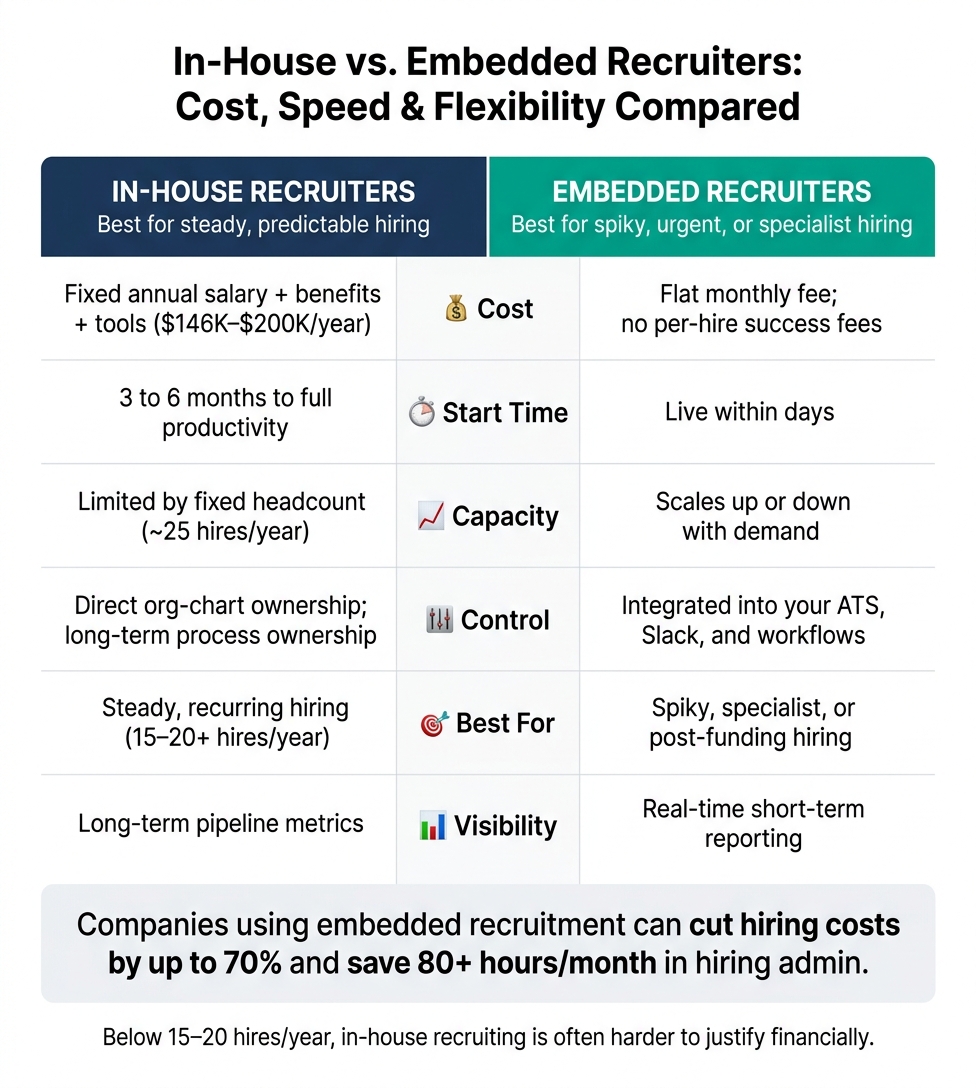
In-House vs. Embedded Recruiters: Cost, Speed & Flexibility Compared
Cost, Control, Speed, and Flexibility: How the Two Models Differ
The tradeoff is simple: fixed internal capacity versus flexible embedded support.
If you compare the two on cost, speed, control, and flexibility, the gap becomes pretty clear. An in-house recruiter sits on payroll as a fixed cost. An embedded recruiter comes in on a monthly, on-demand model. In-house hiring can take months before you see full output. Embedded support can be live in days.
The table below shows the difference in day-to-day terms.
| Dimension | In-House Recruiters | Embedded Recruiters |
|---|---|---|
| Cost | Fixed annual salary, benefits, and tools | Flat monthly fee; no per-hire success fees |
| Start Time | Slow; 3 to 6 months to full productivity [2] | Live in days |
| Capacity | Limited by fixed headcount | High; scales up or down with demand |
| Control | Direct org-chart ownership; long-term process ownership | Integrated into your tools, Slack, and workflows |
| Best For | Steady hiring | Spiky or specialist hiring |
| Visibility | Long-term pipeline metrics | Short-term reporting |
Below about 15 to 20 hires per year, in-house recruiting is often harder to justify. The reason is commercial, not just operational: fixed cost climbs faster than output.
Matching Each Model to Your Stage, Budget, and Hiring Volume
The right model depends on the shape of your hiring demand.
Steady volume usually fits in-house recruitment. Volatile demand tends to suit embedded recruitment. If you’re hiring the same core roles month after month, a permanent recruiter may make sense. If hiring comes in waves, maybe tied to funding, market expansion, product launches, or specialist searches, flexible support is often the better call.
Many scaling companies use both. They keep a lean internal team for recurring roles, then bring in embedded support when demand jumps.
That blend works well when you want to protect payroll, keep control of the process, and add hiring power only when there’s a clear need. For growth-stage companies, the decision often comes down to one thing: is core hiring steady enough to justify permanent headcount?
Conclusion: Build the Structure That Matches Your Hiring Demand
Neither model is better in every case. The right choice depends on hiring volume, urgency, and internal capacity.
In-house talent vs recruitment agencies is a common debate; in-house teams give you long-term process ownership and close alignment with how your company works. But they also come with a fixed cost, plus a 3 to 6 month ramp before they hit full output.
Embedded recruiters give you speed and flexibility instead. They plug into your tools and workflows within days, without adding permanent headcount.
Pick the model that fits your hiring volume, urgency, and budget.
Use these five checks to choose the right structure for the next 12 months.
What to Review Before You Decide
Before you commit to either structure, work through these five questions honestly:
- How many hires do you need in the next 12 months? In-house recruiting usually works best for steady, higher-volume hiring.
- How urgent are your open roles? If speed matters, embedded support is the faster route.
- What’s your current recruiter capacity? If founders or engineering leads are still carrying recruiting work, that’s a clear sign you need dedicated support.
- Are your roles repeatable or specialist? Steady, repeatable roles often suit in-house hiring. Niche technical or executive searches often work better with embedded recruitment.
- Can your budget absorb a fixed annual cost? An in-house recruiter adds a fixed annual cost. If runway is tight, a flat monthly embedded model is easier to manage and easier to pause.
Steady hiring tends to suit in-house. Spiky, specialist, or urgent hiring tends to suit embedded support.
Ready to figure out which model fits your stage? Book a call with Rent a Recruiter to review your hiring plan.
FAQs
How do I know which model fits my hiring plan?
Start by mapping your hiring demand over the next 12 to 18 months against your current team capacity, budget, business stage, and the shape of demand, whether hiring is steady, uneven, or fast-moving.
Choose in-house when hiring is steady and predictable, and you want full control over the process. Use embedded recruitment when you need extra support to scale, handle hiring bursts, or move through a sprint without adding permanent headcount. For high-volume growth or expansion into a new market, a project-based model such as RPO may be the better fit.
This gives you a simple way to match hiring support to business need, instead of overbuilding internally or leaning too hard on traditional recruitment agencies when demand shifts.
Can I use embedded support with a small internal team?
Yes. Embedded recruitment works well with a small internal team because it adds hiring capacity without replacing your existing staff.
An experienced recruiter joins your team and helps you handle hiring spikes or hard-to-fill niche roles. Your core team can stay focused on repeat hiring and culture-led decisions.
That gives you more flexibility, less pressure on your internal team, and no added permanent headcount cost.
What signs show we’ve outgrown founder-led hiring?
You’ve likely outgrown founder-led hiring when leadership is spending 15+ hours a week on sourcing, screening, and interview scheduling. At that point, hiring isn’t just taking time, it’s pulling focus from product work, fundraising, and day-to-day business priorities.
Other signs show up pretty fast:
- You’re hiring 15 to 20 roles a year
- You’ve reached 40 to 50 employees
- Your team is struggling to manage the candidate pipeline alongside core responsibilities
That usually means the cost of keeping hiring informal is starting to climb. Leaders get dragged into admin, interview stages slow down, and good candidates can slip through the cracks.