
If hiring changes from manager to manager, you do not have a system, you have a cost problem.
I’d boil this down to four parts: set clear hiring goals, assign ownership, improve your recruitment strategy by standardising each hiring stage, and score every candidate the same way. Done well, that means lower cost-per-hire, less senior time lost, and more control over headcount planning. It also helps cut the damage from poor hiring, where the average non-executive hire costs about $5,475, and a bad hire can cost at least 30% of first-year pay.
Here’s the short version:
- Tie each role to a business target, such as revenue, retention, or delivery capacity
- Assign one owner per stage so approvals and decisions do not stall
- Use the same hiring flow from requisition to onboarding handoff
- Build role profiles and scorecards so decisions are based on evidence, not gut feel
- Track core metrics like time-to-hire, offer acceptance, and hiring manager response times
- Add embedded recruitment support if you need more hiring capacity without building a full internal team
One stat matters here. Structured hiring can improve quality of hire by 26%. So if you want hiring to scale with the business, the answer is simple, build a process you can repeat, measure, and control.
That is the lens for the rest of the article.
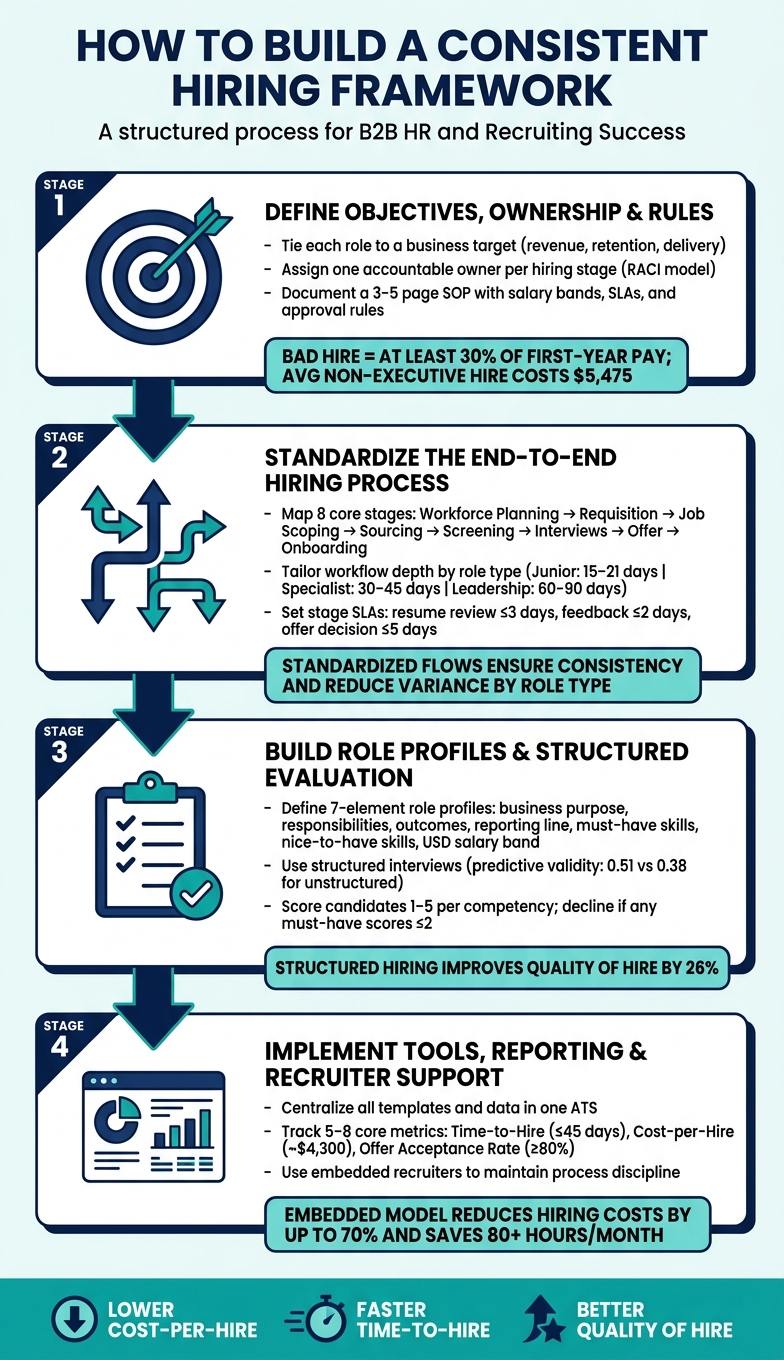
Consistent Hiring Framework: 4-Stage Process for Scalable Recruiting
How to Build a Structured Recruiting Process for Startups
sbb-itb-a23bd6a
1. Define Hiring Objectives, Ownership, and Rules
Start with three decisions: why you’re hiring, who owns each step, and which rules run the process.
Link Headcount Plans to Revenue, Delivery, and Growth Targets
Every role should tie back to a measurable business result. Start with the target, then work backwards.
A U.S. SaaS company aiming to add $2 million in ARR might work out that each Account Executive closes about $500,000 a year. That points to four AEs, plus one Customer Success Manager to help keep net revenue retention above 95%. A professional services firm with three new projects starting in Q4, needing 10,000 billable hours, can model the gap and see that it needs two senior project engineers and one project manager to avoid missed client deadlines.
If a role can’t be linked to revenue, retention, or delivery capacity, move it down the list until the business case is clear.
For engineering and professional services teams, team capacity is a useful trigger. If your current team is running above 80% to 85%, start a headcount review before delivery starts to slip.
Set Clear Ownership Across Leadership, Hiring Managers, and Recruiters
Slow hiring usually isn’t a sourcing issue. It’s an ownership issue. When nobody is clear on who approves a role, who runs intake, or who makes the final call, decisions drag.
Put that into a simple RACI so each stage has one accountable owner. Keep it in one document and share it with everyone involved in hiring. A standard setup often looks like this:
| Hiring Stage | Primary Owner (Accountable) | Support (Consulted/Informed) |
|---|---|---|
| Requisition Approval | Finance / Department Head | Recruiter |
| Intake Meeting | Hiring Manager | Recruiter |
| Sourcing & Screening | Recruiter | Hiring Manager |
| Interview Loop | Hiring Manager | Interview Panel |
| Final Decision | Hiring Manager | Recruiter / Leadership |
| Offer Approval | Finance / HR | Hiring Manager |
In practice, founders or the CEO usually own the overall headcount budget. Department heads are responsible for putting forward role requests linked to team goals. Hiring managers own intake and final selection. Embedded recruiters can own sourcing, pipeline management, and candidate communication, while hiring managers keep decision ownership. The recruiter will often handle negotiation, while Finance or HR signs off on the pay package.
Document the Core Hiring Policy and Operating Standards
A focused 3 to 5-page SOP is enough for most U.S. SMEs.
Include the core rules: approval steps, USD salary bands for standard roles, interview panel rules, and clear SLAs so the process keeps moving. For example, roles above $150,000 base salary might need CEO sign-off. A mid-level software engineer might sit in the $110,000 to $140,000 range. Most roles should stay within 3 to 4 interview rounds, with a clear remit for each interviewer.
Set response times that people can actually follow:
- Resume review within 3 business days
- Feedback within 2 business days
- Offer decisions within 5 business days
For fintech teams, add a compliance screening checkpoint early in the process, before candidates reach final interviews. That saves executive time and stops late-stage drop-off from people who don’t meet regulatory requirements.
Once objectives, ownership, and rules are set, map them into a standard end-to-end hiring process.
2. Standardize the End-to-End Hiring Process
Once ownership and rules are in place, you need a clear path from approved headcount to an onboarded hire. If that path is missing, managers fill in the gaps themselves. The process then shifts from role to role, and hiring gets harder to control. This is where the rules from section 1 become a repeatable workflow.
Map Every Stage From Requisition to Onboarding
A dependable hiring process covers eight core stages: workforce planning, requisition approval, job scoping, sourcing, screening, interviews, selection and offer, and onboarding handoff. Each stage should spell out three things:
- who owns it
- what information must be in place before it starts
- how long it should take
Build a shared process map in a document or ATS that shows each stage in order. For example, a U.S. SaaS company might define Stage 3, Job Scoping, like this: Owner: Hiring Manager; Inputs: validated role profile, salary band in USD, target start date; Output: job description ready for posting; SLA: 2 business days.[5] That level of detail cuts out guesswork and keeps work moving without constant follow-up.
Don’t leave out the handoff from offer acceptance to onboarding. Preboarding starts before day one, so it needs to sit inside the process.[7] A formal handoff checklist for IT setup, credentials, and a 30/60/90-day plan helps new hires show up ready to contribute, instead of spending their first days waiting on admin.
Create Standard Workflows for Different Role Types
Consistency doesn’t mean every role follows the exact same steps. It means each role type has a documented route, with clear decision points and timelines. Use the same stage map, but adjust the depth by role level.
A junior customer support hire usually doesn’t need a panel interview and case study. A leadership or specialist role, such as a Head of Engineering or senior data scientist, usually does.
The table below shows how three common role types differ in workflow depth, hiring speed, and what each route is built to optimise for.[4][5]
| Role Type | Typical Steps | Approx. Time-to-Hire | Speed | Decision Quality |
|---|---|---|---|---|
| Junior / High-Volume | Requisition → Standard JD → Bulk sourcing → Phone screen → 1 structured interview → Offer | 15–21 days | High | Good for core skills; less depth on long-term fit |
| Specialist / Mid-Level | Requisition → Intake → Targeted sourcing → Recruiter screen → Technical task → 2 interviews → Offer | 30–45 days | Moderate | High; skill verification and team fit balanced |
| Leadership / Executive | Planning → Headhunting → Screen → 3+ stakeholder interviews → Case study → References → Offer | 60–90 days | Lower | Highest; strategic alignment and culture assessed in depth |
The core standards stay the same across all three: structured scorecards, documented decisions, and clear ownership. What changes is the number of stages and the depth of evaluation.
Use Checklists and Stage SLAs to Cut Delays
Most delays come from three places: late feedback, unscheduled interviews, and stalled offer approvals. Stage SLAs deal with this by putting deadlines around each step.
Practical targets for U.S. SMEs include post-interview scorecards submitted within 24 hours, offer generation completed within 24 hours of a final decision using pre-approved compensation parameters, and rejected candidates notified within 3 business days.[5][6] Pair those targets with stage checklists, such as budget approval, salary band, and interview panel confirmed before sourcing starts, and your hiring managers spend far less time chasing missing information in the middle of the process.
There is a commercial upside too. With SLAs in place, Finance and leadership get something far more useful than rough estimates: predictable forecasting. If junior roles close in about 3 weeks and specialist roles in about 4 to 6 weeks, headcount planning becomes a much steadier input into quarterly budgets and delivery timelines.
Once the workflow is standardized, define the role profiles and scorecards that run through it.
3. Build Standard Role Profiles and Structured Evaluation
A standard hiring process only works if every role is defined in the same way, and every candidate is judged against the same bar.
Define Role Profiles With Outcomes, Skills, and Salary Bands
Once your workflow is set, lock down the role itself as part of your talent acquisition strategies. That gives your team one target for sourcing, screening, and selection.
A role profile should define the outcome, not just a list of duties. Each profile should include seven core elements: business purpose, core responsibilities, expected outcomes for the first 6 to 12 months, reporting line, must-have skills, nice-to-have skills, and a compensation range in USD.[8]
This is where many hiring teams go off track. A vague line like manage the sales pipeline sounds fine on paper, but it gives recruiters little to work with and leaves interviewers guessing. A clear outcome, such as close $300,000 in new ARR by month 6, is much easier to hire against. It gives sourcing teams a sharper brief and gives interviewers a direct benchmark. Use those same outcomes again in 6 and 12 month reviews.[8]
Salary bands need the same level of detail. A range like $95,000 to $115,000 base plus variable sets expectations early, supports pay equity, and cuts down on offer-stage friction.
Standardize Job Descriptions and Intake Criteria
Next, turn the role profile into a standard job description before sourcing starts.
Each role profile should become a candidate-facing JD with the title, level, team, location, key requirements, pay range, and first-year success measures.[8][9]
The gap between a thin JD and a standard one shows up fast in candidate quality and screening consistency:
| Feature | Minimal Job Description | Detailed (Standardized) Job Description |
|---|---|---|
| Responsibilities | Generic duties and vague tasks | Specific activities tied to business outcomes |
| Requirements | Vague, such as 5+ years experience | Competency-based, such as proven track record managing $1M+ budgets |
| Compensation | Competitive salary or omitted | Clear USD range, such as $90,000 to $115,000 |
| Candidate Quality | High volume, low relevance | Higher relevance; stronger self-selection |
| Screening Consistency | Low; varies by hiring manager | High; shared criteria across the team |
A standard template is only part of it. You also need a short intake checklist before the requisition opens. That should confirm:
- Must-have criteria are agreed
- Interview panel is identified
- Success measures are set
This cuts delays later in the process, especially the kind caused by missing details that should have been agreed at the start.[8][9]
Use Structured Interviews, Scorecards, and Decision Rubrics
The same role profile should drive interviews, scoring, and final decisions.
Use the same interview stages, questions, and scoring rubric for every candidate applying for the same role. Structured interviews have predictive validity of around 0.51, compared with 0.38 for unstructured interviews.[2][11]
| Metric | Unstructured Interviews | Structured Interviews |
|---|---|---|
| Bias Risk | High; relies on gut feel and personal rapport | Lower; evaluation tied to job-related competencies |
| Hiring Speed | Variable; debriefs stall without shared data | Faster; scorecards drive clearer go/no-go decisions |
| Decision Quality | Poor predictive validity for on-the-job performance | Strong predictive validity; evidence-based |
| Auditability | Poor; feedback is anecdotal and hard to compare | High; scores can be aggregated and audited |
A good scorecard should mirror the role profile exactly. For each competency, whether that’s B2B outbound prospecting or stakeholder management, interviewers score the candidate from 1 to 5 using clear definitions for each level. They should also record specific evidence from the candidate’s answers.[3][8]
Timing matters here too. Requiring scorecards within 24 hours of each interview keeps feedback sharp and lowers the risk of panel members swaying each other before scores are logged.[1]
Then comes the decision rubric. This is a short set of rules that turns interview scores into a hiring decision. For must-have competencies, one rule might be that any score of 2 or below means decline. Another might be that a 3+ average, with at least one 4 or 5 in a critical area, moves the candidate forward. Put those thresholds in your ATS so decisions stay consistent and auditable.[9][10]
Store the role profile, scorecard, and decision rubric in one system. That keeps reporting clean, gives recruiters a clear operating model, and makes hiring easier to track and enforce.
4. Put the Framework Into Practice With Tools, Reporting, and Embedded Recruiting Support
Once role profiles, scorecards, and decision rules are in place, the next step is operational control. That’s where many hiring frameworks fall apart.
A framework only works when it shows up in daily hiring. You need one system, clear reporting, and enough recruiter capacity to stop roles from drifting or stalling.
Centralize Templates, Data, and Hiring Reports
Your team should not be hunting through folders, old emails, or Slack threads to find the latest hiring documents. Keep every core hiring asset in one place: job description templates, intake forms, scorecards, decision rubrics, and process SOPs.
A shared hub like Notion, Confluence, or SharePoint works well when it’s organised by job family and seniority. Keep one approved version of each template. Your ATS should stay the single source of truth for candidate data, pipeline status, and hiring decisions. Reporting can sit inside ATS dashboards or in a linked spreadsheet if you need custom views.[12][16]
When it comes to metrics, don’t track everything at once. That usually creates noise, not clarity. Start with five to eight core measures so you can spot recruitment challenges early without drowning in data.[13][16]
| Metric | Target | Action if Off Track |
|---|---|---|
| Time-to-Hire | ≤45 days | Audit stage SLAs and identify where candidates are stalling.[12][15] |
| Cost-per-Hire | Around $4,300 per hire | Reduce agency reliance and review sourcing channel ROI.[14][15] |
| Offer Acceptance Rate | ≥80% | Review salary bands and candidate experience in final stages.[18] |
| Stage Conversion | Stage-specific benchmark | Recalibrate screening criteria or interview quality.[12][13] |
| Hiring Manager Responsiveness | Feedback within 24 to 48 hours | Escalate to leadership and enforce calendar blocks for hiring.[17][18] |
Set threshold alerts in your ATS so the team gets notified when a role runs more than 20% above benchmark, while there’s still time to step in.[12]
Use Embedded Recruiters to Keep the Process on Track
This is where an embedded recruiter can make a big difference.
An embedded recruiter works inside your team and keeps intake, screening, and reporting consistent across open roles. They own the process from intake through reporting, keep pipeline discipline tight, flag stalled roles early, coach hiring managers on structured interviewing and scorecard completion, and run weekly pipeline reviews with stakeholders.[18]
Rent a Recruiter specialises in this model for high-growth SMEs across technology, SaaS, fintech, and professional services. Their embedded recruiters are placed within days and work on a fixed monthly pricing model. Companies using this model typically reduce hiring costs by up to 70% and save over 80 hours per month in internal hiring and admin time.[18]
If you’re scaling but not ready to build a full internal talent function, this gives you extra hiring capacity without the overhead. For CEOs, CFOs, and HR leaders, that means more control over cost, less drag on internal teams, and a steadier path to hiring targets.
Review Results and Improve the Framework Over Time
Reporting only matters if you use it to fix problems before the next hiring cycle starts.
Run a light monthly review focused on pipeline health and offer acceptance for active roles. Then run a deeper quarterly audit across departments and role types. Look at actual results against hiring targets, and check whether your tools, templates, and SLAs still fit the way your business is hiring.[12][18]
Each audit should lead to direct updates, not a document that gets ignored. Use your own trailing 6 to 12-month data to set internal benchmarks, then compare that against market benchmarks for context.[12]
That gives you a cleaner way to tighten salary bands, improve intake checklists, and adjust interview panels before hiring slows down again.
Conclusion: Build a Hiring Framework That Scales With the Business
A consistent hiring framework turns a manager-by-manager process into a repeatable system tied to business goals. That’s the shift, from reactive hiring to a model built to scale.
Without clear ownership, proper evaluation, and reporting, hiring slows down and results vary from team to team. Get those pieces right, and you’re far more likely to see lower costs, faster hiring, and better workforce planning.
When internal bandwidth is stretched, you still need day-to-day control of the process. Rent a Recruiter places experienced recruiters into your team within days and manages hiring end to end. This embedded recruitment model has helped companies scale globally while maintaining process consistency. Companies typically cut hiring costs by up to 70% while saving more than 80 hours per month in internal hiring and admin time.
The framework you build today becomes the hiring infrastructure your business scales on tomorrow. Book a call to benchmark your hiring process and spot time and cost savings.
FAQs
How do I start building a hiring framework from scratch?
Start by moving from reactive headcount planning to a hiring plan tied to business results.
Look at your business plan for the next 6 to 12 months and identify capability gaps, not just open seats. The point is simple: don’t just ask how many people you need. Ask what your business needs to deliver over the next two to four quarters, then map hiring against that.
This helps you prioritise roles by business impact. In practice, that means focusing first on the hires most likely to drive revenue, ship product, support delivery, or remove pressure from key teams. Not all roles carry the same commercial weight.
Then bring structure to the process. Assign clear ownership for each hiring stage so there’s no confusion about who does what, and where decisions get stuck. A RACI model can help if your hiring process spans leadership, HR, finance, and line managers.
You’ll also want an Applicant Tracking System in place for visibility and consistency. If hiring data lives in inboxes and spreadsheets, you lose time and control. An ATS gives you a clearer view of pipeline, process, and bottlenecks, which makes it easier to manage hiring pace and spot issues early.
Set budgets and compensation ranges early as well. That avoids late-stage delays, cuts back-and-forth with finance, and helps managers make decisions faster. If budget and pay bands aren’t clear from the start, hiring slows down, and costs usually creep up.
What hiring metrics should I track first?
Start with the Big Four: cost-per-hire, time-to-fill, offer acceptance rate, and 90-day retention. Together, they give you a baseline for process efficiency, budget impact, and hire success.
Track them as a set. One metric on its own can send you in the wrong direction. A fast time-to-fill sounds good, but it only counts if that hire is still in place after 90 days. Low cost-per-hire can look strong on paper too, but not if offer acceptance drops or early attrition climbs.
Use your applicant tracking system, or even a simple spreadsheet, to monitor progress over time. The key is consistency. When you track the same four metrics month after month, you can spot where hiring is slowing down, where money is being lost, and where your process is delivering the right outcomes.
When should I use an embedded recruiter?
Consider an embedded recruiter when hiring starts to feel reactive, messy, or too slow, or when your team simply doesn’t have the bandwidth to run it end to end.
This model is a strong fit for scaling companies hiring 40 or more roles per year, or dealing with sudden spikes in demand. An embedded recruiter gives you immediate hiring capacity, can cut costs by up to 70%, and save 80+ hours a month in admin time.
That matters for one simple reason: slow hiring costs money. Roles stay open longer, managers get pulled into recruitment admin, and growth plans start to slip. Bringing in embedded support helps you move faster without piling more work onto your internal team.