
Misaligned hiring wastes time, money, and momentum. Scaling companies often struggle with recruitment that doesn’t directly support business objectives, leading to delays, mis-hires, and skills gaps. The solution? Align your recruitment strategy with your company’s goals to hire the right talent, faster.
Here’s how you can do it:
- Prioritize roles based on impact: Focus on the 5% of roles that drive 95% of business outcomes.
- Standardize processes: Clear workflows and ownership ensure consistency as hiring scales.
- Track meaningful metrics: Time-to-fill, cost-per-hire, and quality of hire link recruitment to results.
- Embed recruitment into your business: Treat recruiters as part of your team for better alignment and efficiency.
Scaling companies that follow these steps reduce costs, save time, and build teams ready for future growth. If your hiring process feels reactive or scattered, it’s time to rethink how recruitment supports your business. Rent a Recruiter can help you align hiring with your goals and deliver results without inflated agency fees.
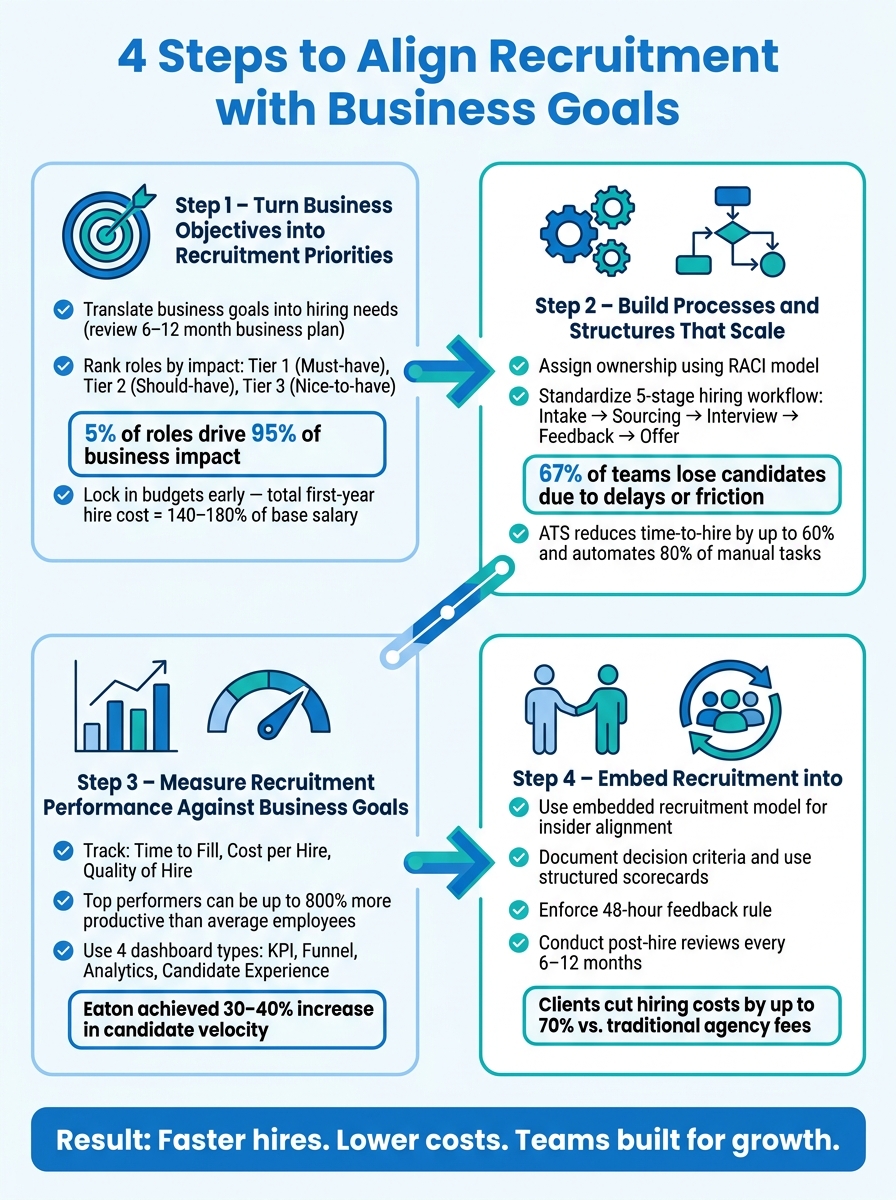
4-Step Framework to Align Recruitment with Business Goals
How to Align Talent Acquisition with Business Goals
sbb-itb-a23bd6a
Step 1: Turn Business Objectives into Recruitment Priorities
The first step in aligning recruitment with your company’s goals is straightforward: translate your business objectives into specific hiring needs before opening any job requisitions. Many companies get this step wrong by rushing to hire in response to internal pressure, without fully understanding why each role is critical.
Identify Hiring Needs from Business Goals
Start by reviewing your 6–12-month business plan. What are your revenue goals? What’s on the product roadmap? Are you planning to break into a new market or launch a new product? These shifts are common when hiring as you scale. Each of these initiatives reveals key capability gaps within your team.
Shift your mindset from headcount to capability. Instead of asking, "How many people do we need?", ask, "What do we need our team to achieve by Q3 that they can’t accomplish today?" [4]. This approach ties every hire to a tangible business outcome, making it easier to challenge hiring requests that lack a clear purpose.
"If the rationale for each hire can’t be summarized in one sentence, revisit your plan." – Employsome [3]
Once you’ve identified the roles needed, rank them based on their impact on the business.
Rank Roles by Business Impact
Not all roles are created equal. Treating every position as equally urgent is a quick way to overextend your recruitment team and slow down hiring.
| Priority Tier | Definition | Examples |
|---|---|---|
| Tier 1 – Must-have | Critical roles that, if unfilled, jeopardize business commitments. | Revenue-driving sales, engineers for key product launches, compliance positions. |
| Tier 2 – Should-have | Roles that improve efficiency but can be delayed if necessary. | IT administrators, HR business partners, backfills for voluntary departures. |
| Tier 3 – Nice-to-have | Roles that add capacity but have workarounds. | Junior analysts, marketing coordinators, roles focused on experimentation or innovation. |
Studies show that about 5% of roles in an organization drive 95% of the business impact [4]. Identifying these high-impact roles early and focusing on them ensures your hiring strategy is proactive rather than reactive.
"When everything is a priority, nothing is. Forcing your recruiting team to push equally hard on every open req guarantees slower results across the board." – 4 Corner Resources [5]
Set Budgets and Constraints Early
After prioritizing roles, lock in your resources by setting clear budgets and constraints. A common reason for recruitment delays is misalignment on compensation. If salary ranges aren’t agreed upon early, you risk derailing offers later in the process.
The solution is simple: involve Finance during the planning phase. Finalize salary ranges and total compensation before posting any roles [5][6]. Remember, the total first-year cost of a new hire typically falls between 140–180% of their base salary once you account for employer taxes, benefits, and recruitment costs [3]. Planning around base salary alone can leave you underprepared.
Non-financial constraints also matter. For example, if your engineering team is already stretched thin, adjust your hiring plan accordingly – even if the budget allows for more hires [2]. A role that’s approved but stuck in limbo isn’t aligned with your goals; it’s just another line item on a spreadsheet.
Step 2: Build Processes and Structures That Scale
Once your recruitment priorities are set, it’s time to focus on creating processes that can handle growth effectively. Ranking roles and finalizing budgets are just the start – turning plans into successful hires requires clear accountability, repeatable workflows, and the right tools to support your team.
Assign Clear Ownership and Responsibilities
Unclear roles often lead to duplicated efforts or missed steps. To avoid this, use a RACI model to define who is Responsible, Accountable, Consulted, and Informed at each stage of hiring – from the initial role intake to closing the offer [7]. For instance, the hiring manager should take charge of the intake brief and make the final decision, while the recruiter focuses on sourcing and screening, and finance provides input before an offer is extended.
As your team grows beyond 15 people, consider introducing fractional recruitment services or specialized roles. A Sourcer can focus on outreach, a Coordinator can handle scheduling and pipeline management, and a Recruitment Operations lead can oversee daily workflows [8]. This pod-like structure ensures accountability stays intact, even when hiring demands increase.
Standardize the Hiring Process
A consistent hiring process is key to scaling without losing quality. Process inefficiencies are a common issue – 67% of recruitment teams lose candidates to competitors due to delays or friction [9]. The good news? Most of these issues are preventable.
Create a lean, repeatable workflow for each stage of hiring: intake, sourcing, interviews, feedback, and offers. Here’s a simple framework to get started:
| Stage | Key Action | Ownership |
|---|---|---|
| Intake | Define must-have vs. nice-to-have skills | Hiring Manager & Recruiter |
| Sourcing | Focus on channels with proven results | Recruiter |
| Interview | Use competency-based questions and scorecards | Interview Panel |
| Feedback | Submit evaluations within 48 hours | Interview Panel |
| Offer | Pre-approve negotiation boundaries with Finance | Finance & Department Head |
One critical area to address is offer management. Clearly define who is responsible for extending offers, approving negotiations, and coordinating the transition to onboarding. Delays at this stage can be just as costly as delays earlier in the process.
Once your process is standardized, the next challenge is maintaining visibility across the pipeline.
Use Tools to Maintain Visibility
Even the best-designed processes can fall apart without transparency. An Applicant Tracking System (ATS) can centralize every step of the hiring process – interview notes, scorecards, approvals, and candidate updates – into one accessible platform [1].
An ATS offers measurable benefits, such as cutting time-to-hire by up to 60%, automating 80% of manual tasks, and reducing hiring admin time by 64% [1]. For example, Livestorm reduced its time-to-hire from 60 days to just 25 after implementing a stage-based ATS [1]. Automated scheduling tools also save an average of 1.3 hours per coordination [10], which adds up quickly during multi-round interviews.
However, it’s crucial to fix your workflows before introducing new technology. Tools only amplify the processes you already have in place – whether they’re effective or not [1]. Establish clear ownership and a standardized workflow first, then use ATS dashboards to identify bottlenecks and avoid delays.
Step 3: Measure Recruitment Performance Against Business Goals
Once you’ve established scalable hiring processes and tools, the next step is to evaluate their impact on your business. Are your recruitment efforts truly driving progress? Without clear and relevant metrics, leadership risks operating without a clear picture of hiring performance.
Focus on the Right Recruitment KPIs
It’s essential to track metrics that directly influence business outcomes. For example:
- Time to fill: Reflects how responsive your hiring process is.
- Cost per hire: Helps control recruitment spending.
- Quality of hire: Evaluated through performance ratings, retention rates, and time to productivity, ensuring new hires are delivering tangible value.
Quality of hire deserves particular attention. As AIHR explains:
"Quality of hire helps prevent trading speed for sustainability. Declining quality often signals rushed decisions, weak role clarity, or misaligned selection criteria." [11]
Why does this matter? Top performers in critical roles can be up to 800% more productive than average employees [11]. On the flip side, a poor hire in a key position can negatively impact your business. While speed is important, it should never come at the expense of finding the right fit.
Use Dashboards to Monitor Progress
Dashboards are a powerful way to provide real-time insights into recruitment performance. They help identify bottlenecks, track progress, and align hiring efforts with business goals. The most effective dashboards focus on four key areas:
- Workload and priorities: Open roles and at-risk vacancies.
- Speed and bottlenecks: Time in stage and drop-off rates.
- Quality and outcomes: Offer acceptance rates and quality of hire.
- Efficiency: Cost per hire and channel performance.
Here’s how different dashboards can serve specific audiences:
| Dashboard Type | Primary Audience | Key Metrics | Best Use Case |
|---|---|---|---|
| Recruitment KPI | TA & HR Leaders | Time to fill, hiring volume vs. plan, cost per hire | Oversight and capacity planning |
| Recruitment Funnel | Recruiters & Managers | Stage drop-off rates, time in stage | Identifying process bottlenecks |
| Recruitment Analytics | Strategic HR Leaders | Quality of hire, retention, time to productivity | Evaluating long-term hiring effectiveness |
| Candidate Experience | TA Leaders | Candidate NPS, satisfaction scores, feedback | Enhancing employer branding and reducing friction |
To ensure accuracy, audit 20–30 recent hires to validate ATS timestamps and source tracking. Clearly define metrics so that everyone on the team interprets them the same way [11].
A great example of this in action comes from Eaton, a global power management company. By consistently tracking metrics like time to market, time to present, and candidate velocity, they achieved a 30% to 40% increase in candidate velocity and expanded their talent network fourfold [11].
Align Hiring Success with Leadership Goals
Data is only useful when it drives action. That’s why recruitment metrics need to align with leadership objectives. Establishing accountability ensures that hiring remains a priority across the business.
Set a regular review cadence to keep everyone on track:
- Daily check-ins: Ideal for operational pipeline updates.
- Weekly reviews: Useful for identifying bottlenecks.
- Monthly sessions: Better for spotting trends and adjusting workforce plans.
To reinforce the importance of hiring, tie recruitment outcomes to leadership and hiring manager performance goals. For example, department heads might be responsible for filling critical roles on time or ensuring new hires stay beyond 12 months. This shared accountability keeps everyone invested in the process.
As Nadine von Moltke, Managing Editor, notes:
"Recruitment dashboards create value only when insights lead to action. Without agreed-upon owners and next steps, even accurate data becomes passive reporting." [11]
Step 4: Embed Recruitment into the Business for Long-Term Alignment
Tracking metrics and dashboards provides visibility, but true alignment comes from weaving recruitment seamlessly into your daily operations. This approach ensures your hiring strategy evolves alongside your business needs.
Use an Embedded Recruitment Model
When recruiters operate as part of your team rather than external partners, everything becomes more efficient and accurate. They gain an in-depth understanding of your teams, learn what defines "a great hire" in your context, and can address mismatched expectations early – before they disrupt the process.
This approach enables funnel diagnostics – identifying where candidates drop off and making targeted adjustments. External recruiters often lack the context to do this effectively, but embedded recruiters thrive in this space.
Embedded recruiters also clarify role-specific trade-offs upfront, such as balancing speed with thoroughness or prioritizing immediate needs versus long-term fit. This ensures hiring managers stay consistent throughout the process. As ZRG Partners highlights:
"Embedded recruiters show up under your brand, aligned to your values, and represent you like insiders, because they are." [12]
This insider perspective ensures critical roles tied to revenue or growth are prioritized appropriately, rather than being treated like standard replacements. It’s a proactive way to keep hiring aligned with your business goals.
Build Internal Recruitment Capability
The ultimate goal is to create a recruitment function that isn’t dependent on any single individual. This means documenting processes, clarifying ownership, and defining what "good enough" looks like for each role type.
Start by documenting decision criteria before opening a role. Establishing clear benchmarks for candidate qualifications ensures evaluations remain consistent. Without this, stakeholders may shift expectations mid-process, slowing hiring and undermining quality. Brendan McConnell explains:
"Hiring slows not because of a lack of effort but because there’s no clear strategy to hold the process together. So decisions shift mid-process. Ownership is unclear. Screening criteria vary." [1]
Structured scorecards, stored in your ATS, help maintain consistency even when priorities change. They also provide new hiring managers with a clear framework from day one. Reinforce a 48-hour feedback rule to keep the process moving and avoid unnecessary delays.
Use Feedback to Refine the Process
No recruitment process remains effective without regular adjustments. Build a habit of conducting post-hire reviews every 6–12 months. These reviews should assess which sourcing channels, screening methods, and interview formats yield top-performing hires.
Track hiring manager satisfaction as a key performance indicator. It’s a strong measure of whether your recruitment efforts are delivering talent that aligns with business goals – not just filling vacancies. Monthly metrics reviews keep you on track, while quarterly strategy sessions allow you to revisit sourcing strategies and adjust priorities as needed.
This structured feedback loop transforms recruitment from a reactive task into a scalable, strategic function that grows with your business.
Conclusion: Key Takeaways and Next Steps
Recap of the 4-Step Framework
Creating a recruitment strategy that aligns with your business goals requires a system that evolves continuously. By integrating every hiring decision with your core business objectives, you lay the groundwork for sustained growth.
This guide outlined four actionable steps to achieve that alignment. It begins with defining clear hiring priorities – understanding which roles drive growth versus those that maintain day-to-day operations, while locking in budgets and constraints early. Next, it focuses on building scalable processes, including clear ownership, standardized evaluations, and efficient tools to streamline hiring. The third step emphasizes measuring what matters, such as quality-of-hire and offer acceptance rates, rather than focusing solely on activity metrics. Finally, it highlights the importance of embedding recruitment into the business, ensuring your hiring function evolves alongside your goals rather than constantly reacting to challenges.
Each step is designed to drive business outcomes, with structured processes and meaningful metrics reinforcing one another. This approach ensures your recruitment function is not only efficient but also aligned with long-term success, offering immediate opportunities for improvement.
How Rent a Recruiter Can Help
If your current hiring function is struggling to keep up with your growth, Rent a Recruiter can bridge that gap quickly and effectively. When internal teams are stretched thin, partnering with an embedded recruiter provides the expertise and resources to execute your strategy seamlessly. These recruiters integrate into your team within days, managing the entire hiring process while delivering the structure and consistency outlined in this guide.
Clients often cut hiring costs by up to 70% compared to traditional agency fees and save over 80 hours of administrative work each month. Marisa Goss, Director of Human Resources at Sheldon College, shared her experience:
"Partnering with Rent a Recruiter has been a great investment… Their seamless integration of the Talent Subscription model has transformed our recruitment processes and candidate experience." [13]
This model not only speeds up hiring but ensures every new hire contributes to your strategic goals. Whether you need short-term support to meet an immediate hiring target or a long-term partner to scale predictably, Rent a Recruiter offers flexible solutions. Plus, they provide a free Recruitment Health Check to help you benchmark your current hiring performance and identify areas for improvement.
FAQs
How do I decide which roles to hire for first?
To make hiring truly effective, start by aligning it with your business goals. Pinpoint the critical skill gaps and roles that are directly tied to revenue or growth. Prioritize these roles by assessing factors such as their impact on revenue, the urgency of filling them, and how challenging they are to hire for.
For early-stage startups, it’s often smarter to focus on hiring generalists – people who can wear multiple hats as the company grows. On the other hand, more established businesses typically see greater value in bringing on specialized talent to tackle specific challenges.
By combining data-driven insights with your strategic priorities, you can ensure your recruitment efforts focus on the roles that will make the biggest difference to your business.
What recruiting metrics actually tie to business results?
Recruitment metrics that connect directly to business success include quality of hire, retention rates, time-to-productivity, manager satisfaction, and the influence of hires on revenue and outcomes. These indicators provide a clear picture of how well your hiring efforts contribute to achieving broader business goals and driving growth.
When should we use an embedded recruiter?
Embedded recruiters are a smart choice when your business is navigating shifting hiring demands, dealing with stretched internal resources, or aiming to make hiring more efficient while ensuring better alignment with your company’s culture. They seamlessly become part of your team, offering adaptable support for ongoing or high-volume recruitment needs. The result? Faster hiring, stronger alignment with your goals, and lower costs – all while simplifying the entire recruitment process.