
After funding, bad hiring gets more expensive, fast. If you hire without a clear plan, you can burn cash, lose time, and slow growth, even with new budget in the bank.
I’d cut this down to five risk areas: wrong headcount, wrong seniority, weak process, poor onboarding, and hidden costs. The fix is simple: tie each role to a business target, budget for the full cost of hiring, use a clear hiring process, and add recruiter capacity before your team gets stretched. For scaling firms, that can mean lower hiring spend, fewer delays, and 80+ hours a month saved in internal admin. In some cases, firms also cut hiring costs by up to 70% versus agency-led hiring.
Here’s the short version:
- Plan headcount against goals, not optimism
- Define outputs before seniority, so you do not overhire
- Use one hiring process, not ad-hoc decisions
- Set clear onboarding steps, so new hires ramp faster
- Budget beyond salary, including fees, benefits, and admin
- Add support early if your team cannot handle hiring volume
For CEOs, CFOs, and HR leaders, the issue is not just filling roles. It is making sure hiring supports growth without knocking cash flow, delivery, or control off course.
5 Hiring Risks That Can Derail Post-Funding Growth
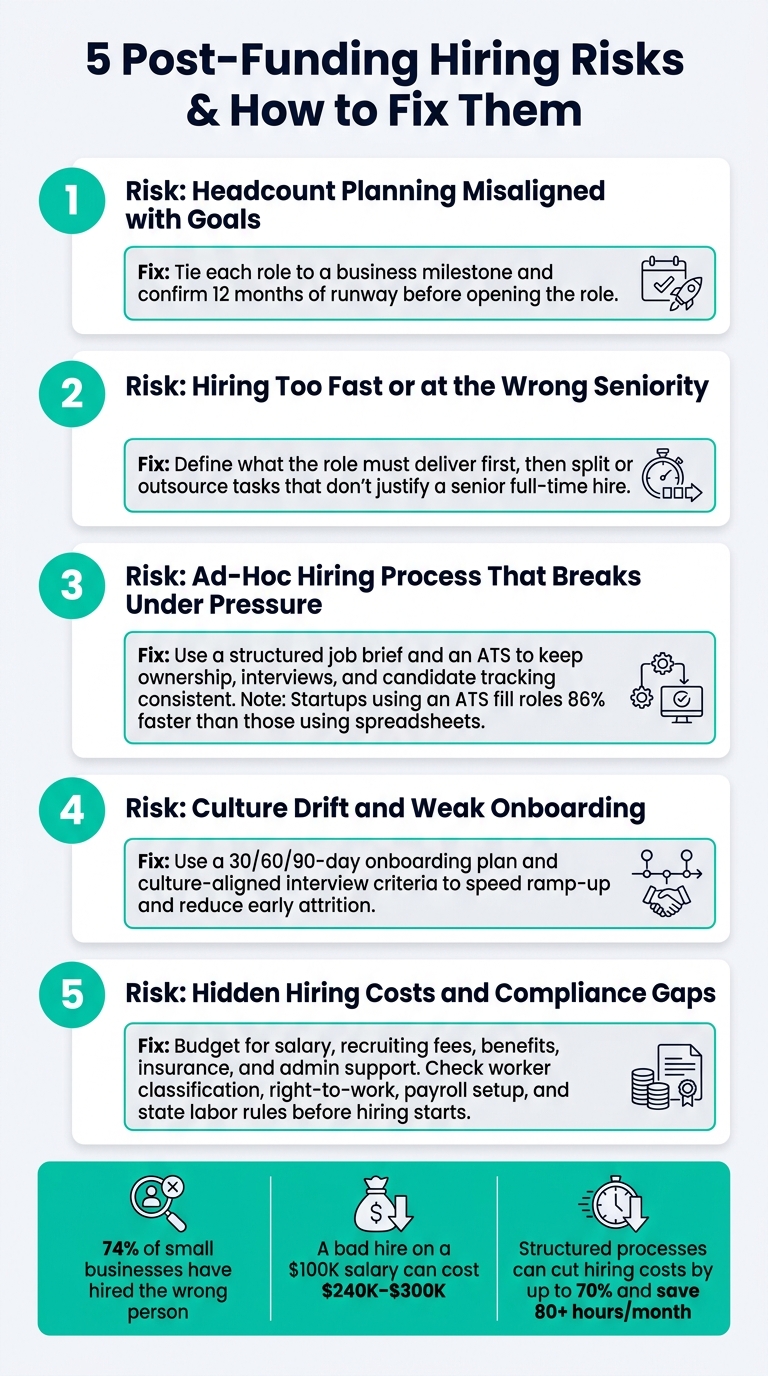
5 Post-Funding Hiring Risks & How to Fix Them
Post-funding hiring can go off track fast. A new round gives you room to move, but it can also push teams into rushed decisions, bloated headcount plans, and hiring systems that crack under pressure.
These are the five post-funding hiring failure points, and the fix for each. Start with headcount, because every other hiring risk gets worse when roles are misaligned.
1. Headcount Planning That Does Not Match Business Goals
After a funding round, it is easy to let hiring run ahead of the business. That usually looks fine on paper, right up until burn climbs and delivery stalls.
A safer move is to tie each role to a clear business milestone. If a hire is not linked to revenue, product delivery, customer growth, or another defined target, you should pause and challenge it.
Before you open the role, check that the round covers 12 months of runway. If the numbers do not work, the headcount plan needs to change before hiring starts, not after spend is already locked in.
Fix: Tie each role to a milestone and confirm the round covers 12 months of runway before you open the role.
2. Hiring Too Fast or at the Wrong Seniority Level
Scaling companies often over-specify roles because they want certainty. On the surface, that feels sensible. In practice, it can shrink the talent pool and push costs higher than needed.
A senior full-time hire is not always the right answer. Sometimes the work is too broad for one person. Sometimes only part of the role needs senior input. That is where hiring plans often drift into overspend.
Define what the role must deliver before you post it. Then decide whether parts of the work should be split across two specialist hires or handled through on-demand recruitment. That gives you more control over cost and often shortens time-to-hire.
Fix: Define the work the role must deliver, then split or outsource tasks that do not justify a senior full-time hire.
3. Ad-Hoc Hiring Processes That Break Under Pressure
When hiring volume goes up, weak process shows up fast. Interviews become inconsistent. Ownership gets fuzzy. Candidate tracking turns messy. And once that happens, hiring quality usually drops.
This is not just an HR issue. It affects time spent by leadership, slows decision-making, and makes forecasting harder.
You need structure early, not after the cracks appear. A clear job brief keeps everyone aligned on what good looks like. An applicant tracking system, ATS, gives you one place to manage ownership, interview stages, and pipeline visibility.
Fix: Use a structured job brief and an applicant tracking system (ATS) to keep ownership, interviews, and candidate tracking consistent.
4. Culture Drift and Weak Onboarding
Once hiring process is stable, the next risk starts after the offer is signed. Fast growth can dilute culture when values and expectations are not built into hiring and onboarding.
This is where many companies lose time and money. A poor start slows ramp-up, puts pressure on managers, and increases early attrition. You have paid to make the hire, but the return takes longer to show up.
Build culture-aligned evaluation criteria into interviews so you are not only hiring for skill. Then back that up with a 30/60/90-day onboarding plan so new hires know what success looks like from day one.
Fix: Use a 30/60/90-day plan and culture-aligned interview criteria to speed ramp-up and reduce early attrition.
5. Hidden Hiring Costs and Compliance Gaps
Even the right hire can blow the budget if you only plan for salary. That is one of the most common post-funding mistakes.
The full cost of building a team is often much higher than expected. Recruiting fees, benefits, insurance, and admin support all add up. Miss one line item and your hiring model starts to drift. Miss a compliance check and the cost can climb even more.
Before hiring starts, budget for the full employment cost, not just base pay. That includes:
- Salary
- Recruiting fees
- Benefits
- Insurance
- Admin support
You also need to check worker classification, right-to-work paperwork, payroll setup, and state labor rules before roles go live.
Fix: Budget for salary, recruiting fees, benefits, insurance, and admin support, and check worker classification, right-to-work paperwork, payroll setup, and state labor rules before hiring starts.
sbb-itb-a23bd6a
How to Build Hiring Capacity Without Losing Control
The five risks above usually come from one core issue: hiring gets treated like a run of urgent, one-off calls, not a system.
Build a Repeatable Hiring Process for the Next 6 to 12 Months
The fix is simple in principle, even if it takes discipline in practice. Turn hiring into a repeatable operating process, not a string of last-minute decisions.
Start with a quarterly workforce plan that links every open role to budget. Then write the role scorecard before the job description. Get clear on what success looks like before the role goes live, then build interview criteria around those outcomes.
That matters because it cuts out gut-feel hiring. Structured interviews predict performance better than unstructured conversations.[1] Across multiple hires, that gap adds up fast.
You also need clear pipeline visibility. Once hiring volume starts to climb, manual tracking tends to fall apart.[1] Startups using a formal ATS fill roles 86% faster than those using spreadsheets and email.[1] As volume grows, centralised tracking keeps ownership clear, follow-ups on time, and fewer candidates slipping through the cracks.
If your internal team is stretched, external recruiters should plug into that same process, not work around it or replace it.
How Embedded Recruitment Support Fits In
For many post-funding SMEs, the fastest way to add hiring capacity is to embed it.
Most post-funding SMEs don’t have a dedicated in-house recruiter. But after funding lands, hiring demand can spike almost overnight. That’s the gap Rent a Recruiter is built to fill.
Rent a Recruiter places experienced recruiters directly into your team within days. They run hiring end-to-end, from sourcing and screening through to offer management, while adding structure to job briefs, interview stages, and candidate tracking.
The commercial upside is clear: you add speed, structure, and pipeline visibility without building a full internal recruitment team.
The Business Case for Scaling SMEs
This structure matters because hiring mistakes are expensive.
A single bad hire on a $100,000 salary can cost between $240,000 and $300,000 in lost productivity and overhead.[1] Nearly 74% of small business employers say they’ve hired the wrong person for a role.[1] That’s why process isn’t just an HR issue. It’s a cost-control issue.
Companies working with Rent a Recruiter often cut hiring costs by up to 70% and save more than 80 hours per month in internal hiring and admin time. Fixed monthly pricing also gives you better cash forecasting.
When growth picks up, that mix of lower cost, time saved, and tighter control can make all the difference.
Conclusion: Lower Post-Funding Hiring Risk With a Structured Approach
These risks all lead back to one core problem: hiring without a clear system.
Post-funding hiring starts to slip when growth moves faster than structure. The answer is simple, but it takes discipline. You need to link roles to business goals, keep seniority in check, standardise the process, protect culture, and budget for the full cost of hiring.
The companies that scale well after funding don’t treat hiring like a series of one-off decisions. They treat it like a repeatable system. That means role scorecards, workforce plans tied to budget, and centralised pipeline management. When your internal team is stretched, embedded recruitment support makes that structure much easier to run.
If capacity is tight, Rent a Recruiter places experienced recruiters into your team within days, giving you more capacity, better visibility, and a steadier hiring process. Ready to reduce post-funding hiring risk? Book a Call to talk through your hiring plan.
FAQs
How do I know if we’re hiring too fast after funding?
You’re likely hiring too fast if your internal recruitment team is stretched too thin.
Most recruiters can only handle 20 to 30 roles at one time. Once hiring demand pushes past that, the cracks start to show. You’ll see delayed sourcing, rushed screening, and slower interview scheduling.
And that has a direct business cost.
When hiring volume goes beyond team capacity, quality often slips. Interviews get skipped. Assessments become inconsistent. Decisions get rushed. That can lead to higher turnover, which means more time, more cost, and more backfilling.
Another clear sign? Your founders or hiring managers are spending 20+ hours a week on hiring admin. At that point, growth has probably outpaced your hiring setup.
Put simply, if your team is busy but hiring outcomes are getting worse, capacity is no longer the issue on its own, your infrastructure is.
What should a post-funding hiring plan include?
A post-funding hiring plan should tie workforce planning directly to business goals and map hiring against a quarterly roadmap.
That means you’re not hiring on instinct or urgency. You’re hiring against what the business needs next, whether that’s a revenue target, a product launch, or team capacity in a key function.
Your plan should include best-case, worst-case, and most-likely forecasts. Review and update those every quarter so hiring stays aligned with changing priorities, revenue milestones, and launch timelines. If growth slows, you can pull back early. If demand picks up, you can move before the gap starts hurting delivery.
The day-to-day setup matters just as much. A strong plan includes:
- Clear ownership across hiring teams
- Defined interview stages so the process doesn’t drift
- Standardized role scorecards and interview guides for more consistent decisions
- Feedback timeline SLAs to keep momentum up
- Centralized documentation so nothing gets lost across teams
- Tracking for time-to-fill, cost-per-hire, and 90-day ramp success
This is where many scaling companies win or lose time. If your hiring plan looks fine on paper but your process is loose, you end up with delays, mixed signals, and hires that take too long to get productive. A tighter structure gives you more control, lower hiring drag, and better odds of hitting growth targets without wasted spend.
When should we add recruiter support?
Add dedicated recruiter support when hiring demand outpaces your team’s capacity, or when recruiting starts pulling leadership away from core growth.
A few signs tend to show up early.
- A founder is spending 20+ hours a week on hiring
- You’re planning 8 to 10 hires within 90 days
- Senior roles have been open for 3+ months
At that point, hiring is no longer just an admin task. It’s starting to drain time from sales, product, delivery, or finance. That has a direct cost.
Rent a Recruiter can add embedded support within days.