
If headcount and people costs can eat up 60% to 80% of early-stage burn, poor hiring timing is not a hiring issue, it is a cash issue.
If you are scaling in SaaS, tech, fintech, engineering, security, insurance, or professional services, your headcount plan needs to do four things: tie roles to business targets, show full cost, account for hiring lag, and test recruiter capacity. That is how you protect runway, avoid missed delivery dates, and stop teams from hiring in panic mode.
In simple terms, you need to know:
- which roles to hire
- when to open each role
- what each hire will actually cost
- how long each person will take to start producing
- whether your hiring team can fill the plan
A few numbers matter fast:
- Fully loaded cost often lands at 1.25x to 1.5x salary
- Roles can stay open for 60 to 90 days
- New hires may take 2 to 3 months to get up to speed
- Staff turnover can add 13% to 15% replacement hiring each year
- Payroll should usually stay below 70% of monthly burn
The hard part? Most companies do not fail because the plan is missing. They fail because the plan is not linked to cost, timing, and recruiter bandwidth.
That is where the rest of this article helps. It shows you how to turn growth targets into a hiring plan you can cost, track, and adjust before delays turn into lost output.
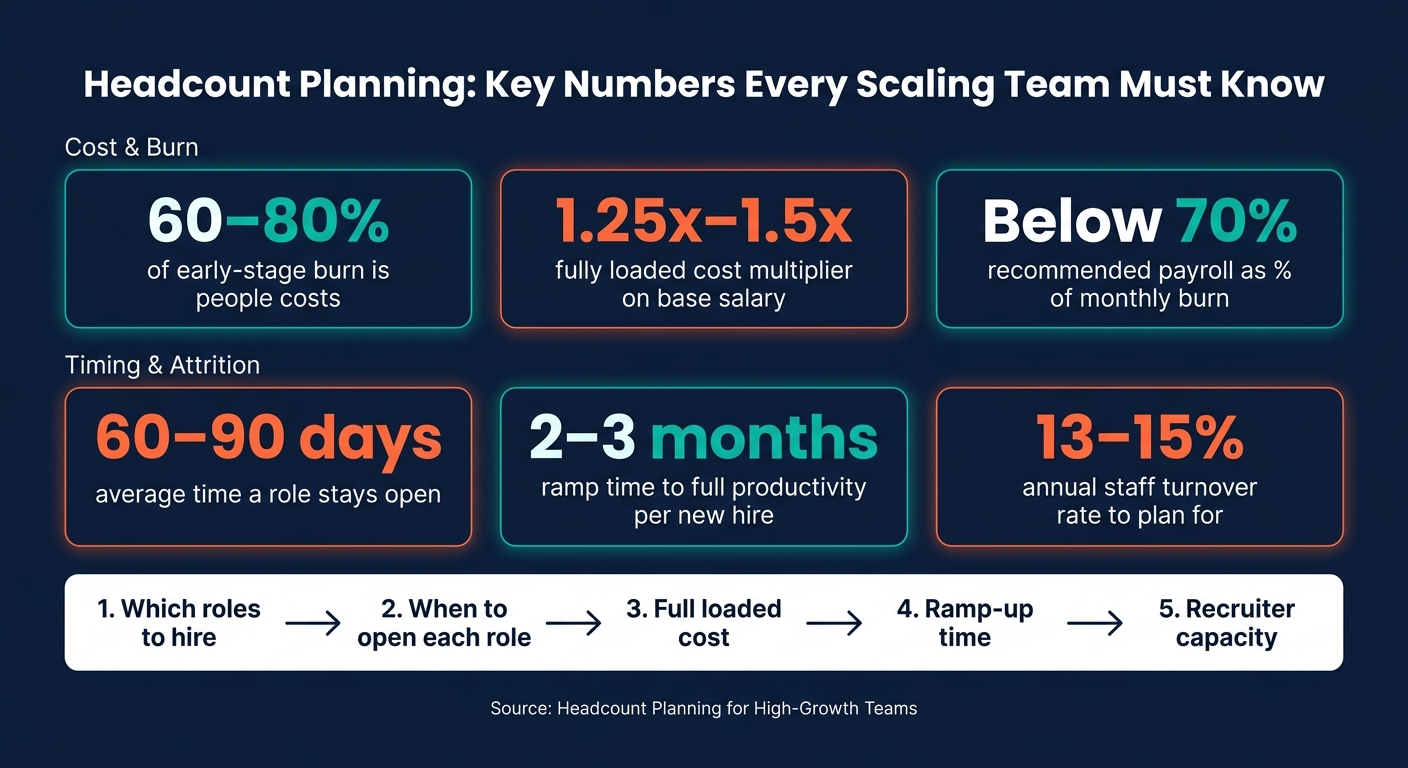
Headcount Planning: Key Numbers Every Scaling Team Must Know
Reimagining Headcount Planning as a Head of Talent – Ashby One
sbb-itb-a23bd6a
How to build a data-driven headcount plan
You need a hiring plan that ties straight back to business goals, not instinct or last year’s org chart.
The simplest way to do that is to turn growth targets into hiring decisions, then pressure-test those decisions against cost, timing, and runway.
Start with business targets and capacity gaps
Every role should link to a business milestone. A product beta or your first 10 customers can set the timing for a hire [4]. If revenue doubles, engineering may need to grow by 40% to 60% to keep up [2].
That shifts the conversation from, “Who do we think we need?” to “What work must get done, and what headcount does that work demand?”
Then look at the actual gaps. In most scaling companies, they fall into four buckets:
| Gap Type | What It Means | Example |
|---|---|---|
| Quantity | Not enough people | Need 8 DevOps engineers, have 3 [2] |
| Skills | Wrong capabilities | Python team lacks MLOps [2] |
| Seniority | Too junior | No senior technical leader [2] |
| Succession | No successors | No successor for VP of Engineering [2] |
This matters because not every gap needs a full-time hire.
Before you open a req, ask whether the issue is best solved by training, hiring in-house or using agencies, contracting, or automating. In some cases, one of those options closes the gap faster and at a lower cost [2].
That kind of discipline helps you avoid one of the most common planning mistakes: using headcount as the default fix for every delivery problem.
Once you know what work needs covering, turn each role into a cost and timeline assumption.
Model fully loaded cost, hiring timelines, and ramp time
Base salary is only the starting point. For U.S.-based roles, fully loaded cost usually lands at 1.25x to 1.50x base salary after payroll taxes, benefits, equipment, and overhead are added [4].
If a role is listed at $120,000, your actual cost may sit closer to $150,000 to $180,000. You can use an embedded recruitment savings calculator to see how different models impact these total costs. That changes budget planning fast, especially across engineering, product, and GTM teams.
Timing carries just as much weight as salary. A hire opened in month 3 can become a year-long cost commitment that hits runway almost at once.
As a working rule, plan on 3 months from req opening to full productivity [4]. So if you need someone producing in Q2, the req likely needs to open in Q1.
Track each hire by month, using prorated salary and expected start dates. That gives you a much clearer read on:
- when payroll steps up
- when output should show up
- where delays will hit execution
Without that level of detail, hiring plans often look fine on paper but miss the mark in practice.
Plan for 3 scenarios: baseline, aggressive, and conservative
Even a solid cost model can fall apart if revenue shifts and the hiring plan stays frozen. Static annual plans go stale fast [2].
That’s why scenario planning matters. Instead of building one version of the future, build three so leadership can move without starting from scratch.
| Scenario | Growth Condition | Hiring Strategy | Budget Impact |
|---|---|---|---|
| Aggressive | Revenue up >30% [2] | Prioritize specialist roles and market expansion | High burn |
| Baseline | Revenue up ~10% [2] | Prioritize core delivery and essential backfills | Moderate burn |
| Conservative | Flat or declining revenue [2] | Freeze non-essential roles; delay new leadership roles | Low burn |
This gives CEOs, CFOs, and HR leaders a cleaner way to make trade-offs. If growth beats plan, you know which roles to pull forward. If revenue softens, you know what to pause first.
Use an active/paused flag in your planning model so you can see how delaying even one hire changes burn and runway [3]. That’s often where the clearest decisions sit, not in a major restructure, but in the timing of two or three key hires.
A good rule is to keep payroll below 70% of monthly burn [4]. That leaves room for software, rent, and infrastructure.
Done well, scenario planning helps you protect runway without losing delivery pace. It keeps hiring tied to what the business can support, and what the business needs to achieve.
Forecast hiring demand and recruiter capacity
A headcount plan breaks down when your recruiting capacity can’t keep up.
Before you forecast demand, split requisitions into three buckets: net new roles, backfills, and vacancies created by internal moves or promotions. That gives you a much cleaner view of actual hiring demand versus available supply. Then comes the harder part: can your recruiting team deliver it?
High-growth teams often miss replacement hiring in the plan. The national employee separation rate is about 13% to 15% annually [2]. On a 50-person team, that’s about 7 to 8 replacement hires a year before you add a single growth role. If you don’t yet have your own attrition data, use the 13% to 15% baseline and tighten it up as your numbers come in.
Calculate recruiter bandwidth against planned requisitions
Once total hiring demand is clear, test it against recruiter capacity or rate your recruitment health.
Don’t measure capacity by open req count alone. That can look tidy on paper and still fail in practice. A better way is to look at throughput: resume-to-interview ratios, interview volume, and how long roles stay open.
If time-to-fill keeps stretching, that’s a warning sign. If specialist roles sit open for longer than planned, that’s another. And in tight labour markets, when interviews go up but offers don’t, the issue often isn’t demand, it’s recruiter bandwidth.
Put simply, if your plan asks for more hiring than your team can process, reqs will slip. By the time that shows up in weekly hiring meetings, you’ve already lost time.
Add embedded recruiting capacity when internal teams will miss plan
When internal capacity falls short, embedded recruitment helps close the gap.
Rent a Recruiter places experienced recruiters directly into your team, often within days, to run hiring end-to-end. That gives you extra delivery power without waiting to build permanent internal headcount first.
The commercial upside is straightforward. Companies typically cut hiring costs and win back internal time [1]. It also gives you room to shift hiring priorities without letting open roles stall.
Turn the headcount plan into a shared operating system
Once the hiring plan is built, the next risk is drift.
A headcount plan only works when Finance, HR, talent acquisition strategies, and business leaders are working from the same set of assumptions. If Finance has budgeted for 8 roles and HR is planning for 15, execution falls apart. The fix is not another spreadsheet. It is a shared operating rhythm.
That means setting ownership, approval rights, and review cadence before requisitions start moving.
Use one company-wide standard for fully loaded cost.
Set ownership, approval rules, and role priority tiers
Every role in the plan needs a clear owner and a clear approval path. Without that, requests stack up, decisions slow down, and hiring loses momentum. Assign one owner to the master plan and one approval path for changes.
When business conditions change, not every role should move at the same speed. A simple three-tier system keeps the picture clear:
- Critical roles tied straight to revenue, product delivery, or customer retention move first.
- Important roles that support growth come next.
- Deferrable roles, like leadership layering, expansion hires, or nice-to-haves, wait until conditions allow.
This sequencing protects the hires that matter most when budgets tighten or timelines get squeezed [1][4].
Review monthly and adjust before gaps become costly
Static annual plans do not hold up in fast-moving companies. A monthly review cadence helps you spot start-date slippage, budget variance, and capacity risk before they snowball. Each check-in should cover four metrics:
| Monthly Review Metric |
|---|
| Actual vs. planned hires |
| Fully loaded cost variance |
| Time-to-fill |
| At-risk roles |
When a department shows yellow or red, the question is not just, "why is hiring slow?" It is, "what slips if this hire moves back three months?" [1]
That shift changes the conversation. Instead of passively reviewing status, you can see the business cost of delay and decide what needs to move now.
Conclusion: A practical headcount planning approach for scalable growth
Once ownership, approvals, and monthly reviews are in place, headcount planning stops being just a spreadsheet. It becomes a control system for growth.
At that point, you’re not simply tracking open roles. You’re tying hiring to business milestones, cost, and team capacity. That’s what turns headcount planning into a financial and operational discipline, not an admin task.
Teams that align talent strategy with business priorities outperform peers, with faster hiring, lower cost per hire, and more predictable execution [2].
But even the best plan can stall if your hiring team runs out of capacity.
When internal recruiting can’t keep pace, execution comes down to adding hiring bandwidth without losing control of cost or quality. That’s where embedded recruitment can help keep the plan on track. Rent a Recruiter embeds experienced recruiters into your team within days to manage hiring end to end, helping scaling companies reduce hiring costs by up to 70% and save over 80 hours per month [1].
If your team is scaling, learn more at Rent a Recruiter.
FAQs
How do I know if a role should be hired, outsourced, or automated?
Review this choice every quarter, based on business milestones, not only short-term pressure. Start by mapping the work needed to hit your next goals.
Then weigh four options: train your team, hire permanent employees for high-impact roles, use contractors or fractional specialists for urgent or temporary needs, and automate repetitive tasks.
The right mix comes down to three things:
- Urgency: what needs to happen now
- Budget: what you can fund without overloading the business
- Long-term importance: what the company should build in-house versus buy in for a period
That matters because not every gap should be filled the same way. Some roles justify a permanent hire. Some work is better handled by short-term support. And some tasks should never sit on a person’s desk in the first place if software can handle them faster and at a lower cost.
What should I do if hiring delays threaten delivery goals?
Assess capacity straight away and prioritise critical roles first. That cuts disruption fast and helps you focus effort where the business feels the strain most. Calculate the cost of vacancy so you can see which roles need urgent attention and where delay is costing you money.
Use a skills-based approach to cover gaps in the short term. That might mean internal promotions, targeted training, contractors, or fractional specialists. The goal is simple: keep work moving without waiting for every permanent hire to land.
At the same time, tighten your recruiting process. Remove bottlenecks like slow feedback, poor interview coordination, or messy candidate management. If hiring demand is high, an embedded recruiter can sit within your team and help speed up delivery with more control and less delay.
When should I add recruiting capacity to stay on plan?
Work backward from your key business milestones. Hiring, interviewing, and ramp-up all take time, so you need to add recruiting capacity 3 to 4 months before a new hire is expected to be fully productive.
That matters when you’re planning around product launches, market expansion, or other growth targets. If hiring starts too late, the cost shows up fast, missed deadlines, slower delivery, and extra pressure on your team.
Tie each hiring req to a clear business deadline. Then review those plans against your 6-to-12-month business roadmap so you can spot gaps early, before they turn into urgent hiring problems.