
If you start a search without market data, you risk wasting recruiter time, missing hiring targets, and overspending on roles the market cannot support.
I see LinkedIn Talent Insights as a planning tool for one job: helping you check talent supply, demand, pay, and talent movement before you commit budget and recruiter hours. For scaling companies in SaaS, Technology, IT, Fintech, Engineering, Security, Insurance, and Professional Services, that means better search plans, fewer resets, and tighter control over hiring cost and timelines.
Here’s the short version:
- It helps you test a role before launch
- It shows where talent sits and where it is moving
- It helps you reset title, location, pay, and target-employer choices
- It does not run outreach, interviews, or applicant tracking
- It matters more when hiring delays affect revenue, delivery, or growth
One stat stands out: 74% of HR leaders say they do not have the data they need for sound workforce decisions. That gap costs time and money. You can rate your recruitment process to identify these gaps.
If you want the plain answer, this tool is most useful when you use it to change the hiring plan early, then pair it with execution, whether that sits in-house or through an embedded recruiter.
What I take from the article is simple. LinkedIn Talent Insights is not about doing more reporting. It is about helping you make better hiring calls before a search goes live.
The two parts that matter most are the Talent Pool Report and the Company Report.
The Talent Pool Report helps you answer a hard question early: is this role fillable in this market at this pay level? If the answer is no, you can change course before your team loses weeks on a weak brief. That can mean changing location, loosening title filters, or reviewing compensation.
The Company Report is more about target selection. It shows where people are joining and leaving, where skills are concentrated, and which employers sit close to your hiring pool. For leaders trying to cut agency spend or reduce wasted sourcing time, that gives you a clearer map of where to focus.
What matters most is not the data itself. It is what you do with it.
If supply is low and demand is high, you may need to:
- expand location scope
- review salary
- shorten interview stages
- shift target employers
If talent is moving out of a certain employer group, you may want to:
- add those firms to your sourcing list
- move outreach there first
- adjust your message to fit the market
That is where the business case sits. Less wasted search effort. Better use of recruiter capacity. Fewer delays caused by poor role design.
I would also keep one point clear with hiring managers and finance teams: LinkedIn Talent Insights does not replace recruiter delivery. It does not contact people, schedule interviews, or move candidates through process. It gives you the market view. The work still needs to happen after that.
So if your team already knows where the problems are but lacks capacity to act, this is where fractional or embedded recruitment can fit. Data without execution just becomes another internal deck.
For hiring decision-makers, the article points to one simple rule: use market data before opening the role, not after the search starts failing. That is how you save time, protect budget, and keep hiring tied to market reality.
If you want to turn planning into delivery, Rent a Recruiter can help you move from market data to live hiring activity. If cost control is part of the decision, you can also see your potential savings.
LinkedIn Talent Insights: Guidance without the Guesswork
sbb-itb-a23bd6a
The Two Core Reports Recruiters Should Know
LinkedIn Talent Insights: Talent Pool Report vs Company Report
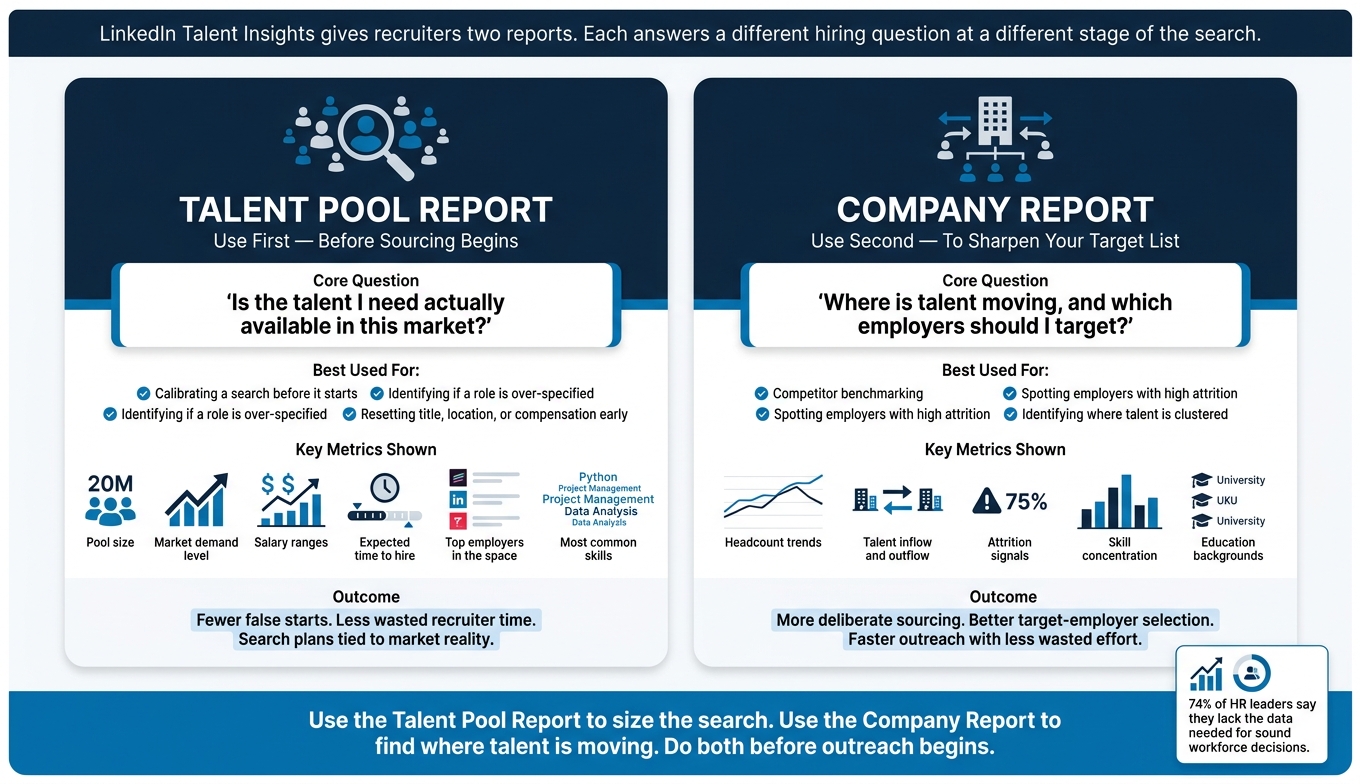
LinkedIn Talent Insights has two core reports. Each one answers a different hiring question at a different point in the search. The Talent Pool Report helps you assess the market first. The Company Report helps you tighten your target list after that.
Talent Pool Report: Assess Talent Supply Before You Start Sourcing
The Talent Pool Report answers a basic but high-stakes question: is the talent you need actually out there? It shows candidate supply by location, title, skills, and company, along with market demand, salary ranges, and expected time to hire [1].
That matters when your brief looks fine on paper but is too tight for the market. If the role is over-specified, this report gives you a way to fix it before your team burns time on a search that was never likely to land. You can widen the title, expand location scope, or reset compensation before sourcing begins.
It also shows where talent sits in the market. You can see which companies employ the highest share of the profile you want and which skills appear most often. That gives you a stronger starting point for search strings, outreach planning, and hiring discussions with stakeholders.
For CEOs, HR leaders, and Talent teams, that means fewer false starts, less wasted recruiter time, and a search plan tied to market reality instead of guesswork.
Company Report: Benchmark Competitors and Track Talent Flow
While the Talent Pool Report looks at roles, the Company Report looks at organisations. It shows headcount trends, skill concentration, education backgrounds, and talent flow, where talent is moving in and out.
That inflow and outflow view is useful when you want to benchmark talent competitors or spot employers with high attrition. If a company is losing people in the skill area you need, that may point to an opening in the market. If another is hiring heavily from the same pool, you may need to move faster or change your approach.
In plain terms, this report helps recruiters shift from reactive sourcing to a more deliberate plan. Instead of chasing profiles one by one, you can map where talent is clustered, which firms are under pressure, and where your outreach is most likely to land.
| Report | Best Used For | Key Metrics |
|---|---|---|
| Talent Pool Report | Calibrating a search before it starts | Pool size, demand level, salary range, expected time to hire, top employers, skills |
| Company Report | Competitor benchmarking and workforce planning | Headcount trends, talent inflow/outflow, attrition, skill concentration, education backgrounds |
Use the Talent Pool Report to size the search first. Then use the Company Report to identify target employers and track where talent is moving next. That’s where better hiring decisions start, before outreach, before agency spend, and before the search goes off course.
Sourcing Signals That Should Change Your Search Strategy
Use the Talent Pool and Company Reports to decide what to change in your search before you launch outreach.
Key Signals to Watch: Companies, Locations, Titles, Skills, and Migration Patterns
Some of the best sourcing signals are easy to miss if you only look at headline numbers.
Use 12-month talent flow to spot competing employers and source pools you may have ignored. That matters because the companies losing talent in your skill area are not always the ones you first think of. If people are leaving those firms, you may have a better opening to reach talent there, with less resistance and less wasted outreach.
Location data matters just as much. Compare supply and demand across markets before you lock in your search. If your main market is crowded, move into a secondary market with stronger talent supply and less competition. That should change both where you search and which filters you use. Done well, this can save time and cut the cost of hiring by avoiding the same small group of people as everyone else.
You should also track hiring spikes and team changes at specific companies. When a business is hiring fast or a team has shifted recently, mobility often goes up. People may be more open to a move, or at least more willing to reply. That makes those employees a better use of your outreach time.
How to Turn Signals Into Better Search Strings
If the Talent Pool Report shows that your main title gives you a thin pool, don’t respond by lowering the bar. Instead, widen your Boolean search with adjacent titles and related skills.
A simple way to do this is through synonym clusters. For example, pair Java with Kotlin, or React with TypeScript, to bring in adjacent profiles. The aim is to match for capability, not just the label on a LinkedIn profile. That’s often where better hiring outcomes start, especially in SaaS, Technology, IT, and Engineering roles where title variation is common.
| Talent Insights Signal | Sourcing Action |
|---|---|
| Companies losing talent in your skill area | Add those firms to your target-company list in LinkedIn Recruiter |
| Secondary market with strong supply | Adjust location filters to focus on that market |
| Thin pool for primary title | Expand Boolean search with adjacent titles and related skills |
| Hiring spike or recent team changes | Prioritise outreach to employees at that company |
Recheck these signals as the market moves, and update your filters before your search starts pointing at the wrong segment. Your sourcing changes should feed straight into your hiring plan, so the team spends less time on poor-fit pools and more time on markets that can actually deliver hires.
How to Turn Talent Insights Into a Hiring Plan
A Simple Workflow From Market Question to Sourcing Action
Start with a clear hiring question: What does the talent market look like for this role and location right now? Then use the report to decide if you need to widen the search, change compensation, or reset target employers.
Companies that use people analytics are 5x more likely to make faster and more effective hiring decisions [1]. The point is simple: data is only useful when it changes what you do next.
Here’s how common signals should shape your hiring plan:
| Signal | What It Means | Hiring-Plan Decision |
|---|---|---|
| High demand, low supply | The role is hard to fill at current specs | Widen the geographic search or revisit compensation and benefits |
| Talent is flowing out of target employers | Target competitors are retaining their staff | Shift to different target employers or sharpen your employer branding messaging |
| Local skills gap | The local pool lacks specific technical requirements | Adjust the job title to attract adjacent skills |
| Competitors are hiring aggressively | Market is saturated; candidates likely have multiple offers | Accelerate interviews and emphasise what makes your company different |
Do this work before you open a requisition, not after sourcing has already started. That saves time, cuts rework, and gives hiring managers a plan they can actually back.
Once the plan is set, turn the findings into something leadership can use.
Using Exports to Align Hiring Managers and Leadership
Don’t send raw data around the business. Share a short leadership deck instead. You can find more advice on talent strategy in our recruitment blog.
A focused presentation can show candidate availability, demand, salary ranges, estimated time-to-hire, and where the competition is hiring [1]. That makes it much easier to justify a change in the search brief, reset the timeline, or ask for a salary adjustment before the role goes live.
This matters for one reason: alignment early is cheaper than course-correcting later.
Before presenting to finance, benchmark compensation against at least three market competitors. A salary banding visual can make the budget conversation much clearer and help you avoid back-and-forth once approvals start.
If your team sees the issue but doesn’t have the capacity to act on it, execution becomes the next problem.
Where Embedded Recruiting Support Fits In
Talent Insights only matters when someone can act on it fast. When internal bandwidth is tight, an embedded recruiter can turn Talent Insights into live sourcing activity and hiring progress.
Instead of letting market data sit in a slide deck, you move straight from insight to action. That means tighter search briefs, faster outreach, and fewer delays between planning and execution.
Conclusion: What Recruiters Should Do Next
LinkedIn Talent Insights is at its best when it changes a hiring decision, not when it just sits in a report. The Talent Pool Report tells you if a search is realistic. The Company Report shows you where talent sits and how it moves. Used together, they cut out guesswork and give you market proof.
That matters in a tight hiring market, where speed and quality have a direct impact on growth.
Companies that use people analytics are 5x more likely to make faster, more effective hiring decisions [1]. Leveraging AI-powered recruitment tools can further accelerate this process.
When your internal team is stretched, the issue is no longer insight. It’s execution. If you don’t have the bandwidth to act on the data, Rent a Recruiter can place experienced recruiters into your team within days, turning Talent Insights into live sourcing, sharper briefs, and steady hiring progress.
If you’re ready to turn market data into a hiring plan, book a call or see your potential savings.
FAQs
When should I use LinkedIn Talent Insights?
Use LinkedIn Talent Insights when you need to make data-led decisions about recruiting and workforce planning.
It’s most useful when you need a clearer view of the market behind your hiring plan. That could mean analysing talent movement, benchmarking pay, forecasting workforce needs, improving employer brand position, or tracking talent supply and demand.
You might use it for a one-off talent pool report before opening a new role or market. Or you might use it as part of your hiring strategy over time, especially if you’re scaling across SaaS, Technology, IT, Fintech, Engineering, Security, Insurance, or Professional Services.
For hiring leaders, the business case is simple: better market data helps you cut guesswork, plan headcount with more confidence, and avoid costly hiring mistakes.
What can the Talent Pool Report tell me?
A Talent Pool Report helps you re-engage past candidates and keep track of relationships you’ve already built. It shows key metrics like reactivation rates, email response rates, and engagement with silver-medalist candidates.
For hiring leaders, that matters because it cuts waste in the process. Instead of starting from scratch every time, your team can focus on people who already know your company and have shown interest before.
That usually means:
- Less reliance on external sourcing
- Shorter hiring timelines
- Better use of your existing candidate database
In plain terms, you get more value from the talent you already have in your orbit.
How does the Company Report improve sourcing?
The Company Report helps you source better by mapping talent flow. It shows where competitors hire from and where people go after they leave. That gives your team a clearer view of which companies are building capability and which are losing key know-how.
With that view, you can tighten your sourcing plan, sharpen outreach, and spend time on the talent targets and market gaps most likely to improve hiring results.