
Need to hire gig workers quickly without sacrificing quality? Scaling companies are increasingly turning to gig platforms for specialized talent. But finding dependable freelancers in a crowded market is challenging.
Here’s the solution: a structured approach to sourcing, vetting, and onboarding gig workers. Save time, reduce costs, and secure top-tier talent by focusing on these key areas:
- Choose the right platform: Match the platform to your needs – freelance marketplaces for specialized projects, on-demand staffing for shift-based roles, or local marketplaces for hands-on tasks.
- Write clear briefs: Define deliverables, pay rates, and timelines upfront to attract qualified freelancers.
- Vetting matters: Use ratings, portfolios, and test tasks to evaluate candidates effectively.
- Streamline onboarding: Set up communication channels, payment milestones, and access to tools for a smooth start.
- Build a repeatable process: Standardize job briefs, maintain a pre-vetted talent pool, and track hiring metrics.
Why it matters: Gig workers offer flexibility and expertise without the long-term costs of full-time hires. With the gig economy projected to reach $674.1 billion by 2026, businesses that master gig hiring will gain a competitive edge.
Want to simplify your hiring process? Rent a Recruiter provides embedded recruitment solutions to handle gig hiring from start to finish, saving up to 70% on costs and reclaiming over 80 hours per month in admin.
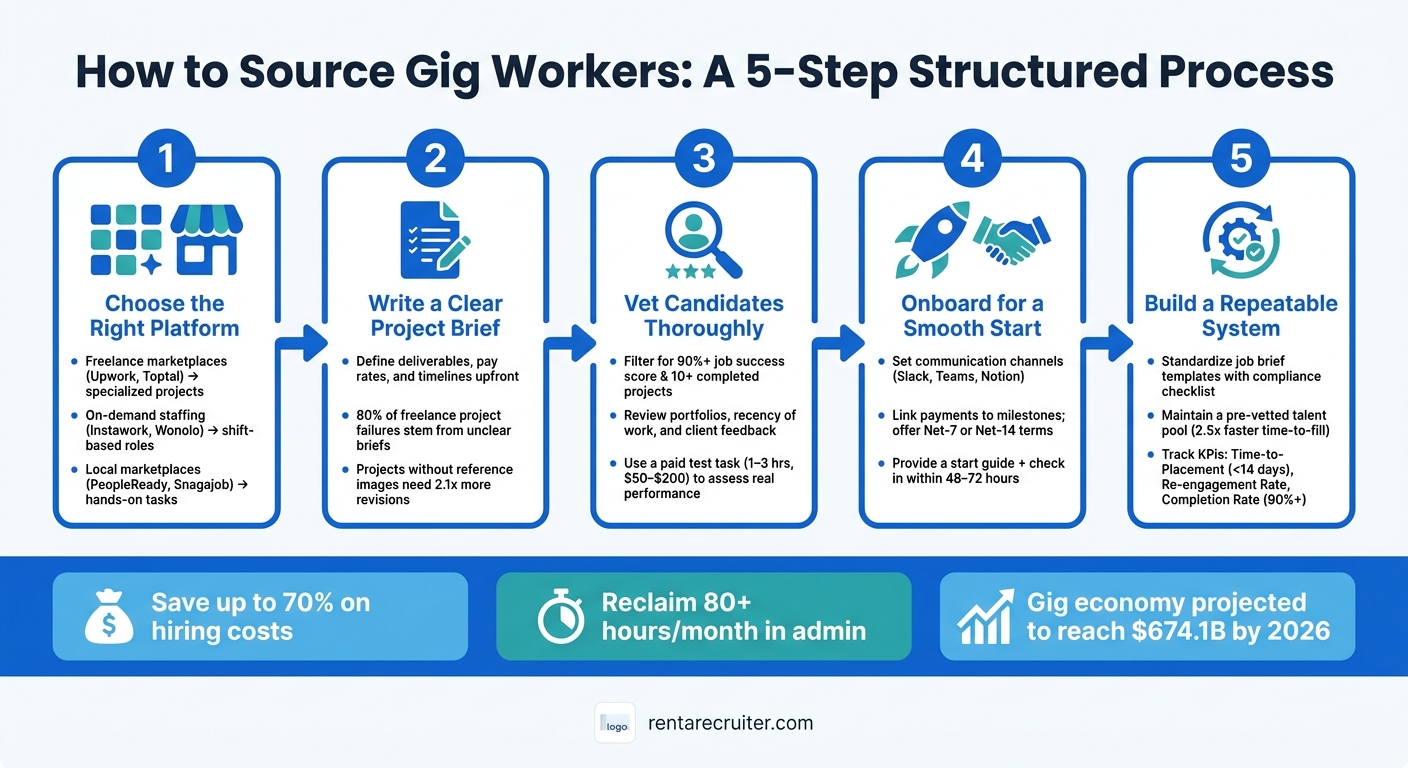
How to Source Gig Workers: A 5-Step Structured Process
9 Ways to Succeed in the Gig Economy
sbb-itb-a23bd6a
What Makes Sourcing Gig Workers Different
Hiring gig workers calls for a completely different playbook compared to recruiting full-time employees. Relying on traditional recruitment methods often leads to inefficiencies and missed opportunities, especially for SMEs trying to secure top-tier contingent talent.
The gig economy moves fast – think in hours or days, not weeks or months. Freelancers, especially those with specialized skills, often juggle multiple offers at once. If your hiring process drags, you risk losing them to competitors. This is particularly true for the millions of highly skilled independent workers in the U.S., many of whom earn over $100,000 annually [1].
When it comes to evaluating gig workers, traditional resumes won’t cut it. Instead, focus on their platform ratings, verified project histories, and work portfolios. For example, developers might showcase their work on GitHub, while designers may use Behance [4]. As Vicky Liu from Juicebox explains:
"Traditional hiring is too slow for today’s business needs. While you post jobs and wait for applications, an agile talent pool of elite specialists – gig workers – is ready to execute now." – Vicky Liu, Juicebox [4]
SMEs also face unique workflow challenges when hiring gig workers. Unlike permanent roles, gig hiring often involves re-engaging the same contractor multiple times, sometimes at varying pay rates, with quick onboarding and offboarding cycles. Most Applicant Tracking Systems (ATS) are designed for linear, long-term hiring and struggle to accommodate this cyclical, fast-paced nature [1]. Choosing the right gig platform becomes critical to overcoming these hurdles.
Another key difference lies in what gig workers value. They prioritize clear deliverables, competitive pay, autonomy, and timelines over traditional benefits like healthcare or retirement plans. If your job postings focus too much on perks and corporate culture, you may fail to attract the best freelancers [3].
| Factor | Gig Worker | Traditional Employee (W-2) |
|---|---|---|
| Hiring Speed | Hours to days [1] | Weeks to months [6] |
| Vetting Focus | Portfolios, ratings, and signals [4] | Resumes and cultural fit [3] |
| Cost Structure | Higher hourly rate; no benefits [7] | Lower hourly rate; ~30% benefits cost [7] |
| Relationship | Project-based or time-bound [4] | Ongoing with expectation of benefits [4] |
| What They Prioritize | Scope, pay, timeline, autonomy [3] | Stability, growth, and benefits [3] |
Recognizing these differences is the first step toward refining your approach to gig hiring and selecting the right tools to support your strategy.
Choosing the Right Type of Gig Platform
When it comes to gig hiring, selecting the right platform or fractional recruitment services can make all the difference in securing the talent you need without wasting time or money. The best platform for your needs will depend on the type of work, the timeframe, and the level of expertise required. Broadly, gig platforms fall into three main categories, each tailored to different hiring scenarios.
Freelance Marketplaces
Freelance marketplaces are ideal for knowledge-based, specialized work like software development, UX design, financial modeling, or content strategy. Platforms such as Upwork, Fiverr Pro, and Toptal provide access to a global pool of skilled professionals with verified portfolios, client reviews, and project histories. For example, Toptal focuses on the "top 3%" of vetted talent in technical and financial fields, though this comes at a premium price [1]. Fiverr Pro, on the other hand, uses a fixed-price model, which simplifies billing for clearly defined deliverables. Keep in mind that workers on these platforms are usually classified as 1099 independent contractors, meaning you’re responsible for ensuring proper classification.
On-Demand Staffing Platforms
If speed is of the essence, on-demand staffing platforms are a powerful option. These platforms, like Instawork and Wonolo, cater to high-volume, shift-based roles in industries such as hospitality, warehousing, or light industrial work. Wonolo, for instance, classifies its workers as W-2 employees, reducing the risk of misclassification [1]. This is critical, as penalties for misclassifying workers can exceed $135,000 per individual in back taxes and legal fees [1]. These platforms are particularly useful when you need workers on short notice – sometimes within hours.
Task-Based Local Marketplaces
For assignments requiring local, hands-on involvement – such as event staffing, retail floor coverage, or general labor – task-based local marketplaces are a practical choice. Platforms like PeopleReady and Snagajob specialise in connecting you with workers available nearby and often on short notice. PeopleReady, for example, employs workers as W-2 employees, further protecting you from classification risks. Additionally, some platforms are embracing AI-powered tools to streamline the hiring process. PeopleReady’s ReadyMatch, for instance, instantly matches job requirements with qualified local talent.
| Platform Type | Best For | Key Examples | Worker Status |
|---|---|---|---|
| Freelance Marketplace | Specialized projects (e.g., design, dev) | Upwork, Toptal, Fiverr Pro | Typically 1099 |
| On-Demand Staffing | High-volume hourly shifts | Instawork, Wonolo | Varies (e.g., W-2 on Wonolo) |
| Task-Based Local | Local manual labor or service roles | PeopleReady, Snagajob | Often W-2 (e.g., PeopleReady) |
Before choosing a platform, clearly define your deliverable. You can also rate your recruitment process to identify gaps in your current strategy. If you need a specific project completed – like an app or a marketing campaign – a freelance marketplace is likely the best fit. If you need immediate coverage for hourly shifts, an on-demand staffing platform is more appropriate. For hands-on, location-based roles, task-based local marketplaces are the way to go.
How to Write Clear Project and Shift Briefs
Your job brief directly impacts the quality of candidates you attract. A vague posting typically draws unqualified applicants, while a detailed and precise one helps prequalify the right talent from the start.
"Vague briefs produce bad candidates. A client who says, ‘We need a developer for a few weeks’ is not ready for you to start sourcing." – RecruitBPM [2]
Defining Scope and Deliverables
Focus on specifying deliverables rather than just listing tasks. For example, instead of saying "design a logo", include detailed requirements like file formats (e.g., SVG, PNG), dimensions, background preferences, and specific exclusions (e.g., no gradients or cursive fonts). Research shows that 80% of freelance project failures are due to unclear briefs, and projects without reference images require 2.1 times more revisions [11].
If the project involves multiple phases, outline clear checkpoints with deadlines. For instance, "Wireframe approval by June 5, final design by June 19" is far more actionable than simply stating "ASAP." A brief that takes less than 10 minutes to write is often too rushed to be effective [11].
When deliverables are clear, it becomes easier to establish transparent terms for compensation and timelines.
Setting Pay Rates and Timelines
Always include your pay rate upfront, whether it’s hourly, project-based, or tied to milestones. Top-tier freelancers often skip postings that lack clear pay details, and with 74% of freelancers citing late payments as a major issue [2], offering transparent terms can set you apart. If you can offer quicker payment terms, such as Net-7 or Net-14 instead of the standard Net-30, you’ll likely attract higher-quality candidates.
"Gig workers don’t care about your 401(k) match. They care about project scope, timeline, rate, and autonomy." – RecruitBPM [3]
Be specific about timelines. For example, "6–8 weeks, starting June 2" shows professionalism and allows candidates to assess their availability. Avoid vague phrases like "short-term" or "as needed", which can create confusion and discourage applications.
Once pay and timelines are established, shift your focus to the essential skills needed for the role.
Listing Required Skills and Certifications
Keep your requirements concise and relevant. For short-term projects, only list the skills and certifications necessary for immediate productivity. Adding unnecessary qualifications can deter capable candidates and slow the hiring process. Instead, prioritize verified work experience, platform ratings, and portfolios over credentials that don’t directly affect the work [2].
Include practical details such as whether the role is remote, on-site, or hybrid; expected weekly hours; and the primary communication tools (e.g., Slack, Microsoft Teams). These specifics help candidates self-assess, reducing mismatches and enabling quicker starts.
How to Vet Gig Workers Before Hiring
Once you’ve nailed down your brief, The next step is to thoroughly evaluate candidates using proven talent acquisition strategies. The goal? Go beyond polished profiles and focus on actual performance.
Using Ratings and Reviews
Start by narrowing your options to candidates with a 90%+ job success score and at least 10 completed projects [12]. Then, dive into the review texts. Look for clues about how they communicate under pressure and handle revisions – qualities that numbers alone can’t show.
"A resume tells you where someone worked. A gig worker’s platform profile, verified project history, and ratings tell you how they actually perform." – RecruitBPM [2]
Also, check the recency of their work. A freelancer with glowing reviews from three years ago but no recent activity might not be as reliable as someone who has completed five similar projects in the past six months.
Reviewing Portfolios and Work Samples
A strong portfolio doesn’t just showcase polished final outputs – it tells a story of problem-solving and results. Look for samples that align closely with your project needs. Go a step further and ask for the "story behind the work." For example, what was the problem? What constraints did they face? This approach helps you identify candidates who not only execute but also adapt [8].
"Strategic projects require judgment… so your vetting criteria must go beyond ‘Can they do the skill?’ to ‘Can they deliver under constraints?’" – Recruitment.link [8]
Running Skill Tests and Verifications
For roles needing specific expertise, a paid test task is a great way to assess real-world performance before committing fully. A scoped task of 1–3 hours (usually costing $50–$200 depending on the role) can provide invaluable insights [12]. Ask candidates to explain their decisions in their submission – this will reveal their thought process, attention to detail, and how they handle ambiguity.
To streamline the process, include a small but specific instruction in your test brief (e.g., "use the word ‘pineapple’ in the subject line"). This simple step can quickly weed out candidates who don’t pay attention to details [12].
| Evaluation Factor | Strong Signal | Red Flag |
|---|---|---|
| Communication | Specific answers, proactive risk flagging | Vague promises, delayed replies |
| Portfolio | Named client outcomes, process artifacts | Anonymous work without context |
| Reliability | Consistent ratings, recent activity | Gaps in work history, stale samples |
| Technical Skill | Clear "first draft" with explained logic | Overpromising on deadlines without detail |
Setting Gig Workers Up for a Smooth Start
You’ve chosen your candidate, and now it’s time to set them up for success. A well-planned onboarding process not only boosts performance but also lays the groundwork for a repeatable and efficient gig hiring system.
Establishing Clear Communication Channels
Once the selection process is complete, the next priority is ensuring communication flows smoothly. Start by defining how and where communication will happen. Let the gig worker know who their main point of contact is – this avoids confusion and conflicting instructions. For day-to-day collaboration, platforms like Slack, Microsoft Teams, or Google Chat are excellent for remote teams [9].
Consistency is key. A quick 15-minute kickoff call helps set expectations, and a short end-of-week check-in keeps everyone aligned without taking up too much time [13][14].
"In remote contexts, ‘grip on asynchronous communication’ often matters more than years of experience." – JobLot
To simplify collaboration, use a shared workspace like Notion to house key documents, briefs, and updates. This saves time and eliminates the frustration of digging through endless email threads for information [14].
Agreeing on Payment and Delivery Milestones
Clarity around payment terms and deliverables is non-negotiable. Document the payment schedule and link it to specific milestones, such as "payment released upon delivery and approval of final draft", instead of vague deadlines like "end of the project." This approach safeguards both parties.
Where possible, leverage milestone-based escrow services offered by gig platforms. Funds are held securely and released only when agreed-upon criteria are met [9][13]. Additionally, many top freelancers now expect Net-7 or Net-14 payment terms, which are faster than the traditional Net-30 cycle [9]. Quick payments can go a long way in building trust and ensuring top talent is eager to work with you again.
"Research shows 74% of freelancers experience late payments, which is one of the fastest ways to lose a contractor permanently." – RecruitBPM [2]
Providing the Right Tools and Information
Equip gig workers with everything they need to hit the ground running. A start guide that includes key contacts, system access, communication protocols, and a 7-day checklist removes uncertainty from their first week [9]. For technical roles, ensure they have access to tools like API documentation, sandbox environments, or shared incident logs right from the start [9].
Consider this example: A mid-sized B2B company hired a fractional head of growth and three marketers across two continents. Using a shared Notion workspace for briefs and weekly outcome demos, they launched two campaigns in 90 days, increasing Marketing Qualified Leads (MQLs) by 38% [JobLot.xyz, 2026]. Their success wasn’t just about the talent – it was about the structure they put in place.
Finally, schedule a check-in within the first 48–72 hours. This early touchpoint helps catch and resolve any misalignments before they become bigger issues. With the right onboarding process, integrating gig workers into your hiring strategy becomes a seamless and repeatable experience. This approach is particularly effective when hiring as you scale, where maintaining quality and speed is paramount.
Building a Repeatable Gig Sourcing Process
Once you’ve onboarded gig workers, the next step is to treat sourcing as a repeatable system. For small and medium enterprises (SMEs), this recruitment on demand approach ensures efficiency and maximizes the potential of gig talent. Instead of treating each hire as a standalone task, systematizing the process aligns seamlessly with the clear briefs and thorough vetting processes we’ve already discussed.
Creating Standard Job Brief Templates
Using a reusable job brief template saves both time and effort while maintaining consistency. Rather than drafting a new posting for every role, create a structured template that you can tweak as needed. Focus on the details gig workers care about most: project scope, timeline, pay rate, and deliverables [3].
To make postings even faster, standardize the deliverable details. Include a compliance checklist to confirm whether the role is for a 1099 contractor or a W-2 position – this step helps avoid costly misclassification penalties [2][3]. Additionally, incorporate a paid trial clause into your template. A short 4–8 hour test task serves as a consistent step in your hiring process, ensuring clarity and fairness [9].
"The organizations that thrive in 2026 will be those that treat gig recruitment not as a marketing exercise, but as a system-level capability, designed for immediacy, intelligence, and integration." – Recruitics [5]
Keeping a Pre-Vetted Talent Pool
Having clear templates is just the start. Maintaining a pre-vetted talent pool takes efficiency to the next level. Instead of starting from scratch with each new hire, build and nurture an active talent community [3][10].
Mark top performers in your ATS at the end of every assignment with notes like "available for redeployment as of [Date]." This way, you can reach out to proven talent before posting roles publicly [10]. For example, fintech company Ramp scaled its design team threefold in just six months by integrating a pre-vetted pool of freelance product designers into its workflows. These freelancers were treated as strategic partners, not just temporary hires [4]. Companies using re-engagement automation have reported 2.5x faster time-to-fill and a 40% lower cost per hire [5]. For SMEs with lean hiring teams, these kinds of efficiencies can make a huge difference.
Tracking Performance Metrics
Streamlining your process with templates and a vetted talent pool is essential, but tracking performance metrics ensures continual improvement. The table below highlights the most critical KPIs to monitor:
| Metric | What It Measures | Target |
|---|---|---|
| Time-to-Placement | How quickly you fill a gig role | Under 14 days |
| Engagement Completion Rate | % of gigs completed as agreed | 90%+ |
| Re-engagement Rate | Frequency of rehiring the same worker | Increasing over time |
| Response Rate to Outreach | Effectiveness of your targeting and messaging | 20–30%+ |
| Classification Error Rate | Worker misclassification incidents | 0% |
While speed and quality are key, pay close attention to your re-engagement rate – this reflects how often you rehire the same gig workers. A higher rate signals a healthy talent pool and shows you’re building long-term relationships, not just filling short-term gaps. Pair this with a simple 1–5 quality rating from hiring managers after each engagement to identify who should stay in your priority pool and who might not meet expectations [9][13].
Conclusion: Building a Stronger Gig Hiring Process
Creating an effective gig hiring system involves more than just posting jobs. It requires a structured approach: selecting the right platforms, crafting clear and detailed briefs, using signal-based vetting to filter candidates, ensuring smooth onboarding, and maintaining a reliable pool of pre-vetted talent.
With the gig economy projected to reach $674.1 billion by 2026 [2][3], small and medium-sized enterprises (SMEs) that invest in structured gig sourcing strategies can scale more efficiently, manage costs, and stay compliant with evolving labor laws.
"Gig labor has evolved from ‘supplemental capacity’ to strategic workforce infrastructure." – Recruitics [5]
This shift highlights the importance of having a repeatable and reliable process. SMEs that excel in gig hiring typically have systems in place that lead to faster placements, fewer compliance issues, and stronger connections with top-tier talent. By aligning platform choice, job briefs, vetting, onboarding, and talent pooling, businesses can build a hiring process that sets them apart.
Call to Action
Ready to make gig hiring simpler and more consistent? If your current process feels scattered or reactive, Rent a Recruiter can help. Their embedded recruiters integrate directly with your team, handling hiring from start to finish while bringing the structure and transparency gig sourcing requires. Most companies save up to 70% on hiring costs compared to traditional agency fees and reclaim over 80 hours per month in administrative tasks. Whether you’re scaling after a funding round or dealing with a surge in demand, this approach offers a smarter, more predictable way to handle recruitment without adding extra overhead.
FAQs
How do I choose the right gig platform for my role?
Start by pinpointing exactly what you need and the type of work the role requires. The right platform will depend on your industry and hiring goals – on-demand staffing platforms are ideal for shift-based roles, while freelance marketplaces are better suited for project-focused digital work.
Take a close look at each platform’s vetting process, compliance tools, and workflow support. Factor in your budget, how quickly you need to hire, and whether you’re looking for short-term help or a longer-term solution to ensure you choose the best match.
How can I avoid misclassifying gig workers (1099 vs W-2)?
To ensure gig workers are classified correctly, assess the working relationship by focusing on behavioral control, financial control, and the overall nature of the relationship. Key points to consider include whether workers have autonomy over their hours, tools, and potential to earn profits. Both the IRS and the Department of Labor emphasize that classification relies on the totality of circumstances rather than just the terms outlined in contracts. Keep thorough records of your evaluation to stay compliant and avoid costly penalties.
What’s the fastest way to vet a freelancer without risking quality?
To evaluate a freelancer efficiently while maintaining high standards, stick to a structured process centered on practical assessments. Start by reviewing their portfolio or past project results – this can often be done in just a few minutes. Next, conduct a small, paid test project to gauge their skills, ability to meet deadlines, and quality of work. Follow this with reference checks to validate their experience. For added assurance, consider a trial period – such as 30 days – to observe their performance in real-world scenarios before making a long-term commitment.