
If you are paying 15% to 30% of salary per hire, your recruitment model can start draining cash fast once hiring volume climbs.
I’d sum this up simply: if you want lower hiring costs, better forecasting, and less internal admin, switching from agency hiring to embedded recruitment is often the cleaner model for scaling teams. In many cases, companies cut recruitment spend by 40% to 70%, reduce time-to-fill by up to 50%, and save 80+ hours per month in hiring admin.
Here’s the full process in plain terms:
- Audit your current agency spend, hiring speed, and shortlist quality (or use a recruitment health check for a faster assessment)
- Set scope for what the embedded recruiter will own
- Move new roles first, while live agency searches finish out
- Track results at 30, 60, and 90 days
- Build internal hiring process so agency dependence keeps dropping
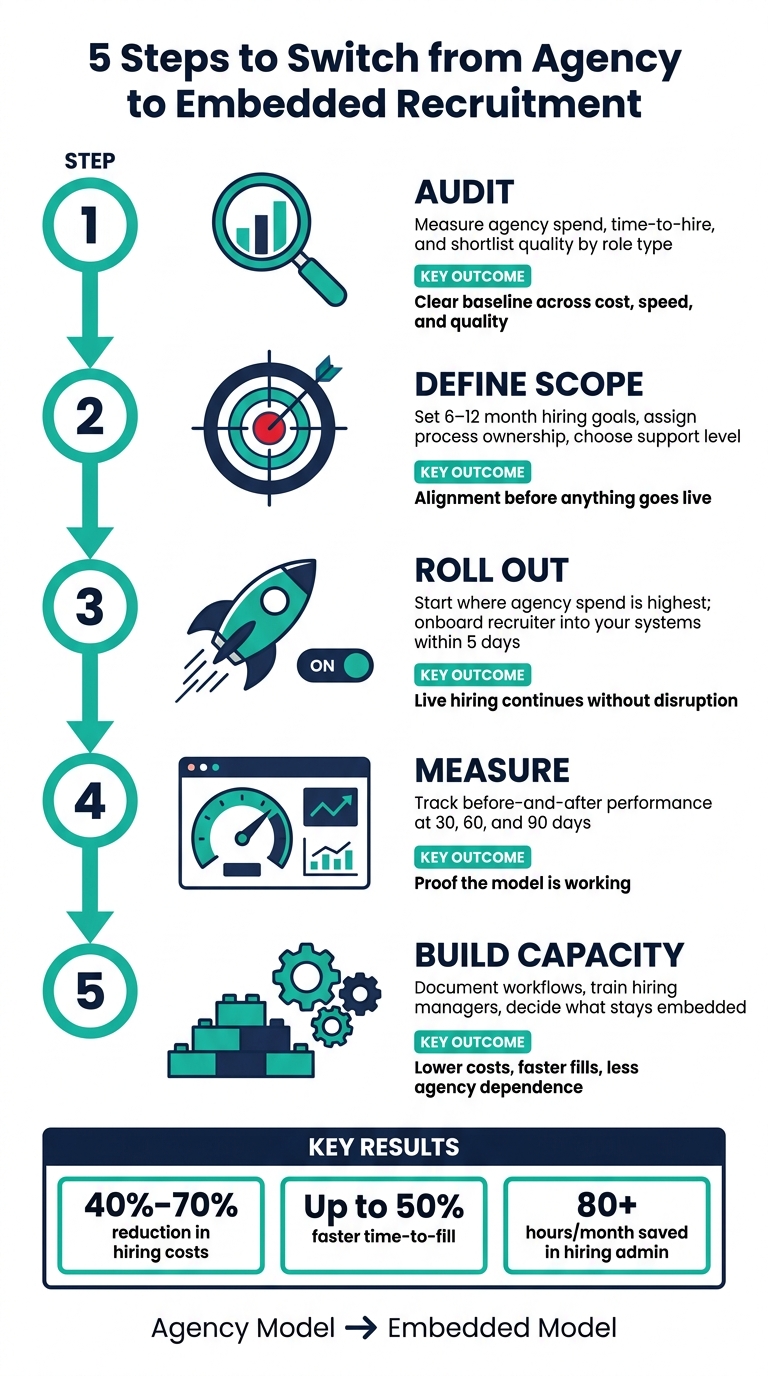
5 Steps to Switch from Agency to Embedded Recruitment
Quick comparison
| Model | Cost structure | Day-to-day control | Best fit |
|---|---|---|---|
| Traditional Agency | 15% to 30% of first-year salary per hire | Low | Low-volume or niche hiring |
| Embedded Recruitment | Fixed monthly fee | High | Scaling teams with repeat hiring demand |
| In-House Recruiter | Salary, tools, and overhead | High | Higher and steady annual hiring volume |
If you are hiring across SaaS, Technology, IT, Fintech, Engineering, Security, Insurance, or Professional Services, this switch is less about changing suppliers and more about taking back control of the hiring engine. The rest of the article shows how I’d do it step by step.
sbb-itb-a23bd6a
Step 1: Audit Your Current Agency Hiring Performance
Before you change anything, review the last 6 to 12 months of hiring activity and rate your recruitment process to set a clear baseline. You need a plain view of total agency spend, time-to-hire, offer acceptance rates, and hiring manager satisfaction. Without that, it is hard to judge what should change and where you will get the best return.
Look at each hire role by role. Was an agency the right choice, or had it simply become the default? Go beyond placement fees. Add the hidden line items too: LinkedIn licenses, job board spend, ATS subscriptions, and interview scheduling tools [8]. That gives you a more honest cost picture and helps you spot which roles are the best first fit for embedded support.
Measure Cost, Speed, and Quality by Role Type
Do not lump all hiring into one number. Break the data out by function, such as engineering, sales, and general and administrative (G&A). This shows where agency reliance is highest, where the most money is going, and where embedded support is likely to have the biggest effect.
For each function, track:
- Cost per hire
- Time-to-hire
- Resume-to-interview ratio
That last one matters more than many teams think. If the resume-to-interview ratio stays high, it often means shortlists are off target. Your hiring managers then spend time reviewing people who were never a strong fit in the first place. That is not just a hiring issue, it is a productivity issue.
Document Process Gaps and Hidden Internal Workload
Agency fees are only one part of the cost. Internal teams often lose over 80 hours per month managing agency-led hiring, including reviewing weak shortlists, chasing feedback, scheduling interviews, and dealing with compliance tasks [4][3]. In many SMEs, that workload lands on founders, product leads, or operations staff.
Write down the points where the process breaks down: weak shortlists, slow feedback loops, and high candidate withdrawal rates. Then connect each one to business impact. Every extra week a key role stays open can slow delivery, stretch your team, and hit revenue. That is the cost that often gets missed.
Baseline Comparison Table: Agency Model vs. Embedded Model
Use the table below as your benchmark before you make any changes. Fill in your own figures in the Current Agency Model column, then define what good looks like in the Target Embedded Model column. Those gaps will shape the operating model in Step 2.
| Metric | Current Agency Model | Target Embedded Model |
|---|---|---|
| Cost per hire | 20% to 25% of first-year salary [6] | Fixed monthly retainer or flat fee |
| Time-to-hire | Variable; often slowed by unclear briefs | Up to 50% faster through streamlined sourcing [4] |
| Offer acceptance rate | Current agency acceptance rate | Higher, with better role alignment and compensation calibration |
| Internal workload | High, roughly 80 hours per month on admin and follow-ups [4] | Low, embedded partner owns the process |
| Hiring manager satisfaction | Often lower when shortlists are weak or slow | Higher with a dedicated partner aligned to the role |
| Candidate quality | Transactional and volume-focused [7][1] | Better aligned with culture and strategy [7][1] |
| Knowledge retention | Leaves when the contract ends [5] | Stays inside the company as processes are built [1][5] |
Use this baseline to define scope and ownership in Step 2.
Step 2: Define the Scope, Goals, and Operating Model
Use your audit to pin down three things: who the embedded recruiter will support, what they will own, and how you’ll measure success over the next 6 to 12 months.
This is where Step 1 starts to pay off. Your baseline should show where embedded support can make the fastest difference, whether that’s high agency spend, slow hiring, or too much admin sitting with your team.
Set Hiring Goals for the Next 6 to 12 Months
Start with the functions putting the most pressure on the business. That usually means teams with the highest agency spend, the most urgent vacancies, or a sharp hiring spike.
Put simply, focus first on roles that cost you the most to leave open. A long vacancy doesn’t just slow hiring, it slows output, strains managers, and adds spend you didn’t plan for.
Before you bring anyone in, set clear targets. That means agreeing:
- your cost-per-hire reduction target
- your time-to-fill target
- the share of roles you want to fill without agency involvement
This matters because embedded recruitment can cut hiring costs by 40% to 70% compared to traditional agency fees and reduce time-to-fill by up to 50% [3][4]. It can also save internal teams more than 80 hours per month [4].
Those numbers give you a simple commercial test. You should be able to see whether the model is working within the first 2 to 6 months [4].
Once your hiring priorities are clear, lock in decision rights before work starts.
Clarify Who Owns Each Step of the Hiring Process
Ownership needs to be clear from day one.
The embedded recruiter should run sourcing, screening, scheduling, feedback collection, and offer management. They do this inside your ATS, your communication tools, and your internal workflows. Hiring managers still keep the final hiring decision [1][3][8].
That split works well because it removes admin from busy teams without taking away control. You get more hiring output, with less drag on managers.
Choose the Right Level of Embedded Support
This model is often a good fit for companies making 10 to 24 hires per year, where a fixed monthly fee is easier to spread across multiple hires [2].
If your hiring plan is still taking shape, a 3- to 6-month pilot can give you room to test the model and check ROI before you commit for longer [4].
With scope, goals, and ownership set upfront, you can move into the handover cleanly and keep active hiring on track.
Step 3: Roll Out the Transition Without Disrupting Live Hiring
Your Step 1 audit showed where agency spend is highest and where time-to-hire is dragging. Use that data to decide where to move first. Then use the targets from Step 2 to set the order.
The aim is simple: protect live hiring while shifting spend away from agencies as fast as you can.
A phased rollout works well because it gives you control. You do not need to change everything at once. You just need a clear cutover point for new roles.
Start with the Functions Where Agency Spend Is Highest
Start with one or two departments where agency fees are hitting hardest, often Engineering or Sales [7][10].
Do not disrupt active agency-led roles that are already in motion. Let those searches run until they close. Instead, have the embedded recruiter take over all new searches in that function from day one.
That line matters. No new agency-led searches. It is a simple rule, and it starts moving the cost line down without slowing hiring or losing candidate flow [3][9].
Once that boundary is in place, the next step is to get the recruiter into your day-to-day setup so hiring keeps moving.
Onboard the Embedded Recruiter into Your Systems and Workflows
Embedded recruiters can often be live in your systems within five days [4].
For that to happen, they need access straight away to your ATS, HRIS, Slack or Microsoft Teams, organisational charts, salary ranges, and interview process stages [4][8]. Set up a company email. Give them access to LinkedIn licences and job boards. Bring them into the planning meetings where hiring calls are made.
This is not admin for the sake of admin. It cuts ramp time. And when a recruiter has context early, candidate conversations tend to be sharper and hiring managers spend less time re-explaining roles.
Within 30 days, line up on:
- role outcomes
- candidate criteria
- weekly reporting
That gives you a shared view of what good looks like, how progress is tracked, and where issues need attention.
Transition Tracking Table: Managing the Agency Handover
Use a simple tracking table to manage the handover and avoid duplicate candidate handling. It keeps the transition visible and shows which agency relationships are still active and which are being wound down.
| Role Family | Previous Agency Usage | Embedded Go-Live Date | Agency Phase-Out Status |
|---|---|---|---|
| Engineering | High (3+ agencies) | Week 1 | Active roles stay with agency; no new searches |
| Sales | Moderate (2 agencies) | Week 2 | Full pipeline handover to embedded recruiter |
| Marketing | High (1–2 agencies) | Week 2 | Active handoff in progress |
| Operations | None (internal) | Week 1 | Embedded supports internal team immediately |
| Executive Search | Case-by-case | Week 4 | Retained for niche roles only; recruiter manages vendor |
Review the table every week until each function is either fully moved across or closed out. Once the handoff is steady, compare the results against your Step 1 baseline in Step 4.
Step 4: Measure Results, Improve the Process, and Scale What Works
Once live hiring moves into the embedded model, set a fixed review cycle. This is how you show the switch is working, not just in theory, but in cost, speed, and internal time saved.
Track Before-and-After Performance Against Your Baseline
Measure current results against the Step 1 baseline.
Review integration and candidate experience at 30 days. Review process efficiency at 60 days. Then review cost, time-to-fill, and internal hours saved at 90 days.
By 90 days, time-to-fill can drop by up to 50%, and internal teams can reclaim 80+ hours per month [4][3].
This matters because hiring changes are easy to talk about and harder to prove. A fixed review rhythm gives you something concrete. You can see whether the embedded model is cutting agency spend, reducing delays, and taking admin off your team.
Set Up Dashboards, SLAs, and Regular Reporting
One of the biggest practical advantages of embedded recruitment is visibility. Because the recruiter sits inside your systems, you get real-time data and more visibility into what is happening.
Use dashboards to track:
- spend
- cost per hire
- time-to-fill
- resume-to-interview ratios
- candidate experience
Review pipelines weekly, and use monthly performance reviews to spot patterns that need fixing [3][7].
Set SLAs for shortlist turnaround, feedback turnaround, and candidate communication. When these rhythms are in place, it becomes much easier to see what is working, where bottlenecks still sit, and which parts of the process should become standard. For more industry insights, visit The Talent Fix recruitment blog.
For CEOs and CFOs, this is where the model starts to feel less like outsourced support and more like a hiring function you can actually manage. You are not waiting for updates. You can see the numbers as they move.
Impact Comparison Table and Next Steps
Use the same role families from Step 3 to compare before-and-after results. Add your own numbers against each metric so the case is based on your hiring data, not guesswork.
| Metric | Before: Agency Model | After: Embedded Model |
|---|---|---|
| Cost per hire | 20% to 25% of first-year salary [6] | 40% to 70% lower than agency fees [4][3] |
| Time-to-fill | Variable | Up to 50% faster [4] |
| Internal hours on hiring | High | 80+ hours per month saved [4][3] |
| Shortlist quality | Variable | 2:1 to 4:1 resume-to-interview ratio [3] |
| Visibility | Limited | Full visibility via internal ATS and weekly reviews [3] |
| Predictable cost | Unpredictable | Fixed monthly retainer; easier to forecast [4] |
If your numbers are moving the right way at 90 days, that is your signal to expand the model into more functions. If one role type or department is still behind, use the weekly review data to work out whether the problem is sourcing, brief clarity, or feedback turnaround, then fix that before you scale.
At 90 days, decide whether to hold scope, expand into new teams, or shift more work in-house. Use those results to decide what stays embedded and what moves into the standard internal process in Step 5.
Step 5: Build Long-Term Hiring Capacity and Reduce Future Agency Dependence
By Step 5, your embedded model is up and running. Your team can see what’s happening in hiring, and agency back-and-forth is no longer eating up every discussion. Now you need to make a clear call on what stays, what your team should build, and what can be handed off.
Turn Repeatable Hiring Tasks into Standard Processes
Once hiring performance is steady, stop treating each hire like a one-off. Start documenting what works.
This is where the embedded phase pays off beyond filling roles. You can turn repeatable hiring work into standard operating procedures, such as role intake templates, structured interview guides, candidate scoring criteria, offer approval workflows, and hiring manager feedback SLAs. When these steps are written down and tested, hiring stays consistent whether you’re filling two roles or twenty.
A strong embedded recruiter should also flag process gaps, suggest tooling changes, and improve how hiring runs while roles are still being filled.
Use this phase to review candidate touchpoints, define your EVP, and keep outreach, interview stages, and offer delivery aligned. That matters because weak handoffs and mixed messaging don’t just slow hiring, they also cost you time and damage conversion.
With the process documented, you can then decide how much hiring capacity should stay embedded and how much makes sense to bring in-house.
Decide When to Keep Embedded Support and When to Scale Internally
The right setup depends on a few plain business factors: hiring volume, predictability, timeline, specialist skill needs, budget room, and how close hiring is to company growth plans.
The benchmark is fairly clear. Use agencies for fewer than 10 hires per year, embedded support for 10 to 24, and in-house recruiting above 25 if you want to cut cost and reduce dependence as volume climbs [2].
In the U.S., a full-time in-house recruiter can cost $175,000+ per year once salary, benefits, ATS licences, and LinkedIn seats are included. Embedded retainers usually sit between $10,000 and $20,000 per month [2].
That’s why many scaling companies don’t jump straight to internal headcount. If your hiring demand moves up and down, which is common after a funding round or product launch, a hybrid model often makes more sense. Keep internal hiring focused on steady, expected demand, and use embedded support for spikes or specialist hiring builds.
Leading talent acquisition teams review their hiring mix every six months, or after funding events, and adjust based on what the numbers show [6].
Use the framework below to lock in the operating model.
Five-Step Switch: Full Process Recap
| Step | What You Do | Key Outcome |
|---|---|---|
| 1. Audit | Measure cost, speed, and quality by role type; document hidden workload | Clear baseline to measure against |
| 2. Define scope | Set 6 to 12 month hiring goals; assign process ownership; choose support level | Alignment before anything goes live |
| 3. Roll out | Start where agency spend is highest; onboard the recruiter into your systems | Live hiring continues without disruption |
| 4. Measure | Track before-and-after performance against your baseline; set dashboards, SLAs, and regular reviews | Proof the model is working |
| 5. Build capacity | Document workflows; train hiring managers; decide what stays embedded | Lower costs, faster fills, less agency dependence |
Outcome: lower costs, faster fills, clearer visibility, and less agency dependence.
FAQs
How do I know if embedded recruitment is right for my company?
Embedded recruitment is a strong fit when your hiring demand is steady, but the work changes from role to role. That often happens during growth, a product launch, or after a funding milestone, when hiring volume goes up but your internal team still has the same number of hours in the day.
In plain terms, you need hiring support without building a full internal recruitment function too early.
This model tends to work well if you want:
- Closer team fit and hiring support that feels part of your business
- A set monthly cost you can plan around
- A hiring process you can repeat and scale as the business grows
If you’re not ready to commit straight away, a 30 to 90 day pilot on one or two high-demand roles is a practical way to test fit, see how the process works, and measure impact before rolling it out more broadly.
What roles should we move from agencies first?
Start with the roles that have the biggest impact on growth and company culture, especially leadership hires and specialist positions where context matters.
Bringing these roles in-house first gives you better alignment with your internal process, stronger hiring decisions, and a more stable talent pipeline. It also helps you move away from high-cost, one-off placements that drain budget without building long-term hiring capability.
How long does it take to see results after switching?
You can start fast, with Rent a Recruiter placing experienced recruiters into your team within five days.
A 30- to 90-day pilot for one or two hard-to-fill roles gives you a low-risk way to test fit with your systems, team, and hiring process. It also gives you a clear view of business impact before you scale.
In that window, you can start seeing gains in hiring efficiency and time-to-fill, with time-to-fill cut by up to 50%.