
Hiring delays are expensive. Missteps cost even more. For scaling SMEs, finding the right hiring strategy can save time, cut costs, and keep growth on track. Traditional recruitment methods often fail under pressure, leaving businesses scrambling to fill roles. But there’s a better way: flexible hiring models. These approaches let you scale your workforce quickly, reduce overhead, and access specialized skills when you need them.
Here’s what you need to know:
- Embedded Recruitment: Dedicated recruiters join your team to manage hiring end-to-end. Ideal for consistent hiring needs. Saves 30-70% compared to agency fees.
- Contingent Workforce: Freelancers and contractors for short-term or project-based needs. Fast, cost-efficient, but requires careful compliance management.
- Contract Hiring: Pre-vetted professionals for defined periods. Great for testing roles or handling specific tasks. Quick results, but knowledge stays external.
- Temp-to-Hire: Temporary workers with the option to convert to permanent. Lower risk, but attracting top talent can be harder.
- Hybrid Staffing: Combines full-time employees, contractors, and outsourced talent for maximum flexibility. Balances stability with scalability but needs careful coordination.
What’s the impact? Flexible hiring can reduce operating expenses by up to 30%, cut time-to-hire to days, and give you the agility to scale without overcommitting. The key is choosing the model that aligns with your current business needs and growth goals.
Let’s break down each model in detail.
How SMBs Build an Intentional Hiring Process that Protects Trust, Clarity, and Team Capacity
sbb-itb-a23bd6a
1. Embedded Recruitment Model
The embedded recruitment model integrates experienced recruiters directly into your team, functioning as an extension of your internal workforce. Unlike external agencies, these recruiters use your tools, align with your processes, and manage the entire hiring journey. Their focus is solely on your business, offering a full-time recruitment solution without the need for a long-term commitment.
But this model isn’t just about filling open roles. Embedded recruiters tackle broader responsibilities like workforce planning, employer branding, candidate relationship management, talent mapping, and even conducting ENPS surveys. This comprehensive approach helps smaller businesses compete with larger companies for top talent. And with a fixed monthly fee instead of percentage-based charges, companies can save anywhere from 30% to 70% on recruitment costs.
Best Suited For
This model works particularly well for small and medium-sized businesses (SMEs) with consistent hiring needs. Whether you’re scaling after securing funding, launching new products, or managing steady growth, embedded recruitment offers the flexibility to expand your hiring capacity without permanently increasing headcount. It’s especially effective when your internal team is overwhelmed with multiple open positions.
Key Advantages
One of the biggest benefits? You stay in control. With predictable, fixed costs, you avoid the guesswork and hidden fees often associated with traditional recruitment agencies. Plus, the dedicated focus of embedded recruiters often results in higher-quality hires.
As Karen Woulfe, HR Manager at Mastertech, shared: "The service we receive is second to none… We now receive only top-quality CVs that lead directly to interviews and placements".
Budgeting also becomes simpler. For small businesses, this can be a game-changer, particularly when 85% of hiring managers report facing recruitment challenges.
Potential Drawbacks
However, this model isn’t without its challenges. It requires a commitment to maintaining clear, regular communication to ensure accountability. Businesses with sporadic hiring needs or long gaps between recruitment cycles may find it less cost-efficient. Additionally, success hinges on properly onboarding the embedded recruiter and aligning them with your company’s culture and strategic objectives.
This model highlights how flexible hiring can adapt to continuous recruitment demands – a concept we’ll explore further in upcoming sections.
2. Contingent Workforce Model
The contingent workforce model taps into non-permanent workers – freelancers and independent contractors – who are hired on a per-project, seasonal, or as-needed basis. These professionals operate independently, managing their own tools, taxes, and benefits, making them a flexible option for businesses looking to address specific needs without committing to permanent hires. For small and medium enterprises (SMEs), this approach is especially useful for filling skill gaps or managing peak demand efficiently.
Currently, contingent workers make up around 40% of the U.S. workforce, and over 83% of large companies rely on this model to maintain flexibility. This trend shows no signs of slowing down, with 63% of employers planning to increase contract hiring in early 2025. For businesses with fluctuating hiring needs, this model provides a practical and adaptable staffing solution. Many SMEs are now turning to Recruitment as a Service to manage these flexible needs without the high costs of traditional agencies.
Best Suited For
This model shines in specialized projects that require expertise you don’t need year-round – think areas like AI prompt engineering, ERP system rollouts, or cybersecurity audits. It’s also ideal for managing seasonal spikes in demand, such as retail surges during the holidays or increased logistics needs during peak shipping periods. If your business is under a hiring freeze but still needs to deliver results, contingent workers can also help bridge the gap, especially when 91% of hiring managers report difficulties finding skilled candidates through traditional methods.
Key Advantages
The standout benefit is financial flexibility. By converting fixed labor costs into variable ones, you only pay for the expertise you need, when you need it. This eliminates expenses like healthcare, retirement plans, and paid time off. Companies leveraging nearshore contingent talent can save between 30% and 70% compared to hiring locally in the U.S..
Another major advantage is speed. Contingent workers can often bypass lengthy budget approvals or headcount reviews, enabling businesses to kick off projects in days rather than weeks. This agility is critical for high-growth SMEs, especially when 42% of managers report increased burnout in their teams due to prolonged vacancies.
As Robert Half explains: "This dynamic staffing strategy lets you dial capacity up or down as demand shifts, cover surprise absences and tap fresh expertise on short notice".
Potential Drawbacks
Despite its benefits, this model comes with risks. Compliance issues are a leading concern. Misclassifying workers as independent contractors instead of employees can result in penalties from the IRS or Department of Labor, tax audits, and back-pay liabilities.
Accounting expert Ken Boyd cautions: "Misclassifying contingent workers as independent contractors when they should be treated as employees can lead to tax penalties, legal disputes, and back-pay liabilities".
Security risks also arise when external workers access internal systems, potentially exposing sensitive data. Additionally, contractors often work independently and may juggle multiple clients, resulting in less oversight and slower responses during urgent tasks. Temporary workers may also struggle to integrate into your team, which can impact alignment with your company’s values and culture. Being aware of these challenges helps businesses navigate the financial and operational dynamics of this model.
Cost Structure
Contingent workers are typically compensated hourly, per project, or on commission. They receive 1099 tax forms if they earn over $600 annually and are responsible for managing their own insurance and taxes. To avoid turnover, consider automating payments – delays in payment are a common reason contingent workers leave assignments.
3. Contract Hiring Model
The contract hiring model brings in external professionals for a specific duration and scope, without committing to permanent employment. For scaling SMEs, this often means partnering with staffing agencies or using digital platforms to quickly access pre-vetted talent, skipping the lengthy internal hiring process. Many companies adopt a contract-to-hire approach, assessing performance and team fit over 3–6 months before extending a permanent offer.
This model is gaining momentum – 63% of employers planned to increase contract hiring in early 2025, while 61% of startups identified as "reliant" or "very reliant" on contract talent that same year. The reason is simple: contractors typically start delivering results within just 9.6 days on average.
Best Suited For
Contract hiring shines in short-term projects lasting up to 6 months or for specialized tasks like ERP rollouts or AI prompt engineering. It’s also ideal for testing new business functions – such as paid media or compliance – before committing to a full-time hire. This model fits seamlessly into flexible hiring strategies, bridging the gap between long-term staffing and independent contract work.
Key Advantages
The primary draw of contract hiring is its speed and adaptability. Scaling SMEs can quickly adjust their workforce to meet growth demands while protecting their core team. Companies using contract staffing report savings of up to 30% on hiring costs compared to direct hires, and those leveraging flexible hiring models see a 30% drop in operating expenses.
Additionally, contract hiring provides access to highly skilled professionals who may be too expensive or difficult to hire permanently. This is crucial in today’s competitive labor market, where 85% of hiring managers at small and midsize firms struggle to find qualified talent. Moreover, the model acts as an extended trial period, allowing businesses to evaluate both performance and cultural alignment before making a long-term commitment.
"A scalable talent model can be a critical safety net when your company’s staffing needs change unexpectedly, or when deadlines are looming and you know your team needs reinforcements."
– Steve Saah, Executive Director, Robert Half
Potential Drawbacks
The main limitation of contract hiring is its short-term focus. Contractors are typically brought in to execute specific tasks rather than to contribute to the long-term development of a role or function. Unlike full-time employees, they don’t build institutional knowledge or deep internal relationships over time.
Legal and compliance risks are another consideration. Contracts need to clearly define intellectual property ownership and confidentiality to avoid disputes. Cultural integration can also be tricky, as contractors might not fully immerse themselves in the company culture or align with cross-functional teams. Relying too heavily on a single contractor for a critical role can create bottlenecks if their contract ends unexpectedly.
"Employees create continuity, whereas contractors create optionality. Most early-stage teams need both – just not always at the same moment."
– Rosalind Toews, Mercury
Cost Structure
Contract hiring typically operates on hourly, daily, or project-based rates, directly tied to time worked or deliverables. While hourly rates may be higher than salaried equivalents, overall costs are often lower because companies avoid expenses like benefits and payroll taxes.
For SMEs looking to scale efficiently, Rent a Recruiter offers on-demand contract staffing services, supplying pre-vetted professionals to streamline hiring and reduce overhead.
4. Temp-to-Hire Model
The temp-to-hire model, also known as contract-to-hire, allows companies to bring in a worker on a temporary basis with the option to convert them to a permanent role after three to six months. Think of it as a trial run for both the employer and the employee. For scaling SMEs, this approach is especially useful when hiring mistakes could be costly, but urgent staffing needs can’t wait.
Best Suited For
This model works best for SMEs experiencing rapid and unpredictable growth, particularly during transitions from smaller teams (20 employees) to larger ones (60+ employees). It’s also a practical choice for roles that require specialized technical skills – skills that are tough to assess fully in an interview. Seasonal businesses with fluctuating workloads benefit as well, as do companies experimenting with the "70-30 rule", where candidates meeting 70% of the job requirements are hired, with the remaining 30% of skills developed during the temp period. Seed-stage startups often use this model to test sales roles before committing to permanent headcount, ensuring their business concept is viable.
Key Advantages
The biggest draw? Lower risk. Instead of committing to a full salary and benefits package upfront, SMEs can evaluate a candidate’s performance in a real-world setting over several weeks. This approach not only tests technical skills but also helps determine how well the candidate fits into the team and company culture. In fact, 91% of hiring managers say finding skilled candidates is challenging with traditional methods.
Another benefit is the immediate support temp-to-hire workers provide, which can ease the pressure on existing staff during busy periods. With 42% of managers citing burnout as a major issue, having temporary help to maintain service levels can make all the difference. Plus, this model allows SMEs to shift fixed labor costs to variable ones – paying only when expertise is needed – while cutting down on recruitment, onboarding, and training overhead.
"A contract engagement is like an extended job interview, but it’s far more thorough because you can observe over days or weeks how professionals perform in your unique work environment."
– Robert Half
Potential Drawbacks
The primary downside is attracting top-tier talent. Many professionals prefer the security of a permanent position with full benefits over a trial arrangement.
There’s also the risk of misclassification. Temporary workers don’t have an implied contract for ongoing employment, which can lead to employment tax and liability issues if not handled correctly. SMEs should seek legal advice to navigate these complexities. For more guidance on scaling operations, explore our hiring resources. Additionally, if you’re working with a staffing agency, you’ll likely face a markup on the worker’s hourly rate, along with a conversion fee – usually a percentage of the worker’s first-year salary – if they’re hired permanently.
"We need someone urgently" is one of the most expensive sentences in an SME.
– The Collective Mind
Cost Structure
During the trial phase, companies typically pay an hourly rate or project fee rather than committing to an annual salary and benefits package. This pay-as-you-go setup keeps costs flexible until the role proves essential. When partnering with staffing agencies, you’ll need to account for the hourly markup and potential conversion fees. Even with these added costs, the temp-to-hire model is often less expensive than the fallout from a poor permanent hire. For context, cost-per-hire benchmarks for scaling companies range from around $25,000 at the Seed stage to $2,000–$3,000 by Series D.
These cost considerations highlight how the temp-to-hire model stands apart from other hiring strategies, which will be explored further in the next section.
5. Hybrid Staffing Model
The hybrid staffing model blends full-time employees, contract workers, and outsourced talent into a single hiring strategy. This setup gives growing SMEs a mix of stability and flexibility: a permanent core team for leadership and long-term goals, paired with adaptable talent to handle specialized tasks or fluctuating workloads. It’s a practical way to balance cost control with the ability to scale quickly.
Best Suited For
This model works particularly well for SMEs in fast-moving sectors like technology, SaaS, and manufacturing – especially when dealing with unpredictable demand or tight deadlines. It’s also useful for managing seasonal peaks or short-term projects requiring specific expertise without committing to permanent hires. In fact, 63% of employers planned to ramp up contract hiring in early 2025 to meet immediate project needs. For businesses, this translates into clear operational and financial advantages.
Key Advantages
One standout benefit is the ability to pivot quickly. Teams can expand or contract without disrupting core operations. For instance, you could bring in a specialist for a one-off project or assemble a temporary team to support a product launch.
"A hybrid hiring model combines three workforce types – full-time employees, contract workers, and outsourced talent – into one adaptable hiring strategy." – Lalita Gaur, Regional Manager, Induspect
The financial upside is also compelling. By shifting fixed labor costs to variable ones, businesses only pay for talent when it’s needed. This avoids ongoing expenses like benefits, equipment, and payroll taxes tied to permanent roles. Leveraging nearshore talent can cut costs further, and flexible hiring often happens in a fraction of the time it takes to onboard a full-time employee.
Potential Drawbacks
Despite its advantages, the hybrid model isn’t without challenges. Managing multiple hiring pipelines for contractors and full-time staff requires careful planning and coordination. Without clear communication, contractors may struggle to integrate with teams, potentially impacting morale. There’s also the risk of visibility bias, where on-site employees receive more recognition than remote or contract workers, which can affect team dynamics.
Security risks are another factor. Dispersed access to systems can increase the chance of cyberattacks. SMEs may also find their existing digital tools insufficient for managing a decentralized workforce. To address these issues, businesses should invest in strong data security measures and ensure all workers receive adequate training.
Cost Structure
The hybrid model combines fixed costs for permanent employees with variable expenses for contractors. Full-time staff come with predictable costs like salaries and benefits, while contractors and outsourced workers are often paid hourly, per project, or through fixed service fees. This approach allows for more precise budgeting, especially for short-term needs. However, relying too heavily on premium agency rates for contractors can eventually outweigh the savings of a direct hire.
Companies using this model have reported annual savings of up to $11,000 per employee, a 40% reduction in workspace needs, and a 12% drop in turnover rates.
| Workforce Type | Primary Role | Cost Type | Best For |
|---|---|---|---|
| Full-Time Employees | Leadership & core strategy | Fixed (Salary + Benefits) | Continuity & culture |
| Contract Workers | Project-based specialization | Variable (Project-based) | Demand spikes & niche gaps |
| Outsourced Talent | Ready-to-deploy resources | Fixed/Variable (Service fees) | Rapid scaling & operational support |
For SMEs ready to adopt a hybrid staffing model, services like Rent a Recruiter can streamline the process, ensuring you balance permanent and flexible talent while maintaining cost efficiency and speed.
Comparison Table
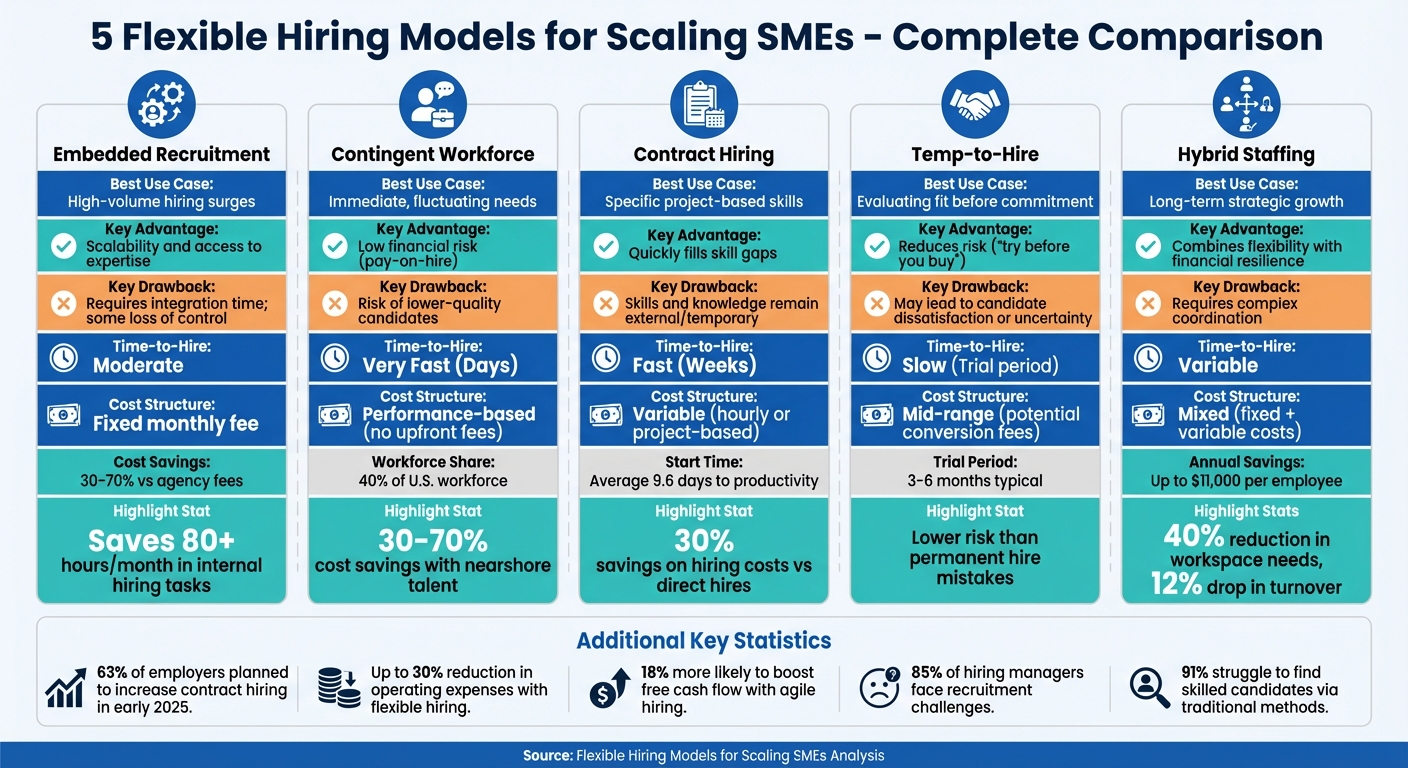
5 Flexible Hiring Models Comparison: Cost, Speed and Use Cases for SMEs
The table below provides a snapshot of how different hiring models stack up, helping you decide which option fits your needs, budget, and growth goals.
| Model | Best Use Case | Key Advantage | Key Drawback | Time-to-Hire | Cost Structure |
|---|---|---|---|---|---|
| Embedded Recruitment | High-volume hiring surges | Scalability and access to expertise | Requires integration time; some loss of control | Moderate | fixed monthly fee |
| Contingent Workforce | Immediate, fluctuating needs | Low financial risk (pay-on-hire) | Risk of lower-quality candidates | Very Fast (Days) | Performance-based (no upfront fees) |
| Contract Hiring | Specific project-based skills | Quickly fills skill gaps | Skills and knowledge remain external/temporary | Fast (Weeks) | Variable (hourly or project-based) |
| Temp-to-Hire | Evaluating fit before commitment | Reduces risk ("try before you buy") | May lead to candidate dissatisfaction or uncertainty | Slow (Trial period) | Mid-range (potential conversion fees) |
| Hybrid Staffing | Long-term strategic growth | Combines flexibility with financial resilience | Requires complex coordination | Variable | Mixed (fixed + variable costs) |
These flexible hiring options can help reduce operating expenses by up to 30% while improving cash flow stability during uncertain times. Companies with agile hiring practices are 18% more likely to boost free cash flow during economic challenges. Additionally, nearshore hiring through these models can cut costs by 30% to 70% compared to local market rates.
For sustained, high-volume growth, embedded recruitment stands out. It not only reduces costs but also saves significant time. Services like Rent a Recruiter can integrate seasoned recruiters into your team in just days, freeing up over 80 hours per month in internal hiring tasks.
"A scalable talent model allows your firm to access specialized skills when and for as long as needed." – Steve Saah, Executive Director, Robert Half
When choosing a model, weigh more than just upfront costs. Consider factors like integration time, knowledge retention, and management demands. The right choice ensures a balance of speed, quality, and long-term growth, tailored to your company’s current stage and priorities. Use this breakdown to identify the best fit for your strategy.
Conclusion
Flexible hiring models give small and medium-sized enterprises (SMEs) a way to cut costs, access specialized skills faster, and scale without unnecessary risks. The numbers speak for themselves – 84% of companies report saving money by using contingent workers, and 90% highlight flexibility as the key advantage. These approaches are no longer optional – they’re essential.
The key is to align the hiring model with your specific needs. For short-term or project-based work, contract hiring is ideal. If you’re looking to evaluate a candidate’s fit before committing, temp-to-hire works well. For high-volume hiring periods, embedded recruitment offers a scalable solution. For instance, between 2023 and 2026, MasterTech partnered with Rent a Recruiter’s embedded Talent Partner for 27 months. The result? 29 successful placements and $123,000 saved compared to traditional agency fees.
A hybrid hiring strategy can also deliver strong results. By combining different models, you can keep your core team lean while bringing in specialized talent as needed. This approach not only helps manage operating expenses but also provides cash flow stability during uncertain times.
Strategic workforce planning plays a huge role here. Ask yourself: What impact does each hire have on the business? What happens if a role remains unfilled for three months? Regularly revisiting your workforce plan keeps your business agile and ensures you’re prioritizing roles that drive revenue over non-critical expansions or additional leadership layers.
As Mark Loughnane, Head of Rent a Recruiter, puts it:
"Workforce planning for SMEs in 2026 requires adaptive, commercially aligned decision-making rather than static headcount plans".
FAQs
How do I choose the right hiring model for my current growth stage?
Choosing the right hiring approach hinges on where your company is in its growth journey, what your priorities are, and the resources you have available. For early-stage SMEs, contingent or contract hiring offers flexibility and helps manage costs, making it a smart choice when agility is key. As your business scales, hybrid or remote hiring models can help you tap into a broader talent pool while keeping expenses under control. The key is to align your hiring strategy with your long-term objectives and focus on bringing in the right skills rather than just increasing headcount. This ensures your growth remains steady and sustainable.
What compliance steps prevent contractor misclassification in the U.S.?
To avoid issues with contractor misclassification in the U.S., it’s essential to document critical factors such as control, independence, and the financial relationship between the business and the worker. Be sure to follow both IRS and state-specific standards, like the federal economic reality test and the widely used ABC test. These frameworks evaluate the nature of the working arrangement to ensure workers are classified correctly. Staying aligned with these guidelines helps protect your business from compliance risks and potential penalties.
How can I protect data and IP when using contractors or outsourced talent?
When working with contractors, protecting your data and intellectual property (IP) should be a top priority. Start with clear, detailed contracts that define confidentiality, data security measures, and IP ownership. These agreements ensure everyone understands their responsibilities from the outset.
Reinforce this protection by including non-disclosure agreements (NDAs) and non-compete clauses. These legal tools act as an extra layer of security, helping to prevent unauthorized sharing or use of sensitive information.
To further minimize risk, limit access to critical data – only provide contractors with the information they absolutely need. Make sure you’re using secure systems to manage and share data, and conduct regular security audits to identify and address vulnerabilities.
Finally, invest in training contractors on data security best practices. Educating them on how to handle sensitive information not only reduces risks but also helps safeguard your company’s competitive edge.