
Transparent hiring isn’t just good practice – it directly impacts your bottom line. Companies that prioritize openness see up to 50% fewer candidate dropouts, faster time-to-fill, and higher offer acceptance rates. For scaling businesses, this translates to cost savings, stronger employer branding, and better hiring outcomes.
Key Benefits of Transparent Hiring:
- Lower dropouts: Clear communication reduces candidate withdrawals by half.
- Stronger engagement: 80% of candidates value transparency, improving offer acceptance.
- Faster hiring: Standardized processes cut time-to-hire by 20%.
What You Need to Do:
- Communicate clearly: Share salary ranges, hiring timelines, and role expectations upfront.
- Be responsive: Provide timely updates and feedback at every stage.
- Show accountability: Explain how AI and human oversight are used in hiring decisions.
Transparent hiring isn’t just about being open – it’s about building trust that attracts top talent while saving time and money. Let’s break down how to make it work for your business.
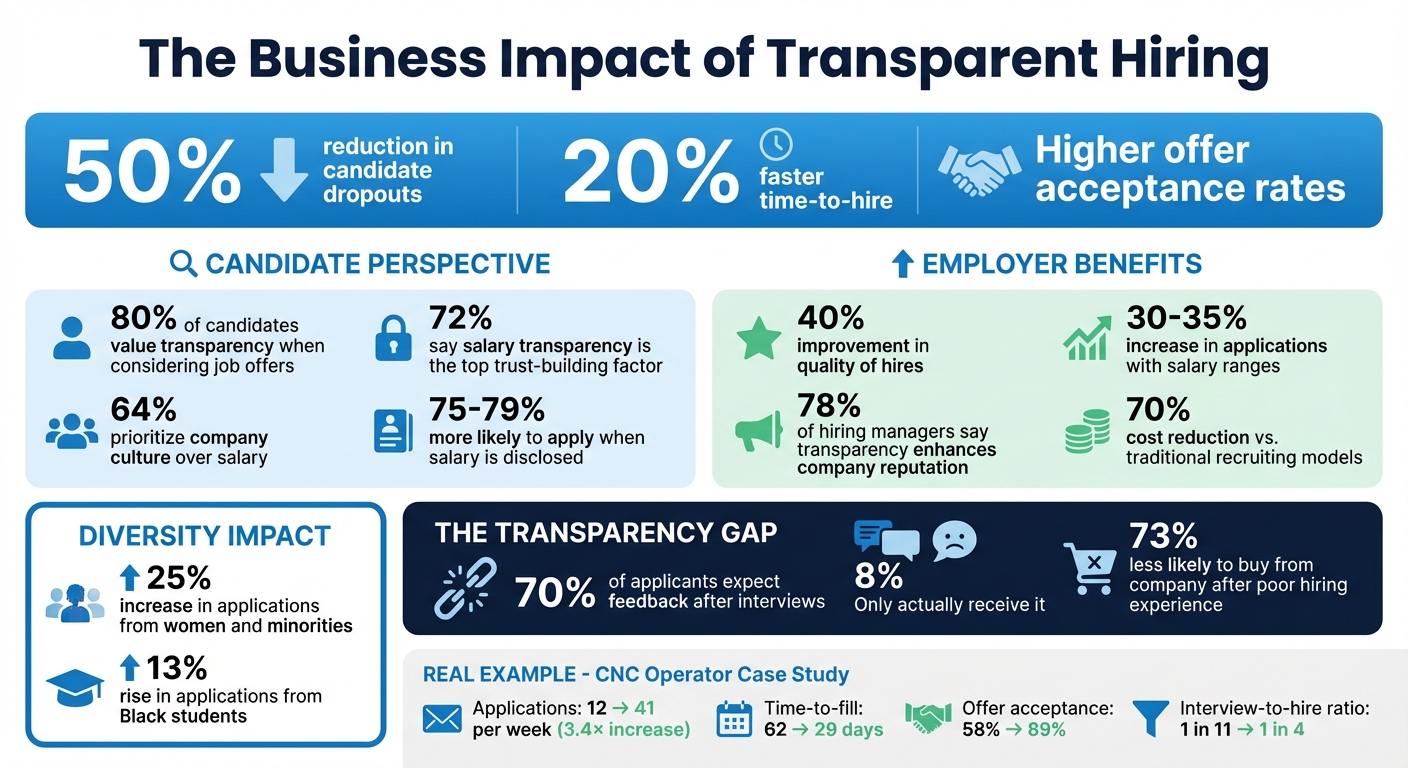
Impact of Transparent Hiring: Key Statistics and Benefits
How to Communicate Your Hiring Process Clearly
Map Out the Recruitment Journey
Start by defining every step of your hiring process – from identifying requirements and sourcing candidates to screening, interviewing, and onboarding [6]. A consistent approach minimizes bias and ensures a level playing field for all applicants [6][3]. Clearly explain the purpose of each stage and how it relates to the role [7]. When candidates understand why they’re completing a skills test or attending a panel interview, they’re more likely to stay engaged.
"GitLab maintains a public handbook that details its entire hiring process, simplifying the application journey and ensuring candidates are aligned with company values before the first interview." [3]
Transparency like this sets expectations early. Before sharing your process, review internal practices to identify and fix bottlenecks, and ensure each stage serves a clear purpose [6]. Then, create a Candidate FAQ that addresses common questions about interview stages, timelines, and evaluation criteria. Share this information upfront – ideally before candidates even apply [6][7]. Companies with standardized hiring processes see a 20% reduction in time-to-hire and a 15% increase in offer acceptance rates [3]. Once your process is mapped out, keeping candidates informed becomes crucial.
Keep Candidates Informed Throughout
Regular communication keeps candidates engaged and prevents them from feeling ignored [6]. Set clear timelines for when they’ll hear back after each stage, and stick to those deadlines [6][3]. Kinetik, for instance, used a data-driven approach to reduce time-to-hire by 20%, improve offer acceptance by 15%, and cut dropout rates by 40% [3].
"Frequent and honest communication about timelines, expectations, and decisions can make or break your candidate experience." – Talroo [6]
Despite 70% of applicants expecting feedback after an interview, only 8% actually receive it [3]. This disconnect harms your employer brand – 73% of job seekers report they’re less likely to buy from a company after a poor hiring experience [3]. To avoid this, use recruitment platforms to automate updates, ensuring no candidate is left in the dark [3]. However, avoid generic automated responses. Personalizing your messages shows respect for the time and effort candidates invest [3].
Give Realistic Previews of the Role and Culture
After outlining your process and keeping candidates updated, offer a genuine glimpse into the role and work environment. Be specific about what the candidate’s first day will look like to set clear expectations and reduce early turnover [7]. Share how the role fits into your company’s broader goals and mission [3]. For example, DHL Aviation highlights internal promotion statistics to paint a realistic picture of growth opportunities during the hiring process [3].
Make sure to clearly state working hours, location, and remote work policies [7]. Avoid vague phrases like "remote-friendly", which can create confusion. With 64% of job seekers prioritizing company culture over salary [3], providing an authentic look at your workplace can be the deciding factor for attracting top talent.
sbb-itb-a23bd6a
Revolutionize Your Hiring: Transparent & Engaging Recruitment Strategies to Attract Top Talent
Being Open About Compensation and Benefits
Clear communication about pay and perks does more than just inform – it builds trust and confidence with candidates.
Add Salary Ranges to Job Postings
Including salary ranges in job ads is one of the simplest ways to win candidate trust. Without this transparency, candidates may worry about being undervalued or receiving lowball offers [8]. In fact, 72% of employees say salary transparency is the top factor in building trust with potential employers [8]. Job postings with salary ranges see a 30%–35% increase in applications, and 75%–79% of job seekers are more likely to apply when pay is disclosed [8][9].
Take this example: A Tier 2 automotive manufacturer in Ohio listed a pay range of $26–$32 per hour for CNC Operator roles in late 2025. The results? Weekly applicants jumped from 12 to 41 – a 3.4× increase. Time-to-fill dropped from 62 days to 29, the offer acceptance rate climbed from 58% to 89%, and the interview-to-hire ratio improved significantly from 1 in 11 to 1 in 4 [9].
To maximize the impact, place salary ranges prominently at the top of your job description. Be clear about what determines where a candidate falls within the range, such as certifications, experience, or shift differentials [9].
"Transparency doesn’t mean everyone gets the max – it means everyone understands the rules."
- TalentTraction [9]
Before posting salary ranges, conduct an internal pay equity review. This ensures fairness for current employees and prevents morale issues. Use reliable market data from government or private sources to make sure your numbers are competitive and realistic [9][11]. And don’t stop at base pay – listing additional benefits can further reinforce trust.
Address Pay Expectations Early in Conversations
Talking about compensation early saves time and avoids surprises. Including salary details in job descriptions reduces ghosting rates by 22% and halves the number of declined offers due to pay mismatches [9]. Train hiring managers to have clear, objective discussions about how a candidate’s skills align with specific pay levels to keep the process efficient [11].
This transparency also helps candidates self-select based on their expectations, narrowing the pool to serious applicants [8][9]. Salary disclosure has been shown to increase applications from women and minority candidates by 25%, and organizations see a 13% rise in applications from Black students when pay information is included [9][10]. By leveling the playing field, you not only attract more diverse talent but also demonstrate a commitment to fairness.
Describe Benefits and Perks in Detail
Go beyond salary – highlight benefits like healthcare, retirement plans, remote work options, and professional development opportunities. This shows candidates that you care about their well-being and growth [8][12]. Research reveals that 68% of workers in industrial sectors distrust employers who fail to provide clear pay and benefit details upfront [9].
In some regions, disclosing healthcare benefits before the first interview is now mandatory, making this transparency even more critical [12]. Use this section to emphasize your company’s people-first mindset. For example, connect benefits to long-term growth opportunities, such as leadership tracks, apprenticeship programs, or company-funded training [9][10].
"Companies that embrace pay transparency treat ‘everyone like an adult and [establish] a culture of openness’ that top talent looks for."
- Michelle Cheng, Talent Director, Notion Capital [10]
Using Technology and AI in Hiring Transparently
To build trust with candidates, it’s essential to be upfront about how you use AI in hiring. While 46% of job seekers report declining trust due to increased AI usage, nearly 75% now use AI tools themselves during their job search. This creates a tricky situation: candidates rely on AI but worry about being judged unfairly by it [14]. The solution? Don’t shy away from AI – explain how it fits into your process. Here’s how to outline AI’s role at every stage of recruitment.
Explain When and How You Use AI
Transparency starts with clear communication. Use your careers page and job descriptions to outline where AI comes into play – whether that’s organizing applications, scheduling interviews, or screening résumés – and specify what data is collected [1][15]. For example, you could include a simple note in your job postings: "We use AI to streamline processes, but all final decisions are made by people. Learn more [Link]" [1].
Here’s an example: during a virtual hiring event for 300 internal sales roles, an AI-powered system evaluated 1,500 candidates in just 24 hours. After a live session attended by 6,800 people, successful applicants advanced to direct meetings with hiring managers. This approach delivered both speed and transparency – candidates understood exactly how AI contributed to the process [13].
Show How Humans Stay Involved in Decisions
AI is a tool, not the decision-maker. Make it clear that human oversight is central to your hiring process. Reinforce that every critical decision is made by a person, not an algorithm [1][14].
"Sharing exactly how AI will be used, and when a human intervenes, changes the whole dynamic. Instead of feeling judged by a system, candidates feel included."
- Generi Wilson, Talent Acquisition Program Manager at Greenhouse [14].
Offer candidates the opportunity to challenge automated decisions by connecting with a recruiter [1][15]. Provide manual alternatives for AI-driven assessments or asynchronous interviews so candidates don’t feel locked into automated systems [1]. Even with tools like chatbots or automated emails, ensure candidates have an easy way to reach a real person, and keep communication personalized [15].
Prevent Bias and Communicate Your Safeguards
Bias in AI can undermine trust, so regular audits are key. Review AI outcomes across demographics to ensure fairness and share these safeguards with candidates [13][15]. Being upfront about your efforts to address bias strengthens the trust built through earlier transparency.
"Our applications clearly outline our AI policy and how we review it over time. That helps candidates understand what’s allowed, what’s evolving, and how we protect against bias."
- Sam Stoker, Talent Acquisition Manager at Greenhouse [14].
Explain the criteria AI uses to evaluate applications. Move away from opaque “black box” systems by detailing what factors – like skills, certifications, or experience – impact candidate scoring [1][15].
"Employers who use AI responsibly in the hiring process, with clear intent and strong human oversight, will be better positioned to compete for talent while maintaining trust."
How to Handle Rejections and Feedback
Rejecting candidates isn’t just about delivering bad news – it’s an opportunity to leave a lasting, positive impression. Yet, only 8% of candidates receive timely feedback, leaving most feeling ignored and frustrated [3]. This disconnect can damage trust, especially when candidates have invested significant time preparing for interviews. Even more concerning, 73% of job seekers say a poor hiring experience makes them less likely to engage with a company’s products or services in the future [3]. By creating a transparent and respectful rejection process, you can turn a potential negative into a powerful advantage.
Offer Useful Feedback to Candidates
Clear communication is just the start – providing tailored feedback takes transparency to the next level. Generic rejection emails fall short. Instead, offer specific, actionable insights. For instance, rather than saying, “We’ve chosen to move forward with other candidates,” explain: “Your application didn’t demonstrate the required experience in Salesforce administration, which is essential for this role” [1][3]. This kind of feedback respects the candidate’s effort and gives them something tangible to improve on.
One recruitment firm adopted a 48-hour feedback policy for rejected candidates after interviews. By delivering timely, scorecard-based feedback linked to the rejection reasons, they reduced drop-offs between second and final-stage interviews from 28% to 14% [5]. Their approach? Highlight one specific strength observed during the interview and one area for improvement. This balanced feedback shows candidates their application was thoughtfully reviewed, not dismissed without consideration [5].
Communicate Rejections Respectfully
Avoid leaving candidates in the dark. Set clear timelines for feedback so they know when to expect an update. This prevents the “black hole” experience that 70% of job seekers find frustrating [2]. For candidates who’ve made it through multiple interview rounds, consider offering a brief phone call to explain the decision. It shows respect for their effort and keeps the door open for future engagement [16].
"When rejection is handled well, candidates often remain advocates. When it’s rushed or vague, trust evaporates instantly."
- Greenhouse [16]
Personalize rejection emails by referencing specific details from the candidate’s application or interview. Avoid using overly automated or generic templates. If AI tools were involved in the screening process, be transparent about it and offer an option for follow-up: “If you believe relevant experience was overlooked, reply to request a review” [1]. This two-way communication builds trust and shows a commitment to fairness.
Keep Candidates as Future Advocates
Respectful rejections don’t just preserve your brand – they create opportunities. With over 33% of candidates receiving little to no feedback [3], simply providing clear and constructive responses can set you apart. Go a step further by sharing professional development resources or training links that address the areas for improvement you identified. This approach not only softens the rejection but also shows that you value their potential growth [3].
"Compassionate rejection isn’t just kind – it’s smart hiring."
Rejected candidates often share their experiences – on platforms like Glassdoor, with friends, or in online communities. Companies that prioritize transparency have seen a 50% drop in candidate withdrawal rates [3]. Treating every candidate with respect, regardless of the outcome, strengthens your reputation and turns even unsuccessful applicants into advocates for your brand. A thoughtful rejection process is more than just a courtesy – it’s a strategy that pays dividends in talent attraction and long-term trust.
Building a Transparent Hiring Process with Rent a Recruiter
Main Lessons from Transparent Hiring
Transparency isn’t just a buzzword – it’s a game-changer with real business impact. It reduces candidate dropouts by 50% and improves the quality of hires by 40% [3]. With 80% of candidates prioritizing transparency when considering job offers and 78% of hiring managers agreeing it enhances their company’s reputation, it’s clear that openness matters [3].
Clear job descriptions, upfront salary details, and timely feedback aren’t just nice touches – they’re essential. These steps reduce workloads, align expectations, and improve employee retention [4][5][17]. When paired with a recruitment partner, these practices can drive even greater hiring improvements.
How Rent a Recruiter Helps You Hire Transparently
Rent a Recruiter takes transparency seriously, embedding experienced recruiters into your team to build trust from day one. They start by auditing your hiring funnel to identify bottlenecks and inconsistencies [6]. From there, they create clear, skill-focused job descriptions, set three realistic KPIs for success, and establish service level agreements to ensure efficiency – like reviewing resumes within 24 hours and delivering interview feedback within 48 hours [4][5][6].
Their approach doesn’t stop at process improvements. Rent a Recruiter trains hiring managers to use structured interview guides and recognize unconscious bias, ensuring fairness throughout [6][18]. They also promote salary transparency early in the process, using market and regional data to set fair compensation and build immediate trust [4][17]. By clearly communicating timelines, interviewer details, and assessment methods, they turn what could feel like a transactional process into a meaningful conversation about the role and company challenges [4][18]. The result? A hiring process that’s efficient, trustworthy, and candidate-focused.
Next Steps: Improve Your Recruitment Process
Partnering with Rent a Recruiter can cut hiring costs by up to 70% compared to traditional commission-based models, while saving over 80 hours a month in hiring and administrative work. Whether you’re scaling after funding, launching a new product, or handling a hiring surge, embedded recruiters provide the flexibility and expertise you need – without delays.
Take the first step with a free Recruitment Health Check at https://rentarecruiter.com. You’ll get personalized insights into your hiring practices, employer branding, and diversity efforts. Turn transparency into a measurable advantage that attracts top talent and strengthens your brand.
FAQs
What should I share upfront in a job post to build trust?
Providing clear information about the role, the hiring process, and your company’s values is key to building trust. When candidates know what to expect, they feel more confident and connected to your mission. This transparency not only sets the right expectations but also creates a smoother, more positive candidate experience.
How can small teams stay responsive without slowing hiring down?
Small teams can keep their hiring process fast and efficient by focusing on clear communication and data-driven decisions. Sharing regular updates, outlining each stage of the hiring process, and maintaining open lines of communication can minimize confusion and build trust within the team and with candidates.
Adding a personal touch goes a long way too. Quick responses and tailored updates show candidates they’re valued, which enhances their experience. These approaches allow small teams to stay nimble and reliable without sacrificing the quality of their hires.
How do I explain AI use in hiring without scaring candidates?
When discussing AI in hiring, it’s important to focus on clarity, fairness, and the human touch. Candidates need to understand that AI is a tool to assist, not replace, human decision-making.
Explain how AI helps streamline tasks, maintain consistency, and minimize bias in the hiring process. Make it clear that final decisions always involve human judgment.
To reassure candidates, be transparent about how AI is used. Share details about the criteria it evaluates and provide options for candidates to opt out of AI-based assessments if they prefer. Above all, emphasize that recruiters remain engaged throughout, ensuring the process stays personal and thoughtful.