
Hiring the right talent is harder than ever, especially in fintech and SaaS. Your employer brand can make or break your ability to attract top candidates – and save millions in hiring costs.
Here’s the issue: fintech needs niche talent skilled in compliance, finance, and security, while SaaS struggles with employer branding challenges in a crowded market. Without tailored branding, you risk higher costs, slower hiring, and missed growth targets.
Key Takeaways:
- Fintech: Focus on trust, regulatory expertise, and stability. Highlight leadership clarity and risk management.
- SaaS: Avoid generic messaging. Use transparency and evidence-based storytelling to stand out.
- Strong employer branding can cut hiring costs by up to 50% in fintech and 34% in SaaS.
Both industries need different strategies, but the goal is the same: attract the right talent faster and for less. Whether you’re hiring for fintech’s complex roles or SaaS’s product-driven teams, your employer brand must align with your business goals. Let’s break down how to get it right.
How Employer Branding is Revolutionizing Recruitment with James Ellis
sbb-itb-a23bd6a
Core Elements of Employer Branding in Tech
Employer branding in fintech and SaaS revolves around three core areas: mission alignment, storytelling, and positioning. While both industries compete fiercely for top engineering talent, their approaches to these elements are shaped by their unique challenges. Fintech brands must address concerns like "Can this company navigate regulation successfully?" Meanwhile, SaaS brands focus on proving, "How quickly can we scale and deliver?" [6][4]
Mission and Values Alignment
Fintech companies anchor their mission in trust-driven narratives, with a strong focus on regulatory compliance and financial inclusion [5][6]. Candidates in this space often care more about clear leadership, especially regarding risk management and long-term stability, than about bold innovation claims [2]. Highlighting regulatory compliance not only signals stability but also serves as a competitive advantage in the market [4][2].
On the other hand, SaaS firms prioritize speed and technical mastery [4]. Their messaging often falls into two categories: "Product & Craft Obsessors" or "Hyper-Growth Rockets" [1]. Companies like GitLab exemplify this with their radical transparency, such as publishing public handbooks. This approach not only attracts talent aligned with their values but also differentiates them from competitors. For instance, in September 2025, GitLab’s transparency model reduced the use of clichés in their branding and increased job applications by 12–35% without additional advertising spend [1].
By clearly defining their missions, both fintech and SaaS companies lay the groundwork for compelling storytelling that resonates with their target audiences.
Brand Storytelling and Differentiation
In fintech, storytelling emphasizes stability over disruption. Candidates want assurance that leadership can navigate regulatory challenges effectively [6][2]. The focus is on solving real-world problems like fraud prevention, secure payment systems, and compliance, steering clear of overused innovation buzzwords [5]. For example, Revolut’s 2025 announcement of a 40% workforce expansion highlighted growth in payments and open banking, steering away from vague claims of "disruption" [2].
SaaS storytelling faces what’s often called the "sameness tax" – the challenge of standing out in a crowded market. Success comes from replacing generic slogans with specific, evidence-backed messaging. Take Notion, for instance, which has distinguished itself with an "intellectually charged mission" rather than relying on typical hyper-growth clichés [1]. Companies that avoid generic language can reduce cost-per-hire by as much as 34% [1].
Positioning for Talent Attraction
Once missions and narratives are aligned, the final piece of the puzzle is positioning – how companies present themselves to attract the right candidates.
In fintech, positioning often involves offering competitive pay alongside specialised training. Nearly 75% of fintech companies report difficulty finding candidates who combine financial, compliance, and technical expertise [3]. A strong employer brand can help cut hiring costs by 50% and improve retention rates by 28% [3]. Additionally, offering remote or hybrid roles has proven to double applicant interest compared to roles restricted to specific locations [2].
SaaS companies, however, lean heavily on differentiation and cultural transparency. The best SaaS brands use what’s known as a "Choosability Engine" – a messaging strategy designed to attract the right talent while discouraging those who might not be a cultural fit. This approach transforms employer branding into a precise tool that not only speeds up hiring but also safeguards company culture.
These distinct approaches to positioning highlight how fintech and SaaS companies tailor their strategies to secure the talent they need, showcasing the contrasts in their employer branding priorities.
Employer Branding Strategies: Fintech vs. SaaS
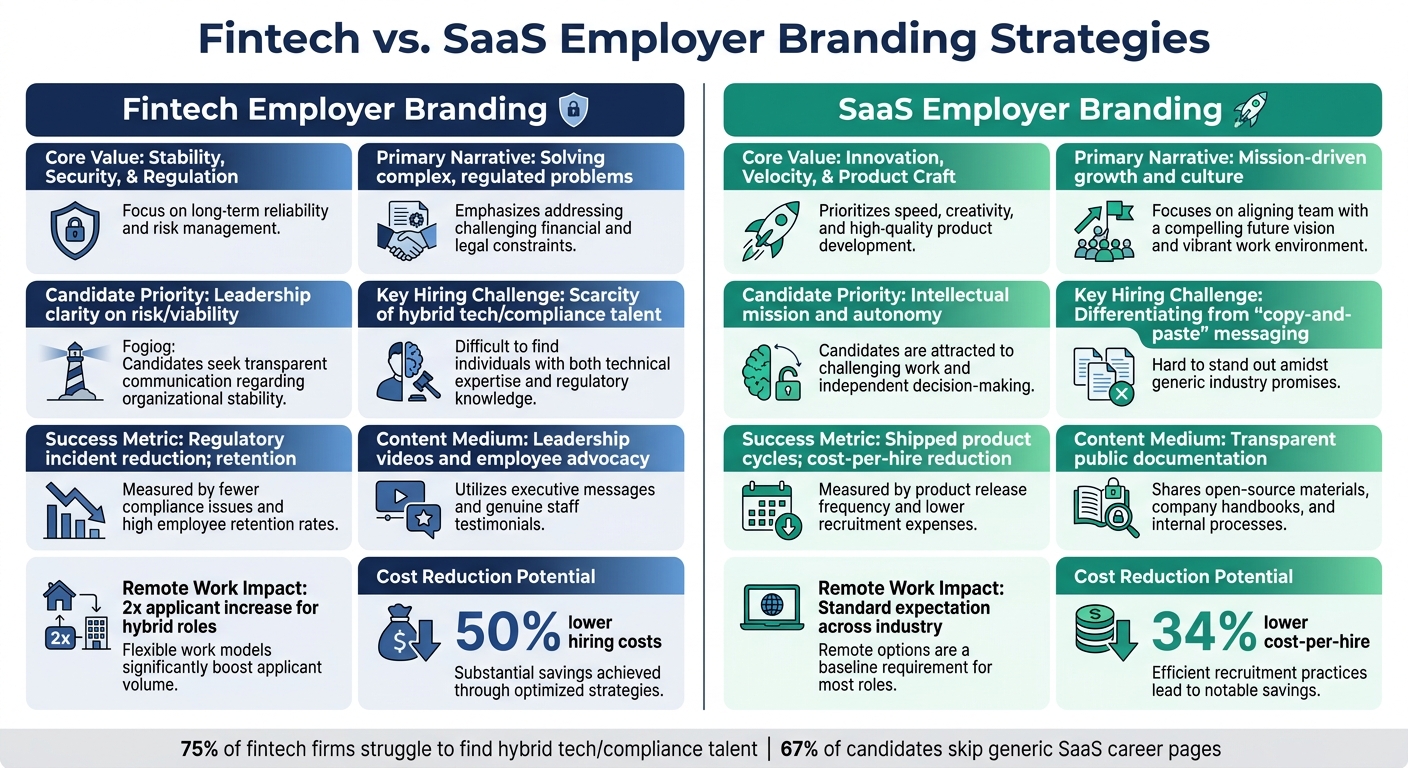
Fintech vs SaaS Employer Branding Strategies Comparison
When it comes to employer branding, fintech and SaaS companies take distinct approaches, shaped by their industries’ demands and challenges. By focusing on mission alignment, storytelling, and clear positioning, these strategies help each sector stand out in the competitive hiring market.
Fintech Employer Branding Tactics
For fintech firms, credibility and compliance are at the heart of their employer branding. With startups often dedicating 12–18 months to compliance before launching [4], it’s no surprise that candidates value leadership’s ability to handle risk responsibly. This focus on regulatory expertise is a critical draw for talent.
Video storytelling has emerged as a key tool for fintech recruitment in 2026. Through video job descriptions and leadership testimonials, companies bring a human touch to the often-intimidating world of finance [3]. This approach is especially important as 75% of fintech firms face challenges in finding candidates with a mix of technical, financial, and compliance skills [3]. Strong employer branding not only addresses this gap but can also cut hiring costs by 50% and improve retention by 28% through flexible recruitment on demand [3].
Fintech messaging often highlights long-term career stability and specialised growth opportunities. Training in areas like blockchain, real-time payments, and regulatory frameworks is a key selling point, appealing to professionals looking to deepen their expertise. SaaS firms, on the other hand, face a different branding challenge: avoiding generic messaging.
SaaS Employer Branding Tactics
SaaS companies frequently grapple with what experts call the "Sameness Tax" – the cost of blending into a sea of identical messaging. This lack of differentiation can lead candidates to overlook career pages entirely [1]. For a mid-sized SaaS firm hiring 100 employees annually, this could translate to $1.2 million in wasted resources and slower hiring timelines [1].
The most successful SaaS brands counter this with evidence-based storytelling. Take GitLab, for instance: they embrace radical transparency by publishing detailed public handbooks covering everything from pay structures to decision-making processes. This not only attracts talent but also filters for candidates aligned with their values. Differentiated messaging like this can reduce cost-per-hire by up to 34% while increasing applications by 12–35%, all without additional advertising spend [1].
SaaS companies often organise their branding into four distinct tracks: Mission-Driven Innovators, Product & Craft Obsessors, People-First Cultures, or Hyper-Growth Rockets [1]. The key is to pick one track and back it with evidence, avoiding overused phrases like "disrupting industries" or "fast-paced environments."
Comparison Table: Fintech vs. SaaS Strategies
Below is a snapshot of how fintech and SaaS employer branding strategies differ:
| Feature | Fintech Employer Branding | SaaS Employer Branding |
|---|---|---|
| Core Value | Stability, Security, & Regulation | Innovation, Velocity, & Product Craft |
| Primary Narrative | Solving complex, regulated problems | Mission-driven growth and culture |
| Candidate Priority | Leadership clarity on risk/viability | Intellectual mission and autonomy |
| Key Hiring Challenge | Scarcity of hybrid tech/compliance talent | Differentiating from "copy-and-paste" messaging |
| Success Metric | Regulatory incident reduction; retention | Shipped product cycles; cost-per-hire reduction |
| Content Medium | Leadership videos and employee advocacy | Transparent public documentation |
| Remote Work Impact | 2x applicant increase for hybrid roles [2] | Standard expectation across industry |
| Cost Reduction Potential | 50% lower hiring costs [3] | 34% lower cost-per-hire [1] |
Best Practices for Scalable Employer Branding
Creating a strong employer brand doesn’t require a massive budget – it requires focus, measurable goals, and a structured approach. Whether you’re in SaaS or fintech, the companies that stand out are those that follow a few proven practices to attract top talent without wasting resources on generic messaging. These strategies ensure that every aspect of your employer branding delivers real, measurable results.
Conduct Employer Branding Audits
Regular audits help you understand whether your brand stands out or just blends into the noise. For SaaS companies, this includes performing what’s often called a "Cliché Audit" – reviewing how often terms like "disruptive", "fast-paced", or "collaborative culture" appear in your messaging. High-performing brands such as GitLab and Notion limit these clichés to fewer than four mentions per 1,000 words, which has been linked to increased application rates [1]. This process aligns with the need for consistent storytelling and a clear mission. As James Ellis from Employer Brand Labs explains:
"If your competitor could say it too, it’s not differentiation" [1].
For fintech firms, audits should focus on credibility and regulatory alignment. This means assessing how effectively your messaging communicates leadership’s approach to risk management and compliance. With 75% of fintech companies struggling to find specialized talent [3], your brand must establish credibility from the first interaction. Key areas to evaluate include how you present salaries, benefits, and your handling of compliance processes like KYC and regulatory frameworks.
Use Embedded Recruitment Solutions
Embedded recruitment brings authenticity to your employer branding because they work directly within your team. They understand your culture and can effectively communicate your Employee Value Proposition (EVP). This approach helps avoid the generic messaging that leads 67% of candidates to skip over career pages entirely [1].
Partnering with Rent a Recruiter gives you access to recruiters who integrate into your team within days, managing the hiring process from start to finish. This model reduces hiring costs by up to 70% compared to traditional commission-based recruitment. For high-growth SaaS and fintech companies, embedded recruitment ensures consistent messaging even during rapid scaling – whether you’re expanding after a funding round or preparing for a product launch. On top of cost savings, companies reclaim over 80 hours per month previously spent on hiring admin, allowing leadership to focus on strategic priorities.
Link Branding to Business Metrics
Your employer brand should directly impact business outcomes, not just serve as a marketing exercise. For SaaS companies, failing to differentiate your brand can cost a 500-employee business hiring 100 new staff around $1.2 million annually in hidden expenses [1]. A strong, distinct brand can reduce cost-per-hire by up to 34%, increase applications by 12–35%, and, in fintech, lower hiring costs by 50% while boosting retention by 28% [1][3].
Fintech firms should also track metrics that reflect industry-specific challenges. Key indicators include offer acceptance rates (aim for 85% or higher), the percentage of hires from organic applications (target 40% or more), and first-year retention rates [7]. For example, when Accelleron partnered with Universum to create a data-driven EVP in late 2024, they doubled global job applications and saw a significant rise in employee advocacy [8]. These results highlight how aligning employer branding with business metrics can deliver measurable success.
Conclusion and Next Steps
Key Differences Between Fintech and SaaS Branding
Fintech and SaaS companies face distinct challenges in recruitment when it comes to employer branding, shaped by the unique demands of their industries. Fintech firms focus heavily on trust, compliance, and stability in their messaging. These qualities are crucial for attracting candidates with expertise in areas like blockchain or real-time payment systems – skills that 75% of fintech firms report struggling to secure [3]. Highlighting regulatory credibility and technical accuracy in branding becomes a non-negotiable for success.
SaaS companies, on the other hand, must navigate what’s often referred to as the "sameness tax." Overused phrases like "hyper-growth" or "people-first culture" fail to stand out. Instead, standout SaaS brands lean into transparency and originality – examples like GitLab’s public handbook or Notion’s thoughtful mission statements demonstrate how authenticity resonates with top talent. These contrasting approaches reflect the specific hurdles and opportunities each sector faces.
Optimize Your Recruitment Strategy
To translate strong employer branding into hiring success, companies need recruitment strategies tailored to their sector. Whether it’s fintech’s focus on regulatory expertise or SaaS’s need for differentiation, having the right recruitment partner is crucial. For instance, a SaaS company failing to differentiate its brand could lose around $1.2 million annually in wasted recruitment spend [1], while fintech firms risk falling behind without access to niche talent.
Rent a Recruiter offers a solution that addresses these challenges head-on. By embedding experienced recruiters into your team within days, this service provides the consistency and structure needed to manage hiring from start to finish. With this model, companies can cut hiring costs by up to 70% and reclaim over 80 hours each month. Whether your focus is fintech’s regulatory precision or SaaS’s emphasis on innovation, embedded recruitment ensures your employer brand stays aligned with your mission while delivering measurable hiring outcomes.
FAQs
What should a fintech employer brand emphasize to build candidate trust?
A fintech employer brand should prioritize building a strong company culture that values innovation, supports employees’ professional development, and clearly outlines its vision for reshaping the financial industry. By showcasing these aspects, you can build trust and appeal to top-tier talent.
How can a SaaS company avoid “copy-and-paste” employer branding?
Crafting a genuine employer brand is essential for SaaS companies looking to stand out. Relying on generic slogans or cookie-cutter messaging often leads to higher costs and lower engagement. Instead, focus on building a narrative that reflects your company’s culture, mission, and values.
The "4 P’s of employer branding" framework – People, Purpose, Place, and Product – is a powerful way to achieve this. Highlight your team’s unique qualities, the meaningful impact of your mission, the environment you provide, and the quality of your product. By weaving these elements into your storytelling, you’ll create a brand that feels authentic and connects with candidates on a deeper level.
Which metrics best prove employer branding is improving hiring results?
Metrics like cost-per-hire, time-to-fill, and quality of hires are key indicators that your employer branding efforts are paying off. A strong brand can cut hiring expenses, draw in better-qualified candidates, and improve retention rates. For SaaS companies, sharpening your messaging to differentiate from competitors can accelerate hiring and build confidence among stakeholders. Monitoring these metrics demonstrates how effective employer branding drives talent attraction, retention, and overall hiring efficiency.