Campus hiring is one of the most cost-efficient ways to build a talent pipeline for scaling companies. It reduces hiring costs, increases retention rates, and ensures a steady flow of early-career talent who can grow into future leadership roles. However, without a structured approach, you risk wasted resources and missed opportunities.
Here’s what you need to know:
- Plan strategically: Identify roles, skills, and target universities that align with your business needs.
- Move fast: Simplify your processes to ensure offers are finalized within three weeks.
- Build relationships: Partner with universities, career services, and alumni networks to access top candidates.
- Focus on skills: Use structured interviews and practical assessments to evaluate candidates beyond academic credentials.
- Measure success: Track metrics like retention, conversion rates, and cost per hire to refine your approach.
For companies without the capacity to manage this internally, embedded recruitment offers a scalable solution. Providers like Rent a Recruiter embed experienced recruiters into your team, cutting costs by up to 70% and saving over 80 hours of admin time monthly.
The result? Faster hiring, better outcomes, and a recruitment process you control.
Hiring for Potential: A Campus Recruitment Strategy
sbb-itb-a23bd6a
Planning Your Campus Hiring Strategy
Building a strong campus hiring strategy is essential for creating a talent pipeline that supports the growth of SMEs. Without a clear plan, you risk wasting resources on candidates who don’t fit your needs. The key to success lies in knowing exactly what you’re looking for and where to find it.
Identifying the Roles and Skills You Need
Start by conducting a gap analysis to identify both current and future skill shortages. This helps you move beyond filling immediate vacancies and focus on long-term growth [5]. As CPS HR Consulting puts it:
"The foundation of any successful recruitment process begins with understanding the role. This includes creating clear job descriptions and identifying essential skills and qualifications so that there is a strong alignment between candidates and company needs." [5]
Group your hiring needs into role families like technical, operations, or sales to establish clear success metrics for each category [1]. Focus on core competencies that predict early-career success – qualities like learning agility, teamwork, ownership, and customer focus [1]. These observable behaviors often outweigh traditional qualifications.
Next, determine which academic programs align with your needs. Are you looking for graduates with BAs, MBAs, JDs, or those from technical institutes? [1][4] Adopt a skills-based hiring approach by prioritizing what candidates can do over where they studied [1][5]. Using a structured interview early in the application process can help evaluate skills rather than credentials [1]. Laura Belfield, Head of Marketing at Sapia.ai, highlights this approach:
"Interview-first focuses on capabilities, not credentials. As such, it gives every applicant a fair, structured start in the campus recruitment process." [1]
Once you’ve defined your roles and skills, it’s time to identify the universities that align with your hiring needs.
Choosing the Right Universities
Not all universities will deliver the same results. Select schools based on programs that match your hiring goals, rather than relying solely on reputation [3]. Use a tiered approach to categorise institutions into "Core" (in-person focus), "Opportunistic" (niche events), and "Virtual-only" (digital engagement) [1].
Consider factors like geographic proximity and alumni networks. Schools near your offices often produce candidates more likely to accept offers and stick around [1]. Target universities with diverse student populations to enhance representation in your talent pool [1]. Don’t overlook vocational colleges and technical institutes – they often produce skilled candidates who are underutilised by larger companies [1].
Building relationships with career services offices can provide valuable insights into student demographics and help promote your roles [3]. Timing is also critical – align your efforts with academic calendars to avoid missing key graduation or internship periods [3]. Recent graduates can also serve as brand ambassadors, offering authentic perspectives to potential candidates [1].
Setting Goals and Tracking Metrics
Before launching your campus hiring efforts, establish clear, measurable goals that tie directly to business outcomes. Whether you aim to speed up hiring, cut costs, or increase candidate volume, tracking the right metrics is essential [6]. For campus hiring, focus on metrics like campus conversion rates (hires per campus) and career fair-to-interview conversion rates [6][1].
Speed matters. Track time-to-first-interview in hours. At career fairs, use QR codes that let candidates start interviews immediately – this captures high-intent applicants on the spot [1]. Set realistic targets for metrics like intern-to-hire conversion rates, offer acceptance rates, and first-year retention. These figures help measure whether your recruits are becoming productive team members [1][6][7].
Monitor diversity throughout your applicant pool and ensure your process avoids adverse impact. Protected groups should have a selection rate of at least 80% compared to non-protected groups [7]. Admiral Grace Hopper’s quote sums it up perfectly:
"One accurate measurement is worth a thousand expert opinions." [6]
A well-executed campus hiring strategy can be completed in as little as 90 days [1]. High-volume campaigns, like those in retail or logistics, often operate on six-week timelines [1]. Keep presentations short – around 12 minutes – to respect students’ time while delivering impactful messaging [1]. For Gen Z, package your content into 15-45 second video clips for quick and effective engagement [1].
With clear goals and an efficient process, you’ll be ready to engage campuses effectively and secure top talent.
Building University Partnerships
Partnering with universities can provide SMEs with a steady talent pipeline, but it requires a long-term perspective. Career services offices are gatekeepers to student engagement – they manage access to student databases, career fair booths, and promotional communications [8]. Establishing trust with these offices is essential, as it lays the groundwork for more meaningful collaboration.
A tiered approach can help you focus your efforts effectively. In fact, the average number of target schools has decreased from 39 in 2020 to 25 in 2024, with 63% of recruiting teams now using a tiered strategy [8]. Concentrate your resources on 5–8 Tier 1 schools, where you can make a significant impact by visiting twice a year, building faculty relationships, and sponsoring capstone projects. For Tier 2 schools (8–12 institutions), moderate engagement – such as attending career fairs and hosting virtual events – can suffice. Meanwhile, Tier 3 schools can be managed through digital outreach [8].
Working with Career Services Offices
Career services play a pivotal role in determining which employers gain priority access to students. To stand out, offer value in return. Participate in activities like mock interviews, resume workshops, or sharing hiring outcomes to show you’re invested in the partnership [8]. Assign a dedicated contact for each university to streamline communication and handle any challenges that arise [10].
Start your outreach early – 6–8 weeks before campus events – using "save-the-date" emails and hosting virtual Q&A sessions to build anticipation [1]. After meeting students, follow up within 24 hours with personalized emails that reference specific conversations. This simple step can make a lasting impression [8]. Robin Erikson, former Vice President of Talent Acquisition Research at Bersin by Deloitte, captures it well:
"An effective campus recruiting program also requires a strong relationship with the colleges and universities involved." [2]
Campus recruiting budgets typically average $114,000 annually, with a cost-per-hire of $6,275 [8]. By nurturing these relationships, you can unlock deeper opportunities through student programs and alumni networks.
Supporting Student Programs and Activities
To go beyond career services, immerse yourself in the university’s academic and extracurricular ecosystem. Sponsoring capstone projects allows you to assess talent over a semester while gaining actionable insights for your business [8]. Partnering with student clubs or societies can also enhance your visibility among specific talent pools [1].
Building relationships with faculty and department heads is another effective strategy. They often know which students are the best fit for particular roles and can provide direct referrals that bypass talent acquisition services [9]. Delivering guest lectures or joining advisory boards can further establish your credibility [8].
Kathryn Starke, Founder and CEO of Creative Minds Publications, highlights the value of these connections:
"Small businesses that are able to establish partnerships with a university in their area should take advantage of the opportunity… you get to connect with creative, bright, and innovative talent." [10]
Internships are another powerful tool. Offering programs that fulfill academic credit requirements can attract top talent while giving students valuable hands-on experience. The national intern-to-hire conversion rate is 51%, with in-person interns receiving full-time offers at a rate of 72%, compared to 56.2% for hybrid interns [8]. Instead of traditional info sessions, consider hosting interactive events like skills challenges or panels featuring recent hires – these formats resonate more with students [8].
Connecting with Alumni Networks
Your recent hires can become some of your strongest recruiting ambassadors. Alumni voices resonate deeply with Gen Z, as their experiences transitioning from campus to the workplace feel more relatable than corporate messaging [1]. Train your alumni to return to their universities as guest speakers, mentors, or brand ambassadors.
Start by polling your current employees to identify their alma maters. These schools can serve as a natural starting point for building alumni-driven pipelines [2]. Research shows that students are 2.2× more likely to engage with an employer after repeated exposure to their content, and it typically takes about eight touchpoints before they decide to apply [8].
SMEs have a unique edge here. Janet Smith, President of Ivy Planning Group, explains:
"Fewer layers to access senior executives, an opportunity to take on more responsibility sooner… often represents the right combination for top talent graduates." [2]
When alumni speak to students, emphasize how your company provides faster career growth and direct access to leadership – advantages that larger corporations often can’t match. While results may take time, consistent engagement builds brand recognition that pays off when students enter the job market [10].
Running Campus Recruitment Activities
Turning strong university partnerships into successful hires requires well-executed campus recruitment activities. These efforts bridge the gap between engagement and onboarding and play a key role in securing top talent.
Participating in Career Fairs and Campus Events
Career fairs are a staple of campus recruiting, but to stand out, you need more than just a booth. Design your space with clear zones: one for welcoming students (think QR codes for quick info), another for showcasing your company through short demos or presentations, and a final area for taking action, like mobile-friendly applications. This layout keeps things organized and ensures students feel comfortable engaging with your team.
Engage students proactively, especially those who seem hesitant. Share quick career tips and follow up within 24 hours with personalized emails referencing your interaction. Keep presentations short – about 12 minutes – and focused on your company’s unique opportunities. A mobile-optimized landing page can allow students to apply immediately, while automated "thank you" messages with clear next steps help maintain their interest. For standout candidates, offering instant interview scheduling links can make all the difference, especially in a competitive hiring market.
Virtual career fairs also offer value by reaching a broader audience without the logistical costs of travel. While in-person events build deeper connections, virtual platforms provide scale and flexibility, making them a great complement to your recruitment strategy.
From career fairs, the focus can shift to internships, a proven way to build a long-term talent pipeline.
Building Internship Programs as Hiring Pipelines
Internships are one of the most effective ways to convert students into full-time employees. To make your program impactful, include structured mentorship, skill-building opportunities, and meaningful assignments that go beyond busywork. Research indicates that 75% of Gen Z workers value managers who actively coach and mentor them [11].
Pair each intern with a "buddy", ideally a recent graduate who can provide relatable advice and help them navigate the transition to corporate life. Create a sense of community early by forming intern groups on platforms like Slack, Discord, or WhatsApp. This helps reduce dropout rates and keeps enthusiasm high between offer acceptance and start dates.
Use skill-based evaluations, like coding challenges or work simulations, to identify top-performing interns. These methods not only highlight potential but also reduce bias by focusing on ability rather than academic credentials. Once the internship ends, offer clear pathways to full-time roles and extend offers quickly to stay ahead of competitors.
Keep the connection alive throughout the year by supporting student projects, offering ongoing mentorship, and maintaining visibility within academic circles. A well-designed internship program doesn’t just build a talent pipeline – it also helps cut costs. In the U.S., the average cost per hire is around $4,129 [11], and internships can significantly lower this figure.
To amplify these efforts, a strong digital presence is essential.
Reaching Students Through Digital Channels
Gen Z expects mobile-friendly and transparent recruitment experiences. They value fast, easy-to-navigate applications and even chat-based interviews. A company’s technological sophistication matters – 91% of Gen Z candidates say it impacts their interest in working there [11].
Start your digital outreach 6–8 weeks before events with save-the-date notices, role previews, and “Ask Me Anything” (AMA) sessions. Authentic, bite-sized content resonates best – think 15–45 second videos, "day in the life" stories, or micro case studies featuring recent hires. These formats feel more genuine than traditional corporate messaging.
Expand beyond LinkedIn to platforms where students naturally gather, such as Discord, Reddit, and WhatsApp. Recent graduates can serve as brand ambassadors, hosting Q&A sessions and sharing their experiences. Their insights often carry more weight with student audiences.
For flexibility, offer on-demand video interviews and self-serve scheduling options, accommodating students’ busy schedules. Automated reminders can reduce no-show rates, while providing clear role guides, assessment tips, and pay band details helps ease candidate stress. As the Hirevue Team puts it:
"Trust isn’t a bonus – it’s a competitive advantage" [12].
Be upfront about how you use technology in hiring. With 79% of job seekers wanting transparency around AI in recruitment [12], explaining tools like automated screening or chat-based assessments can foster trust and demonstrate fairness to Gen Z candidates.
Evaluating and Selecting Campus Candidates
Once you’ve connected with candidates through campus events and digital platforms, the next step is identifying those who align best with your organization. This stage is about more than just ticking boxes – it’s about finding individuals whose skills and potential match your talent acquisition strategies for long-term hiring goals. Relying too heavily on GPAs or the prestige of a candidate’s school can lead to missed opportunities. By prioritizing practical skills and capabilities over academic credentials, you can focus on what truly matters: what candidates can bring to the table.
Focusing on Skills and Experience Over Grades
Grades only paint part of the picture. To truly assess a candidate’s potential, consider attributes like learning agility – their ability to adapt to new challenges – and key competencies such as problem-solving, collaboration, and taking ownership. Instead of requesting transcripts as a default, use scenario-based questions to uncover how candidates approach real-world situations. For instance, you might ask them to share how they navigated a challenging group project, including their decision-making process.
Practical assessments also provide valuable insights that grades can’t offer. For technical roles, short coding exercises or writing samples can showcase actual skills. For other positions, situational judgment tests can help gauge how candidates would handle workplace scenarios. Keep in mind that students often juggle multiple responsibilities, so it’s best to keep these assessments brief – anything over 30–60 minutes risks higher dropout rates [14].
To build on these evaluations, it’s essential to implement a structured and consistent interview process.
Creating Consistent Interview Processes
A consistent approach ensures fairness and clarity. Structured interviews with standardized questions allow you to evaluate every candidate using the same criteria. Anchored rubrics, which use clear behavioural benchmarks on a 1–5 scale, help replace subjective "gut feel" decisions. For example, a "5" for teamwork might describe someone who "proactively identifies team needs and supports others without being asked", while a "3" might indicate someone who contributes only when prompted.
Many companies are now adopting an "interview-first" model, which shifts the focus away from resumes and academic pedigree and instead prioritizes competencies. This approach not only reduces bias but also appeals to Gen Z candidates who value a streamlined process [1].
To ensure consistency, hold weekly calibration sessions where hiring managers review sample answers together, aligning their evaluations [13]. Additionally, document the reasoning behind scores during the interview itself to maintain accuracy and accountability.
While structured interviews are a strong foundation, additional measures are needed to ensure fairness across the board.
Ensuring Fair Candidate Evaluation
Bias can influence hiring decisions in subtle ways, but there are strategies to mitigate its impact. Blind screening – removing names and university affiliations during initial evaluations – helps focus attention on skills and responses rather than irrelevant factors [1]. For candidates on the borderline, having a second evaluator review their application independently can help counteract individual bias [1].
During debrief sessions, ask targeted questions to uncover potential bias. Questions like "Do we have enough evidence to support this conclusion?" or "Are we letting assumptions about personal style influence our decision?" can help keep the process objective [13]. Transparency also matters – 79% of candidates want to know how AI tools are used in hiring [12]. If you use automated tools for screening, be upfront about how they work and the safeguards in place to ensure fairness.
Finally, monitor representation and inter-rater reliability throughout your hiring funnel. Over half of employers now use pre-employment assessments, and those focusing on skills-based evaluations report a 24% improvement in hiring outcomes [15]. To ensure these tools are effective, make sure they are statistically validated, legally compliant, and accessible. Features like screen-reader compatibility, low-bandwidth functionality, and captioning should be integrated from the outset to ensure inclusivity.
Measuring Campus Hiring Performance
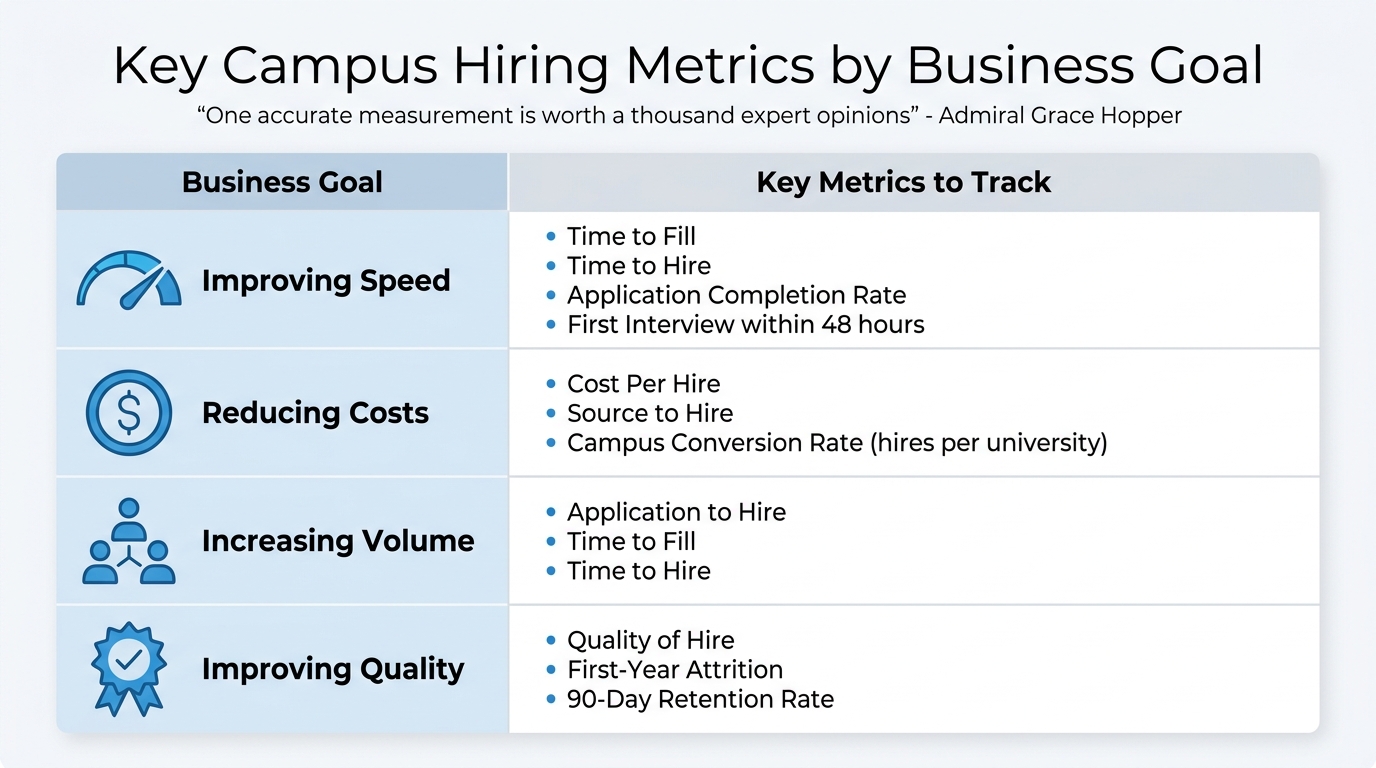
Campus Hiring Metrics by Business Goal: Speed, Cost, Volume, and Quality
Building a successful campus hiring program requires more than just effort – it demands a clear focus on data and ongoing adjustments. As Admiral Grace Hopper wisely put it:
"One accurate measurement is worth a thousand expert opinions" [6].
The challenge lies in choosing metrics that directly support your business goals, rather than getting lost in an ocean of data.
Tracking the Right Metrics
The metrics you track should align with what your organization values most. If reducing costs is a priority, focus on cost per hire (total recruitment spend divided by hires) and campus conversion rate (hires per university). These numbers help identify schools that deliver the best return on investment and highlight areas where spending can be trimmed [6].
For companies aiming to hire faster, key metrics include time to hire (from application to offer acceptance) and application completion rate (the percentage of applicants who finish the process). Top programs aim to schedule the first interview within 48 hours of application to secure sought-after Gen Z talent [1]. If improving quality is the goal, look at first-year attrition and 90-day retention rates. These figures reveal whether your hiring and onboarding processes are setting candidates up for success or falling short [6].
Pay attention to offer acceptance rates to uncover issues with compensation, timing, or how the role is being presented. A high renege rate (candidates backing out before starting) could signal that better offers are luring them away or that there are concerns about the role itself [1].
| Business Goal | Key Metrics to Track |
|---|---|
| Improving Speed | Time to Fill, Time to Hire, Application Completion Rate |
| Reducing Costs | Cost Per Hire, Source to Hire, Campus Conversion Rate |
| Increasing Volume | Application to Hire, Time to Fill, Time to Hire |
| Improving Quality | Quality of Hire, First-Year Attrition, 90-Day Retention |
Gathering Feedback and Making Improvements
Numbers tell part of the story, but qualitative feedback fills in the gaps. Gathering input from candidates, university partners, and your internal team is crucial. Candidate experience surveys using NPS can help identify sticking points in the process. If students drop off during applications, check for technical issues like browser compatibility [7].
Feedback from university career services can help explain low conversion rates, potentially guiding you to refocus efforts on more productive partnerships [6].
Internally, a 90-day review with hiring managers and recruiters can reveal what worked well and what needs adjustment. Weekly 20-minute calibration sessions, where managers review sample candidate answers, ensure consistent evaluation criteria. If feedback suggests a mismatch between candidate expectations and the role, revise job descriptions to provide an honest preview of both the positives and challenges of the position [7].
Regularly analysing these insights helps fine-tune your hiring process, exposing inefficiencies and uncovering opportunities for improvement.
Reducing Costs with Embedded Recruitment
Once inefficiencies are identified, embedded recruitment can simplify operations and cut costs. Managing multiple campus hiring programs can quickly overwhelm internal teams, consuming over 80 hours per month just on administrative tasks like coordinating with universities, scheduling interviews, tracking metrics, and managing candidate communication.
This is where services like Rent a Recruiter can make a difference. By embedding experienced recruiters directly into your team, you gain the expertise to streamline processes and cut costs – up to 70% compared to traditional agency fees. These recruiters focus on improving time to hire and lowering cost per hire through efficient sourcing and screening.
Embedded recruitment is especially effective for companies scaling quickly after funding rounds or launching new products. It provides the flexibility to meet ambitious hiring goals without delays or the need to build a large in-house team. Whether you need short-term help to meet immediate targets or long-term support to create a scalable recruitment function, embedded recruitment offers a practical way to maintain control while accessing expert support.
Expanding Campus Hiring with Embedded Recruitment
Understanding Embedded Recruitment
Embedded recruitment places experienced recruiters directly within your team, working as an extension of your internal operations. Unlike traditional agencies that function externally, embedded recruiters integrate seamlessly into your systems, join your stand-ups, and collaborate closely with hiring managers [17]. They immerse themselves in your company culture while bringing expertise in campus hiring – from fostering university partnerships to using mobile-first workflows that appeal to Gen Z candidates. This approach prioritizes speed and alignment with your existing processes.
One of the standout advantages of this model is its flexibility. For small and medium-sized enterprises (SMEs) dealing with seasonal campus hiring surges, embedded recruitment allows you to scale your hiring capacity during peak periods and scale down when demand decreases [1]. As ZRG Partners highlights:
"Embedded recruiting is not just the next big thing, it’s now. And if your company isn’t already exploring it, you’re missing the opportunity to build a talent engine that scales" [17].
Let’s take a closer look at how embedded recruitment delivers measurable value to campus hiring efforts.
Benefits for Campus Hiring Programs
The financial rationale is clear. Hiring a dedicated campus recruiter typically costs between $80,000 and $130,000 annually [16]. For companies with smaller hiring volumes, embedded recruitment offers a cost-effective alternative. Instead of relying on manual CV screening, which can introduce delays and bias, embedded teams can implement interview-first workflows. These workflows leverage mobile chat and automated scoring to speed up decision-making [1].
Automation also plays a crucial role in streamlining processes like candidate screening, interview scheduling, and sending reminders. This frees up your team to focus on final hiring decisions [1][12]. The importance of speed cannot be overstated. Laura Belfield, Head of Marketing at Sapia.ai, puts it succinctly:
"Speed to interview and speed to offer determine whether you win or lose top candidates" [1].
Embedded recruiters can launch mobile-first chat interviews as soon as applications are received, cutting the time-to-first-interview from days to just hours.
How Rent a Recruiter Supports Campus Hiring
Rent a Recruiter takes these benefits further by embedding recruiters into your team within days. They manage your campus hiring process from start to finish, ensuring structure and consistency at every step. This approach is ideal for SMEs looking to scale their hiring efforts efficiently, whether after a funding round or during a seasonal hiring surge. With Rent a Recruiter, companies can cut hiring costs by up to 70% and save over 80 hours of administrative work each month.
For SMEs targeting multiple universities with limited resources, this model is especially effective. Embedded recruiters can implement tiered university strategies, handle career fair logistics, develop internship-to-hire pipelines, and integrate modern tools into your Applicant Tracking System without requiring a complete system overhaul [1]. Some businesses use this service for short-term boosts during peak hiring seasons, while others rely on it as an ongoing solution to build a scalable, predictable recruitment function aligned with their growth goals.
Conclusion
Campus hiring goes beyond simply filling entry-level positions; it’s about creating a talent pipeline that supports long-term growth. Companies hiring 14.7% more college graduates year-over-year aren’t relying on luck [15]. They’ve established structured programs that emphasize speed, fairness, and genuine engagement – key factors for connecting with Gen Z candidates who value mobile-friendly experiences and transparent hiring processes.
The steps you take now directly influence your organization’s future leadership. Businesses that track recruitment metrics report a threefold increase in retention [15], while those using skill-based assessments see a 24% improvement in hiring effectiveness [15]. These improvements can be the difference between building a committed workforce and constantly refilling entry-level roles.
For growing companies without the capacity to hire a dedicated campus recruiter, embedded recruitment offers a smart solution. Rent a Recruiter places experienced recruiters directly into your team within days, handling tasks like university partnerships and interview workflows. This approach can cut hiring costs by up to 70% and save over 80 hours per month in admin time – freeing up resources to focus on candidate experience and strengthening your employer brand.
Whether you’re scaling after new funding or tackling seasonal hiring peaks, consistency and speed are essential. As Laura Belfield, Head of Marketing at Sapia.ai, puts it: “Speed to interview and speed to offer determine whether you win or lose top candidates” [1]. Start small with one or two key universities, implement structured evaluations, and expand from there.
Looking to scale campus hiring without increasing permanent headcount? Discover how Rent a Recruiter can provide the hiring support you need to compete for top graduates.
FAQs
When should I start campus hiring each year?
Starting your campus hiring process 10 to 12 months before your target start date is a smart move. This timeline fits well with most university recruiting cycles and ensures there’s enough time to handle applications and interviews without unnecessary pressure.
How do I choose which universities to recruit from?
To choose the right universities for recruitment, start by aligning your approach with your hiring needs. Look for schools that offer programs directly related to the roles you’re hiring for, whether that’s undergraduate degrees, MBAs, or specialized fields. Consider factors like the institution’s reputation, the success of its alumni, and its location relative to your business.
It’s also smart to assess the diversity of the student body and how engaged the students are with career opportunities. These elements can help you tap into a broader and more dynamic talent pool. By focusing on universities that align with your company’s values and priorities, you can create a recruitment strategy that delivers better results.
What metrics should I track to prove campus hiring ROI?
To measure the return on investment (ROI) of campus hiring, focus on tracking cost per hire, time to fill, candidate quality, offer acceptance rate, and retention rate. These metrics give you a clear picture of how efficient your process is and the long-term impact of the hires you make.