
Succession planning is not just about replacing leaders; it’s about protecting your business from disruption while saving costs and time. Yet, only 14% of leaders feel confident in their approach, and 70% of small businesses fail to transition successfully. The risks are real – unplanned exits can wipe out up to 50% of a company’s value.
To avoid this, tracking the right metrics is essential. Here’s what you should focus on:
- Bench Strength: Measure how many internal candidates are ready to step into critical roles. Aim for three successors per role to reduce risk.
- Internal Promotion Rate: A higher rate shows effective talent development and reduces hiring costs.
- Time-to-Fill Key Positions: Shorter times indicate a prepared pipeline, cutting downtime and external hiring expenses.
- Risk of Loss: Monitor turnover among high-potential employees to avoid gaps in leadership.
- Successor Development Progress: Track how well successors complete development plans and perform post-placement.
By focusing on these metrics, you ensure leadership transitions are smoother, faster, and less costly. Companies using this data-driven approach often reduce hiring costs by up to 70% and save over 80 hours monthly on admin tasks.
Want to future-proof your business? Rent a Recruiter can embed experienced recruiters directly into your team, helping you build a strong leadership pipeline while cutting costs.
How To Evaluate The Succession Plan? | KnowledgeCity
sbb-itb-a23bd6a
Core Metrics for Succession Planning
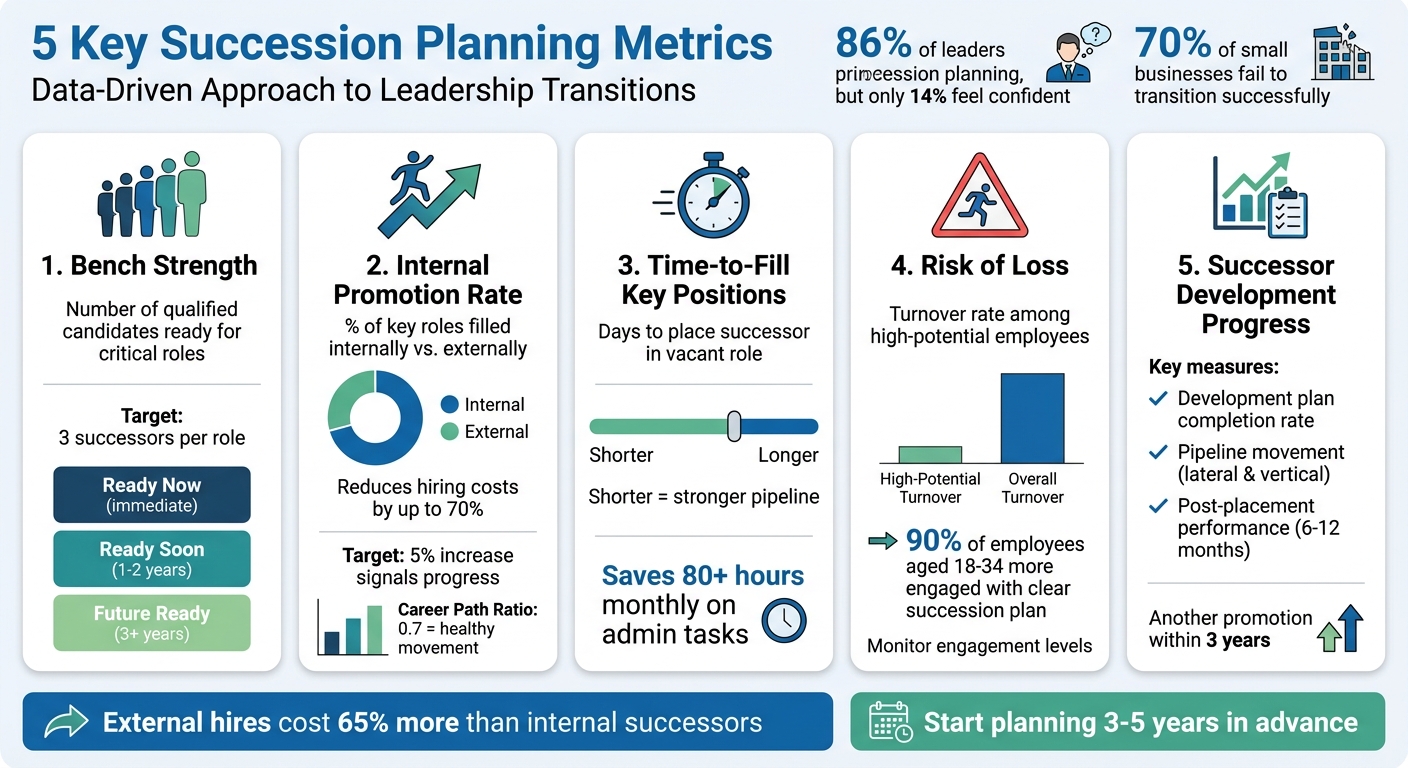
5 Key Succession Planning Metrics Every Business Should Track
The following metrics can help SMEs shift from reactive hiring to a more prepared approach. Each one highlights a different aspect of your organization’s ability to manage leadership transitions smoothly. Let’s dive into the most critical metrics, starting with bench strength.
Bench Strength
Bench strength reflects the depth of your talent pipeline – essentially, how many qualified individuals are ready to step into critical roles. To calculate it, divide the number of people ready for promotion by the total number of critical positions [3].
Readiness can be broken into three categories:
- Ready Now: Candidates who can take on the role immediately.
- Ready Soon: Those needing 1–2 years of development.
- Future Ready: Individuals requiring 3+ years of preparation [3].
A strong bench typically includes at least three qualified successors for every critical role. This provides a buffer if your first choice isn’t available or doesn’t perform as expected [3].
To avoid shallow pipelines or over-reliance on a single candidate, start identifying and grooming multiple successors early – ideally, 3–5 years in advance [4][2].
Internal Promotion Rate
This metric measures the percentage of management and critical roles filled by internal candidates versus external hires. It’s a direct indicator of how effective your talent development efforts are [3].
A robust internal promotion rate also reassures high-potential employees that they have opportunities to grow within the company, reducing the risk of losing them to competitors. Even a 5% increase in internal promotions for key roles can signal progress, especially for companies just launching a succession strategy [3].
"The ability to cultivate internal talent will be measured by the percentage of essential roles filled by internal promotion." – Natasha Chimphondah, Organizational Development Consultant [6]
Keep an eye on your career path ratio – this compares promotions to total position changes. A ratio of 0.7 indicates healthy movement, while a lower ratio, such as 0.2, may point to stagnation [3].
Time-to-Fill Key Positions
Time-to-fill measures how long it takes to place a successor once a key role becomes vacant. Shorter times suggest strong succession planning, while extended vacancies highlight potential gaps in your talent pipeline [3]. These gaps often mirror the biggest challenges in recruitment faced by HR leaders today.
This metric complements internal promotion tracking, offering a clear view of how prepared your organization is to handle vacancies. If key roles remain open for too long or require external searches, it’s a sign your internal development strategy might need attention [3][6].
"Time-to-fill is an important metric that provides you with information about how challenging it might be to fill specific critical positions. It’s a measure of succession efficiency and planning readiness." – Linda Pophal, Visier [3]
By focusing on succession planning, you can reduce both time-to-fill and hiring costs by leveraging talent acquisition services and a pre-trained internal talent pool instead of starting external searches from scratch [6].
Risk of Loss and High-Potential Turnover
This metric tracks the likelihood of losing key talent and monitors turnover rates among high-potential employees. For SMEs, losing a high-potential successor is far more disruptive than losing an average performer, as it directly impacts your leadership pipeline.
Unplanned departures can happen, so it’s crucial to monitor engagement levels among key employees. Research shows that over 90% of employees aged 18 to 34 feel more engaged when their company has a clear succession plan [6]. Providing a transparent growth path for high-potential talent not only boosts engagement but also strengthens overall workforce stability.
Measuring Successor Development and Readiness
Focusing on successor readiness ensures that a strong leadership pipeline translates into effective future leaders. Once successors are identified, it’s crucial to monitor how their skills and experiences evolve over time.
Development Plan Completion Rate
This metric measures the percentage of successors who successfully complete their individualized development plans. These plans should go beyond vague promises of promotion, incorporating specific goals like challenging projects, job rotations, and clear milestones [7].
High completion rates show strong engagement and that the program is working as intended. On the other hand, low rates might suggest that plans are too generic, overly ambitious, or not aligned with real career opportunities. For smaller organizations with limited resources, tracking this metric helps ensure efforts are directed toward successors actively preparing for leadership roles.
Succession Pipeline Movement
Progress within the succession pipeline isn’t just about promotions. It also includes lateral moves, job rotations, and stretch assignments that help successors build broader experience [7].
Keep an eye on how successors move through readiness stages – like progressing from "Future Ready" to "Ready Soon" to "Ready Now." Additionally, tracking cross-functional roles can highlight whether successors are gaining diverse experience or becoming overly specialized. A key sign of successful development is when a successor earns another promotion within three years of their first placement, validating their initial readiness [7]. Monitoring cross-functional mobility also demonstrates the strength of internal career growth opportunities.
Performance of Successors Post-Placement
The true test of your succession planning lies in how well successors perform after stepping into leadership roles. Metrics like team productivity and appraisal scores within the first 6–12 months can provide valuable insights [7].
If a high percentage of successors struggle in their new roles, it may point to gaps in your readiness assessments. This reinforces the importance of a strong internal development process, especially since external hires typically cost 65% more [7]. Measuring the "post-move failure rate" ensures you’re identifying and preparing the right leaders for long-term success.
Diversity and Flexibility Metrics
When it comes to building a resilient succession plan, diversity and flexibility are just as important as the core pipeline metrics. While many leaders recognize the importance of succession planning, few manage to execute it effectively[5]. A major reason for this is the lack of focus on tracking whether plans are genuinely inclusive and adaptable. By addressing these areas, you can strengthen your overall strategy.
Diversity in Successors
Understanding the demographic makeup of your successor pool – such as gender, race, and ethnicity – is essential[3]. These metrics provide early insights into how well your organization is progressing toward DEI recruitment best practices to meet your goals. They can also highlight areas where talent development efforts need to improve.
"Monitoring the level and type of diversity in your succession pipelines can provide leading indicators of where you are making, or failing to make, DEI progress." – Linda Pophal, Visier[3]
To avoid falling into the trap of self-replication bias – where outgoing leaders choose successors who mirror themselves – use AI-powered analytics to uncover high-potential talent that traditional reviews might overlook. Tools like the Career Path Ratio can help assess whether diverse employees have real opportunities for advancement. Additionally, categorizing successors by readiness levels, such as "Ready Now", "Ready in 1–2 years", and "Future Ready", and comparing these metrics to external benchmarks can help ensure an inclusive and sustainable pipeline[3].
Succession Plan Flexibility
The true test of a succession plan comes during unexpected challenges, whether it’s rapid growth, restructuring, market changes, or sudden leadership departures. In today’s fast-paced environment, agile, data-driven workforce planning is critical[3].
"Agile workforce planning practices enable organizations to minimize risk, such as talent shortages, and capitalize on upside opportunities in an era of disruption." – Linda Pophal, Visier[3]
To maintain flexibility, ensure you have at least three qualified successors for every critical role[3]. Predictive analytics can help you identify potential turnover risks and prevent over-reliance on a single "heir apparent." This approach not only reduces risk but also ensures your organization is prepared for whatever comes next[3].
Linking Succession Metrics to Business Results
Succession metrics aren’t just numbers on a spreadsheet – they’re tools that directly impact your company’s financial and operational success. These metrics go beyond assessing readiness; they have a measurable effect on your bottom line by driving smarter, more efficient transitions.
For instance, tracking time-to-fill for leadership roles can significantly reduce downtime during transitions, helping you avoid costly delays and budget overruns[3]. Similarly, a high internal promotion rate not only slashes recruitment costs but also speeds up onboarding, ensuring new leaders contribute faster to your business goals[3].
Leadership stability is another critical factor. Using predictive analytics to monitor turnover risk among successors allows you to step in before top talent walks out the door[3]. This proactive approach avoids the disruptive and expensive cycle of losing prepared successors and scrambling to rebuild your leadership pipeline. Without proper preparation, new CEOs often falter – many fail within their first 18 months when thrown into a "sink or swim" scenario[2]. By keeping an eye on these metrics, you ensure leadership transitions are smooth and cost-effective.
"Effective succession planning ensures productivity continuity by preparing leaders who can rapidly achieve full effectiveness." – Linda Pophal, Visier[3]
Another key metric is the career path ratio, which measures the balance between internal advancement opportunities and total headcount. This ratio acts as an early warning system for retention issues among high-potential employees[3]. When employees see clear opportunities for growth, they’re more likely to stay engaged and committed to your organization. By tracking this, you can gauge whether your succession planning fosters the kind of internal mobility that keeps your best talent motivated and loyal.
In short, succession metrics are not just about readiness – they’re about building a leadership pipeline that protects your business’s financial health and operational stability.
Conclusion
Data-driven succession planning is the difference between smooth leadership transitions and costly disruptions. While 86% of leaders rank succession planning as a priority, only 14% feel their efforts are effective. Add to that the staggering 70% of small businesses that fail in exit or sale plans, and the need for strategic planning becomes clear [1][2].
The metrics discussed – from bench strength ratios to successor readiness – offer an objective way to avoid bias and create a leadership pipeline that delivers results. Tracking these metrics three to five years in advance allows you to develop talent proactively [4][2]. Yet, 63% of SME owners without a plan believed it was "too early" to start [2]. Delaying leaves businesses exposed to the "5 D’s" – Death, Disability, Divorce, Disagreement, and Distress [4]. By focusing on these metrics, you not only strengthen your succession strategy but also highlight the value of structured external support.
For scaling businesses, Rent a Recruiter places experienced recruiters directly within your team in just days. We partner with high-growth SMEs in sectors like technology, SaaS, fintech, engineering, and professional services to build the bench strength needed for sustainable growth. The results? Up to 70% reduction in hiring costs and over 80 hours saved each month on internal hiring tasks. These benefits underscore the importance of starting succession planning early.
Without proper preparation, new CEOs often fail within their first 18 months [2]. Using these metrics ensures you’re not just planning for the future – you’re securing your business’s financial health and operational resilience.
FAQs
Which roles should be considered “critical” for succession planning?
Critical roles in succession planning aren’t limited to leadership positions. They also encompass roles that are key to driving business success – think customer-facing positions, sales teams, product development experts, and specialist roles requiring niche expertise. These positions are essential for keeping operations running smoothly and hitting your strategic targets.
How do you determine if a successor is ‘Ready Now’ versus ‘Ready Soon’?
A ‘Ready Now’ successor is someone who already possesses the necessary skills, experience, and leadership qualities to take on a role without delay. On the other hand, a ‘Ready Soon’ successor is nearly prepared but requires further development – whether through training or gaining additional experience – to confidently step into the position. Evaluating readiness means carefully examining their current abilities and pinpointing the areas where growth or improvement is needed.
How often should succession planning metrics be reviewed and updated?
Succession planning metrics need consistent attention and updates. Many companies now lean on an agile approach, emphasizing ongoing, data-driven evaluations instead of occasional reviews. This approach helps keep metrics aligned with shifting business priorities and ensures they remain relevant over time.