75% of candidates research your company’s reputation before applying. If your employer brand isn’t clear or consistent, you’re losing top talent to competitors. For small and mid-sized businesses (SMEs), employer branding isn’t about big budgets. It’s about building trust through every candidate interaction – from job descriptions to Glassdoor reviews.
The result? Lower hiring costs, faster time-to-hire, and stronger retention. Companies with a solid employer brand cut hiring costs by 50% and attract 3.5x more applicants per role. Here’s how SMEs can build an employer brand that scales without breaking the bank:
- Audit your current reputation: Check Glassdoor, social media, and candidate feedback for gaps.
- Define your EVP (Employer Value Proposition): Why should someone work for you? Highlight what makes your workplace stand out.
- Streamline hiring communications: Ensure job posts, emails, and interviews reflect your EVP.
- Track results: Use metrics like cost-per-hire, offer acceptance rates, and retention to measure success.
- Get support when scaling: Embedded recruitment can help maintain consistency as your hiring needs grow.
Want to save time and cut costs? Rent a Recruiter provides embedded recruitment support, helping SMEs scale hiring efficiently while staying true to their brand.
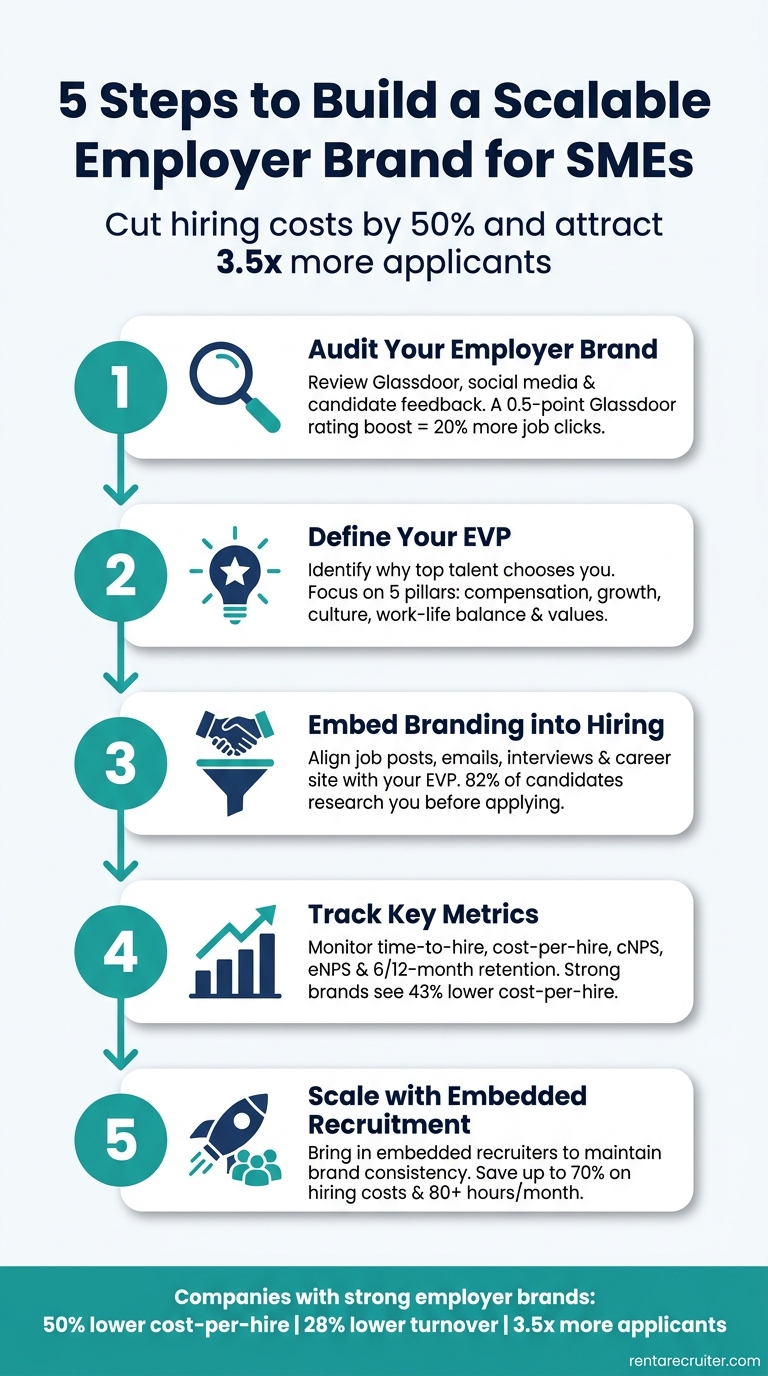
5 Steps to Build a Scalable Employer Brand for SMEs
Create a Killer EMPLOYER BRAND Strategy for Your Small Business
sbb-itb-a23bd6a
Step 1: Audit Your Current Employer Branding and Candidate Experience
Before you scale, it’s crucial to take a hard look at how candidates and employees perceive your company. A thorough audit can uncover gaps in your employer brand and candidate experience – gaps that, if left unchecked, could cost you top talent.
How to Conduct an Employer Brand Audit
Start by Googling your company name with terms like "reviews" or "careers." This is often the first impression candidates get, so it’s worth understanding what they see. Dive into your last 50 Glassdoor and Indeed reviews to identify recurring themes. This isn’t just about vanity metrics – boosting your Glassdoor rating by 0.5 points can result in 20% more job clicks and 16% more application starts [3].
Next, examine your job descriptions, career site, and LinkedIn page side by side. Are they consistent in tone? Does your messaging clearly communicate why someone should work for you? If your job posts sound overly formal but your Instagram presence is lighthearted and playful, candidates will notice. Also, review your candidate communications – offer letters, interview invites, and rejection emails. These should reflect the same voice and professionalism as your external branding.
| Audit Area | What to Review | What to Look For |
|---|---|---|
| External Reputation | Glassdoor, Indeed, Google, social mentions | Trends in ratings, consistent positives/negatives [5] |
| Messaging | Career site, job descriptions, social media | Consistent tone, clear "why work here" message [5][1] |
| Candidate Comms | Emails, rejection notices, interview invites | Professional tone, alignment with branding [1] |
| Internal Experience | eNPS, exit interviews, pulse surveys | Gaps between internal culture and external promises [5] |
Finally, step into a candidate’s shoes and experience your hiring process firsthand. This will help you identify disconnects between your brand promise and the actual candidate experience.
How to Map the Candidate Journey
Visit your career page as if you were seeing it for the first time. Can you understand the role and its appeal in under 30 seconds? If not, it’s time for a refresh. Test the application process – how many steps does it take? Overly complicated forms often lead to drop-offs.
Map out every stage of the candidate journey: discovering your job post on social media, navigating your career site, applying, recruiter outreach, interviews, receiving an offer, and onboarding. At each step, look for bottlenecks. Are there moments where communication slows or stops entirely? These "black holes" can seriously damage your brand. Keep in mind, 70% of candidates expect the hiring process to take three weeks or less [3]. Delays not only frustrate but also drive candidates away.
"Candidates remember how you made them feel. A fast, respectful ‘no’ is a thousand times better for your brand than silence. They’ll tell their friends you’re a class act, even if they didn’t get the job." – Jasmine Makkar, Marketing Professional, HireZapp [1]
How to Gather Internal Feedback
Tap into your employee base with an anonymous eNPS survey. Ask them how likely they are to recommend your company as a place to work. A score above 30 is a good sign [7], but anything lower points to areas needing attention.
Go further with stay interviews. Ask your best employees why they joined, what keeps them engaged, and what might make them leave. Similarly, check in with new hires during their first 90 days – why did they pick you over other offers? These conversations often reveal your true employee value proposition (EVP). If what employees experience internally doesn’t match what you’re promoting externally, that’s the gap you need to close.
"The strongest employer brand is not the one that claims to be the best. It is the one whose employees spontaneously attest that it delivers on its promises." – Balencio [7]
Bridging the gap between internal feedback and external messaging ensures your employer brand feels genuine and can grow with your company. For more insights on optimizing your hiring strategy, explore our recruitment blog.
Step 2: Build a Clear Employer Value Proposition (EVP)
After completing your audit, the next step is to establish your Employer Value Proposition (EVP). At its core, your EVP answers the question: "Why should someone choose to work here instead of somewhere else?"
Think of the EVP as the internal agreement – what employees genuinely gain in return for their time and effort. Your employer brand is the external expression of this agreement. If the foundation (your EVP) isn’t solid, no amount of branding or marketing can make up for it[4][11].
How to Define Your EVP Pillars
Start by speaking directly with your top-performing employees. Ask them:
- Why did you decide to join?
- Why do you continue to stay?
- What might make you consider leaving?
Look for recurring themes in their responses. These patterns will help you uncover your genuine strengths as an employer[11]. For SMEs, this often includes advantages that larger companies can’t easily offer: access to leadership, quicker decision-making, opportunities to take on varied roles, and the chance to make a noticeable impact hiring as you scale[4]. These are the qualities that resonate with the right candidates.
"A high-impact EVP attracts the right candidates, not just more candidates." – Randstad Enterprise [8]
A strong EVP typically revolves around five key areas: compensation and benefits, career development, work environment and culture, work-life balance, and company values[9]. Flexibility has become especially important – 91% of workers now prioritize flexible work options, a massive jump from 51% in 2019. Interestingly, 94% of small businesses already offer hybrid work setups, compared to 83% of larger organizations[9][10].
Once you’ve identified your pillars, document them clearly. These will serve as the foundation for all candidate-facing communication.
How to Document and Apply Your EVP
After defining your EVP pillars, put them into a format that’s easy for your team to use. A simple EVP playbook can be an effective tool. Build it around a core positioning statement, using this template:
"At [Company], [target employee type] can [primary benefit] while [secondary benefit] in an environment that [cultural differentiator]. Unlike larger companies, we offer [unique small-team advantage]." [4]
Avoid generic claims like "great culture." Instead, use specific, measurable examples such as "engineers deploy to production in their first week" or "we publish all salary ranges internally and externally."[11] Specificity builds credibility and trust.
Once your EVP is documented, involve HR, team leads, and other employees to ensure it accurately reflects the reality of working at your company[11]. A concise, one-page playbook works best. Include:
- A clear positioning statement
- The five EVP pillars, supported by concrete proof points
- A few real employee stories or quotes
This document will ensure consistent messaging across job postings, your careers page, and even interview discussions. When everyone is aligned, your EVP becomes a powerful tool for attracting the right talent.
Step 3: Embed Employer Branding into Your Hiring Process
Once your EVP is documented, the next step is ensuring it resonates throughout your hiring process. The disconnect between an inspiring EVP and a candidate’s actual experience is where many SMEs falter. Here’s how to weave your EVP into every hiring touchpoint using proven talent acquisition strategies.
Standardize Job Descriptions and Outreach
Your EVP should guide the tone and structure of all hiring materials. Start by creating a consistent format for job descriptions. Include a clear "About Us" section – just two or three sentences that highlight your mission and what sets your team apart. Follow that with an "Opportunity" section that focuses on the role’s impact rather than just listing responsibilities. For instance, instead of saying, "Reports to senior leadership", write something like, "You’ll collaborate directly with our CEO on product strategy starting in your first week." This level of detail makes the role more relatable and engaging.
Extend this consistency to all candidate communications. Branded, EVP-aligned responses at every stage – whether it’s a follow-up email or a rejection note – demonstrate professionalism and respect. As marketing expert Jasmine Makkar puts it:
"Candidates remember how you made them feel. A fast, respectful ‘no’ is a thousand times better for your brand than silence. They’ll tell their friends you’re a class act, even if they didn’t get the job." – Jasmine Makkar [1]
Build a Career Site and Online Presence That Scales
Your careers page is a critical piece of your employer branding. It should feature authentic team photos (ditch the stock images), outline your interview process, and showcase at least one or two stories of employee growth. With 82% of candidates researching an employer’s reputation before applying [2], a thin or outdated careers page can cost you top talent before they even consider hitting "Apply."
Your social media presence also matters. LinkedIn is indispensable for most SMEs – use it to share employee milestones, provide context for open roles, and establish thought leadership. Instagram, on the other hand, is great for showcasing your workplace culture. Whatever platforms you choose, consistency is key. Strike a balance between cultural content and job postings to keep your audience engaged. Tools like Buffer (~$6/month) and Canva Pro (~$15/month) can help you stay consistent without requiring a full marketing team.
Improve the Candidate Experience
Every step of the interview process reflects on your brand. Confirm interviews well in advance, stick to scheduled times, and provide clear next steps. These small but meaningful actions communicate respect for the candidate’s time and effort. Ensure that everyone involved in the hiring process, from recruiters to team leads, understands your EVP so the brand message remains consistent throughout.
Respectful communication and punctuality are non-negotiable. Additionally, collect feedback from candidates after each hiring cycle to identify areas for improvement. With 75% of job seekers researching a company’s reputation before applying [6], a poor candidate experience can tarnish your brand far beyond the hiring process itself.
Step 4: Track, Review, and Manage Your Employer Branding Efforts
Crafting a strong employer brand is just the beginning. The real challenge lies in knowing if it’s working and ensuring it improves over time. Without clear metrics, it’s impossible to measure success.
Key Employer Branding Metrics to Track
Once your Employer Value Proposition (EVP) is integrated into your hiring process, you need to evaluate its impact using specific metrics. These metrics generally fall into four categories: recruitment efficiency, candidate sentiment, employee advocacy, and retention quality.
For recruitment, focus on time-to-hire and cost-per-hire. A well-regarded employer brand can reduce reliance on paid job boards and external agencies, saving money. In fact, companies with strong employer brands report a 43% lower cost-per-hire [13].
When it comes to candidate sentiment, tools like the Candidate Net Promoter Score (cNPS) are invaluable. This post-interview survey asks candidates how likely they are to recommend your hiring process. Combine this with your offer acceptance rate to get a clear picture. A drop in acceptance rates often signals a disconnect between your brand promise and the actual hiring experience.
On the employee side, track your Employee Net Promoter Score (eNPS) and referral rates. Employee referrals are about 10 times more likely to convert into hires compared to job board applicants [12]. A strong referral rate indicates that employees trust and believe in your brand. Lastly, monitor retention at 6- and 12-month intervals to ensure new hires’ experiences align with what they were promised during recruitment.
| Metric Category | Key KPIs | What It Tells You |
|---|---|---|
| Recruitment | Time-to-hire, Cost-per-hire | Efficiency and cost-effectiveness of hiring |
| Candidate Experience | cNPS, Offer acceptance rate | Candidate perception of your brand during hiring |
| Employee Advocacy | eNPS, Referral rate | Internal trust and engagement with the brand |
| Retention | 6/12-month attrition, Quality-of-hire | Long-term alignment between promise and reality |
How to Set Up a Regular Review Process
Rather than focusing on weekly fluctuations, look at quarterly trends across these metrics. Compare current data to the previous quarter and flag any notable changes.
A practical way to maintain alignment is by comparing leadership’s portrayal of the workplace with employees’ actual experiences. Use brief pulse surveys or informal feedback sessions to identify gaps. As TuraHire wisely notes:
"The employer brand should meet the standard of accuracy, not perfection. A gap between the brand promise and lived experience is a direct driver of turnover." [12]
Additionally, monitor and respond to reviews on platforms like Glassdoor and LinkedIn. 70% of candidates are more likely to apply to companies that actively engage with reviews [14]. Address critical feedback thoughtfully – this demonstrates maturity and appeals to top candidates.
By regularly tracking and reviewing these metrics, you can validate your branding efforts and adjust as your hiring needs grow. But the process doesn’t stop there. Assigning ownership is essential to ensure consistency and accountability.
Assign Ownership of Your Employer Brand
To turn insights into action, assign clear responsibilities for managing your employer brand. Without ownership, progress often stalls. One effective strategy is to use a RACI model:
- Responsible: HR or People team handles daily execution and tracking.
- Consulted: Marketing ensures alignment with the overall brand.
- Accountable: The CEO acts as the visible champion of your EVP.
Line managers also play a critical role by shaping employees’ day-to-day experiences, which can either strengthen or weaken your brand externally.
"Your employer brand exists whether you manage it or not – it’s shaped by current employees, ex-employees, and public perception." [12]
Once roles are defined, develop an annual branding plan tied to measurable business goals. For example, reducing agency spend, increasing offer acceptance rates, or improving diversity hiring. This approach keeps your efforts grounded in outcomes that matter most to your business.
Step 5: Use Embedded Recruitment Support to Scale Faster
Even with a strong EVP and clear metrics, scaling up hiring can stretch your team thin. This often leads to inconsistencies that push your employer brand to the backseat. Spotting these issues early gives you the chance to bring in specialized recruitment support, ensuring your brand remains intact as you grow.
When to Bring in Embedded Recruitment Support
Some clear signs that your recruitment setup is falling behind include fewer career site conversions, lower offer acceptance rates, and an EVP that no longer aligns with your current reality. This mismatch becomes even more apparent if you’ve embraced remote or hybrid work, undergone leadership changes, or entered new markets. Outdated or generic messaging can weaken your brand and fail to attract the right talent.
As Lori Sylvia, Founder & CEO of Rally, explains:
"Your employer brand is one of your most powerful tools for attracting talent – but only if it reflects who you are today and connects with the talent you need tomorrow." [15]
What Embedded Recruitment Delivers
When these gaps start to show, embedded recruitment can provide the solution. Rent a Recruiter places experienced recruiters directly into your team within days, handling the entire hiring process with a consistent and structured approach. This means every job description, candidate interaction, and offer discussion reflects your values and tone, turning your EVP from a static document into a lived experience.
Embedded recruitment doesn’t just bring consistency; it also helps you allocate your budget more effectively. Companies partnering with Rent a Recruiter often cut hiring costs by up to 70% compared to traditional commission-based agencies. On top of that, they save over 80 hours per month on hiring admin – time that can be redirected toward strategic projects like strengthening your employer brand instead of being bogged down in logistics.
"Wherever your biggest gaps are, having the right support can help you move faster and make smarter decisions." – Lori Sylvia, Founder & CEO, Rally [15]
Conclusion and Next Steps
Creating an employer brand that scales with your business takes dedication, but the payoff is worth it. Start by taking these five steps: assess where you stand today, define a clear and genuine EVP, weave your brand into every hiring touchpoint, measure your progress with key metrics, and secure the right support to grow efficiently.
The numbers speak for themselves: companies with strong employer brands see a 50% reduction in cost-per-hire, 28% lower turnover rates, and attract 2.5x to 3.5x more applicants [3][4][6]. These results come from consistently engaging candidates with purpose and authenticity.
And here’s the thing – small and mid-sized businesses don’t need huge budgets or branding teams to get started. Focus on the basics: sharpen your job descriptions, respond to every Glassdoor review within 48–72 hours, and ensure every candidate receives a response, even if it’s a rejection. These small but consistent efforts build a reputation that draws in top talent and sets your business apart.
If your hiring efforts begin to outpace your internal resources, embedded recruitment can be a game-changer. Rent a Recruiter places seasoned recruiters directly in your team, ensuring your hiring stays aligned with your employer brand. No inflated fees, no delays – just structured, efficient hiring. You can even start with a free Recruitment Health Check to identify quick wins and strengthen your employer branding strategy.
FAQs
What’s a simple way to write an EVP for a small team?
When building an EVP for a smaller team, start by conducting interviews with 15–20 of your top performers. Focus the conversation on three key questions: why they joined, what keeps them engaged, and what might cause them to leave. These insights will help you uncover recurring themes that genuinely reflect your team’s day-to-day experience.
Steer clear of generic phrases like "great culture" – they don’t tell the full story. Instead, pinpoint 2–3 specific traits that truly set your team apart. Use a clear and compelling structure to communicate your EVP:
"At [Company], [target employee type] can [primary benefit] while [secondary benefit] in an environment that [cultural differentiator]."
This approach not only highlights what makes your team unique but also connects directly with the kind of talent you’re looking to attract.
Which hiring touchpoints impact employer brand the most?
Employer branding is influenced by every interaction candidates and employees have with your company. Some of the most impactful touchpoints include:
- Interview process: The pace and quality of communication during interviews shape how candidates perceive your company.
- Onboarding: A smooth, engaging onboarding experience fosters trust, while a disorganized one can quickly erode confidence.
- Digital presence: Platforms like your career page, social media profiles, and review sites such as Glassdoor or LinkedIn heavily impact how your company is viewed.
- Employee advocacy: Stories and reviews shared by employees carry significant weight and are often seen as the most credible source of insight.
What metrics should I track first to prove employer branding ROI?
To measure the ROI of employer branding, focus on two key metrics: Candidate Net Promoter Score (cNPS) and Employee Net Promoter Score (eNPS).
- cNPS gauges how likely candidates are to recommend your hiring process to others, offering a snapshot of your external reputation.
- eNPS, on the other hand, measures employee satisfaction and their willingness to advocate for your company, reflecting the strength of your internal culture.
Tracking these scores gives you a clear starting point to evaluate the impact of your employer branding efforts and supports the case for further investment in your hiring strategy.