If you are still trying to win hires on salary alone, you are making recruitment more expensive than it needs to be.
I see the same pattern across scaling companies in SaaS, Technology, IT, Fintech, Engineering, Security, Insurance, and Professional Services. Salary budgets are tight, offer pressure is up, and hiring teams lose time when candidates push for more cash or walk away late in the process. A clear non-cash offer can help you protect fixed payroll cost, improve offer acceptance, and cut repeat hiring caused by early churn.
Here is the short version:
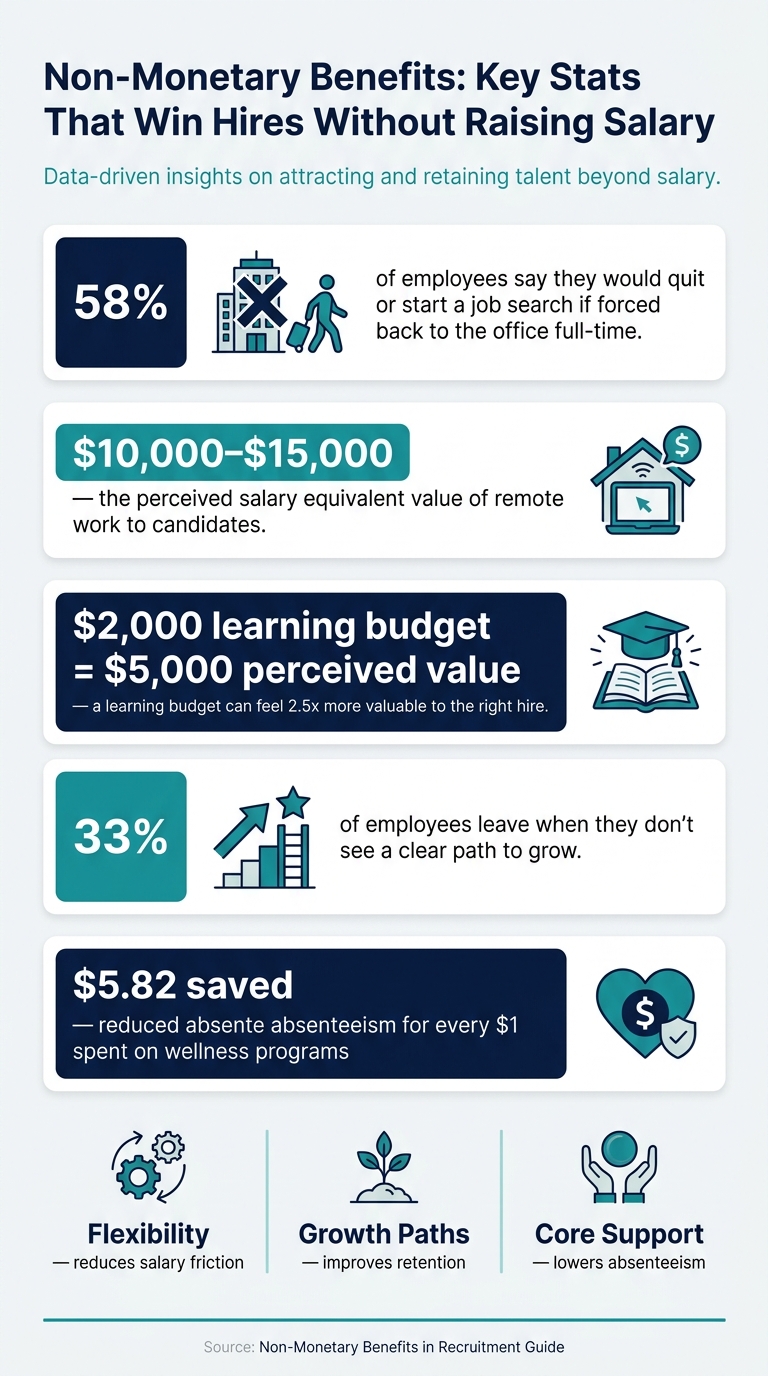
- Flexibility matters fast. 58% of employees say they would quit or start a job search if forced back to the office full-time.
- Remote work can carry a perceived salary value of $10,000 to $15,000.
- A $2,000 learning budget can feel like $5,000 in value to the right hire.
- Around 33% of employees leave when they do not see a path to grow.
- Low-cost support, like EAPs or LSAs, can improve attendance and reduce pressure on managers.
What this means for you is simple. Non-monetary benefits are not side perks. They are part of the offer price in the mind of the person deciding whether to join.
If you want better hiring outcomes without adding long-term salary cost, focus on three things:
- Flexibility that is easy to explain and easy to use
- Growth paths with clear milestones, not vague promises
- Core support that stops weak benefits from pushing salary demands higher
The commercial point is straightforward. When your hiring team can explain total offer value in plain numbers, you get less salary friction, less offer confusion, and fewer delays to close.
Below, I break down how to use non-monetary benefits to make offers stronger, keep messaging aligned, and track whether the package is improving hiring results.
Non-Monetary Benefits: Key Stats That Win Hires Without Raising Salary
Non-Monetary Incentive and Motivation for Your Team
sbb-itb-a23bd6a
What Counts as a Non-Monetary Benefit and Which Ones Matter Most
Non-monetary benefits are the non-cash parts of an offer: flexibility, time off, development, benefits, recognition, and equity.
For SMEs, the goal is simple: give candidates something they care about without driving up fixed cost. The benefits that tend to matter most sit in three areas: flexibility, growth, and core support.
Flexible Work and Time Off
Flexibility now carries real weight in hiring. 58% of employees say they would quit or start a job search immediately if forced back to the office full-time [2][3]. That has a direct business impact. If your offer lacks flexibility, you can lose strong candidates before pay even becomes the main issue.
Remote work is a good example. Candidates may value it at $10,000 to $15,000 in salary equivalent [4]. For you, it can also reduce office overhead. That makes it one of the clearest cases where candidate demand and cost control line up.
For most SMEs, the most workable options are remote or hybrid setups, flexible start-time windows, and compressed workweeks:
| Benefit Option | Candidate Appeal | Operational Complexity | Business Impact |
|---|---|---|---|
| Full Remote Work | Very High | Moderate (Tax/Nexus) | High (Saves office costs) |
| Hybrid Schedule | High | Low | High (Retention/cost savings) |
| Flexible Start Times | High | Low | Moderate (Reduces burnout) |
| Compressed Workweek | Moderate | High | Moderate (Efficiency) |
| Unlimited PTO | Moderate (Often viewed skeptically) | Low | Low (No accrued liability; can result in less time taken) |
That table tells a pretty clear story. Hybrid and flexible start times often give SMEs the best return for the least friction. Full remote can be strong too, but tax and nexus issues need thought. Unlimited PTO may sound attractive on paper, yet many candidates now view it with caution.
Candidates are also asking more often about mental health strategies and mental health days during interviews, so your PTO policy needs to be specific and easy to explain [2]. If a hiring manager gives a vague answer here, confidence can drop fast.
If flexibility helps you win candidates, development benefits help you keep them.
Development, Recognition, and Meaningful Work
Development benefits matter a lot, especially for early-career hires. A $2,000 annual learning budget can carry $5,000 in perceived value for someone who wants to build skills [4]. That is a strong trade if you’re trying to stay disciplined on base salary.
There is also a retention angle. Around 33% of employees leave roles because they don’t see a clear path for professional development [2]. So this is not just about making an offer look better. It affects how long people stay and how often you have to hire for the same role again.
The key is being specific. "Growth opportunities" means very little on its own. A clear 6-, 12-, and 18-month learning roadmap says much more. So does introducing candidates to people who have moved into new roles or earned promotions inside the business.
A vague promise feels cheap. A visible path feels real.
Recognition and meaningful work are harder to measure, but they still shape retention. Low-cost recognition, like peer shout-outs or direct feedback tied to business results, helps people see that their work matters. That visibility can make a bigger difference than leaders sometimes expect, especially in smaller companies where each hire has a clear effect on output.
Wellness, Core Benefits, and Equity-Based Perks
Once flexibility and growth are in place, core benefits and equity help round out the offer.
In the U.S. market, health insurance is expected. If medical cover is weak, candidates often look for more base pay to close the gap. In other words, underpowered core benefits can push salary cost up anyway.
For SMEs, two practical wellness add-ons stand out. Employee Assistance Programs (EAPs) can cost as little as a few dollars per person per month. Lifestyle Spending Accounts (LSAs) let employees use a set budget for things like gym memberships, mental health apps, or home office equipment. Employers see $5.82 in reduced absenteeism for every $1 spent on wellness programs [6], which makes this easier to defend in budget talks.
For 401(k) matching, even a modest employer contribution sends a strong signal. It shows long-term intent and tends to land well with mid-career candidates who care more about financial stability than surface-level perks.
Equity, whether stock options or RSUs, tends to work best for senior hires at growth-stage companies. But it needs to be explained plainly. Simple scenario-based modelling usually works better than broad statements about upside, because candidates want to know what the numbers could look like in practice.
How to Use Non-Monetary Benefits in Offers and Recruitment Messaging
Knowing which benefits matter is only half the job. If candidates can’t see them, they won’t count them.
Make Benefits Clear in Job Ads, Recruiter Conversations, and Offer Templates
Phrases like "competitive benefits" don’t do much. They’re vague, easy to skim past, and hard to compare. Use specific numbers instead, like a $3,000 learning budget, so candidates can weigh the offer properly.[4]
The same applies in recruiter conversations. Don’t say "$140K plus benefits" and leave the rest fuzzy. Spell out the package: "$140K base, $21K target bonus, $50K in equity, and a $3,000 learning budget, a total package of $214K."[4] That changes the conversation. You’re no longer debating salary alone. You’re showing the full offer in plain terms.
Offer letters need the same level of clarity. Break out each part clearly: base pay, bonus, equity scenarios, benefits, and 6-, 12-, and 18-month development milestones.[1][4] If someone has to guess where the value sits, trust starts to slip.
Use Benefits to Handle Offer Trade-Offs Without Raising Salary
Once benefits are visible, you can use them to manage trade-offs without touching base pay.
If your salary band is fixed, the conversation doesn’t need to stall there. Ask candidates what they care about most during the interview process.[2] Some will want flexibility. Some care more about PTO. Others are focused on learning and career growth.[4]
That gives you room to shape the offer in a way that feels stronger without breaking pay discipline. This level of negotiation is often easier when using fractional recruitment services that embed experts directly into your team.
If a candidate pushes back on base salary, you still have options:
- An extra three to five days of earned PTO can mean a lot to someone worried about burnout, and it costs little.[1]
- A structured quarterly bonus tied to clear milestones often lands better than a vague discretionary payout at year-end.[1]
The point is simple: make the full value of the offer easy to see.
Common Mistakes That Reduce Offer Credibility
Offer strength depends on consistency. If the package says one thing and the hiring experience says another, candidates will spot the gap.
A common issue is the vague "discretionary" bonus. If it’s been paid at 100% every year, most candidates will treat it as part of expected cash compensation. If that changes later, it won’t feel like a bonus disappeared. It will feel like pay was cut.
The same problem shows up with benefits that exist on paper but not in practice. If mental health days are listed in the handbook but managers make people feel bad for using them, that damages trust fast.
Token equity grants can create the same problem.[4] If equity is part of the offer, show the numbers clearly using conservative, target, and optimistic scenarios.[4] Without that, upside claims sound vague, and vague claims don’t build trust.
How SMEs Should Build and Measure a Non-Monetary Benefits Strategy
Once the offer is defined, non-monetary benefits need to become a system you can review, explain, and track.
For SMEs, that matters because a benefits strategy only works if it helps you win offers, cut churn, and save management time. If it lives in scattered docs, informal manager talking points, or half-remembered interview answers, it will create friction instead of trust.
Audit Your Current Benefits and Identify the Biggest Gaps
Start by mapping your current package across compensation, benefits, work-life flexibility, recognition, and development, then identify the biggest gaps.[5]
A short anonymous survey can help you see what employees value most and where the current package is falling short.[2][7] That step is often eye-opening. What leadership thinks matters most is not always what employees talk about day to day.
Once you have that data, focus on low-cost, high-value benefits. These are the changes that cost the business relatively little but carry strong perceived value for employees.[4]
Think about the commercial upside. If a small change improves offer acceptance or reduces early exits, the return can be far greater than the direct cost. That is especially true for scaling firms using talent acquisition services for SMEs in SaaS, Technology, IT, Fintech, Engineering, Security, Insurance, and Professional Services, where hiring delays are expensive.
Pilot one change at a time for six months, then scale, adjust, or drop it.[7] That keeps the process simple and gives you a cleaner read on what is working.
Standardize Benefit Messaging Across Hiring Teams and Growth Stages
To keep candidates clear on what they are being offered, build one approved benefits summary that covers how benefits are described and what they are worth.
Everyone involved in hiring, recruiters, hiring managers, and HR, should present the same total package in the same terms.[5] If one person frames flexibility as informal, another calls it policy, and a third cannot explain it at all, confidence drops fast.
The goal here is internal consistency. When any member of the hiring team gets a benefits question, the answer should be identical regardless of who is asked or what stage of growth the company is in.[5]
This is not just a messaging issue. It affects hiring outcomes. Clear benefit messaging reduces confusion, speeds up decisions, and lowers the risk of mismatched expectations after someone joins.
Track the Metrics That Show Whether Benefits Are Working
Once the package is standardised, track whether it changes hiring and retention behaviour.
| Metric Category | What to Track | What It Tells You |
|---|---|---|
| Recruitment | Offer acceptance rate, time-to-accept, decline reasons, referral rate | If acceptance drops while pay stays near market, benefits may be undervalued or poorly explained.[5] |
| Retention | Voluntary turnover by tenure, early attrition (under 12 months) | High early attrition can signal a mismatch between what was promised and what was delivered.[7] |
| Engagement | eNPS, engagement survey scores, benefits utilization rate | Low uptake usually signals poor communication, not poor value.[5] |
| Efficiency | Absenteeism, unscheduled leave | Improvements here often correlate with better wellness and flexibility policies.[7] |
These metrics give you a practical read on business impact.
- Recruitment metrics show whether your package helps close candidates faster.
- Retention data shows whether the offer holds up after hiring.
- Engagement and usage show whether employees understand and use what you provide.
- Efficiency signals can point to lower disruption and less pressure on managers.
Review your total rewards strategy at least once a year, aligned with your compensation cycle.[5] For new initiatives, set a six-month checkpoint to decide whether to scale, adjust, or drop them.[7]
Conclusion: Turn Non-Monetary Benefits Into a Repeatable Hiring Advantage
Non-monetary benefits give you a practical way to compete on total offer value, not just salary. When your package is clear, consistent, and measured, it becomes a hiring edge you can use again and again.
That’s where the gap often shows up. Plenty of companies offer good benefits, but they don’t present them well. If hiring managers describe them one way, HR frames them another way, and recruiters leave out half the detail, you lose impact. Clarity wins deals. Consistency helps you scale.
The strongest programmes are usually simple. They make the value easy to see, keep the hiring team aligned, and get better over time. That matters when you’re hiring across SaaS, Technology, IT, Fintech, Engineering, Security, Insurance, or Professional Services, where candidate demand can move fast and offer pressure can drive up costs.
If your team needs help putting that structure in place fast, Rent a Recruiter embeds experienced recruiters into your team and helps turn this into a repeatable process.
FAQs
Which non-monetary benefits matter most to candidates?
Candidates often care more about benefits that improve day-to-day life and back long-term career growth than they do about a small pay bump.
The big priorities are flexible or hybrid work, career development through mentorship and stretch assignments, health and wellness support, meaningful recognition, and a positive, inclusive culture.
Clear growth paths matter too. So do transparency and respect for people’s time and well-being.
For hiring leaders, that has a direct business impact. If your offer leans too heavily on salary and ignores the rest, you risk slower hiring, lower offer acceptance, and more drop-off late in the process.
People want to know what working with you will feel like, not just what it pays. They want to see whether they can grow, whether leadership is clear, and whether the company treats employees like adults.
That means your employer value proposition should speak to more than compensation. It should show:
- How work fits into life
- How careers progress inside the business
- How managers support performance and development
- How your company respects time, well-being, and trust
For scaling companies, this is where hiring outcomes often shift. The businesses that spell this out well tend to attract stronger interest and spend less time selling the role from scratch in every interview.
How can we measure the ROI of non-monetary benefits?
Measure ROI by looking at how non-cash benefits shape both hiring and retention.
Start with baseline metrics such as cost-per-hire, time-to-fill, application volume, offer acceptance rates, and voluntary turnover. These give you a clear before-and-after view, so you can see whether your benefits mix is helping you hire faster, reduce attrition, and cut avoidable spend.
It also helps to review eNPS, engagement surveys, benefit usage, and feedback from candidates and employees. That gives you a clearer picture of which benefits are swaying decisions, improving loyalty, and supporting business growth while saving money.
What low-cost benefits can SMEs offer first?
Start with low-cost, high-impact benefits that ease pressure on your team and make your offer more appealing without pushing up fixed payroll costs.
A good place to start is with benefits that help people manage time, growth, and day-to-day stress. These tend to matter a lot in scaling companies, especially when you are competing for talent in SaaS, Technology, IT, Fintech, Engineering, Security, Insurance, and Professional Services.
You do not need an expensive perks package to make a difference. Often, a few well-chosen options can improve offer acceptance and help you keep good people for longer.
- Flexible and hybrid work arrangements
- Professional development, such as modest learning budgets, mentorship, or low-cost course subscriptions
- Lifestyle perks like extra annual leave, birthday holidays, or wellness stipends for mental health support