
One bad hire can cost your business 50% to 200% of salary, and for a scaling SME, that hit lands fast.
If you are hiring into finance, tech, SaaS, engineering, security, insurance, or professional services, background checks help you cut hiring risk before it turns into lost time, team drag, or customer issues. They do not just help you screen people. They help you protect cost, output, and trust.
Here is the short version:
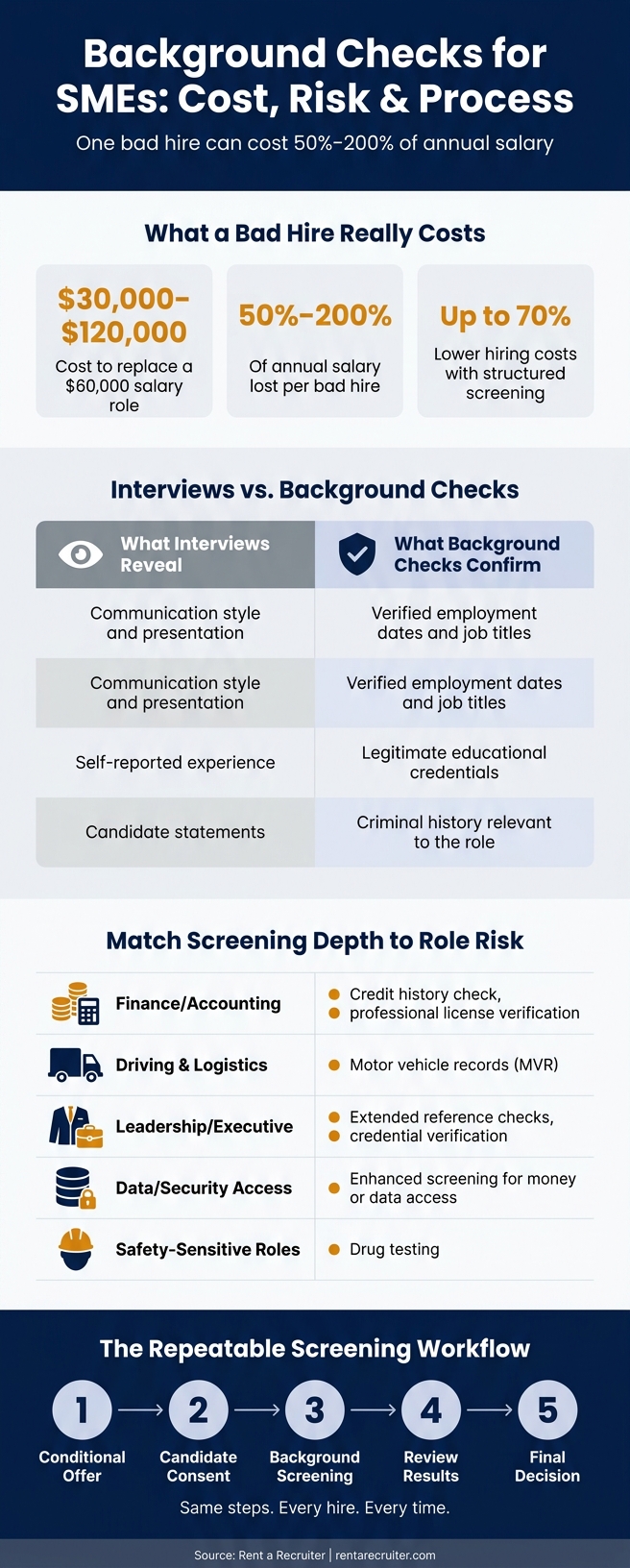
- Bad hires are expensive, often costing $30,000 to $120,000 on a $60,000 salary
- Small teams feel the impact faster because there is less room to absorb mistakes
- Interviews do not verify facts, they only show how well someone presents
- Role-based checks help you match screening depth to money, data, systems, or customer risk
- A fixed hiring process helps you save time, keep records clean, and make more consistent hiring calls
If you are scaling and do not want hiring admin to eat up internal time, Rent a Recruiter can help you put screening into a structured hiring process without adding full-time headcount. That can mean up to 70% lower hiring costs versus agency fees and 80+ hours saved per month in internal hiring admin.
Put simply, background checks are not extra admin for SMEs. They are a cost control tool.
Background Checks vs. Bad Hires: The Real Cost for SMEs
Pre-Employment Background Checks: What Employers Should Know
sbb-itb-a23bd6a
The Hiring Risks SMEs Face Without Background Checks
For SMEs, the risk shows up fast in cost, exposure, and team disruption. In practice, it comes down to three areas: money, exposure, and false assumptions.
Bad Hires Cost More in Lean, High-Growth Businesses
In a lean team, a bad hire hits hard straight away. There is no spare capacity to soak up the mistake. Projects slip. Managers get pulled into fixing problems instead of moving the business forward.
That pressure spreads fast. Strong performers pick up extra work, internal time gets eaten up, and keeping your team settled becomes much harder. For scaling companies, that is not just a people issue. It is a time and cost issue.
Safety, Fraud, and Reputation Risks Are Harder to Absorb
When unvetted employees have access to customer data, financial records, or internal systems, the business takes on real exposure. Fraud, data loss, and misconduct can cost far more than the salary attached to the role.
In smaller businesses, the impact can hit even faster. Employees are often the public face of the company, so a single incident can damage customer trust more quickly than it might in a larger business [1]. Weak screening can also create negligent hiring liability if it leads to harm or loss [3].
Resumes and Interviews Do Not Confirm the Full Picture
Interviews show how well someone presents themselves. They do not prove that what they say is accurate.
Candidates often overstate qualifications, inflate job titles, or leave out past disciplinary issues [1][3]. A polished interview might feel convincing, but it tells you nothing for certain about employment history, credentials, or past conduct.
The gap is simple: interviews test presentation, checks verify facts.
| What Interviews Reveal | What Background Checks Confirm |
|---|---|
| Communication style and presentation | Verified employment dates and job titles |
| Self-reported experience | Legitimate educational credentials |
| Candidate statements | Criminal history relevant to the role |
How Background Checks Reduce Risk and Improve Hiring Outcomes
Verified Information Leads to Better Hiring Decisions
Once the risk is clear, screening gives you facts instead of guesswork. Background checks turn candidate claims into verified information. Identity checks, employment history checks, and education checks give you a clearer view of who you’re hiring.
That matters because verified information leads to better hiring calls. You cut the odds of a mis-hire, reduce early turnover, and reduce the cost of hiring the same role twice.
Screening Protects Customers, Teams, and Business Assets
For roles tied to financial records, customer data, or physical inventory, screening is a basic safeguard. Role-based checks can flag issues before someone gets access to money, data, or stock.
The risk is real. One breach can hit an SME hard, both financially and operationally. Screening before access is granted helps protect your team, your customers, and the parts of the business that keep revenue moving.
Screening Costs Less Than Replacing a Bad Hire
In most cases, screening costs far less than dealing with a bad hire. The bigger cost usually comes later: turnover, lost training spend, manager time, and the drag of having to restart the process.
That’s why smart screening is not just about compliance. It’s about protecting hiring outcomes and keeping costs under control.
The next step is matching the checks to the role. You can also find answers to common recruitment questions regarding our process.
What SMEs Should Check and How to Keep the Process Practical
Core Background Checks for U.S. SME Hiring
Not every check fits every role. Still, most SMEs in the U.S. start with a simple baseline:
- Identity and SSN verification
- Criminal history screening
- Employment verification
- Education verification
- Reference checks
That gives you a solid starting point without slowing hiring to a crawl.
Reference checks work best when you keep them structured. Use the same template every time. Ask how the candidate handled conflict, met deadlines, and performed under pressure. That makes feedback easier to compare, and it cuts down on vague, hard-to-use answers.
Once you have that baseline, add role-based checks only when the level of risk makes sense. More screening is not always better. Better-matched screening is.
Match Screening Depth to Role Risk
Use a role-risk matrix to line up checks with actual exposure.
| Role Type | Additional Checks to Consider |
|---|---|
| Finance/Accounting | Credit history check, professional license verification |
| Driving & Logistics | Motor vehicle records (MVR) |
| Leadership/Executive | Extended reference checks, license and credential verification |
| Data/Security Access | Enhanced screening for money or data access |
| Safety-Sensitive | Drug testing |
This kind of setup keeps your process practical. You avoid over-screening low-risk roles, and you put more scrutiny where a bad hire could cost you money, time, or internal trust.
Use credit checks only where legally allowed and directly tied to the role. [2]
Disclose screening early to reduce surprises and late-stage withdrawals. [4]
After you match checks to risk, lock in the order of steps so every similar hire moves through the same process.
Build a Fast, Repeatable Screening Workflow
Role-based screening only works if it doesn’t jam up hiring.
Keep the sequence fixed: conditional offer, candidate consent, screening, review, final decision. When the order stays the same, your team moves faster and makes cleaner decisions. It also helps protect speed and fairness.
Documentation matters here. Every candidate for a similar role should go through the same steps and be judged against the same criteria. Store consent forms and screening records securely, so you’re ready for audits and can show exactly how the process was handled. [1]
Build one documented process your team can repeat for every similar role.
Once the workflow is in place, the next step is keeping it compliant with FCRA and state rules.
Legal and Compliance Basics for U.S. Employers
A screening workflow only works if it follows the rules behind it.
In the U.S., background check rules change at the federal, state, and local level. Miss one step, and the cost can look a lot like a bad hire: delay, legal risk, wasted time, and extra spend. For scaling companies, that can hit hiring velocity and create avoidable problems across teams.
Review your process with employment counsel.
Follow FCRA Consent and Disclosure Rules
If you use a third-party screening provider, the FCRA requires a standalone written disclosure and candidate authorization before you run any check.
If the report affects your hiring decision, you need to follow the adverse action process in the right order:
- Send a pre-adverse action notice
- Include a copy of the report
- Give the candidate time to respond
- Then send the final adverse action notice
That is the federal baseline. After that, you still need to apply any state or city limits before screening starts.
Check State and Local Rules Before You Screen
Many states and cities add rules on top of federal law.
These can include ban-the-box rules that limit when you can ask about criminal history, restrictions on credit checks and salary history questions, and limits on how far back criminal records can be reviewed.
The key point is simple: follow the rules where the candidate will work.
For growing teams hiring across states, this is where workflows often break. A process that works in one market may not work in another. That is why these rules should sit inside a written, role-based screening policy. It saves time, cuts back-and-forth, and helps your team make the same call every time.
Use Job-Related Criteria and Apply Them Consistently
Selective checks or undocumented exceptions can increase discrimination risk.
Do not treat criminal history as an automatic disqualifier. Instead, use an individualized review based on whether the information is actually relevant to the role.
Document the criteria you use. That keeps decisions consistent, gives hiring teams a clear standard, and cuts the risk of one-off judgments that create legal or commercial fallout later.
Pros and Cons of Background Checks for SMEs
Key Benefits and Common Tradeoffs
Background checks help SMEs make better hiring decisions by checking whether a candidate’s experience, credentials, and employment history match what they’ve claimed. They also surface risk that interviews alone won’t show. For lean teams, where one poor hire can hit output, team morale, and manager time, that makes screening a hiring tool, not just a compliance task.
The cost of getting it wrong can be steep. Replacing a mid-level manager earning $60,000 can cost $30,000 to $120,000 in direct and indirect costs [2]. For CEOs, CFOs, and HR leaders, that’s not a small admin issue. It’s a cost, time, and performance issue.
That said, screening can create friction if the process is too slow or too invasive. Good candidates may drop out, especially in tight hiring markets where they have options. And if your team mishandles consent, disclosure, or reporting steps, you can add legal risk on top of hiring risk.
The smart move is to match the check to the role. This is especially true when using fractional recruitment services to scale quickly without over-committing resources. Not every hire carries the same level of risk, so not every background check should go equally deep. A lighter process may work for lower-risk roles. Deeper checks make more sense when a role involves money, data, systems access, or company assets.
Put simply, the goal isn’t to check more. It’s to check the right things for the right role. The next step is deciding how deep screening should go for each hire.
Building a Repeatable Screening Process as You Grow
Build Background Checks Into Your Hiring Process
Once you’ve matched checks to role risk, the next move is to make the process repeatable.
Ad hoc screening leaves holes in your process. Build screening into the workflow so role-based checks happen before an offer is made, onboarding begins, or system access is given. When those steps are locked in, they happen the same way every time, no matter who’s managing the hire.
Use one disclosure and one application template for every candidate in the same role. That keeps records consistent and audit-ready.
How Rent a Recruiter Can Help SMEs Add Structure Without Adding Headcount
If you need that structure without adding internal headcount, Rent a Recruiter can help put it in place fast.
Rent a Recruiter places experienced recruiters directly inside your team, often within days. They manage hiring end-to-end, including building role-based screening workflows that match the depth of each check to the actual level of risk.
That means finance roles and positions with system access can go through deeper verification, while lower-risk roles move faster without extra friction.
The business impact is clear:
- Up to 70% lower hiring costs
- 80+ hours saved per month in internal hiring and admin time
- Fixed monthly pricing that keeps spend predictable as hiring demand shifts
Conclusion: Make Background Checks a Standard Part of Your Hiring Process
Make background checks a standard part of how you hire. Audit your current roles, set screening rules by risk, and build those steps into your hiring workflow.
If your team doesn’t have the capacity to manage that alongside active hiring, it may be worth looking at what embedded recruitment support could save you, both in cost and in team hours.
FAQs
When should SMEs run background checks?
SMEs should run background checks consistently for every candidate in the same role category, and only after a conditional offer is made. That matters even more in locations with ban-the-box laws, where timing and process can create legal risk.
Before any screening starts, give the candidate a standalone disclosure and get written consent. Keep the process standardised and tied to the job itself, not gut feel or one-off decisions.
If a report shows negative information, you can’t jump straight to a rejection. You need to follow the pre-adverse action process before making a final call. That gives you a cleaner, lower-risk hiring process and helps protect the business from avoidable compliance issues.
How long do background checks usually take?
Background check timing depends on what you’re screening for and which reporting agency is handling it. Some organizations turn reports around in under 24 hours, but that is not the norm across every case.
For hiring teams, the takeaway is simple: build this step into your hiring timeline. If a report includes adverse information, federal law requires you to give the candidate a copy of the report and allow at least five business days to dispute it or respond.
That matters for planning. If you’re hiring at pace and leave background checks to the last minute, a delay here can push back start dates, slow offer acceptance, and create extra admin for your team.
What if a background check finds an issue?
If a background check turns up adverse information, you need to follow the pre-adverse action process to stay compliant.
Start by sending the candidate a pre-adverse action notice, a copy of the report, and the FCRA Summary of Rights. Then give them at least five business days to respond or dispute the information.
Once that window has passed, you can send the final adverse action notice. Include the screening company’s contact details in that notice.