If AI is screening out strong applicants before your team sees them, you do not just have a process issue, you have a hiring cost problem.
I’d treat ethical AI in recruitment as a flexible embedded recruitment control, not a policy exercise. The article comes down to four checks: know every tool in your funnel, stop auto-rejects, keep named human review at each decision point, and review outcomes on a fixed schedule. That protects hiring quality, cuts rework, and helps you keep control as volume grows across SaaS, Technology, Embedded IT Recruitment, Fintech, Engineering, Security, Insurance, and Professional Services.
At a glance, here’s what matters:
- Map every AI tool used in sourcing, screening, matching, scheduling, and outreach
- Assign an owner for each tool, with a review date and audit trail
- Remove proxy inputs like ZIP codes, school names, and employment gaps where they do not tie to job performance
- Require human approval for shortlist, interview, and offer decisions
- Log overrides so you can spot drift, weak review, or poor tool output
- Use structured scorecards to keep selection standards consistent
- Limit data access and retention so your team only keeps what it needs
- Review results quarterly against hiring quality, time-to-hire, and selection-rate gaps
The commercial point is simple. If the same model filters out strong people across multiple roles, you lose talent, burn recruiter time, and create extra work later. The rest of the article shows how to put those checks into day-to-day hiring.
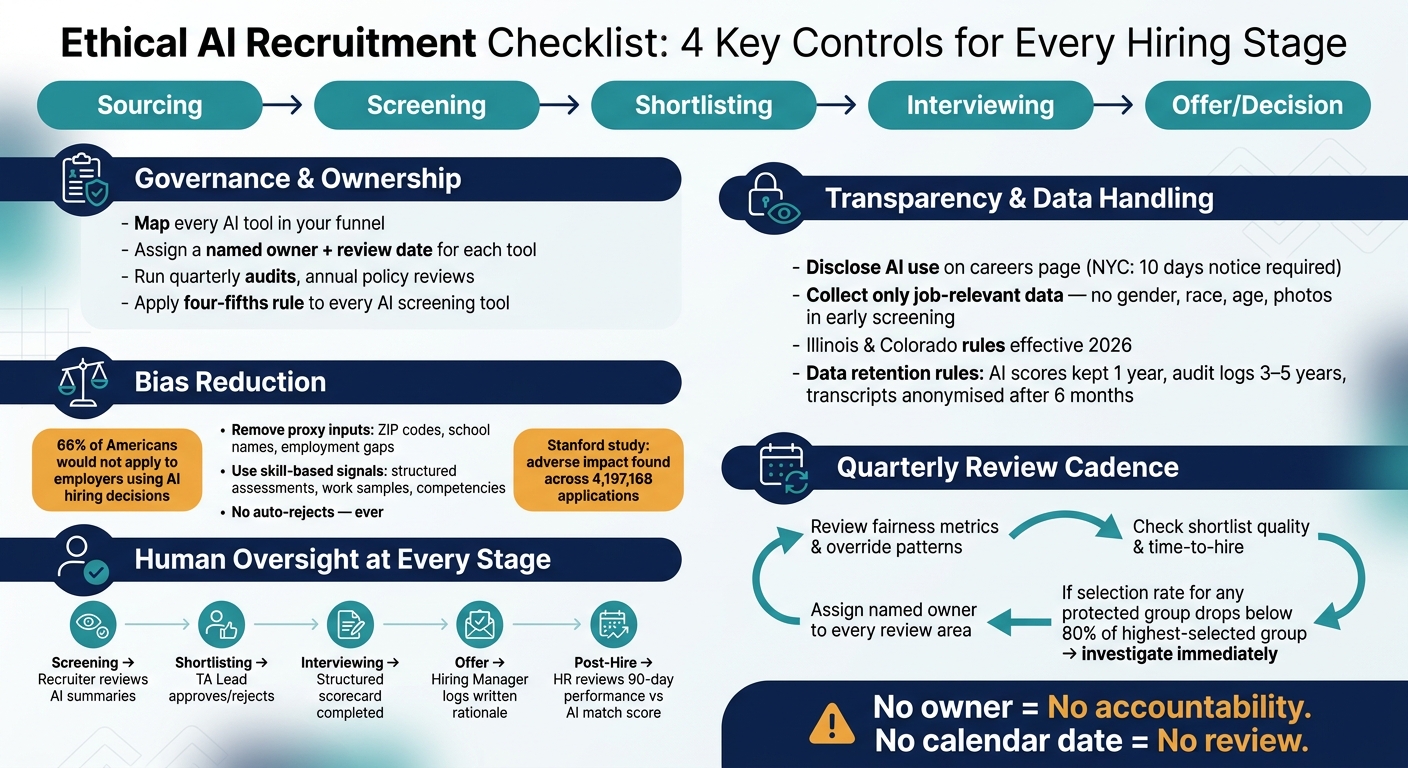
Ethical AI Recruitment Checklist: 4 Key Controls for Every Hiring Stage
Ethics of AI in HR | Bias, Privacy and Legal Risks Explained
sbb-itb-a23bd6a
Checklist Section 1: Governance, Ownership, and U.S. Risk Controls
Start with the basics. You need to know every AI tool in your hiring process, who owns it, and how often it gets reviewed. This section helps you map each AI touchpoint before it shapes candidate decisions, or rate your recruitment process to identify existing gaps. If AI is left unchecked, it can scale the same hiring mistake across every open role.
Build an AI Tool Register for Your Hiring Funnel
An AI tool register is a living document that maps every AI-enabled tool used across your hiring funnel. For each tool, record its purpose, the hiring stage where it appears, its role in decision-making, the owner, version, input fields, and override logs [4].
There’s a big difference between tools that support decisions and tools that rank or reject candidates. That second group needs more control. You’ll need explainability, adverse impact checks, and a clear appeal path [4].
Your register should also show which data fields each tool uses, and which ones are excluded. Keep exportable logs so decisions can be explained and audited later. This matters more than many teams think. Without that record, proxy signals like zip codes or employment gaps can slip into the process and affect outcomes without anyone spotting it [4].
Assign Ownership and Set a Review Schedule
Once every tool is on the list, assign a named owner. If no one owns it, no one is accountable when something goes wrong. Governance tends to fall apart at that point.
Set responsibility across Talent Acquisition operations, Legal, IT, and DEI. Some companies also use a dedicated AI ethics committee to oversee deployment [1].
Review can’t be a one-off task. Use continuous monitoring, quarterly audits, and annual policy reviews. If the workflow changes, or a vendor updates its product, review the tool again.
Monitor Adverse Impact and Confirm Job-Related Criteria
Run the four-fifths rule on every AI screening or ranking tool. At the same time, confirm that each model is using job-related criteria rather than proxy data [6].
You also need to apply any state or local AI hiring rules that affect your workflow [5].
| Governance Check | Owner | Review Frequency | Evidence Required |
|---|---|---|---|
| AI Tool Register Review | TA Operations / IT | Quarterly | Tools, versions, purpose |
| Adverse Impact Audit | Legal / DEI Lead | Annual (or per NYC LL144) | Selection rates, four-fifths rule analysis [5] |
| Human Override Log | Hiring Managers | Monthly | AI recommendations rejected and reasons |
| Vendor Compliance Check | Procurement / Legal | At onboarding / Annual | SOC 2 reports, access controls, bias-mitigation evidence |
| Candidate Disclosure | HR / Communications | Per workflow change | Public-facing policy and AI usage notifications [5] |
With governance in place, the next step is bias reduction and human checkpoints.
Checklist Section 2: Bias Reduction, Human Oversight, and Decision Quality
Governance maps your tools. This section is about cutting bias and putting human control back into hiring decisions.
Audit Data Inputs and Remove Proxy Risks
The biggest bias risk usually comes from proxy data. Think ZIP codes, school names, and employment gaps. On the surface, these fields may look harmless. In practice, they can correlate with race, gender, or income.
That matters because a model trained on past hiring data can repeat old patterns instead of fixing them. If your process was biased before, AI can scale that problem fast.
Go field by field through every input your AI uses. Check whether each one links directly to job performance. If it does not, remove it or flag it for human review.
A better route is to lean on skill-based signals instead of resume shortcuts. That includes:
- Structured assessments
- Work samples
- Demonstrated competencies
This gives you a cleaner basis for screening and helps your team make decisions you can defend.
Add Human Checkpoints to Screening and Selection
If AI is involved in screening, a named human should approve every stage move. That means shortlist, interview, and offer.
Do not allow auto-rejects. Full stop.
A Stanford-led study of 4,197,168 applications found adverse impact at the per-position level, even with demographic-blind screening [3]. That’s the kind of finding hiring leaders can’t afford to ignore. Looking only at top-line numbers can hide problems inside a single role or business unit.
Every override should be logged with a clear reason. That creates accountability, gives HR and legal teams an audit trail, and helps you spot patterns before they turn into a compliance issue.
You should also apply the four-fifths rule at the per-position level, not just across hiring as a whole. That’s how you see whether one requisition is producing disparate impact [3].
Colorado’s SB 26-189 adds a right to meaningful human review of AI-assisted decisions [3]. For employers, that means human oversight is not just good practice. It may shape how you stay on the right side of new rules.
Use Structured Scorecards to Improve Consistency
Once candidates move past screening, structured scorecards help keep interviews consistent and auditable.
Without them, interview decisions can drift. One manager values polish. Another values sector background. Someone else goes on gut feel. That slows hiring, impacts recruitment metrics, and makes decision quality harder to defend.
Scorecards give your team one standard for comparing candidates. They reduce subjectivity and make it easier to show why one person moved forward and another did not.
For high-volume hiring, calibration sessions before a role goes live can save a lot of time later. They help interviewers agree on what “strong” looks like for each criterion before the first interview starts. That means fewer mixed signals, less rework, and better hiring discipline.
The table below shows the human oversight action, fairness check, and accountable role that should sit at each stage:
| Hiring Stage | Human Oversight Action | Fairness Check | Accountable Role |
|---|---|---|---|
| Screening | Review AI-generated summaries against the resume | Verify no proxy filters are active | Recruiter |
| Shortlisting | Approve or reject candidates for the next stage | Apply the four-fifths rule to selection rates | TA Lead / Hiring Manager |
| Interviewing | Complete a structured scorecard for each candidate | Calibrate scores across interviewers | Interview Panel |
| Selection / Offer | Log a written rationale for the final hire decision | Audit for consistency with the scorecard | Hiring Manager / HR |
| Post-Hire Review | Review 90-day attrition and performance | Compare AI match scores with actual quality of hire | HR Director / Talent Ops |
Once bias controls and human checkpoints are in place, the next step is candidate transparency and data handling.
Checklist Section 3: Transparency, Candidate Data Handling, and Process Trust
After internal oversight, make the process visible to candidates.
Tell Candidates Where AI Is Used in Your Process
Candidates deserve a straight answer about how AI touches their application. The numbers show why this matters. 66% of Americans say they would not apply for a position with an employer that uses AI to make hiring decisions [5]. That is a major trust gap, and trust gaps slow hiring, hurt offer acceptance, and can damage your employer brand.
Post a plain-language notice that explains where AI is used and what it affects.
Publish a plain-language disclosure on your careers page and in the application flow. Say where AI is used, confirm that humans make final decisions, and explain how candidates can ask for review or correction.
Spell out the candidate’s right to human review, explanation, access, and correction. In New York City, employers must notify applicants at least 10 days before using AI tools, including the types of data collected and the characteristics the tool analyses [5]. Illinois and Colorado have added similar rules taking effect in 2026 [5]. Keep the disclosure beside the application, not hidden away on a policy page.
Once candidates know where AI is used, the next step is simple. Limit the data those tools can access.
Limit Data Collection and Secure Access
Collect only job-relevant data. Avoid sensitive identifiers such as gender, race, age, or photos during early screening. If a data point is not tied to job fit, it should not sit in your AI input set [2] [5].
Use role-based access so recruiters, hiring managers, and system owners see only what they need. Protect records with multi-factor authentication, encryption, monitoring, and audit logs [2] [5].
This is not just a privacy issue. It is a process trust issue. The more data you pull in, the more risk you carry, and the harder it becomes to explain decisions clearly if a candidate asks.
Set Rules for Data Retention, Deletion, and Review
Data minimisation only works if retention and deletion are just as strict.
Set a retention period, owner, and review date for every data type [2] [5].
| Data Category | Retention Approach | Owner | Review Interval |
|---|---|---|---|
| Candidate Resumes | Retained for duration of hiring cycle plus legal limit | Talent Acquisition Lead | Annual |
| AI scores and rankings | Duration of requisition + 1 year for audit purposes | Recruitment Ops | Quarterly |
| Interview Transcripts | Anonymised after 6 months; deleted after 2 years | HR Manager | Semiannual |
| Workflow and audit logs | Kept for 3 to 5 years for compliance and audit trails | IT/Security Team | Annual |
| Candidate Consent Records | Retained permanently while the record exists | Data Privacy Officer | Semiannual |
Route access and correction requests to the named owner and log the response [2].
Checklist Section 4: Putting Ethical AI Into Day-to-Day Hiring
Policies only matter when they show up in live hiring. The test is simple: does your team use the same standards on every open role, not just when audit season comes around?
Apply the Checklist at Each Stage of a Live Requisition
Once governance, bias controls, and candidate disclosures are in place, use the same checklist across every open requisition. That’s how you reduce drift, protect hiring quality, and avoid a process that changes from one recruiter or hiring manager to the next.
Here’s what that looks like in practice:
- Intake: Set out where AI can support the process and where a person must approve the decision.
- Sourcing: Use AI for outreach and passive search, but keep search criteria broad so old bias does not get baked back in.
- Screening/shortlist: Every AI output needs human review. No auto-rejects.
- Interviews: Limit AI to scheduling and FAQs. Recruiters stay responsible for role fit, communication, and team fit.
- Offer: Final decisions stay human-led and must be approved by the hiring manager.
At the shortlist review stage, log every case where a recruiter changes or overrides an AI recommendation. That record helps you spot decision drift in live hiring and shows that human judgment is being used, rather than people just approving the ranked list without challenge [7].
Use Embedded Recruiters to Keep Oversight Consistent
If your internal team is stretched, give one named recruiter responsibility for keeping the checklist active across live reqs.
This is where embedded recruiter support can help. A named recruiter can keep oversight, documentation, and override logs consistent across open roles. For scaling teams, that means less risk of process gaps when hiring volume jumps or internal capacity gets tight.
Review Results and Improve Every Quarter
Run the review on a fixed quarterly schedule. If it is not on the calendar, it usually slips.
Each quarter, review fairness metrics, override patterns, shortlist quality, time-to-hire, and any gaps in documentation. If selection rates for a protected group drop below 80% of the highest-selected group, investigate before the next hiring cycle starts [6]. Also watch for weak human review or repeated approval of AI rankings without challenge [7].
The table below links each checklist area to an owner, a clear success measure, and the action to take each quarter.
| Checklist Area | Process Owner | Success Measure | Quarterly Review Action |
|---|---|---|---|
| Sourcing & Intake | Talent Acquisition Lead | Diversity of applicant pool | Audit training data for proxy risks, such as zip codes |
| Screening Quality | Lead Recruiter | AI vs. human shortlist alignment | Review override logs and blind-approval patterns |
| Candidate Trust | HR Operations | Candidate satisfaction score | Update transparency disclosures and FAQ content |
| Compliance | Legal/Compliance | Audit readiness | Verify recency of vendor bias audits, NYC Local Law 144 |
| Efficiency | Hiring Manager | Time-to-hire reduction | Compare AI-assisted vs. manual workflow speed |
Assign a named owner to each row and lock in a standing review date. No owner means no accountability. No calendar date means no review. And when that happens, process gaps stay hidden until they hit hiring speed, cost, or compliance.
Conclusion: A Practical Ethical AI Checklist for Better, Safer Hiring
Ethical AI in recruitment is not a one-off task. It needs to run as a repeatable process across every role, every tool, and every quarter. This checklist covers governance, bias control, transparency, and day-to-day execution.
Keep the checklist live. Log every AI tool. Require human review for every shortlist. Review outcomes quarterly on a fixed schedule, with a named owner for each area.
If internal capacity is the issue, embedded recruiting support can help keep these controls active in live hiring. Rent a Recruiter can place experienced recruiters inside your team, so hiring stays structured, visible, and consistent across every open requisition.
FAQs
How can we tell if AI is unfairly filtering applicants?
Monitor your hiring funnel for adverse impact with the EEOC’s four-fifths rule.
Here’s the practical test: calculate the selection rate for each demographic group. If one group falls below 80% of the highest selection rate, treat that as a red flag and investigate it.
Don’t stop at company-level reporting. Run bias audits for each job because averages across the business can mask role-specific issues. A hiring process may look fine on paper, while one team or one vacancy shows a clear pattern you need to address.
Keep human oversight in place at every stage. Record the reason for every rejection. And if your system ranks, filters, or shortlists people, make sure you can explain how those decisions were made.
That matters for more than compliance. It helps you spot risk early, protect hiring quality, and avoid wasting time on a process that quietly screens out strong talent.
What should a human reviewer check before moving a candidate forward?
Before any candidate moves forward, a human needs to review the AI shortlist against the actual job criteria. That means checking whether the person meets the role requirements, then using human judgment to weigh softer factors like communication style, team fit, and how they may work with others day to day.
AI can sort and surface profiles. It should not make the final call. In hiring, that distinction matters because poor decisions cost time, money, and trust.
Each decision to advance or reject a candidate should also be logged with a clear human rationale. Keep it specific. A short note tied to job-related criteria gives you:
- Accountability for each decision
- An auditable record if decisions are later reviewed
- Clear proof that final hiring authority stays with the recruiter
This kind of review process does more than reduce risk. It gives your team a cleaner hiring record, stronger decision control, and a process you can stand over if challenged.
How often should we audit AI tools in our hiring process?
Audit AI hiring tools for each job before initial deployment. Once the tool is live, run formal bias audits at least once a year.
For day-to-day compliance, review results every quarter using the EEOC’s four-fifths rule to spot adverse impact. This gives you an early warning if performance starts to drift by role, so you can fix issues before they affect hiring outcomes, slow down decisions, or create legal risk.