
If your hiring plan is growing and agency spend is climbing, employee referrals can cut cost-per-hire, cut time-to-fill, and give you more control over hiring output.
I’d keep it simple. Referral programmes work when you run them like a hiring channel, not a one-off ask in Slack. The numbers are hard to ignore: referred candidates are hired at around 30%, compared with 7% from other sources. Time-to-hire can drop to 29 days, and cost-per-hire often sits between $1,000 and $2,500, against a $4,700 average from other channels.
If I were building this for a scaling business in SaaS, tech, fintech, engineering, security, insurance, or professional services, I’d focus on four things first:
- Clear rules on who can refer, which roles qualify, and when bonuses are paid
- Fast process with a simple submission form, ATS tracking, and a 48-hour response SLA
- Steady promotion so priority roles stay visible across the business
- Tight measurement on conversion, time-to-fill, retention, and participation
The commercial point is simple. You spend less, fill roles sooner, and reduce pressure on internal teams.
If referral volume starts to outgrow internal capacity, embedded recruitment can help you keep intake, follow-up, and reporting under control without adding more hiring admin.
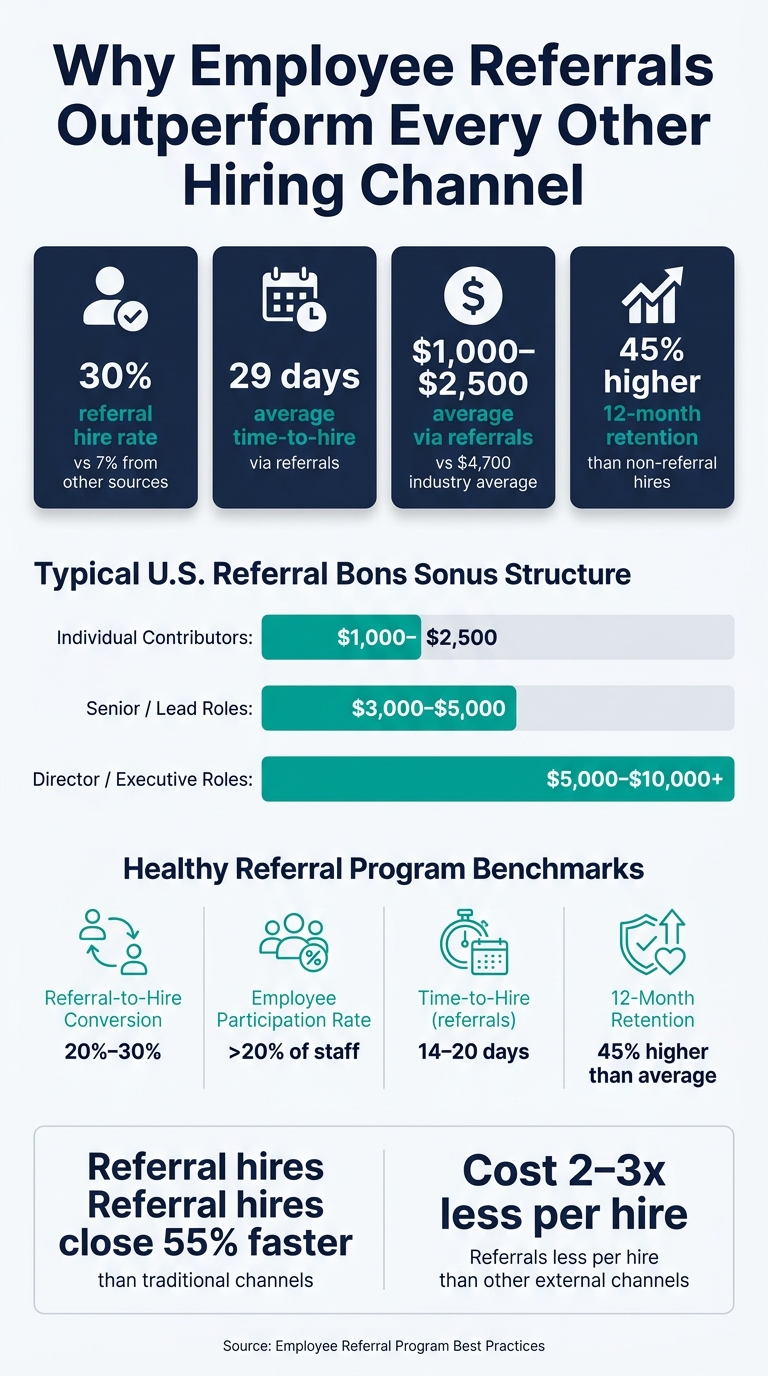
Employee Referrals vs Other Hiring Channels: Key Stats
Secret Weapon to Hiring: How to Create an Effective Employee Referral Program
sbb-itb-a23bd6a
1. Build the Foundation Before You Push for Volume
Build the system first, then go after volume. If you ask people to send names before the basics are in place, the program usually falls flat.
Start with clear goals, clear ownership, and rules people can follow without reading a policy document twice.
Set goals, budget, and ownership for the program
Pick 2 to 3 measurable targets that link straight to your hiring plan. Good choices include quality of hire, time-to-hire, and cost-per-hire.
Just as important, decide who owns what.
HR or Talent Acquisition should run the day-to-day admin. Finance and Legal should agree on the rules and payout timing. You also need an executive sponsor at VP or C-suite level to keep the program visible and make sure it does not drift down the priority list.
Budget matters too. You can use an embedded recruitment savings calculator to estimate potential cost reductions. Set aside spend for software, admin time, and internal promotion. If you skip this part, the program can turn into extra work with no structure behind it.
Write simple referral rules employees can follow
If the rules are vague, participation drops. Once ownership is clear, publish the rules in plain English.
Set these rules up front:
- Who can refer: Employees and any other groups you explicitly allow. Hiring managers should usually be left out of bonus eligibility for referrals into their own direct reports, to avoid conflicts.
- Which roles qualify: Aim the program at hard-to-fill, senior, or specialist roles, not entry-level roles with high organic volume.
- Duplicate referrals: Use a first-to-submit rule. Whoever enters the candidate into the system first gets the credit.
- When rewards are paid: A split-payout model works well. Pay 50% when the candidate starts and the other 50% after they complete 90 days [5][6]. That helps reduce early-turnover risk without making people wait too long.
- Bonus amounts: A simple U.S. structure is $1,000 to $2,500 for individual contributors, $3,000 to $5,000 for senior or lead roles, and $5,000 to $10,000+ for director or executive roles [3].
One rule often gets missed, and it has a big effect on trust in the program. Commit to a 48-hour response SLA on every referral submitted [1]. If someone sends a strong contact and hears nothing for a week, they are far less likely to refer again.
Track a small set of metrics from day one
Track a small set of numbers from the start. You want to see volume, speed, and hiring quality without drowning in reports.
| Metric | Healthy Benchmark | Why It Matters |
|---|---|---|
| Referral-to-hire conversion | 20% to 30% [1] | Shows whether referrals are producing quality leads |
| Employee participation rate | >20% of staff [1] | Indicates whether the program is staying top of mind |
| Time-to-hire (referrals) | 14 to 20 days [1] | Referrals should close faster than other channels |
| 12-month retention | 45% higher than average [6] | Helps show the long-term value of the program |
Track these from month one and adjust fast. If participation is low, fix communication. If referrals are coming in but not converting, tighten the role focus or improve screening. The point is simple: measure early, spot gaps fast, and keep the program tied to hiring outcomes.
2. Design a Referral Process That Can Handle Hiring at Scale
Once your goals and rules are set, the next job is building a workflow that holds up as hiring volume grows. Fast intake, clear ownership, and solid tracking are what keep referral volume from turning into admin chaos. Get that structure right, and referrals become far easier to submit, manage, and report on.
Make referrals fast to submit and easy to track
This is where a lot of referral programs lose steam.
If the form feels like homework, people put it off. Or they skip it altogether. Keep it tight: name, email, LinkedIn, and a short note on role fit. The aim is simple, under two minutes from start to submit so employees can act quickly when someone comes to mind [1][6].
Make the form mobile-friendly too. People often think of a strong referral outside working hours, on the train home, after a call, or while scrolling on their phone. If the process only works on desktop, you’ll lose submissions.
Once a referral comes in, it should be tagged by source in your ATS automatically, not dumped into a spreadsheet. Manual tracking falls apart fast. It creates gaps, slows reporting, and leaves you guessing which channels are pulling their weight.
Assign clear steps from submission to offer
Every stage needs a named owner.
Employees make the introduction. Recruiters handle screening, ATS tagging, and updates to the referring employee. Hiring managers own fast feedback and final decisions. When ownership is vague, referrals stall—often a sign you need a recruitment health check to identify process gaps. And when referrals stall, trust in the programme drops with it.
Build automated status updates into your ATS so employees hear what’s happening at each stage: confirmation, screening result, interview, offer, or rejection. That cuts follow-up messages, saves recruiter time, and gives employees a better experience without extra manual work.
Use tools and operating support to manage volume
A spreadsheet might work for a handful of referrals. At scale, it becomes a problem. You get data gaps, missed candidates, and patchy reporting. That’s not just messy, it makes it harder to judge hiring channel performance or forecast recruiter workload.
ATS platforms with native referral tracking handle source tagging, automated notifications, and pipeline reporting without extra admin.
| Feature | Manual Tracking | ATS-Enabled Tracking |
|---|---|---|
| Admin time | High; manual entry and follow-ups | Low; automated tagging and notifications |
| Data quality | Prone to duplicates and lost entries | Centralised, structured, and accurate |
| Reporting visibility | Difficult to aggregate; often outdated | Real-time dashboards for recruiters and leaders |
| Scalability | Breaks down at high volume | Designed for high-throughput hiring |
When internal recruiting capacity is tight, an embedded recruiter can manage referral flow, reporting, and follow-up without adding more admin pressure to your team. That gives you cleaner execution, better visibility, and less drag on internal hiring teams.
3. Increase Referral Volume With Incentives, Communication, and Team Habits
Once referrals are easy to submit, the next job is getting more people to take part.
Choose incentives that support both volume and quality
Focus on qualified referrals, not just more names.
A flat bonus across every role can push employees to send anyone they know. On the flip side, bigger bonuses can also attract low-fit referrals if the reward becomes the main focus. A better approach is to use tiered rewards for hard-to-fill roles and link payouts to successful hires and retention.
For higher-paid employees, cash is not always the strongest nudge. Extra PTO, paid experiences, or charitable donations in their name can land better than another deposit [1][6][4]. A mixed model helps you manage budget, keep referral quality on track, and still drive volume.
Keep open roles visible across the company
If people do not see open roles often, they stop thinking about referrals.
Keep the programme in front of the business through Slack, internal newsletters, all-hands meetings, and manager-led team conversations [4][6][2]. Direct asks from hiring managers often beat mass emails [1].
It also helps to narrow the focus. Highlight 10 to 15 priority roles with short briefs that explain:
- the team
- required experience
- location
- must-have skills [7]
Send these updates weekly so employees can scan their networks with a clear brief in mind, instead of guessing who might fit [6][1].
Run focused referral drives around strategies for tough positions
Steady visibility keeps referrals active. But when you need a short burst of hiring activity, referral sprints can help.
These are time-limited campaigns built around urgent roles, often with a doubled reward to increase participation [1]. A simple format is to choose a small group of priority roles, set a two-week window, and run a sourcing session where teams review their LinkedIn or GitHub networks together for likely matches [2][8].
That time limit matters. It creates urgency without locking you into a higher long-term spend.
After each drive, review what worked. Track which roles and channels brought in the most referrals, then use that data to shape the next campaign.
4. Measure Results, Reduce Risk, and Improve the Program Over Time
Review referral performance against hiring outcomes
Now that referrals are coming in, the next step is simple: check whether they turn into hires.
Focus on output, not just activity. A high number of referrals means very little if they don’t move through the funnel. Look at speed, cost, conversion, and retention against your hiring goals. If your referral program is working well, it should outperform other hiring sources across all three.
Track employee participation too, and watch for drop-offs by department. A monthly review helps you spot issues early. Then use a deeper quarterly funnel and ROI check to see what’s working, what’s slowing down, and where spend is paying off.
Protect quality, consistency, and team diversity as referrals grow
As referral volume increases, one risk shows up fast: a narrower talent pool.
People tend to refer from their own networks, and those networks often reflect people like themselves. That matters. Women of color are 35% less likely than white men to receive an employee referral [1]. As referral volume goes up, network bias can spread quietly through the process and affect hiring outcomes at scale.
The answer is not to slow the program down. It’s to put clear guardrails in place.
Apply the same structured screening process to every candidate, whether referred or not. Document decisions at each stage. Then review referral-to-hire conversion rates by demographic group from time to time so you can spot patterns before they become bigger issues [1][3].
Targeted incentives can help as well. For underrepresented candidates, options like doubled referral bonuses may help counter network bias without reducing overall referral volume [1].
Use recruiting support to scale without losing control
When referral volume starts to outgrow your team’s admin capacity, things can slip. Follow-up slows down. Hiring managers get uneven updates. Reporting becomes patchy.
This is where embedded recruiting support can help. An embedded recruiter can keep intake, follow-up, and reporting consistent as hiring grows. That means managing submissions, coordinating hiring managers, maintaining SLAs, and keeping the program running cleanly without adding more admin pressure to your internal team [1].
For scaling companies, that’s often the difference between a referral program that looks good on paper and one that keeps delivering hires without losing control.
Conclusion: Turn Referrals Into a Predictable Hiring Channel
A referral program only works when you run it properly. It needs clear rules, a fast submission flow, visible open roles, and steady rewards.
That’s what turns referrals from occasional help into a hiring channel you can plan around. Referral hires close 55% faster, stay 45% longer, and cost 2 to 3 times less per hire than other external channels [6].
Most programs don’t fail because people won’t take part. They fail because the setup is weak. Put a 48-hour response SLA in place, publish a monthly list of priority roles, and use tiered incentives [1][7]. Then track the numbers that matter:
- Referral-to-hire conversion
- Time to fill
- Retention
- Participation rate
If hiring demand climbs faster than your internal team can handle, added recruiting support helps keep referrals moving. When volume outgrows internal capacity, Rent a Recruiter can cut hiring costs by up to 70% and save more than 80 hours per month in internal hiring and admin time.
Done well, referrals stop being a nice extra. They become a core part of how you hire: predictable, lower cost, and built to grow with your business.
FAQs
What makes an employee referral program scalable?
A referral program becomes scalable when it stops being a manual, ad hoc effort and turns into a structured, repeatable, data-led hiring channel.
That starts with a frictionless, mobile-friendly submission process that takes less than 60 seconds. If it feels slow or clunky, people won’t use it. From there, you need consistent tracking, automated updates, and clear reporting so you can see what’s working, where referrals are coming from, and how they’re moving through the funnel.
As volume grows, quality can slip if you don’t put guardrails in place. Set clear referral guidelines so employees know who to send and for which roles. Use tiered incentives to steer attention toward hard-to-fill or high-priority positions, instead of paying the same reward for every hire. Keep the program tied to business needs, not just activity.
Speed matters too. Review referred candidates fast. That keeps employees engaged and stops strong candidates from losing interest or dropping out. In practice, the companies that get the best return from referrals treat them like any other hiring channel: measured, managed, and built to scale.
How do we keep referral quality high?
Focus referrals on the roles that are hardest to fill, especially where domain know-how or team fit matters most. You do not need to open every vacancy to referrals. In most scaling companies, that just creates noise.
Keep incentives in check. Oversized referral bonuses can push volume instead of quality. A tiered payout, tied to both hiring and retention, tends to work better. It gives you a cleaner signal and helps you spend where it counts.
Discipline matters here too. Set a 48-hour SLA for initial screens so referred candidates do not sit in limbo. Then track referral-to-hire data and close the loop with employees. When people get feedback, the programme starts to reward better referrals, not just more of them.
When should we add recruiting support?
Bring in recruiting support when your internal team is stretched and can’t keep hiring structured, consistent, and effective. That usually shows up when you’re trying to manage 30 to 50 open roles at the same time, and the process starts becoming reactive instead of planned.
It’s also the right time to add support when hiring delays start slowing growth, costs go up, or you need extra capacity for a short-term spike in demand. At that point, the issue isn’t just workload. It’s the impact on time-to-hire, hiring quality, and team focus.