
If your TA titles are blurry, your hiring cost goes up and your team slows down.
I’d read this article one way: match the role to the bottleneck. If recruiters are buried in scheduling, you need a Coordinator. If pipeline is weak, you need a Sourcer. If reporting is poor, you need TA Ops or an Analyst. That matters more than the title on the job spec.
A few numbers make the point fast:
- In 2026, the average in-house recruiter is handling 13.4 open reqs at once
- That is 56% higher than in 2021
- Recruiters can lose up to 40% of their time to admin and scheduling
- Teams can cut interview turnaround by up to 35% with dedicated coordination support
For CEOs, CFOs, HR leaders and TA leaders, the commercial point is simple: do not hire by title habit, but focus on talent acquisition strategies. Hire for the part of the process that is slowing output, wasting senior time, or hurting offer conversion.
This piece maps the 10 TA roles that show up most often in scaling firms across SaaS, Technology, IT, Fintech, Engineering, Security, Insurance and Professional Services, then shows where each role tends to pay off first.
Job description of Talent Acquisition – Role, Responsibilities & Skills
sbb-itb-a23bd6a
Quick comparison
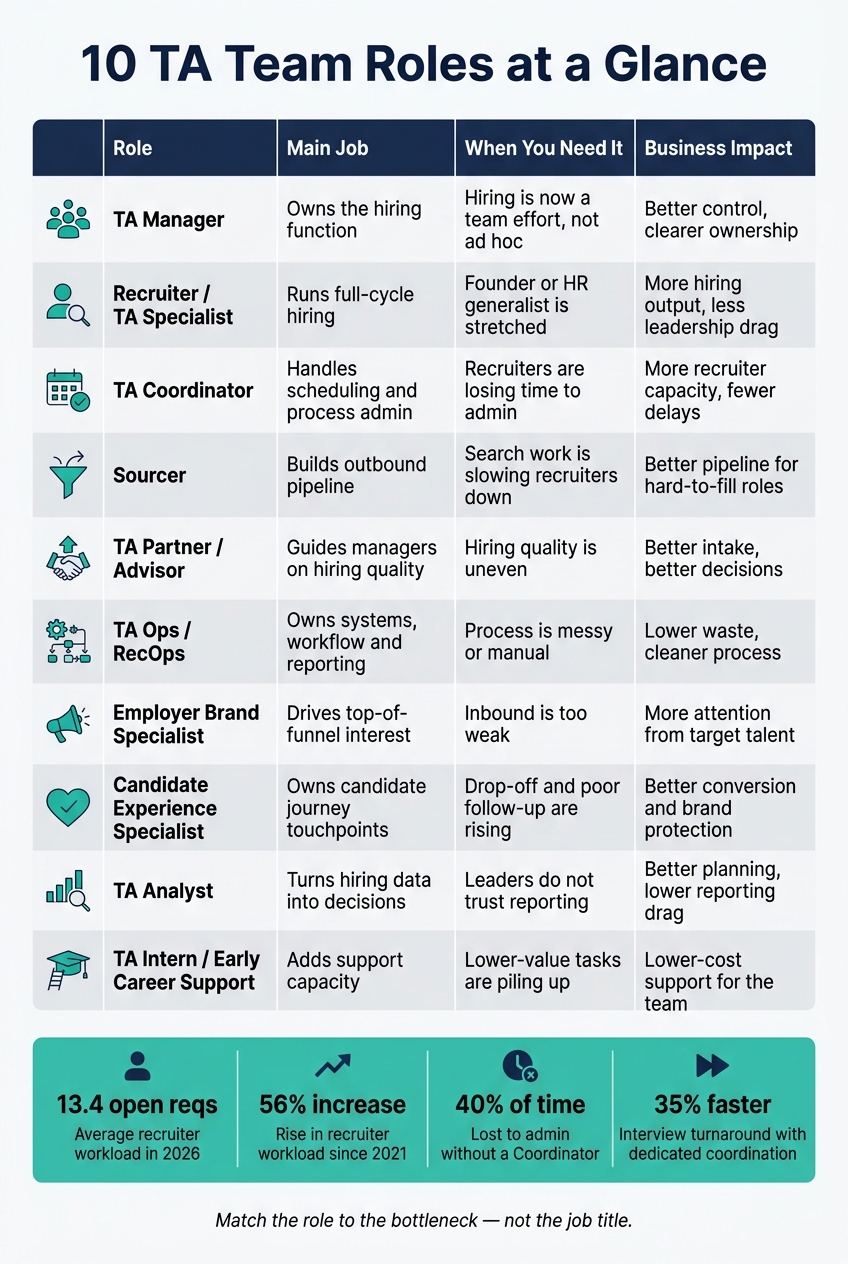
10 TA Team Roles: When to Hire Each & What They Do
| Role | Main job | When you usually need it | Business impact |
|---|---|---|---|
| TA Manager | Owns the hiring function | Hiring is now a team effort, not ad hoc | Better control, clearer ownership |
| Recruiter / TA Specialist | Runs full-cycle hiring | Founder or HR generalist is stretched | More hiring output, less leadership drag |
| TA Coordinator | Handles scheduling and process admin | Recruiters are losing time to admin | More recruiter capacity, fewer delays |
| Sourcer | Builds outbound pipeline | Search work is slowing recruiters down | Better pipeline for hard-to-fill roles |
| TA Partner / Advisor | Guides managers on hiring quality | Hiring quality is uneven | Better intake, better decisions |
| TA Ops / RecOps | Owns systems, workflow and reporting | Process is messy or manual | Lower waste, cleaner process |
| Employer Brand Specialist | Drives top-of-funnel interest | Inbound is too weak | More attention from target talent |
| Candidate Experience Specialist | Owns candidate journey touchpoints | Drop-off and poor follow-up are rising | Better conversion and brand protection |
| TA Analyst | Analyzes essential recruitment metrics to drive decisions | Leaders do not trust reporting | Better planning, lower reporting drag |
| TA Intern / Early Career Support | Adds support capacity | Lower-value tasks are piling up | Lower-cost support for the team |
If your team has hiring demand now but lacks in-house capacity, embedded recruitment can fill the gap while you decide which TA roles to build next.
How to Read TA Job Titles Without Getting Confused
TA titles are not standardised. The title alone won’t tell you much. What matters is the scope.
A Talent Acquisition Specialist might run the full hiring cycle in one company, then handle only screening in another. Same title, very different job.
As companies grow, hiring work usually gets split across more focused roles, like Sourcer, Coordinator, and Recruiting Operations. That happens for a simple reason: one person can’t do everything well forever. Splitting ownership helps stop burnout and process decay [4][3].
Industry adds another layer. In tech, companies often put more weight on Sourcers because reaching passive talent is a big part of the job. In healthcare and finance, Coordinators may carry more weight because compliance and credentialing matter more [3][4]. That’s why the roles below are divided across sourcing, coordination, operations, and candidate experience.
To make sense of each role, this guide looks at every position through four lenses:
- Primary focus: strategy or execution
- Typical responsibilities: full cycle or one stage
- Seniority level: hands-on or consultative
- Best fit for high-growth SMEs: where the role gives you the most leverage as you scale
Use those four lenses as you read the role breakdown below. For more industry insights, you can also explore The Talent Fix Recruitment Blog.
Start with the Talent Acquisition Manager. In many scaling companies, this is the role that sets TA priorities and owns hiring outcomes.
1. Talent Acquisition Manager
Primary Focus
The Talent Acquisition Manager leads your recruitment function.
This role is about building a hiring system that works at scale, not just filling roles one at a time. That includes workforce planning, team leadership, budget control, and making sure hiring lines up with business goals [1][10].
If your company is growing, this matters fast. Without clear ownership, hiring can drift into reactive mode, costs climb, and teams lose time.
Typical Responsibilities
On a day-to-day basis, the role usually covers:
- Headcount forecasting
- Interview design
- ATS ownership
- Team coaching
- Workload balancing across open roles
- KPI tracking, including time-to-fill, cost-per-hire, and quality of hire
- Hiring compliance [1][8][12]
Compliance also means keeping the process in line with EEO, ADA, and salary-history ban laws [1][2].
In plain terms, this person keeps the engine running. They bring structure, track performance, and stop hiring from turning into a bottleneck.
That’s why the roles that follow tend to focus on narrower parts of the process.
Seniority Level
This is a leadership role, not a hands-on recruiter role.
Talent Acquisition Managers usually bring 5+ years of related experience and often report to an HR Director, Head of People, or a C-suite leader [1][10].
They’re there to guide the function, set standards, and make sure hiring supports growth instead of slowing it down.
Best Fit for High-Growth SMEs
A TA Manager becomes important when informal hiring starts to crack.
That usually happens when hiring goes beyond 50 roles per year or when the business passes 100 employees [2][3].
At that point, spreadsheets, ad hoc interviews, and shared hiring ownership often stop working. You need one person accountable for process, pace, and results.
As hiring volume grows, this role often shifts more of the day-to-day delivery to specialist TA roles. Sourcing, coordination, and operations then split into separate jobs as demand increases.
2. Talent Acquisition Specialist or Recruiter
Primary Focus
If the TA Manager sets the system, the Recruiter runs the day-to-day hiring engine.
The Talent Acquisition Specialist, or Recruiter, owns hiring from intake to offer. In many companies, those two titles mean much the same thing, though the scope shifts based on company size. The role usually covers intake meetings, sourcing, screening, interview coordination, offer negotiation, and the onboarding handoff [1][11].
In practice, this is often the person keeping the whole process moving. They are usually the main point of contact for hiring managers and candidates, which means they have a direct effect on hiring speed, team time, and offer acceptance.
Typical Responsibilities
Day to day, this role works with hiring managers to define success profiles and job requirements, builds sourcing plans, runs screening calls, submits candidates, and manages offers through acceptance [1][5].
They also track the numbers that tell you whether hiring is working or stalling, such as:
That matters for one simple reason: if you cannot see where hiring slows down, you cannot fix it. You can use an embedded recruitment savings calculator to see how these efficiencies impact your bottom line.
Seniority Level
Most TA Specialists bring 2–5 years of experience and sit between the Coordinator and the Senior TA Partner [1]. For many scaling companies, this is the first dedicated TA hire once recruiting volume moves beyond what a founder or HR generalist can handle.
In 2026, the average in-house recruiter manages 13.4 concurrent open requisitions, a 56% increase from 2021 [4]. That tells you a lot about the pressure on internal teams. A practical workload is usually 13 to 15 active searches for general roles, and 4 to 5 for niche or technical roles [4].
If you push past that, quality tends to slip. Hiring managers wait longer, candidate follow-up slows, and the process gets messy fast.
Best Fit for High-Growth SMEs
This role becomes essential when hiring volume reaches 20 to 25 roles per year, or when a founder or HR generalist is spending more than 50% of their time on recruiting [3][4]. That is usually the point where informal hiring stops working.
What does that look like on the ground? Delays in feedback. Inconsistent screening. Too much admin. Too little market reach. And a lot of senior time tied up in work that should not sit with leadership.
An embedded recruiter can step in and cover that gap while demand grows. That gives you hiring support without rushing into a full internal build. As volume climbs further, coordination often needs to split into its own role.
3. Talent Acquisition Coordinator
Primary Focus
If the recruiter drives hiring, the Coordinator keeps the process moving.
The TA Coordinator is the operational centre of the recruiting team [1][14]. This person usually does not assess candidates or make the final call. Their job is to keep every step between application and start date on track.
That includes scheduling, paperwork, communication, and interview logistics. A strong TA Coordinator cuts drop-off by keeping calendars aligned, staying on top of candidate touchpoints, and making sure documents do not slip through the cracks. This role tends to appear when hiring volume reaches the point where admin becomes a full-time job. As that volume grows, the Coordinator takes on the admin work recruiters can no longer carry without slowing hiring down.
Typical Responsibilities
The role is heavily process-led. Coordinators often handle:
- Interview scheduling across time zones
- ATS updates and record accuracy
- Candidate instructions and status updates
- Scorecard collection
- Background checks, offer letters, and onboarding handoff
Without dedicated coordination support, recruiters can lose up to 40% of their time to scheduling and admin follow-up [14]. Put simply, that is time you are paying for, but not spending on hiring the right people. Dedicated coordination has also been shown to improve interview turnaround times by as much as 35% [14].
In practice, the title matters less than the ownership. If one person is responsible for logistics, accuracy, and follow-through, you have this function in place whether the title says Coordinator or not.
Seniority Level
This is usually an entry-level role, often requiring 0 to 1 years of experience [16]. Many Coordinators move into recruiter roles within 1 to 2 years [1][15].
Best Fit for High-Growth SMEs
This role starts to make sense when admin work begins to crowd out actual recruiting. A useful signal is when those tasks are taking up 40% or more of a recruiter’s time [14]. It is also often added once annual headcount plans move above 50 hires per year [2].
For scaling companies, the Coordinator is often the first specialist hire after a generalist recruiter [3][2]. That move can protect recruiter capacity, shorten delays, and keep hiring teams from getting stuck in calendar chaos. Without that support, scheduling gaps and weak follow-up can hurt candidate experience and slow down offers.
Next comes the role focused on finding talent before they apply.
4. Sourcer or Talent Researcher
After coordination keeps hiring on track, sourcing does the next job: building pipeline before applications even show up. The title can change, but the job stays the same. This role is there to create talent flow before hiring demand spikes.
Primary Focus
The Sourcer finds and qualifies people before a role is filled, and often before it is even advertised. The Sourcer builds the pipeline. The Recruiter turns that pipeline into hires.
This is the first role in the team centred on proactive search, not just screening inbound applicants.
Typical Responsibilities
Sourcers turn job requirements into a clear target candidate profile. They run Boolean searches across LinkedIn, GitHub, and sector-specific databases, then map where target talent works now.
From there, they build personalised outreach sequences, make contact, gauge interest, and pass qualified people to the recruiter.
A strong sourcer does more than search. They build pipelines, keep passive candidates warm, and make sure candidate data stays clean in the ATS or CRM.
Seniority Level
Sourcing is a research-heavy specialism, not just an entry-level recruiting task. In SMEs, mid-level sourcers often give the best return because they can build process, not just follow one.
Best Fit for High-Growth SMEs
A dedicated sourcer makes sense when discovery becomes the bottleneck. If recruiters spend more than 30% of their time searching for candidates [17], a sourcer gives that time back so recruiters can focus on interviewing, assessment, and closing.
This role has the biggest impact when inbound applicants are weak and search work is slowing the team down. It also matters more in niche or technical hiring, where application volume may be thin.
Pre-sourcing 4 to 8 weeks before a role opens can cut time-to-fill and improve offer acceptance [17][18].
At a business level, that means:
- Less recruiter time lost to manual search
- Shorter hiring cycles for hard-to-fill roles
- Better use of recruiter capacity
- Stronger pipelines before hiring pressure hits , as seen in our embedded recruitment case studies
Once sourcing is covered, the next role shifts from finding talent to advising hiring managers and closing offers.
5. Talent Acquisition Partner or Talent Advisor
A Talent Acquisition Partner, or Talent Advisor, is a senior individual contributor who works closely with hiring managers on role design, market conditions, and hiring process quality. Unlike a Recruiter, this role shapes the process before sourcing begins. In some companies, Partner and Recruiter mean the same thing, but in practice, the Partner role is usually more consultative and less focused on day-to-day execution [1][19][20].
Typical Responsibilities
This person pressure-tests the job brief, helps design the interview process, sets scorecards and decision criteria, and brings market data on pay and talent supply into hiring decisions [1][19][21].
That matters because poor hiring outcomes often start long before the first candidate enters the pipeline. If the brief is vague, the interview plan is weak, or decision-makers aren’t aligned, you lose time, slow down hiring, and increase the odds of a bad hire.
They’re usually measured on quality-of-hire and pipeline health, not just the number of roles closed [11][19].
Seniority Level
This is usually a senior individual contributor role. Most companies expect 5+ years of full-cycle recruiting experience, plus strong business judgement and the confidence to challenge hiring teams when needed [1][11].
In other words, this isn’t just someone who fills roles. It’s someone who helps you make better hiring decisions from the start.
Best Fit for High-Growth SMEs
This role tends to make the most sense when interview quality is inconsistent, hiring managers need more support, or different teams are using different standards. In high-growth companies, that’s a common problem. One team runs a tight process, another wings it, and suddenly hiring quality becomes uneven.
A Talent Acquisition Partner brings structure through:
- scorecards
- decision criteria
- intake frameworks
That structure helps each search begin with the same standards, which can save time, cut rework, and improve hiring consistency across the business [3][21].
Once that advisory layer is in place, the next bottleneck is often process control. That’s where Recruiting Operations comes in.
6. Recruiting Operations or Talent Acquisition Operations
Recruiting Operations, often called RecOps or TA Ops, runs the engine behind hiring. It sits in the background so your TA team can spend less time fighting systems and more time getting roles filled. Recruiters own the candidate relationship. Coordinators keep the process moving. RecOps owns the system both teams rely on [4][7].
At a business level, this matters for one simple reason: better hiring systems cut waste. You save recruiter time, reduce process drift, and get more consistent hiring outcomes.
Primary Focus and Typical Responsibilities
The main job is to make hiring faster, cleaner, and easier to repeat. In practice, that means setting up and maintaining the ATS, managing the recruiting tech stack, building dashboards and funnel reports, shaping handoffs between hiring stages, standardising interview workflows, and keeping the process aligned with EEO, ADA, and CCPA rules [4][5].
RecOps usually covers four core areas:
- Technology: ATS setup, tool integrations, and AI tools
- Data: funnel conversion tracking, time-to-fill reporting, and leadership dashboards
- Process design: standard scorecards, pipeline stages, and stage handoffs
- Compliance: data privacy, vendor contracts, and governance
It also often owns vendor management for background check providers, assessment tools, and job boards [4][5].
Here’s the blunt version: if recruiters are spending more than 25% of their time on manual admin, you do not have a recruiter capacity issue first. You have a RecOps issue [4].
Seniority Level
This is why RecOps often begins as a shared job and later turns into a stand-alone role. In smaller teams, the Head of TA usually carries it until hiring volume makes that hard to sustain. The first dedicated hire is often a TA Operations Manager or Systems Analyst [2][4].
That shift tends to happen when TA leaders are spending too much of their week fixing workflows, pulling reports, handling tool issues, or patching over process gaps instead of leading hiring.
Best Fit for High-Growth SMEs
This role becomes hard to ignore when informal processes stop holding up under volume. One of the clearest signs is when manual workarounds are the only thing keeping hiring on track [9][4]. That might mean spreadsheets sitting outside the ATS, patchy reporting, broken stage handoffs, or interview steps that change from team to team.
For high-growth SMEs, a dedicated RecOps hire makes sense when admin work and tech management start eating too much of TA leadership’s time. That’s not just an annoyance. It’s a cost issue. Senior people end up doing process repair instead of work that moves hiring forward.
Before you add more full-cycle recruiters, check the bottleneck first. If the drag is poor process, weak data, or clunky systems, RecOps may solve it at a lower cost and with better hiring results than adding more delivery headcount [9].
Once the hiring system is stable, the next roles can focus more on attraction and candidate experience.
7. Employer Branding and Talent Marketing Specialist
Once your hiring process is steady, the next pressure point is top-of-funnel demand. That’s where an Employer Branding and Talent Marketing Specialist comes in.
This person owns your employer brand, careers site, recruitment content, and talent marketing. In plain English, they build the attraction engine that makes it easier for recruiters to do their job [2][8][5]. Their remit is attraction, not scheduling interviews or screening candidates.
Primary Focus and Typical Responsibilities
This role sits between marketing and HR. The job is to shape how people see your company before they ever speak to a recruiter.
That usually means:
- Managing the careers page
- Running recruitment marketing campaigns
- Creating employee stories and social content
- Monitoring review sites like Glassdoor [22][5]
The commercial point is simple: better market perception can lift outreach response rates, especially with passive talent. But this is not an instant-fix role. Results build over time.
Seniority Level
This is usually a specialist mid-to-senior hire. In some businesses, the title shifts to Employer Brand Manager when the scope includes external agency oversight or a small content team [5][6].
In most SMEs, it’s still an individual contributor role. They often report to the Head of TA or a Marketing lead [22][6].
Best Fit for High-Growth SMEs
The clearest sign you need this role is when inbound applications stop being enough, especially in tight markets.
One number stands out: about 70% of workers are passive job seekers. They are not actively applying, but what they see about your company online can shape whether they engage at all [8].
That’s the business case. A strong employer brand helps turn passive awareness into applications, which gives your team a larger and warmer pipeline to work from.
For most companies, the setup tends to follow growth stage:
- In startups, founder-led branding often does the heavy lifting
- In scaleups, a dedicated specialist usually makes more sense
- In larger teams, a manager or executive may be needed
- If a full-time hire is out of reach, a marketer can support recruitment marketing part-time [6]
Branding pulls people in. Candidate experience is what keeps them moving.
8. Candidate Experience Specialist
Employer branding helps bring people into your hiring funnel. The Candidate Experience Specialist shapes what happens next, from first touch to final decision. That puts the role right between candidate perception and hiring conversion [24][26]. And the stakes are high, 65% of candidates lose interest after a poor interview or application experience [25].
Primary Focus
Recruiters run selection. Coordinators handle scheduling and admin. This role looks after the candidate journey itself [24][13].
That means making sure communication is clear, timely, and respectful at every stage. For scaling teams, that is not just a people issue. It affects conversion rates, recruiter workload, and brand reputation.
Typical Responsibilities
The day-to-day work usually includes candidate updates, rejection feedback, post-interview surveys, Candidate NPS, and hiring funnel drop-off analysis [24][27]. It also covers improving the application flow to cut drop-off [29].
When hiring volume climbs, this work often slips if recruiters are expected to do it on top of sourcing and stakeholder management. That is where this role starts to pay for itself. You get a more consistent experience for candidates, while recruiters get time back to focus on hiring outcomes.
Seniority Level
This is usually an entry-to-mid-level role, often the next step for an experienced TA Coordinator [23][1]. At senior level, the role moves into mentoring, process redesign, and tracking candidate satisfaction and time to offer acceptance [28].
In scaling teams, that matters. A good specialist protects candidate trust and gives recruiters space to spend time on interviews, pipeline quality, and hiring manager alignment.
Best Fit for High-Growth SMEs
This role starts to make sense when hiring volume creates communication bottlenecks or patchy follow-up. As companies grow, ghosting candidates or sending generic rejection emails can hurt the employer brand [23][24].
A dedicated specialist keeps the experience consistent, timely, and respectful. That can improve conversion, cut drop-off, and protect your brand while the team scales.
Put simply, if candidates are falling out of the funnel because the process feels slow, vague, or impersonal, this role helps fix that. Better candidate experience often means more completed applications, better interview attendance, and stronger offer acceptance rates.
9. Talent Acquisition Analyst or People Data Analyst
Where Recruiting Operations owns the system, this role explains what the data is telling you. The Talent Acquisition Analyst, or People Data Analyst, turns recruiting data into decisions that improve hiring speed, cost, and workforce planning.
Primary Focus
This role looks at the output of the hiring system, not the setup behind it. It measures how the process is performing, where delays show up, and where things start to slip. That makes the analyst the team’s measurement layer, not the process owner.
Use this title when the job is centred on analysis first, not ATS admin.
Typical Responsibilities
The role usually covers:
- Dashboards and reporting
- Data quality checks
- Headcount forecasting
- Source and funnel analysis
- Hiring performance tracking
In practice, that means building dashboards in Tableau or Power BI, auditing ATS data for accuracy, analysing drop-off, forecasting headcount, and reporting channel ROI. TA Analysts often work with advanced Excel, SQL, and ATS platforms such as Greenhouse, Workday, or iCIMS.
Seniority Level
This is usually a mid to senior role, often asking for several years of experience in HR analytics or workforce analytics. In larger teams, it often sits under TA Operations or Talent Acquisition leadership.
Best Fit for High-Growth SMEs
This role starts to matter when hiring volume grows and leadership needs reporting they can trust. A few signs tend to show up fast: leaders need more than 24 hours to answer basic questions on cost-per-hire, recruiters spend more than 30% of their time cleaning data, or hiring data lives in spreadsheets no one trusts [30].
A useful benchmark is one dedicated TA operations or systems analyst for every 10 recruiters [2]. Only 25% of TA professionals feel confident their organisation can accurately measure quality of hire [25].
When hiring picks up, this role gives you cleaner reporting, better planning, and less time lost to spreadsheet fixes.
10. Talent Acquisition Intern or Early Career TA Support
This role adds extra capacity without handing over full ownership. It tends to show up when admin work starts piling up faster than your team can handle it, not just because TA needs an entry-level starting point. If you’re unsure where your gaps lie, you can rate your recruitment to identify specific bottlenecks.
Primary Focus
The job is there to support recruiters and coordinators while the person learns the basics of TA. In practice, that usually means help with sourcing, employer brand content, and hiring events, rather than taking charge of process steps or running logistics.
"The operational backbone: interview scheduling, ATS updates, background checks, candidate communications, and core reporting… It’s the most common entry point into TA." – Dimensional Search [1]
Typical Responsibilities
On a day-to-day basis, this role often helps with:
- Posting job ads
- Basic resume screening
- ATS updates
- Employer brand content support
- Campus events or hiring event support
The key point is simple: coordinators run the workflow, interns support it.
Seniority Level
This is an entry-level role, often suited to someone with 0 to 3 years of experience, and in some cases no prior TA background at all [1]. For many teams, it is the first step toward recruiter or TA specialist roles.
Best Fit for High-Growth SMEs
This role tends to make sense when hiring volume moves past around 50 hires per year, or when support work is eating into recruiter time [2][5]. That matters because once recruiters are stuck in admin, you start paying senior-level salaries for lower-value work.
A solid early-career hire can take a chunk of that volume off the team and give recruiters more time for work that drives hiring outcomes, like stakeholder management, pipeline quality, and closing. In a scaling business, that can mean better use of recruiter time and lower delivery strain.
At scale, this role works best as support under a recruiter or coordinator, not as a standalone owner.
How These TA Roles Work Together as a Company Grows
TA teams usually start lean. Then they add roles as hiring volume climbs and the process gets harder to manage.
Early stage (0 to 50 employees): hiring often sits with the founder or an HR generalist. That works for a while. But once hiring becomes a steady part of the business, you need a first recruiter to take ownership and keep things moving.
Growth stage (50 to 200 employees): this is where bottlenecks start to show up. Interview scheduling eats time. Candidate follow-up slips. Recruiters get pulled into sourcing all day and lose time for stakeholder work. In most cases, the first add is a Coordinator. After that, a Sourcer makes sense if recruiters are spending too much time finding candidates instead of running the process. As hiring volume keeps climbing, roles split into narrower lanes.
Mature SME (200 to 500 employees): a Head of TA owns the hiring plan and team direction, with 2 to 4 recruiters split by function, such as tech versus business hiring [4]. A dedicated Sourcer, Coordinator, and Recruiting Operations hire round out the core team [4].
When demand moves past what your internal team can handle, extra support inside the team can make more sense than handing work to an outside agency. An embedded recruiter can step in at the recruiter or TA Partner level, report to your internal TA Manager, and work inside your ATS and day-to-day workflows [1].
That means more hiring capacity without losing control. You keep your process, your systems, and your internal ownership. If you want to talk through what that looks like in practice, Rent a Recruiter can plug into your team within days [1].
Quick Comparison Table: Common TA Roles at a Glance
Once you’ve gone through each role in detail, this table gives you the fast version. It’s built for a quick scan, so you can compare scope, seniority, and the point at which each role tends to make sense.
| Role | Primary Focus | Key Responsibilities | Typical Seniority | When It Typically Shows Up |
|---|---|---|---|---|
| Talent Acquisition Manager | Strategy & Leadership | Headcount planning, team coaching, budget management, KPI tracking | Senior / Lead | When hiring becomes a managed function |
| Talent Acquisition Specialist / Recruiter | Full-Cycle Execution | Intake meetings, screening, interviewing, offer negotiation | Entry to Mid-Level | When one person owns full-cycle hiring |
| Talent Acquisition Coordinator | Logistics & Admin | Interview scheduling, ATS data accuracy, background checks | Entry / Junior | When scheduling and admin slow recruiters down |
| Sourcer / Talent Researcher | Passive Talent Pipeline | Market mapping, Boolean searches, outreach campaigns | Junior to Mid-Level | When pipeline building becomes a bottleneck |
| Talent Acquisition Partner / Advisor | Business Advisory | Workforce planning, role design, market intelligence, manager coaching | Senior | When hiring managers need more strategic support |
| Recruiting Operations (RecOps) | Systems & Infrastructure | ATS configuration, vendor management, process automation, reporting | Mid to Senior | When process and systems need dedicated ownership |
| Employer Branding Specialist | Talent Marketing | Careers site, social media, EVP content | Mid-Level | When attraction needs a dedicated owner |
| Talent Acquisition Analyst | Data & Insights | KPI tracking, funnel analytics, cost-per-hire reporting | Mid-Level | When leadership needs reliable TA reporting |
| Talent Acquisition Intern | Short-Term Capacity Support | Resume triage, job postings, event logistics | Student / Entry-Level | When the team needs short-term support |
One thing stands out on cost: TA Managers sit in a much higher pay band than TA Specialists. If you’re building out dedicated TA roles, the smartest move is to match that spend to actual hiring volume, not job title preference.
Conclusion
TA teams should match hiring demand, not job-title habits.
Now that the roles are clear, the next step is simple: find the bottleneck. In most teams, scheduling overload points to a Coordinator. A weak pipeline points to a Sourcer. Missing reporting points to an Analyst.
Then you need to decide whether to hire for that gap or bring in short-term support. If the need is immediate, embedded recruitment can bridge the gap while you build in-house. If you’re dealing with hiring spikes or fast scaling, Rent a Recruiter gives you immediate capacity without adding permanent headcount.
Build only the roles your current hiring load needs.
FAQs
Which TA role should I hire first?
Start with a recruiter. This is the core talent acquisition role. They run the hiring process from screening through offer and act as the main link between candidates and hiring managers.
As hiring volume grows, admin work starts to eat time. Scheduling, interview logistics, and ATS upkeep can pull your recruiter away from actual hiring. That’s when it makes sense to add a recruiting coordinator to keep the process moving and protect recruiter capacity.
When should a recruiter and coordinator split duties?
Recruiters and coordinators should split duties when admin work starts slowing hiring down.
A dedicated coordinator usually comes in when recruiters spend more than 25% of their time on scheduling, candidate communication, and ATS admin. At that point, you’re paying recruiter-level cost for work that doesn’t move hiring forward in the same way.
Smaller teams can often keep one recruiter doing everything. But as you grow, that setup starts to drag. Most companies make the split when hiring goes past 50 hires a year, or when admin work pulls recruiters away from sourcing, interviewing, and closing candidates.
The business impact is pretty clear. When recruiters are stuck in calendars and system updates, you lose time on the work that fills roles. A coordinator frees up recruiter capacity, helps keep the process moving, and cuts the risk of delays that slow down hiring outcomes.
Do I need TA Ops before hiring more recruiters?
Usually, no.
Most teams don’t need a dedicated TA Ops hire until they reach around 10 to 20 recruiters.
Before that point, TA leaders can often handle process setup and reporting. Recruiters and coordinators usually cover admin work and candidate volume.
A dedicated TA Ops role starts to make sense when that operational load gets too heavy to manage on the side. At that stage, the business case is simple: less time lost to admin, better reporting, and a hiring team that can stay focused on delivery.