
A poor hiring process costs you hires, time, and money, fast. If you run a scaling SME and candidates wait too long, face messy interviews, or hit a clunky application flow, you will see lower offer acceptance, more drop-off, and more rework for your team.
I’d boil it down to this: fix the process first, then add capacity if your team cannot keep up. That means clear job ads, a short application, reply times within 24 to 48 hours, structured interviews, and a planned pre-boarding flow. If those basics are in place, you can cut hiring drag without adding headcount.
Here’s the short version:
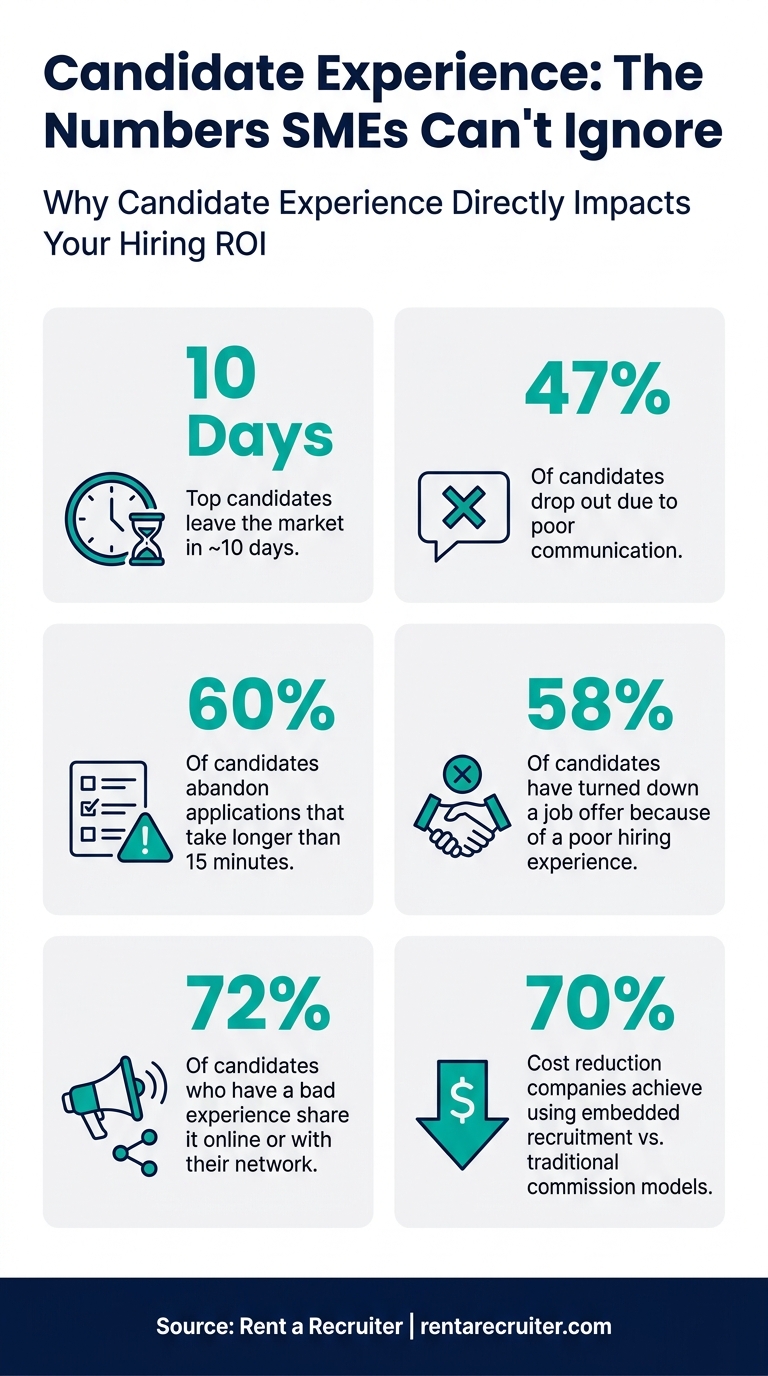
- Slow hiring loses good people, especially when strong candidates leave the market in about 10 days
- Poor communication drives drop-off, with 47% leaving processes because updates are weak
- Application friction cuts conversion, and 60% drop applications that take more than 15 minutes
- Bad hiring experience hits offer acceptance, with 58% saying they have turned down offers because of it
- Execution capacity matters when hiring volume climbs and internal teams cannot keep response times and coordination on track
- Embedded recruitment can help when the issue is no longer process design, but delivery at scale
For CEOs, CFOs, HR leaders, and Talent Leaders, the commercial point is simple: better candidate experience means lower hiring waste, less admin time, and stronger conversion across the funnel. The rest of this article breaks down where SMEs lose candidates, what to fix first, and when it makes sense to bring in Rent a Recruiter for added hiring capacity.
Candidate Experience Stats SMEs Can’t Ignore
Positive Candidate Experience Strategies
sbb-itb-a23bd6a
Common Candidate Experience Problems SMEs Face
In practice, these problems tend to show up in three areas. And when they do, the cost is not just a poor impression. It shows up in slower hiring, more drop-off, and lower offer conversion.
Slow, Unstructured Hiring Causes Delays and Candidate Drop-Off
When there is no defined hiring process, decisions slow down fast. Approvals bounce between the founder, the hiring manager, and whoever happens to be free. Interview stages change depending on who is running them. Offer decisions sit in limbo because no one owns the final call.
From the candidate side, silence sends a clear message: this company does not have its act together. Top candidates are typically off the market within 10 days [1], so a process that drags on without updates can lose them with very little warning.
For SMEs, that has a direct business cost. You spend time sourcing, screening, and interviewing, only to lose people because the process itself gets in the way.
Without a standard process, it is also much harder to see where things are breaking down, which means the same delays keep happening.
The same lack of structure spills into communication and assessment.
Poor Communication and Inconsistent Evaluation Damage Trust
47% of candidates withdraw from hiring processes because of poor communication [4]. In day-to-day hiring, that often means an interview ends with, "we’ll be in touch", then nothing happens for days.
That gap does damage quickly. Candidates start to lose confidence. Hiring managers lose momentum. Internal teams end up revisiting people who were ready to move earlier in the process.
Inconsistent interviews make it worse. If different hiring managers ask different questions and there is no scoring rubric, decisions become subjective and unfair. That weakens hiring decisions and makes the process harder to defend internally.
There is also a brand cost. A negative candidate experience rarely stays private. 72% of candidates who have a bad experience share it online or with their network [4]. For scaling firms, that can make future hiring harder and more expensive.
Friction in Applications, Employer Brand, and Onboarding Reduces Conversion
Three points of friction tend to hurt conversion at different stages of the hiring funnel.
At the application stage, complexity is often the biggest problem. 60% of candidates abandon applications that take longer than 15 minutes to complete [3]. Mandatory accounts, long forms, and poor mobile design all push people out before the process even starts.
Lack of clarity creates another problem. When salary ranges or hiring timelines are missing, doubt creeps in. That often leads to late-stage drop-off [2][1]. If candidates cannot quickly see what the role offers or how the process will run, many simply disengage.
Then comes the post-offer gap. After offer acceptance, many SMEs go quiet. The 2 to 4 week period between offer acceptance and Day 1 is where momentum often fades, and candidates may second-guess the move or accept a counteroffer [3][1].
That disconnect often shows up in the first 45 days, when turnover is highest if Day 1 does not match the hiring promise [1][3].
The good news is that these are process problems. That matters, because process issues can be fixed without adding headcount.
Practical Fixes SMEs Can Apply Without a Large Talent Team
These are process problems, not team size problems. The fix is straightforward: standardise the process, then cut friction at each stage.
Standardize the Hiring Process and Set Clear Communication Rules
Set your hiring process before you open the role. Write down your screening criteria, interview stages, and communication templates. When everyone works from the same playbook, approvals move faster and hiring gets less messy.
Reply to every candidate within 24 to 48 hours. Use three templates: one for confirmation, one for interview invites, and one for rejections. Those three cover most hiring communication and save time on every hire [1].
Once your communication is consistent, put a structured scorecard in place.
Use Structured Evaluation and Simplify the Application Process
Use 5 to 7 role-specific questions tied to the core needs of the job, with a 1-to-5 rating scale for each answer [1][2]. Ask the same questions and use the same scorecard for every candidate. That gives you cleaner decisions and cuts back-and-forth between interviewers.
Keep the application form to under 15 minutes. Remove forced account creation. Make sure it works properly on mobile [2][1][5]. If someone has to fight the form just to apply, you’ll lose good people before the process even starts.
Keep interview rounds to two or three, and tell candidates that upfront [4]. Clear expectations save time for your team and reduce drop-off.
Sharpen Employer Messaging and Organize the Onboarding Experience
Vague job descriptions push good candidates away. Focus on 3 to 5 must-haves, include the salary range, and spell out your hiring timeline, for example, "We respond to all applicants within five business days." [1][2]
After offer acceptance, keep things moving with three touchpoints:
- A welcome email within 24 hours of acceptance
- Digital paperwork sent 1 to 2 weeks before the start date
- A detailed Day 1 schedule sent one week before the start date [1][3]
Include practical details like parking, dress code, arrival time, and one contact person [2][1]. Assign a peer buddy before Day 1 as well. It takes little effort, but it helps stop no-shows and reduces first-week confusion.
If the process still feels stretched after that, the next bottleneck is hiring capacity, requiring more robust talent acquisition strategies.
How to Scale Candidate Experience When Internal Capacity Is Limited
When hiring volume jumps, even a solid process can crack if nobody has the time to run it properly. A founder juggling sales calls, team management, and day-to-day decisions cannot give every candidate the attention the process needs. Response times slow down. Communication starts to slip. Strong candidates lose interest and move on.
At that stage, the problem is not process design. It is execution capacity.
47% of candidates cite poor communication as their primary reason for dropping out [4]. For a lean team, that gap adds up fast across several open roles.
Where Embedded Recruiters Add the Most Value for SMEs
An embedded recruiter keeps the candidate journey moving without adding more pressure to your internal team.
They take ownership of:
- Candidate communication
- Interview scheduling
- Structured interviews
- Training hiring managers on structured evaluation
That matters when growth brings new people into hiring for the first time. Without support, interview quality can vary, feedback can drift, and delays can pile up. An embedded recruiter helps keep the process tight, consistent, and moving.
How Rent a Recruiter Supports Better Candidate Experience at Scale
This is where added hiring capacity becomes a candidate experience fix, not just a staffing fix.
Rent a Recruiter helps high-growth SMEs in technology, SaaS, fintech, engineering, and professional services add hiring capacity fast without adding internal headcount. Experienced recruiters embed directly into your team within days and manage hiring end-to-end. That means shorter hiring cycles and a better candidate experience.
Companies typically cut hiring costs by up to 70% compared to traditional commission-based models, while saving over 80 hours per month in internal hiring and admin time. That gives founders and managers more time to focus on the business, while candidates get a faster and more consistent experience throughout.
Measuring Results and Taking the Next Step
Track the Metrics That Reveal Hiring Friction
Once your hiring process is standardised, the next job is simple: find where people still drop off.
You do not need a fancy system to do this well. A spreadsheet is enough to start tracking application views versus submissions, and interview invites versus attendance.
The metrics below help you see where friction shows up, and what it may be costing you:
| Metric | What It Tells You | Target Benchmark |
|---|---|---|
| Application Completion Rate | Whether the application is too long or broken | Above 60% is healthy [2] |
| Time to First Contact | Speed of initial response to applicants | Under 3 business days [2] |
| Interview Show Rate | Engagement level between application and interview | 85 to 95% [3] |
| Offer Acceptance Rate | Whether your close and process are working | Above 80 to 85% [2][3] |
| Candidate Recommendation Score (cNPS) | Likelihood of candidates to recommend your company | 50+ is strong [2] |
| 90-Day Retention Rate | Alignment between hiring promises and reality | 85 to 95% [3] |
Review these numbers every quarter, or every 5 to 10 hires [6][1]. That gives you enough data to spot patterns before they become a bigger hiring problem.
Numbers tell you where the issue is. Feedback tells you why.
Send a short three-question survey in the first week covering communication, fairness, and the Day 1 experience [1]. It is a small step, but it can show whether your process feels smooth or frustrating from the other side.
It also helps to send a brief anonymous survey to rejected candidates 48 hours after a decision. In many cases, that is where you get the clearest feedback [6].
A simple spreadsheet can show you where the process is leaking time, trust, and hires.
Conclusion: Fix the Process First, Then Add Capacity Where Needed
Candidate experience usually improves fastest when you fix the process first.
That means:
- Structured hiring
- Clear communication rules
- Fair evaluation
- A simple application flow
- A smooth onboarding sequence
Get those pieces right, and you remove a lot of friction without adding more headcount.
If your metrics still miss target after that, the problem is no longer process design alone. It is execution capacity. Response times slip. Follow-up gets patchy. Interview quality starts to vary from one hiring manager to the next.
At that point, adding support is not just a staffing move. It is a hiring outcome decision. 58% of candidates decline offers after a poor hiring experience [2].
If your SME is scaling and hiring is starting to crack under pressure, Rent a Recruiter can place an experienced recruiter into your team within days to run the process end-to-end. You can also start with a free Recruitment Health Check to benchmark where your hiring stands today and see which gaps to fix first.
FAQs
What should we fix first in our hiring process?
Start by mapping the full candidate journey so you can spot where things slow down or fall apart. For most SMEs, the first changes that make the biggest difference are faster, more consistent communication.
Focus on three areas first:
- Acknowledge every application within 24 to 48 hours
- Share updates or feedback within 3 business days after interviews
- Cut out post-offer silence so new hires feel prepared and supported before Day 1
These fixes don’t just tidy up the hiring process. They save time, reduce drop-off, and help you avoid losing good people late in the funnel.
How do we know if candidate experience is hurting hires?
Track where candidates drop out of your hiring process. That’s where the leaks usually are.
A few warning signs tend to show up early:
- Application completion below 50%
- Repeat drop-off after interviews
- Slow follow-up from your team
- Offer acceptance below 80%
- Negative public reviews
These aren’t just hiring issues. They affect time-to-hire, recruiter workload, and your ability to land strong talent before someone else does.
A few benchmarks can help you spot trouble fast:
- First contact within 48 hours
- Offer acceptance above 80%
- Candidate Net Promoter Score above 20
Short anonymous surveys after applying or interviewing can also help. They give you a clearer view of where friction is showing up, whether that’s a long application form, poor interview handoffs, or delays after final rounds.
When should an SME add embedded recruiting support?
An SME should look at embedded recruitment when hiring starts to feel slow, messy, or hard to control.
You’ll usually see the signs early. Roles stay open for too long. Follow-up slips. Strong candidates drop out. Different hiring managers run different processes. Then growth kicks in, and the pressure gets worse.
That’s where an embedded recruiter can make a big difference.
They manage hiring end-to-end, so you’re not stitching the process together across HR, hiring managers, and outside suppliers. They also help protect consistency and brand integrity, which matters when you’re scaling and every candidate touchpoint shapes how your business is seen.
From a commercial point of view, the gains are hard to ignore:
- Save over 80 hours per month in hiring admin
- Reduce hiring costs by up to 70%
- Build a more consistent process as hiring demand grows
For SMEs that are scaling, this is often less about adding more hiring spend and more about getting better control, lower cost, and stronger hiring outcomes from the process you already have.