
Candidate journey management ensures every interaction with your company, from the first contact to onboarding, builds trust and confidence. For SMEs hiring as they scale, losing just one strong candidate can impact hiring capacity by up to 33%. Long hiring processes, poor communication, and inconsistent practices cost time, money, and top talent.
Here’s the bottom line: Streamlining your candidate journey leads to faster hires, higher offer acceptance rates, and reduced early turnover. For SMEs, this can save $15,000–$50,000 per role in replacement costs and up to 80 hours per month in admin work.
Key Takeaways:
- Time-to-hire matters: Processes over 40 days increase candidate drop-off by 12%.
- Simplify the application process: 60% of candidates abandon complex applications.
- Speed is critical: Top candidates are off the market in 10 days.
- Structured interviews work: Standardized questions and scoring improve fairness and decisions.
- Embedded recruitment can cut costs by 70% compared to agencies and ensure consistency.
If your hiring feels slow or unstructured, consider embedding an experienced recruiter directly into your team. They’ll manage the process end-to-end, saving time and ensuring no candidate falls through the cracks. Ready to improve your hiring outcomes? Learn more about embedded recruitment.
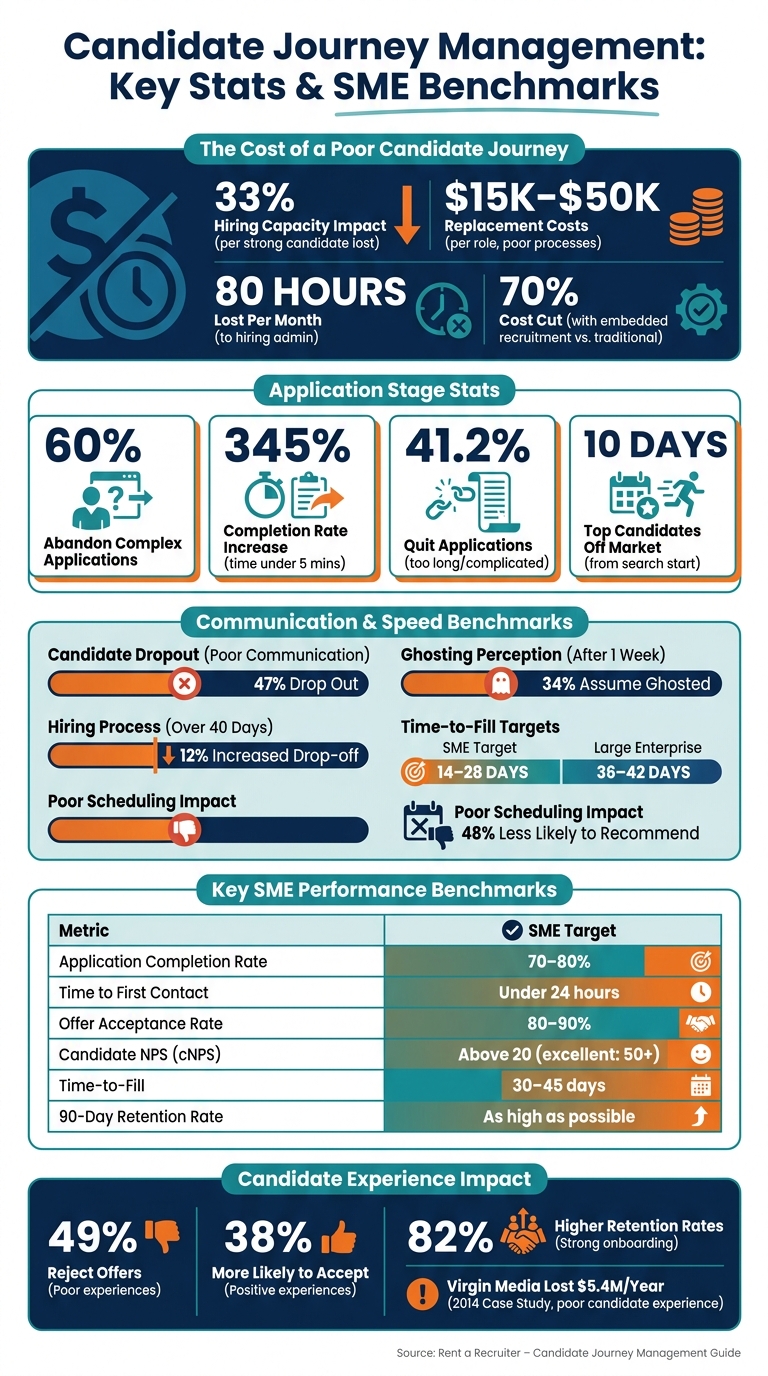
Candidate Journey Management: Key Stats & SME Benchmarks
Winning the Talent Game: 10 Essential Facts About Candidate Journey & Employer Brand
sbb-itb-a23bd6a
Core Stages of the Candidate Journey
The candidate journey mirrors a marketing funnel. At every step, unnecessary friction – like a drawn-out application process, lack of communication after interviews, or delays in making offers – can cause top candidates to drop out. Streamlining each stage through Recruitment as a Service is key to keeping talent engaged.
Awareness and Attraction
First impressions matter, and candidates form theirs before they even apply. They browse job boards, check your LinkedIn activity, and read reviews on platforms like Glassdoor. At this stage, your job description plays a critical role. A well-written job post that includes a salary range and clear timelines (e.g., "we’ll respond within 5 business days") shows respect for candidates’ time and helps attract the right applicants.
To measure success here, focus on metrics like the number of applications and the click-through rates on your job postings. Once you’ve captured interest, a smooth and simple application process ensures that curiosity turns into action.
Consideration and Application
When a candidate decides to apply, the process itself can either convert them or drive them away. Research shows that 41.2% of candidates quit applications that are too long or complicated [1]. One major culprit? Requiring candidates to create an account before they even start.
As FirstHR puts it:
"If your application process starts with ‘create an account,’ you are filtering for patience, not talent." – FirstHR [3]
To keep candidates engaged, aim for an application process that takes less than 15 minutes to complete. Offer features like "Apply with LinkedIn" or "Easy Apply" to simplify the experience, and ensure everything works seamlessly on mobile devices. Shortening application time to under five minutes can increase completion rates by up to 345% [5].
Your careers page is another key touchpoint. It serves as a resource for candidates to imagine what it’s like to work at your company [2]. A strong page can reinforce their interest and encourage them to take the next step.
Once the application is submitted, the focus shifts to evaluating candidates – where timing and consistency become essential.
Interview, Selection, and Offer
This stage is where trust is built – or lost. Structured interviews using 5 to 7 consistent questions and a clear scoring system ensure fairness and improve the candidate experience. Keep the interview process manageable, with no more than 4–6 rounds, to avoid exhausting candidates. Poor scheduling can leave a bad impression; in fact, 48% of candidates say a negative scheduling experience makes them less likely to recommend the company [1].
Speed becomes even more critical when it’s time to make an offer. Sending a digital offer within 24 hours of making a decision keeps the momentum going. Tools like DocuSign or Dropbox Sign allow candidates to review and accept offers directly from their phones, reducing delays. Remember, top candidates are often off the market within 10 days of starting their job search [3], so acting quickly is non-negotiable.
Here’s a summary of the key focus areas and metrics for each stage:
| Stage | Key Focus | Success Metric |
|---|---|---|
| Awareness | Clear job descriptions, salary transparency, consistent job postings | Application volume, JD click-through rate |
| Application | Short, mobile-friendly process; no account creation required | Application completion rate |
| Interview & Selection | Structured scorecards, efficient scheduling, 4–6 rounds max | Interview-to-offer ratio, candidate NPS |
| Offer | Digital offers sent within 24 hours | Offer acceptance rate |
Mapping the Candidate Journey for SMEs
Getting your candidate stages in order is just the first step. Mapping out the full candidate journey shows you exactly where tweaks can make the biggest difference. A clear map, outlining every interaction candidates have with your company, is a must for improving recruitment in SMEs.
Setting Objectives and Defining Success Metrics
Start by setting clear recruitment goals. Whether it’s cutting down time-to-hire, increasing offer acceptance rates, or reducing hiring costs, your goals should guide your process. From there, track metrics that align with these objectives. Here’s a quick look at some key metrics for SMEs:
| Metric | What It Measures | Benchmark |
|---|---|---|
| Candidate NPS (cNPS) | Satisfaction with the hiring process | >20 is good; >50 is excellent [6] |
| Application Completion Rate | Ease of completing applications | >50% (anything lower needs attention) [6] |
| Time-to-First-Contact | How fast candidates hear back | Under 48 hours [5][6] |
| Offer Acceptance Rate | Trust built during the journey | >80% [6] |
| 90-Day Retention Rate | Alignment of role with expectations | Higher is better [6] |
The average time-to-hire across industries is roughly 31 days [7]. Setting your own target helps you spot bottlenecks and address delays in the process.
Once your metrics are in place, focus on understanding your candidates and tailoring interactions to meet their expectations.
Identifying Candidate Personas and Touchpoints
A candidate journey map is only effective if it’s built with your candidates in mind. Different roles attract different types of people. For instance, a software engineer may care about your tech stack and team culture, while a sales candidate might prioritise earning potential and career growth. Creating detailed candidate personas for your key roles helps you fine-tune every interaction.
From there, map out every touchpoint candidates have with your company. This includes everything from job ads and career pages to recruiter outreach, interview processes, and offer letters.
Don’t forget to consider where your candidates are coming from. A mid-level engineer might find you through GitHub or a tech forum, while someone in finance is more likely to see your job post on LinkedIn. With 58% of job seekers using mobile devices to search for jobs [6], it’s critical to ensure every step of the process – from job listings to applications – is mobile-friendly.
One often-overlooked aspect? How you handle rejections. Even candidates who don’t get the job form strong impressions of your company. Aleksandra Gurskaite, former recruitment manager at Tellent, puts it perfectly:
"You have to be more understanding and compassionate to the candidates you work with or reject." [1]
Once you’ve nailed down personas and touchpoints, the next step is using data and tools to keep improving.
Tools and Data for Journey Mapping
You don’t need expensive software to map your candidate journey. Most SMEs already have the tools they need – it’s just a matter of using them effectively.
Your Applicant Tracking System (ATS) is a goldmine of data. It tracks where candidates are in the pipeline, how long they spend in each stage, and where drop-offs occur. Pair your ATS data with tools like Google Analytics and quick candidate surveys to identify problem areas and improve the experience.
Sending cNPS surveys at key stages – after the application, interview, and when offers or rejections are made – gives you insights beyond just numbers. Denise Loschek, Head of HR at RSM Austria, highlights the importance of this approach:
"To improve the candidate journey, we focus on clear communication, quick feedback and a transparent selection process. Digital solutions allow us to interact with candidates seamlessly." [1]
Treat your journey map as a living document. As your business grows, new roles emerge, and tools evolve, your map should adapt to keep your recruitment process focused on delivering a seamless and candidate-friendly experience.
Running a Managed Candidate Journey at Scale
Mapping out your candidate journey is just the first step. The real challenge comes when you need to manage that process for 10, 20, or even 50 hires at once. As hiring scales up, even small issues – like slow follow-ups or inconsistent communication – can quickly snowball into bigger problems, impacting your ability to secure top talent.
Governance and Ownership
One of the biggest reasons candidate journeys break down at scale is unclear ownership. When multiple teams share responsibilities, details can slip through the cracks, leaving candidates feeling ignored. To avoid this, assign clear ownership for every stage of the process and set strict service-level standards. For example, implementing a 24-hour response rule ensures every application gets acknowledged within a day. This matters because 47% of candidates say poor communication would make them drop out of a hiring process [4]. Even worse, 34% assume they’ve been ghosted after just one week of silence [4].
To prevent drop-offs, ensure candidates never wait more than five business days for a status update. Clear accountability and timely updates can make or break your hiring experience.
Process Design for Speed and Consistency
Scaling up doesn’t mean sacrificing quality for speed. The solution lies in automating repetitive tasks – like application confirmations, status updates, and interview scheduling – while keeping human interaction where it counts. Key moments, such as recruiter calls, interview debriefs, and offer discussions, should remain personal to leave a lasting impression.
Long hiring cycles are a major risk in high-volume recruitment. While large enterprises often take 36–42 days to fill a role, small to mid-sized businesses (SMEs) should aim for a 14–28 day timeline to avoid losing top candidates to faster-moving competitors [9]. Tools like self-serve scheduling, where candidates pick interview slots based on real-time availability, can eliminate unnecessary delays without requiring extra staff.
Structured interviews are another critical tool often overlooked by SMEs. As Maren Hogan, CEO of Red Branch Media, explains:
"I used to think I could just shoot the breeze in interviews. I hired some of the worst candidates that way. The structure isn’t about rigidity. It’s about fairness to everyone in the room." [4]
Using a scoring rubric ensures interviews are consistent, reduces bias, and speeds up decision-making. It also makes your hiring process more defensible if challenged.
To maintain consistency and avoid process gaps, having the right talent acquisition strategies on hand is essential.
Leveraging Embedded Recruitment Expertise
When hiring ramps up, it’s tempting to spread recruitment tasks across multiple teams. But this often leads to fragmented communication and an inconsistent candidate experience. Embedded recruitment offers a smarter solution: a dedicated expert who manages the entire process from start to finish.
With Rent a Recruiter, you get an embedded recruiter who works directly within your team, ensuring every step – from first contact to onboarding – runs smoothly. This approach not only eliminates communication gaps but also significantly cuts costs. Clients typically reduce hiring expenses by up to 70% compared to traditional recruitment models while saving over 80 hours per month in administrative tasks.
Measuring and Improving the Candidate Journey
Key Metrics to Track at Each Stage
Tracking the right metrics at every stage of the candidate journey helps identify where candidates drop off. The table below highlights the most critical metrics for small and medium-sized enterprises (SMEs) to monitor, alongside realistic performance targets:
| Recruitment Stage | Key Metric | SME Target |
|---|---|---|
| Application | Application Completion Rate | 70–80% (below 50% indicates high friction) |
| Screening | Time to First Contact | Under 24 hours |
| Interview | Feedback Submission Time | Within 24 hours of the interview |
| Offer | Offer Acceptance Rate | 80–90% (issues arise if below 70%) |
| Post-Offer | 90-Day Retention Rate | Reflects alignment with role expectations |
| Overall | Time-to-Fill | 30–45 days (over 60 days signals a bottleneck) |
| Overall | Candidate NPS (cNPS) | Above 20 is strong; above 50 is excellent |
One often-overlooked metric is what happens after an offer is accepted. Surprisingly, 10–15% of accepted offers fall through before the candidate starts [10]. To prevent this, keep candidates engaged during pre-boarding with digital paperwork, introductions to the team, and a warm welcome message.
Using Feedback to Address Process Gaps
While metrics show what is happening, feedback reveals why. Some of the most actionable insights come from candidates who weren’t hired, as they tend to provide honest evaluations of where the process failed [6].
Timing is crucial when collecting feedback. Surveys should be sent within three days of a key interaction – whether it’s an interview, rejection, or offer. Waiting longer than five days can reduce accuracy by 30–40% [6]. Keep surveys short and focused. For instance, a single-question cNPS survey like, “How likely are you to recommend applying to our company?” establishes a baseline, while an open-ended follow-up such as, “What one thing would you change about our process?” provides deeper insights.
Ignoring feedback can have real consequences. In 2014, Virgin Media found that 6% of 123,000 rejected candidates canceled their subscriptions, costing the company $5.4 million annually [6].
The next step? Turning this feedback into meaningful changes that create a hiring culture focused on candidate experience.
Building a Candidate-Centric Hiring Culture
Metrics and feedback are only valuable if they lead to action. Creating a hiring culture that values every interaction starts with treating candidates the way you’d treat customers. Poor experiences drive 49% of candidates to reject offers [6], while positive ones make candidates 38% more likely to accept [6].
Small, consistent improvements can make a big difference. For example:
- Publish a hiring roadmap on your careers page so candidates know what to expect.
- Train interviewers to clearly outline next steps at the end of every session.
- Avoid automated rejections for candidates who’ve completed multiple interview rounds.
As the TuraHire Editorial Team put it:
"The companies winning top talent in 2026 aren’t the most famous – they’re the most consistent, transparent, and respectful in how they hire." [6]
Companies that prioritise candidate experience see real results. Those with strong hiring and onboarding processes report 82% higher retention rates for new hires [6]. That’s not just a hiring win – it’s a competitive edge that pays off long after the recruitment process ends.
Conclusion: Taking Control of Your Candidate Journey
Key Takeaways
Success in managing your candidate journey comes down to consistency. Most small and medium-sized businesses don’t struggle with quality – they struggle with maintaining a steady process. It’s the gaps between stages, not the stages themselves, where candidates are often lost [4].
The essentials? Speed, structure, and clear communication. Delays, disorganized interviews, and weak follow-up processes can cost you top-tier talent [2][4][8].
"It costs nothing to be nice to a person… it costs almost nothing to communicate. And the cost of not communicating is far higher than most organizations realize." – Maren Hogan, CEO of Red Branch Media [4]
The companies excelling in talent acquisition by 2026 won’t necessarily be the biggest or most famous. Instead, they’ll be the ones treating every candidate interaction as a direct reflection of their brand. Start applying these principles now to refine your recruitment process.
Next Steps
If this guide has highlighted gaps in your process, begin with a funnel audit. Look at metrics like application completion rates, time-to-first-contact, and offer acceptance rates to identify where candidates are dropping off. Fix these areas before tackling larger changes. This foundational step sets the stage for a streamlined process – something an embedded recruiter from Rent a Recruiter can help you implement effectively.
For SMEs aiming to scale quickly without the burden of building an internal recruiting team, Rent a Recruiter offers a solution. By embedding experienced recruiters directly into your team, they bring structure, speed, and consistency to your hiring process from day one. Companies typically cut hiring costs by up to 70% compared to traditional commission-based models while saving over 80 hours per month on hiring admin. Ready to take control of your candidate journey? Book a consultation today and see how embedded recruitment can transform your hiring process.
FAQs
What’s the fastest way to spot where candidates drop off in our hiring process?
Track where candidates drop off during your hiring process by leveraging your applicant tracking system (ATS) or recruitment data. Pay close attention to critical stages: application submission, interview scheduling, and feedback. Tools like real-time pipeline tracking and automated alerts can highlight bottlenecks – whether it’s delayed communication or overly complex steps. Identifying these pain points allows you to act swiftly, streamline the process, and create a smoother experience for candidates.
What candidate journey metrics should SMEs track first?
Tracking the right metrics can transform how SMEs approach hiring. Focus on key areas like application completion rate, response time, offer acceptance rate, and time-to-fill. These numbers reveal where candidates may lose interest and how smoothly your process operates. By understanding these trends, you can pinpoint weak spots and make precise adjustments to keep hiring efficient and on track.
When should we use an embedded recruiter to manage the candidate journey?
Embedded recruitment works best when your company faces consistent yet varied hiring demands but lacks the internal capacity to manage them effectively. It’s a smart choice for businesses experiencing rapid growth, scaling, or unpredictable hiring spikes. By integrating directly with your team, an embedded recruiter can cut hiring costs by up to 70% and reduce time-to-fill by as much as 50%. They operate as part of your organization, aligning with your company’s culture, refining hiring processes, and ensuring candidates have a seamless experience – all while easing the load on your HR team.