
After a Series A, hiring breaks down when role order, process, and recruiter capacity do not keep pace with growth.
If you are planning to grow from roughly 25 to 50 employees, the research is clear. You need to fill revenue and product roles first, keep senior hires under 45 days where possible, and avoid building fixed recruiting cost too early. Poor sequencing drives up burn, slows delivery, and pulls founders back into hiring admin when they should be running the business.
Here is the short version:
- Headcount often grows 30% to 60% in the first six months after funding
- Business roles take about 56 days to fill, technical roles about 76 days
- A vacant Account Executive can cost $60,000 to $120,000 in lost ARR
- Companies that hit 70% of planned hiring within 90 days are 2.4 times more likely to hit revenue targets
- <a href="https://rentarecruiter.com/embedded-recruitment-service/">Embedded recruitment</a> fits when demand spikes but a full-time recruiter would leave you with fixed cost and ramp time
- <a href="https://rentarecruiter.com/contact-us/">Rent a Recruiter</a> is built for this gap, giving you extra hiring capacity, process control, and reporting without adding permanent recruiter headcount
If you want the main takeaway in one line, it is this: the best Series A hiring plans do not just hire more people, they hire in the right order and use a hiring model that matches demand.
Below, I break down what the data says about sequencing, funnel performance, internal capacity, and where <a href="https://rentarecruiter.com/embedded-recruitment-service/">embedded recruitment</a> can help you keep hiring output high without letting cost drift.
Post-Series A SaaS hiring patterns: headcount growth, role mix, and sequencing mistakes
Typical headcount growth in the first 12–18 months after funding
After Series A, many SaaS startups move fast toward a 50 to 100 person team within 12 to 18 months.
On paper, that sounds neat. In practice, it rarely plays out in a straight line.
Most teams go through a sharp hiring push right after funding, often a dozen or more hires in the first quarter, then a slower stretch while the business absorbs those hires and gets back to execution. That is why hiring order matters as much as hiring volume. If you hire the wrong roles first, cost goes up before output does.
Companies that reach 70% of planned post-funding headcount within 90 days are 2.4 times more likely to hit their 12-month revenue targets [2].
There is also a practical limit to how fast you can grow. Around 30% headcount growth per quarter is often the ceiling. Push beyond that and onboarding, manager bandwidth, and day-to-day execution start to crack before new hires can make a dent.
Early-stage teams can get a lot done with generalists. Post-Series A is different. You now need specialists, team leads, and managers who can take ownership and build repeatable output.
Which roles get prioritized first and why
Once hiring kicks off, the issue is not just who you need. It is who you need first.
The best Series A teams hire in waves, not all at once [7]. That keeps cost tied to business need and gives each hire a clear job to do.
In the first 90 days, the focus is usually on mission-critical roles that either unlock revenue or reduce founder dependency. That often means:
- Engineering leads
- Account Executives
- SDRs
This mix is common for a reason. It gives you more delivery strength, more sales capacity, and less day-to-day reliance on founders to keep the machine moving.
Series A companies that take longer than 45 days to fill senior technical or GTM roles often underperform against 12-month growth targets [3].
From days 90 to 180, the focus shifts. At that point, the pressure is less about opening the next role and more about building management capacity. That is where team leads, managers, Sales Ops, RevOps, and HR support start to matter.
After 180 days, the plan usually expands into more strategic hires, including new market specialists, brand roles, and specialist R&D [7].
One mistake shows up a lot here. Analytics and instrumentation roles often get pushed out of Wave 1. It can feel sensible in the moment, but the downside is simple: product decisions end up running on guesswork instead of data [3].
Role sequencing mistakes that raise costs and slow growth
When hiring sequence is off, the damage shows up fast in burn, delays, and founder time.
Over-hiring engineering before GTM capacity is in place increases cost without improving revenue. You add payroll, but not enough commercial motion to justify it.
Hiring VPs before there is a team for them to lead creates overhead before output. You are paying for management structure before there is enough activity underneath it.
Leaving People and RevOps hires too late creates another problem. Founders stay stuck in hiring admin and process gaps, and agency spend starts creeping up because there is no internal engine to keep things moving. Utilizing Recruitment as a Service can help stabilize these costs while maintaining hiring momentum.
Each month a critical role stays open can increase product delays by 10% to 15% [4]. In stressed Series A settings, turnover can rise from the industry average of 13% to 20% to 30% [4].
| Sequencing Mistake | Measurable Impact |
|---|---|
| Engineering before GTM | Higher burn, lower output per engineer |
| VPs before teams | Management overhead with no output gain |
| People/RevOps too late | Process breakdown, rising agency fees, founder burnout |
| No data hires in Wave 1 | Product decisions driven by guesswork, not data |
sbb-itb-a23bd6a
What the data shows about recruitment process design at scaling SaaS companies
Once the hiring order is set, talent acquisition strategies decide whether you can hire at Series A pace or get stuck in drag.
Funnel benchmarks: time-to-hire, conversion rates, and cost per hire
The numbers behind a typical Series A hiring funnel are tougher than most founders expect. You can rate your recruitment process to see how your current metrics compare to these benchmarks.
In 2025, the average hire needed more than 300 applications [11]. Application-to-interview conversion sat at just 3.6% to 4.7% [11]. Median time to fill reached 56 days for business roles and 76 days for technical roles [11].
That gap gets worse as seniority rises. Senior roles take 37% longer to fill than junior roles, while technical hiring adds about 15 extra days versus business hiring [9].
There’s also a clear workload cost. Technical roles averaged 17.6 interviews and 23.3 team hours per hire. Business roles averaged 11.7 interviews and 12.2 hours [11].
That matters because hiring drag is not just a recruitment issue. It pulls founders, hiring managers, and interview panels away from revenue work, product delivery, and team leadership.
Decision quality can slow down too. About 38% of scorecards show at least a one-point gap between interviewers, and nearly half of those disagreements cross the yes/no line, which often slows decisions [9].
Structured hiring practices linked to better outcomes
The data points in one direction: more process discipline, fewer wasted steps.
Structured interviews with defined rubrics are twice as likely to produce high performers at 12 months. Using 1-to-4 scoring, interviewer training, and automated notes helps teams line up faster and make cleaner decisions.
"This data confirms that more interviews don’t lead to better outcomes. High-performing startups define competencies up front, and run only high-signal steps." – Heather Doshay, Former Partner, Head of Talent, SignalFire [10]
There’s a direct time saving here too. Automated scheduling is 26% faster than manual coordination, saving an average of 1.3 hours per interview stage [9].
For scaling SaaS companies, that’s the point. A better hiring process does not just cut admin. It cuts delay, lowers manager load, and helps you fill roles before missed hires turn into missed targets.
Comparison table: founder-led vs. structured internal vs. embedded recruitment
How you run the process matters just as much as who you’re hiring. The table below compares three common models against the metrics that shape hiring speed, cost, and internal team load.
| Factor | Founder-Led / Ad Hoc | Structured Internal | Embedded (e.g., Rent a Recruiter) |
|---|---|---|---|
| Time-to-Hire | High variability; often >60 days [6] | 30 to 56 days for business roles [11] | ~12 days to first qualified candidate [6] |
| Cost Predictability | Low; high opportunity cost [2] | Fixed overhead: $80,000 to $120,000+ per year, plus benefits and software [1] | Variable; $2,000 to $7,000 per hire or about $80/hour [1][6] |
| Hiring Manager Time | Very high; founders handle sourcing to close [2] | Moderate; focus on interviews and feedback [10] | Low; sourcing and screening handled end-to-end [1] |
| Visibility | Low; spreadsheets and email [2] | High; ATS-driven [9] | High; end-to-end delivery data [1] |
| Scalability | Poor; hits a wall with founder bandwidth [2] | Moderate; limited by recruiter headcount [1] | High; scales up or down with hiring demand [1] |
Embedded recruiters combine internal-level process control with immediate execution capacity. That makes embedded recruitment a strong fit when hiring demand rises faster than internal capacity [1].
The next section turns these process gains into an 18 to 24 month hiring roadmap.
Recruitment capacity models for Series A growth: when embedded support fits
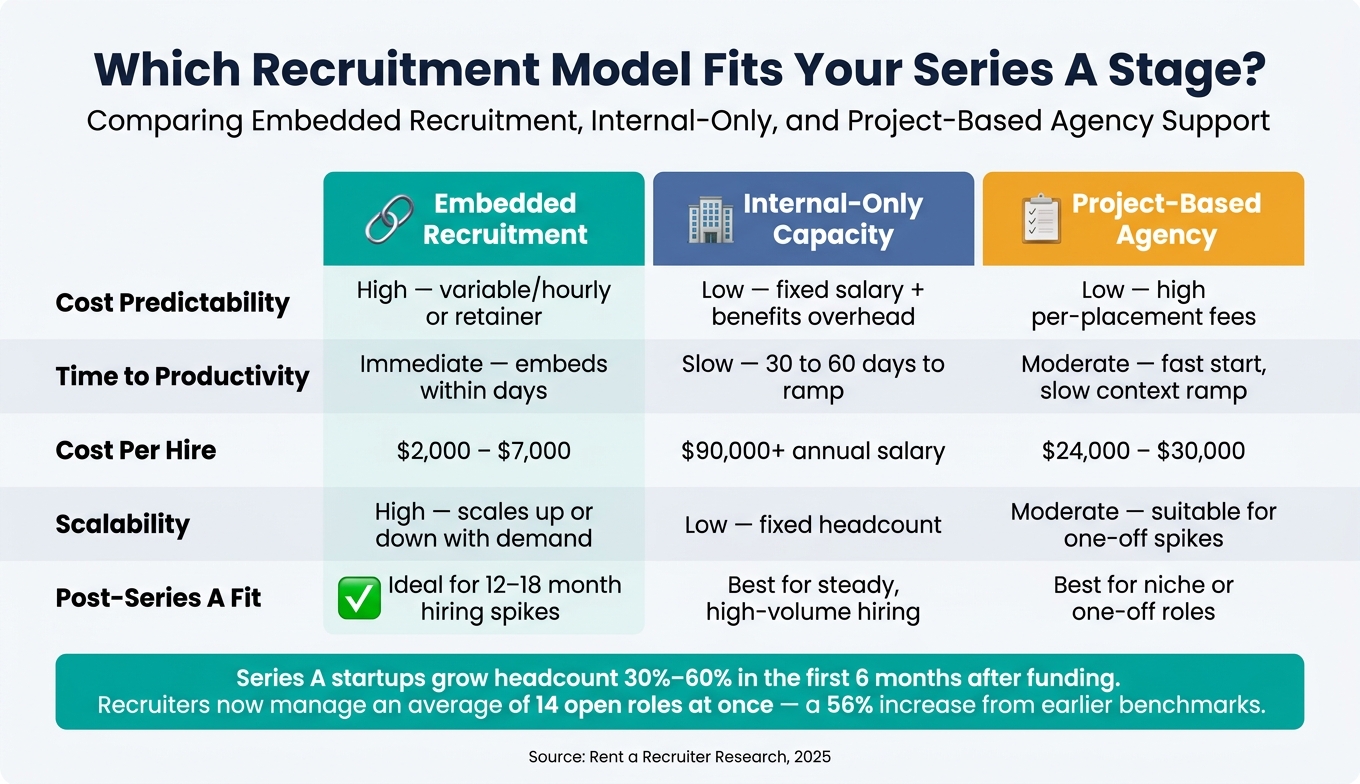
Series A SaaS Hiring Models Compared: Embedded vs. Internal vs. Agency
Once your hiring process is in place, capacity becomes the next problem.
When startups add internal talent capacity
The trigger points are pretty clear. You should look at dedicated recruiting support when a founder is spending 20+ hours per week on recruiting, when 8 to 10 hires are planned in the next 90 days, or when senior roles have been open for 3+ months [1][12].
At that stage, the issue usually is not process. It is bandwidth. You may have a solid hiring plan, but demand starts to outrun the team’s ability to execute. That is where embedded recruiting can fit.
The sticking point with a full-time recruiter is ramp-up time. A new recruiter usually needs 30 to 60 days to reach full productivity [1]. For a Series A company, that can eat up a big chunk of the first 90 days after funding lands. On top of that, a full-time recruiter often costs $90,000 to $120,000+ per year, plus benefits and software licenses [1].
"A full-time recruiter works well when filling two to three roles monthly. But between funding rounds, your needs might range from zero to eight roles per month." – Dover [1]
How embedded recruiters can improve speed, structure, and visibility
Embedded recruitment gives Series A startups extra capacity without adding fixed headcount. Instead of locking into a permanent hire or paying per-placement fees, you bring in recruiting support that works inside your team and can scale back once the hiring spike settles.
Rent a Recruiter places experienced recruiters into your team within days, runs hiring end-to-end across core functions, and adds reporting and process control from day one. That includes sourcing, screening, pipeline management, and ATS integration, without waiting for a new internal hire to get up to speed.
This matters most in the post-funding window. Series A startups often grow headcount by 30% to 60% within the first six months after a raise [6]. At the same time, recruiters are now handling an average of 14 open requisitions at once, a 56% increase from earlier benchmarks [1].
If you do not have the right capacity model in place, that workload slides back to founders and hiring managers. And that comes at a cost. Time spent chasing interview feedback, reviewing CVs, and managing pipelines is time not spent on sales, delivery, or team leadership.
Comparison table: embedded recruitment vs. internal-only capacity vs. project-based agency support
The table below compares the three capacity models on cost, speed, and scalability.
| Factor | Embedded Recruitment | Internal-Only Capacity | Project-Based Agency Support |
|---|---|---|---|
| Cost Predictability | High; variable/hourly or retainer [1] | Low; fixed salary + benefits overhead [1] | Low; high per-placement fees [1] |
| Time-to-Productivity | Immediate; embeds within days [12] | Slow; 30 to 60 days to ramp [1] | Moderate; fast start, slow context ramp [6] |
| Cost per Hire | $2,000 to $7,000 [1] | $90,000+ annual salary [1] | $24,000 to $30,000 [1] |
| Scalability | High; scales up or down with demand [1] | Low; fixed headcount [1] | Moderate; suitable for one-off spikes [6] |
| Post-Series A Fit | Ideal for 12 to 18 month hiring spikes [1] | Best for steady, high-volume hiring [12] | Best for niche or one-off roles [12] |
That capacity choice shapes the month-by-month roadmap below.
A research-backed recruitment roadmap for the first 18–24 months after Series A
Stage-based hiring roadmap by company size and growth phase
Once hiring starts to outgrow founder-led execution, the issue is no longer effort alone. It becomes a sequencing problem. Who do you hire first, and when? That’s where embedded recruitment for tech startups starts to matter most, especially when hiring volume moves past what your internal team can handle at each stage.
| Stage | Primary Focus | Key Hiring Priorities |
|---|---|---|
| 10–25 employees | Emerging specialization | First team leads (player-coaches), generalist engineers, first GTM hire [5][13] |
| 25–50 employees | Departmentalization | Head of Engineering, Product, Marketing, Sales; first People/HR hire [13] |
| 50–100 employees | Scaling management | Second-line managers, specialized ICs (DevOps, Data), formal HR, Finance, and Legal [13] |
As you move through these stages, a few patterns matter.
- Add managers when span of control starts to stretch.
- Pace hiring against onboarding capacity.
- Document values and decision rules before you reach 25 employees [13].
The first 90 days should stay focused on mission-critical roles that unblock revenue or product delivery. Days 90 to 180 are better used to add scale support and management capacity. After 180 days, you’re in the right window for more strategic expansion [7].
That order matters more than many teams expect. Hiring too early into support functions can tie up cash. Hiring too late into management can slow delivery, drag founders back into day-to-day work, and create gaps your team feels almost at once.
Core metrics hiring leaders should track every month
Once roles are staged, monthly metrics tell you if your hiring engine is keeping up. A roadmap on paper is one thing. Execution is what counts. You need a clean view of speed, quality, and capacity every month.
| Metric | What It Tells You | Benchmark |
|---|---|---|
| Time-to-Hire | Process speed and bottlenecks | Under 45 days for Series A senior roles [3] |
| Offer Acceptance Rate | Compensation and brand competitiveness | Higher is better; low rates signal friction or weak offers [3][8] |
| 90-Day Ramp Success Rate | Hiring accuracy and onboarding quality | High rate means hires are contributing quickly [7] |
| Cost Per Hire | Capital efficiency | $2,000 to $7,000 (embedded/fractional) vs. $24,000 to $30,000 (agency) [1] |
| Recruiter Output | Recruiter capacity and workload | About 2 to 3 hires per recruiter per month [1] |
| Early Attrition (6 and 12 months) | Cultural fit and onboarding gaps | Low rate indicates strong hiring and integration [7] |
Founder time is often the clearest signal that hiring is still draining operating capacity. A simple way to track this is to look at how many hours per week a new hire takes off the founder’s plate. If that time isn’t being given back, the role may not be scoped well, onboarded well, or placed at the right moment.
That’s not a soft metric. It ties straight to output. Every month a critical role stays open can push product roadmap slippage up by 10% to 15% [4]. In a SaaS or technology business, that can mean slower launches, slower revenue, and more pressure on the team you already have.
You should also build a 15% to 20% buffer into capacity forecasts to account for attrition, recruiter turnover, or delays you didn’t see coming [1]. Without that buffer, hiring plans can look fine in a spreadsheet and still miss the mark in practice.
Conclusion: Key findings and next steps for hiring leaders
Post-Series A hiring tends to go off track for three common reasons: weak role sequencing, missing process structure, and underbuilt capacity. Speed on its own is not the goal. The goal is stage-fit hiring that works within your operating constraints. Series A companies that take more than 45 days to fill senior technical or GTM roles often underperform against 12-month growth targets [3].
The startups that scale well tend to follow the same pattern. They sequence roles by revenue impact, put process in place before the hiring surge, and match their hiring model to the volume and volatility of demand. Put simply, the right roles, in the right order, with the right support, give you a far better shot at turning new funding into steady growth.
FAQs
Which roles should we hire first after Series A?
Prioritise the roles that remove your biggest growth bottlenecks. In many scaling companies, that starts with engineering leadership, such as a VP or Director of Engineering, when product delivery begins to slow.
If your go-to-market motion is sales-led, a Head or VP of Sales may need to come first. If churn is climbing or expansion has stalled, a Head of Customer Success often becomes more urgent around $10M to $20M ARR.
The point is simple: hire for the constraint, not the org chart. The right leadership hire can speed up delivery, improve revenue performance, or protect recurring revenue before small cracks turn into expensive problems.
When do we need dedicated recruiting support?
Dedicated recruiting support usually becomes necessary when hiring demand starts to outpace what your internal team can handle, especially after Series A funding.
In the early stages, founders and existing team members often take on hiring themselves. That can work for a while. But as the business grows, it often slows decision-making, pulls people away from core work, and increases the risk of missed hires.
If your headcount plan suddenly jumps, for example, 15 or more roles over a few months, you need more than good intentions. You need hiring capacity that keeps pace.
Dedicated support helps you:
- Maintain hiring speed when role volume increases
- Protect quality as interview load rises
- Keep a steady talent pipeline moving so teams aren’t left waiting
For scaling companies, this is less about adding recruitment activity and more about protecting business momentum. When hiring stalls, growth usually stalls with it.
What hiring metrics should we track each month?
Track the metrics that show hiring speed, quality, and efficiency:
- Time-to-hire
- Offer-acceptance rate
- Quality-of-hire
- Source-of-hire
- Cost-per-hire
- Candidate funnel pass-through rates
You should also watch hiring velocity, including your headcount growth rate. That gives you a clearer view of whether your team can keep up with demand, or whether hiring is starting to lag behind the business.
Review these metrics monthly. It helps you see which channels are producing hires, where candidates are dropping out of the process, and whether you’re growing headcount at the right pace without lowering hiring quality.