If you are hiring in bursts, agency fees can get expensive fast. Beyond the obvious commission, there are often hidden costs of using multiple agencies that drain internal resources. For many scaling SMEs, a freelance recruiter or embedded recruiter gives you lower cost, more control, and less drain on leadership time.
I’d boil it down like this:
- Agencies often charge 15% to 25% of salary per hire, which can mean $20,000 to $25,000 on a $100,000 role
- Freelance recruiters often charge $3,000 to $8,000 per month, which can cover more than one role
- Embedded support gives you direct view of pipeline, feedback, and bottlenecks
- Lean teams can save 80+ hours per month in hiring admin with the right support model
- Some firms cut hiring spend by up to 70% versus agency-led hiring
If you are a CEO, CFO, or HR leader in SaaS, tech, fintech, engineering, security, insurance, or professional services, the choice is usually not about who can send CVs. It is about which model gives you better cost control, stronger hiring output, and less internal drag.
Quick Comparison
| Factor | Freelance Recruiter / embedded recruitment | Traditional Recruitment Agency |
|---|---|---|
| Pricing | Fixed monthly fee or flat fee | % of salary per placement |
| Cost across several hires | Lower and easier to forecast | Climbs with each hire |
| Pipeline visibility | Direct access | Limited |
| Internal time needed | Lower | Higher |
| Fit for burst hiring | Strong | Often weaker |
So By implementing talent acquisition strategies designed for growth, if your hiring plan is uneven, your team is lean, and your agency spend keeps stacking up, this is why more SMEs are moving to Recruitment as a Service, including providers like Rent a Recruiter.
sbb-itb-a23bd6a
The hiring problems that push SMEs away from agency recruitment
Agency-led recruiting can work for a single hard-to-fill role. But when a scaling U.S. SME needs to hire across several roles in a short window, the model starts to crack.
The issue is not just spend. It’s how fast costs build, how much internal time gets pulled into hiring, and how little control you have when demand changes.
High agency fees are hard to manage across multiple hires
Agency fees are transaction-based and tied to each placement. Every time you make a hire, the fee starts again.
That might be fine for one role. It becomes a problem when vacancies start piling up.
Once you need to fill more than two or three roles in the same quarter, the per-placement model often stops making financial sense. Costs can climb fast, and those fees tend to land in lumps rather than in a way that’s easy to plan around. If you’re hiring after a recent funding round, that can put pressure on cash flow at exactly the wrong time.
For CFOs and founders, that’s the catch. As hiring volume goes up, budget planning gets harder, not easier.
Lean teams carry too much of the hiring load
In many SMEs, hiring doesn’t sit with a full internal talent team. It lands on founders, hiring managers, and HR leads who already have full plates.
So what happens? Screening gets delayed. Scheduling drags. Follow-up slips.
That slows the whole process down, and top candidates notice. If they’re weighing a few offers at once, a slow or patchy hiring process doesn’t just create admin. It costs you hires.
Internal delays also affect decision-making. When feedback loops are slow, offers take longer, approvals stall, and good candidates move on.
Hiring demand shifts fast in scaling companies
Scaling companies rarely hire in a flat, predictable rhythm.
A funding round can spark an urgent hiring push. A spike in customer demand can do the same. Then a few months later, things may go quiet again.
That’s where the agency model often struggles. Traditional recruitment agencies are usually set up for steadier hiring patterns, not sudden surges followed by slower periods.
This is where talent acquisition services for SMEs and freelance recruiters have started to win attention. They can give you more control and move faster when hiring pressure hits.
So when companies compare models now, the conversation usually comes back to three things: cost, speed, and control.
Freelance recruiters vs. agencies: a direct comparison for SMEs
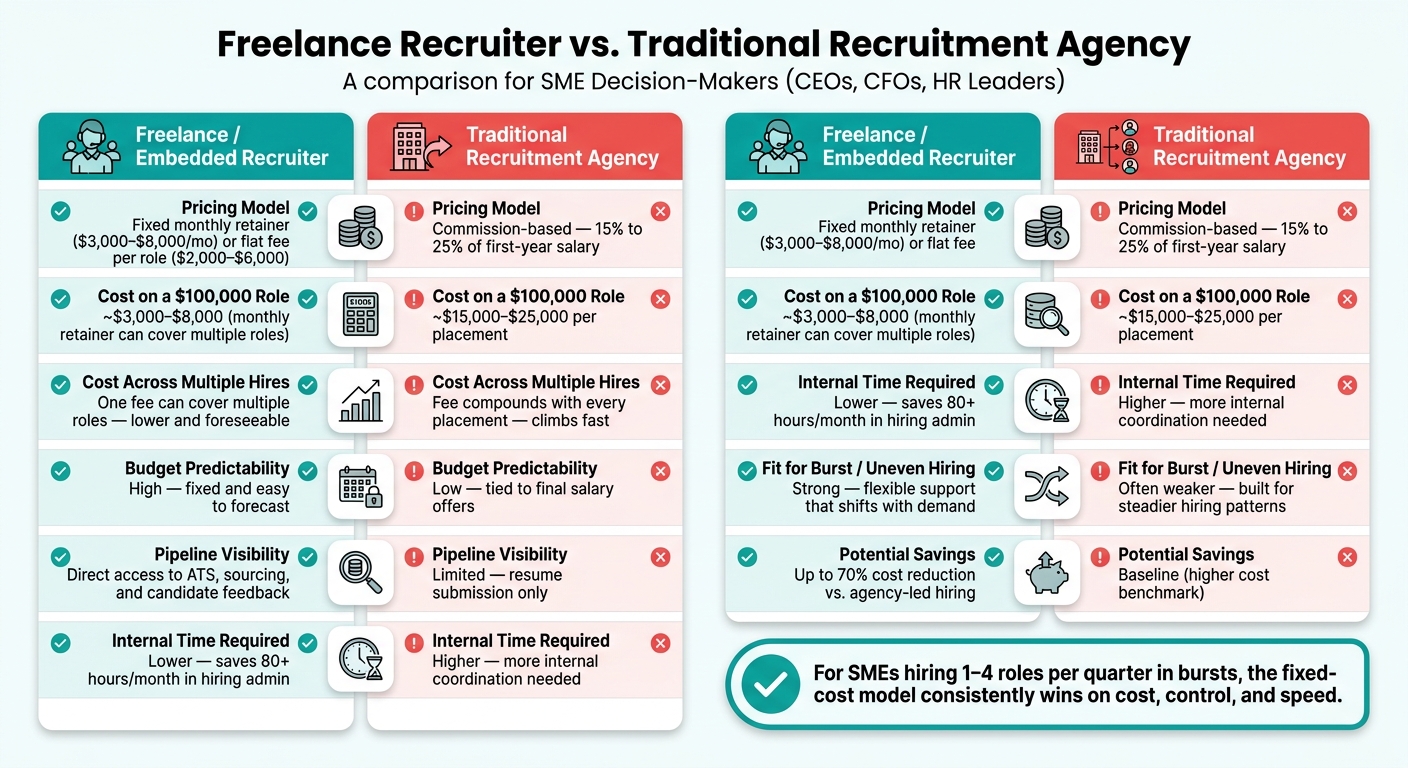
Freelance Recruiter vs. Agency: Cost & Control Comparison for SMEs
In practical terms, this decision comes down to cost, visibility, and flexibility.
Once cost pressure is on the table, the next issue is simple: how much control do you have when hiring needs shift?
Cost control and pricing clarity
Traditional agencies usually charge a fee on each placement, often 15% to 25% of a new hire’s first-year salary [1][2]. That starts to bite when you open several roles in the same quarter. One hire is one fee. Five hires means five separate fees.
Freelance and embedded recruiters work in a different way. They often charge a monthly retainer between $3,000 and $8,000, or a flat fee per role of $2,000 to $6,000 [1]. For SMEs, that usually means more predictable spend, simpler forecasting, and less risk of costs climbing with every accepted offer.
| Decision Factor | Freelance Recruiter | Traditional Recruitment Agency |
|---|---|---|
| Cost Structure | Monthly retainer or hourly rate | Commission-based (15% to 25% of salary) |
| Total Cost (Multiple Hires) | One fee can cover multiple roles | Fee compounds with every placement |
| Budget Predictability | High; fixed and foreseeable | Low; tied to final salary offers |
| Hiring Visibility | Direct access to pipeline and process | Limited; resume submission only |
Speed, focus, and day-to-day visibility
For lean teams, visibility isn’t a nice-to-have. It’s what keeps hiring moving.
With a traditional agency, you send over a brief and then wait for resumes to show up. What happens in the middle often stays hidden. You may not know who is being sourced, how outreach is being handled, or why people are dropping out. That gap slows decisions and creates more admin for founders, HR leaders, and hiring managers.
A freelance recruiter sits much closer to your team. They’re inside your ATS, speaking directly with hiring managers, and keeping feedback loops short. That gives you clearer pipeline visibility and makes it easier to change course if the shortlist is off target.
It also helps in the small moments that decide whether a hire closes or slips away. If a candidate hesitates, someone on your side can step in fast, instead of pushing every question through an account manager.
Flexibility, embedded support, and scalability
Hiring rarely arrives in a smooth, even flow. More often, it comes in bursts. That’s where the model matters.
Agencies tend to work best for one-off searches. Freelance recruiters are often a better fit for uneven demand across multiple roles. You can bring one in for a fixed project, a hiring spike, or as part of an embedded recruitment setup. The support can shift with your hiring plan, instead of forcing you into a rigid fee model [1].
"A fractional recruiter sits in the gap between [an agency and a full-time hire], and for a lot of growing teams it is the most sensible option on the table." This model of fractional recruiter agility allows SMEs to scale without the overhead of traditional firms. – Abhishek Singla, Founder, Prepzo [1]
Why embedded recruiter support is gaining ground with scaling SMEs
Once cost and control are clear, the next question is simple: who actually does the hiring work day to day?
For most SMEs, the answer is not "hire more internal HR staff" and not "hand it all to an agency and hope for the best". You need support that fits your process, cuts admin, and keeps hiring moving.
What SMEs gain from an embedded recruiter model
An embedded recruiter works inside your process, manages candidate communication, and helps coach hiring managers.
That has a direct effect on output. Job descriptions get written. Interview scorecards get set up. Screening stays consistent from one candidate to the next.
It also takes scheduling, triage, and candidate follow-up off your internal team’s plate. That’s time your HR leaders and hiring managers get back to spend on higher-value work.
In one engagement, Rent a Recruiter screened 1,481 applicants for VicReturn over four months, filling 18 senior roles while saving the internal HR team over 600 hours of administrative time [3].
There’s another part that often gets missed. Candidate notes, sourcing history, and hiring context stay inside your ATS. When a traditional recruitment agency fills a role, that know-how often walks out the door with them. With an embedded recruiter, it stays with your company after the engagement ends [1].
For scaling SMEs, that’s a big deal. You get extra hiring capacity without giving up process control.
How Rent a Recruiter fits this model
Rent a Recruiter embeds recruiters directly into your team within days and manages hiring end-to-end inside your existing workflow.
The pricing is fixed and monthly, so budgeting is clear. No commission swings. No surprise fees. Just a model that lets you tie hiring spend back to output.
Companies working with Rent a Recruiter typically reduce hiring costs by up to 70% compared to traditional commission-based models, while saving over 80 hours per month in internal hiring and admin time [3].
It also works well when hiring demand isn’t steady. If your plan shifts, support can shift with it, without locking you into a long-term contract [3].
That makes the next question simple: when does embedded support become the right hiring model for your team?
Conclusion: When to choose a freelance recruiter and what to do next
Key signals that a freelance or embedded model is the right fit
For scaling SMEs, the right model usually becomes obvious when hiring starts eating into leadership time.
Once hiring demand moves past what your internal team can handle, freelance or embedded support helps you get back speed, control, and cost predictability.
After looking at cost, speed, and control, there are a few clear signs it’s time to change your model. You may be there already if founders or hiring managers are spending several hours each week on screening and scheduling, if you expect 1 to 4 hires over the next two quarters, if hiring tends to come in bursts, or if your team doesn’t yet have a structured interview process or a clean ATS pipeline.
If you expect 1 to 4 hires in the next two quarters, the fixed-cost model will often come out ahead. A retainer suits burst hiring without repeated placement fees. A freelance or embedded recruiter can also help put a repeatable hiring system in place.[1]
Next step: Book a Call or see your potential savings
If these signals apply, the next move is simple. Audit your hiring plans for the next two quarters, then compare likely agency spend against a fixed monthly retainer.
You can Book a Call with Rent a Recruiter to review your hiring plan, or start with a free Recruitment Health Check.
Choose the model that gives your SME more control, clearer costs, and less drag on your leadership team than an agency-led approach.
FAQs
When is a freelance recruiter more cost-effective?
A freelance or embedded recruiter becomes more cost-effective once your hiring needs move past a single role.
Instead of paying a commission, often 17% to 30% of a new hire’s first-year salary, you usually pay a flat monthly retainer or project fee. That gives you a more predictable cost base and far better budget control.
This model works especially well if you’re hiring 10 to 24 people per year. You replace unpredictable per-placement fees with a steady expense, and you can save more than 80 hours per month in hiring admin.
For CEOs, CFOs, and Talent Leaders, that means lower hiring costs, less internal drag, and more control over delivery.
How does an embedded recruiter fit into my team?
An embedded recruiter works as a dedicated part of your team, not an external vendor. They work inside your existing tools, like your ATS, Slack, and email, to run hiring from sourcing and screening through to scheduling and reporting.
Because they join stand-ups, planning sessions, and hiring meetings, they get up to speed on your culture and what good looks like in each role. You stay in control of hiring decisions, while they take care of the day-to-day admin that often slows your team down.
What hiring plans suit this model best?
This model fits companies in fast-growth mode, dealing with uneven hiring demand, or trying to build a repeatable hiring process without the high cost of traditional commission-based agencies.
It works especially well for scaling businesses making 10 to 24 hires per year. It’s also a strong fit during post-funding expansion, product launches, or market entry, when you need expert support to scale headcount fast and keep hiring on track.