
If your hiring process changes by manager or department, growth gets slower, costs climb, and hiring targets slip.
I’d sum it up like this: a standard recruitment workflow gives you more control over hiring speed, spend, and decision quality. It helps you cut delays in approvals, scheduling, feedback, and offers. It also makes your ATS data more useful, so you can see where time is being lost and what it is costing the business.
Here’s the short version:
- Standardisation helps hiring move faster when stages, owners, and deadlines are fixed.
- Structured interviews improve consistency more than unplanned interviews.
- Clear scorecards and ATS rules cut rework and make decisions easier to track.
- Better measurement matters because time-to-hire, time-to-fill, and stage delays are often mixed up.
- Results depend on rollout. A fixed process alone will not fix weak job criteria or poor interviewer training.
A few numbers stand out:
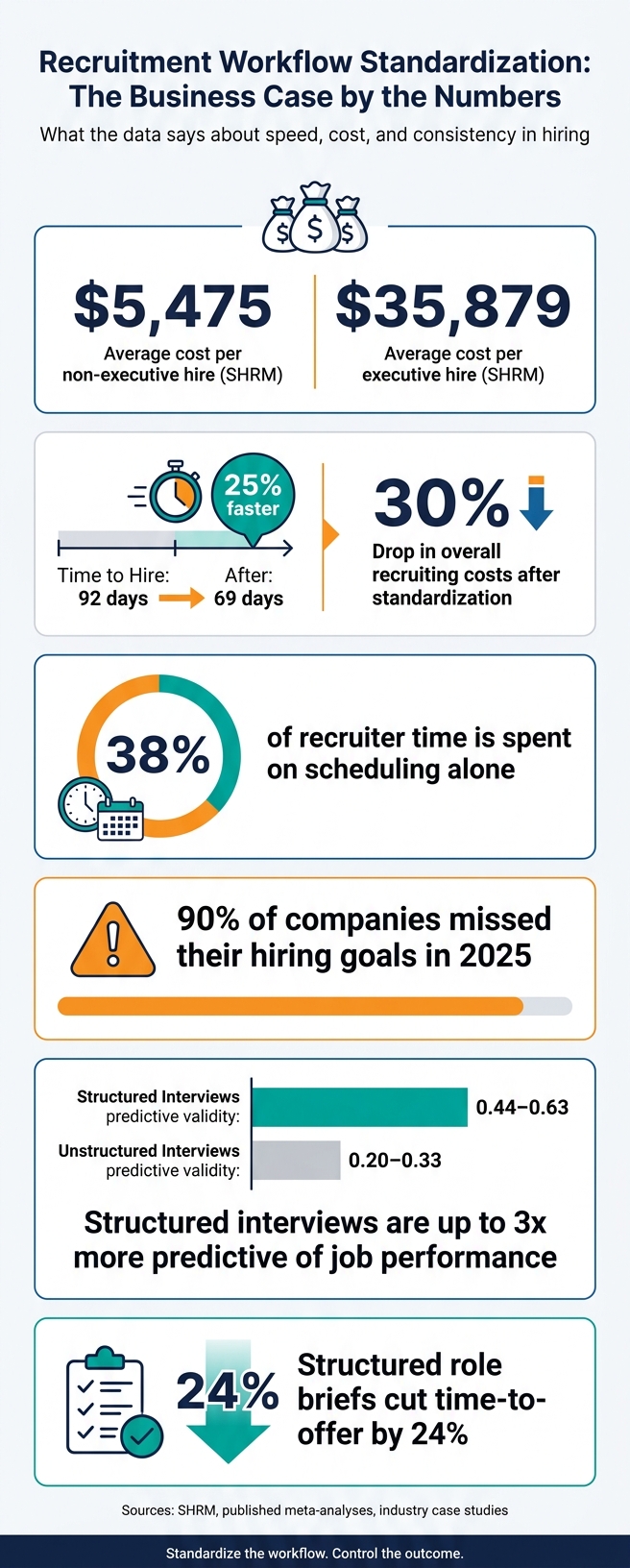
- SHRM puts average cost per non-executive hire at $5,475
- Average cost per executive hire is $35,879
- One case study showed time to hire dropping from 92 days to 69 days
- The same case study reported a 30% drop in recruiting costs
- Scheduling takes up 38% of recruiter time on average
- 90% of companies missed hiring goals in 2025
For CEOs, CFOs, HR leaders, and Talent Leaders, the point is simple. Hiring workflow is not just an HR process. It is a business system. If you want cleaner execution, lower hiring drag, and more predictable headcount delivery, standardising the workflow is one of the first places to look.
Below, I break down what standardisation means, what the research supports, where the limits are, and what to track if you want the process to improve in a way you can measure.
Recruitment Workflow Standardization: Key Stats & Business Impact
How to Create an Effective Hiring Process Flowchart | Episode 127
sbb-itb-a23bd6a
What the research shows about speed, cost, and consistency
The clearest evidence sits around speed, cost, and interview consistency.
How standardized workflows improve time to hire and cost control
Start with the definitions, because this is where a lot of teams get tripped up.
Time to hire measures the period from candidate entry to offer acceptance. Time to fill measures the period from requisition approval to acceptance. For scaling companies, that difference matters. It affects how you benchmark performance, how you plan headcount, and how much confidence you can have in hiring forecasts using talent acquisition strategies for scaling. If those terms get mixed together, your reporting becomes shaky and your comparisons stop meaning much.
One case study found that standardising the recruiting process reduced time to hire from 92 days to 69 days, a drop of 23 calendar days, or about 25%, and reduced overall recruiting costs by about 30%.[1] That kind of shift usually comes from tighter ownership, fixed approval steps, and deadline-led handoffs. Put simply, when everyone knows who owns each stage and by when, delays become harder to hide.
The usual bottlenecks are familiar:
- Approval delays
- Poor handoffs between teams
- Slow interviewer feedback
That said, those numbers should be treated as a case-study result, not a rule. What you can achieve depends on hiring volume, role difficulty, labour market conditions, tech stack, the quality of your starting process, and how well the new workflow is rolled out.
If you want reporting that helps you make decisions, track medians and percentiles, not just averages. One drawn-out search can throw off the mean and make performance look worse, or better, than it is. If your median time to hire drops from 74 to 61 days, while your 90th percentile drops from 140 to 95 days, that tells you far more about process control than one blended average ever could.
It also helps to track stage-level ageing. Look closely at time spent in requisition approval, scheduling, feedback submission, and offer authorisation. That’s where you spot the drag. And once you can see the delay, you can fix it.
Better efficiency matters. But it does not prove that hiring decisions improved.
Why structured interviews produce more reliable hiring decisions
Research shows that structured interviews are more predictive than unstructured ones. One widely cited meta-analysis estimated predictive value at 0.44 for structured interviews versus 0.33 for unstructured interviews.[2] Another broad review found an even larger gap, 0.63 versus 0.20, in one comparison.[3]
| Dimension | Unstructured Interview | Structured Interview |
|---|---|---|
| Question consistency | Varies by interviewer or candidate | Core questions defined in advance |
| Scoring | Informal overall impression | Scored against a shared rubric |
| Documentation | Notes may be incomplete or inconsistent | Evidence and ratings are recorded systematically |
| Calibration | Limited or informal | Interviewers align on criteria before and during the process |
| Predictive value | Generally lower in the cited research (est. 0.20 to 0.33)[2][3] | Generally higher in the cited research (est. 0.44 to 0.63)[2][3] |
This is why standardised scoring matters inside a hiring workflow. Without it, interviews can drift all over the place. One interviewer goes off instinct. Another asks different questions. A third writes little down. Suddenly, you are comparing candidates on uneven ground.
That creates more room for similarity bias, affinity bias, and first-impression bias.
In practice, a structured interview process should include:
- Job-based competencies
- Standardised core questions
- Clear scoring rubrics with behavioural anchors
- Written interviewer notes
- Independent ratings before group discussion
- Calibration sessions so interviewers agree on what each score means
The aim is not to make interviews stiff or mechanical. It is to make sure judgement is applied consistently, at the right stage, by the right people. Structured interviews do not guarantee fair or accurate decisions, but they do give you a better shot at consistency, comparability, and later review.
These findings point to improvement, not automatic causation.
What the evidence does not prove
The 92-to-69-day result and the 30% cost reduction should be read as one case study, not a standard benchmark for every business. Before-and-after comparisons can show a relationship, but on their own they do not prove that standardisation caused the outcome. More recruiting capacity, an easier market, fewer hard-to-fill roles, or better systems could all have played a part.
Just as important, consistency is not proof of better hiring. A process can be very repeatable and still lead to poor outcomes if the competencies are vague, the interview questions do not match the actual job, or interviewers use scorecards without grasping what they are judging.
Standardisation helps you run the process with more control. It also makes weak spots easier to measure. But it will not fix weak job criteria or undertrained interviewers by itself. Those need separate work, and they have a direct effect on hiring quality, team performance, and the cost of a bad hire.
The workflow controls that make standardization work
Evidence only helps if it shows up in the day-to-day workflow.
Standardize the full hiring path from role approval to onboarding
The best place to start is simple: treat each step in hiring as a clear handoff. That makes delay, cost, and ownership visible at every stage.
Each stage should have a set input, owner, required record, outcome, and maximum turnaround time. If any of those pieces are missing, work stalls, decisions drift, and accountability gets fuzzy.
A full hiring path covers nine stages: workforce planning and requisition approval, job analysis and success criteria, sourcing, screening, structured assessment, selection, offer management, onboarding, and post-hire review.
| Stage | Owner | Required Record | Outcome | Service-Level Target |
|---|---|---|---|---|
| Requisition approval | Hiring manager + finance or executive owner | Business justification, approved salary range, target start date, reporting line, employment type | Approved or rejected role | 2 business days |
| Job analysis | Recruiter + hiring manager | Role-specific scorecard, interview plan, evidence standards | Interview plan ready | Target |
| Sourcing | Recruiter | Approved requisition, candidate profile, outreach record | Qualified candidate slate or restart sourcing | 10 business days |
| Screening | Recruiter | Eligibility checks, compensation alignment, location or work-authorization requirements, evidence against minimum qualifications | Advance or decline | Target |
| Structured assessment | Interviewers | Interview assignments, questions, scorecards, written evidence, ratings | Advance or decline | Feedback within 24 hours of interview |
| Selection | Hiring manager + interview panel | Final scorecards, debrief notes, decision rationale | Hire or no hire | 2 business days after the last assessment |
| Offer management | HR + finance | Approval, compensation range, offer date, candidate response, reasons for acceptance or decline | Accepted or declined | Target |
| Onboarding | HR + hiring manager | Onboarding checklist, start-date confirmations | Onboarding complete | Target |
One rule is worth locking in early: no role should enter sourcing until the requisition is fully approved and documented.
That single gate stops wasted effort. Your recruiter works from confirmed headcount, budget, reporting line, employment type, target start date, and hiring priority. No guessing. No chasing sign-off halfway through the search.
It also helps to add a 30-, 60-, or 90-day review against the hiring success criteria. That closes the loop between hiring decisions and early job performance, which is where cost and quality start to show up in plain view.
Use scorecards, calibration, and ATS data to reduce inconsistency
A strong scorecard should define four to six competencies before interviews start. For each one, set out the evidence interviewers should look for, a rating scale with behavioral anchors, and a required comments field.
One small detail makes a big difference: separate "insufficient evidence" from "does not meet requirement." Those are not the same thing. One means the team still lacks data. The other means the person is not a fit on that point.
Before interviews begin, the hiring team should line up on what strong and weak evidence look like, confirm who covers which competency, and rate a sample answer together. This kind of calibration cuts down on mixed standards across interviewers.
After each interview, interviewers should submit their own ratings and written evidence before any group debrief. That matters. It lowers the chance that a senior interviewer or early consensus shapes everyone else’s view before they’ve recorded it. Well-built rating scales, interviewer training, and calibration can support more consistent, evidence-based decisions and cut common rating errors and personal bias.[4]
Your ATS should act as the system of record for approvals, status changes, assignments, scorecards, notes, and reporting.
Every status needs a plain definition. For example:
- "screen complete" should mean minimum qualifications and compensation alignment are documented
- "decision pending" should mean all required scorecards are in, but the hiring decision has not yet been recorded
Required fields and automated reminders help stop candidates getting stuck in vague stages. When set up properly, the ATS can flag overdue actions, show who owns the next step, and escalate delays on its own.
But there’s no magic here. Tech can improve traceability and reporting. It cannot fix weak competencies, poor interview questions, soft rating anchors, or interviewers who have not been trained.
Build governance without making the process rigid
The trick is to keep the core controls fixed while leaving room for the role itself.
Keep approval gates, scorecard completion, documented decisions, and turnaround expectations in place across the board. Then let role-specific pieces, like technical questions, work samples, and competency weighting, shift based on the actual job.
That gives you control without turning the process into a box-ticking exercise.
In practice, governance means regular checks on the points that drive delay and rework. That includes stage delays, scorecard completion rates, whether screening criteria still match the job, and why candidates are withdrawing.
You should also recheck the workflow when the business changes in a material way, such as after a funding round, geographic expansion, product launch, or a sharp change in hiring volume.
These controls only matter if they cut delay, inconsistency, and rework. Once they are in place, the next step is to test whether they are improving speed, consistency, and cost.
How to measure recruitment workflow health and business impact
Once your workflow is standardised, the next job is simple: check whether it cuts delays, rework, and hiring risk.
That means measuring the same stages and handoffs the workflow was built to control. If you standardised approval, screening, interviews, offer, and onboarding, those are the exact points you should track.
The metrics that matter most for scaling companies
For scaling companies, five groups of metrics matter most: process activity, efficiency, funnel performance, quality, and business outcomes.
Activity metrics show whether people are actually following the process. The main one is scorecard completion rate, meaning the share of interviewers who submit feedback within 24 hours. Top-performing teams require scorecards inside that window [5]. If completion is low, the workflow is not being used in a steady way, and the data that follows becomes hard to trust.
Efficiency metrics show speed and internal effort. Time-to-shortlist and time-to-hire sit at the center of this. So do recruiter admin hours. That matters more than many teams think, because scheduling alone takes up 38% of recruiter time on average [5]. If your team is spending hours chasing calendars, that is time not spent moving hires forward.
Funnel metrics track movement through the pipeline. Time-to-offer and interview-to-offer rate help you spot where candidates are slowing down or dropping out. A weak interview-to-offer rate often points to poor screening at the top of the funnel or a weak intake process with the hiring manager. Structured role briefs can cut time-to-offer by 24% [5], which has a direct effect on hiring speed.
Quality metrics take longer to show up, but they matter most over time. Decision accuracy looks at whether interview scores line up with post-hire performance. Early attrition and hiring manager satisfaction help show whether the process is producing hires who perform well after onboarding, not just hires who looked good on paper.
How to evaluate results without overstating the impact
Before-and-after comparisons sound neat, but they can mislead if you do not start with a baseline.
Labor market conditions, pay changes, hiring volume, employer brand, and leadership input can all shift results on their own [5]. If you skip that context, it is easy to give the workflow credit for changes it did not cause.
A better approach is to:
- set a clear baseline before rollout
- record what changed and when
- compare the same roles or job families over time
- use the same metric definitions every time
That gives you a cleaner view of whether the process is getting faster, cleaner, and better at predicting hiring success.
The table below covers the core metrics, where the data comes from, how often to review it, and the main catch with each one.
| Metric Category | Metric | Definition | Data Source | Review Frequency | Main Limitation |
|---|---|---|---|---|---|
| Activity | Scorecard Completion | % of interviewers submitting feedback within 24 hours | ATS / Interview Platform | Weekly | Does not measure the quality of feedback |
| Efficiency | Time-to-Shortlist | Days from role opening to a qualified shortlist | ATS | Monthly | Dependent on initial application volume |
| Efficiency | Recruiter Admin Hours | Time spent on manual scheduling and chasing | Time tracking / Calendar audit | Quarterly | Hard to track without specific tools |
| Funnel | Time-to-Offer | Days from first interview to offer extended | ATS | Monthly | Influenced by candidate notice periods |
| Quality | Decision Accuracy | Correlation between interview scores and post-hire performance | Performance Management System | Biannually | Subject to manager bias in performance reviews |
| Business Outcome | Hiring Goal Attainment | % of headcount targets met within the quarter | HRIS / Workforce Plan | Quarterly | Affected by external labor market shifts |
Hiring goal attainment deserves close attention. In 2025, 90% of companies missed their hiring goals [5]. Standardisation will not solve every issue. It will, however, give you much better visibility into what is slowing hiring down, where handoffs are failing, and which parts of the process need fixing.
Once that baseline is in place, accountability becomes much clearer for the teams running the workflow.
What implementation looks like for high-growth SMEs
Once you’ve measured the workflow, the next step is to standardize how it runs.
For a scaling company, recruitment standardization is an operating model. It means fixed stages, clear owners, and checkpoints that still hold when hiring pressure builds. That matters most when hiring volume climbs fast and informal ways of working start to crack.
A practical place to start is a simple, standardized workflow:
- approved requisition
- intake
- job description approval
- sourcing
- screen
- structured interviews
- debrief
- offer
- references
- onboarding handoff
Each stage should have one owner and a deadline. For example, feedback should land within 24 to 48 hours, and interview scheduling should happen within two business days. That kind of structure cuts ambiguity and makes bottlenecks far easier to spot during fast growth.
Keep the process fixed. Tailor the assessment.
In practice, that means approval steps, documentation, scorecards, feedback deadlines, scoring rules, decision rights, and ATS fields stay the same across roles. What changes is the way you test for fit. A software engineer might complete a technical exercise. A sales candidate might do a role-play. But both should still be assessed against predefined competencies and logged in the same system.
That consistency matters. Without it, hiring teams drift, interview quality drops, and decision-making slows down. With it, you get cleaner data, tighter control, and fewer delays.
When the process is stable but internal capacity is stretched, embedded support can keep the workflow moving. An embedded recruiter works inside your workflow, your ATS, and your team structure. They handle sourcing, screening, scheduling, ATS records, candidate communication, and onboarding, while hiring managers keep final decision authority.
Rent a Recruiter embeds recruiters directly into your team within days, managing hiring end-to-end while bringing structure, visibility, and consistency to the process. The company reports clients typically reduce hiring costs by up to 70% and save more than 80 hours per month in internal hiring and admin time.
Conclusion: standardization improves execution when measurement and ownership are clear
This is where structure starts to pay off.
When growth demands speed, you can’t afford a hiring process that changes from manager to manager or role to role. Standardized workflows can improve hiring speed, cost control, consistency, and scalability. But those results depend on valid job criteria, structured assessment, trained interviewers, and disciplined measurement.
Put simply, standardization improves execution when ownership, measurement, and criteria are clear.
If you’re ready to bring more structure and predictability to how your company hires, the practical next step is to audit your recruitment process, identify where delays and rework are piling up, and pilot a standardized workflow on one role family before rolling it out across the business.
Book a Call to talk through what a structured hiring model could look like for your team.
FAQs
How do I standardize hiring without making it rigid?
Standardise hiring with a simple framework your team can use every time, instead of leaning on gut feel. Set 4 to 6 job-related competencies before the role goes live. Then use the same interview kits and shared scorecards across the process.
That keeps every interviewer locked in on the same criteria. The upside is clear: less subjectivity, better hiring decisions, and fewer costly mis-hires.
You should also automate admin work like scheduling and status updates. That saves time and cuts friction for your team. But the hiring decision itself should stay human. Automation should support judgment, not replace it.
What metrics should we track first to measure hiring workflow health?
Start with the Big Four: cost-per-hire, time-to-fill, offer acceptance rate, and 90-day retention. These metrics give you a baseline for hiring efficiency, how well you compete in the market, and the quality of your hiring outcomes.
From there, track funnel metrics like time-in-stage, stage conversion rates, and source effectiveness. This is where bottlenecks show up. If any stage takes more than 48 to 72 hours, that points to a process delay that can slow hiring, hurt candidate momentum, and increase the risk of losing strong people to other offers.
How long does it take to see results from a standardized recruitment workflow?
You can usually see results fairly fast. If you’re new to standardised recruitment workflows, run a 60- to 90-day pilot and review progress every 30 days.
Before you start, track KPIs for 4 to 6 weeks so you have a clear baseline. After rollout, monitor monthly efficiency metrics and use quarterly reviews to assess broader outcomes and longer-term trends.