
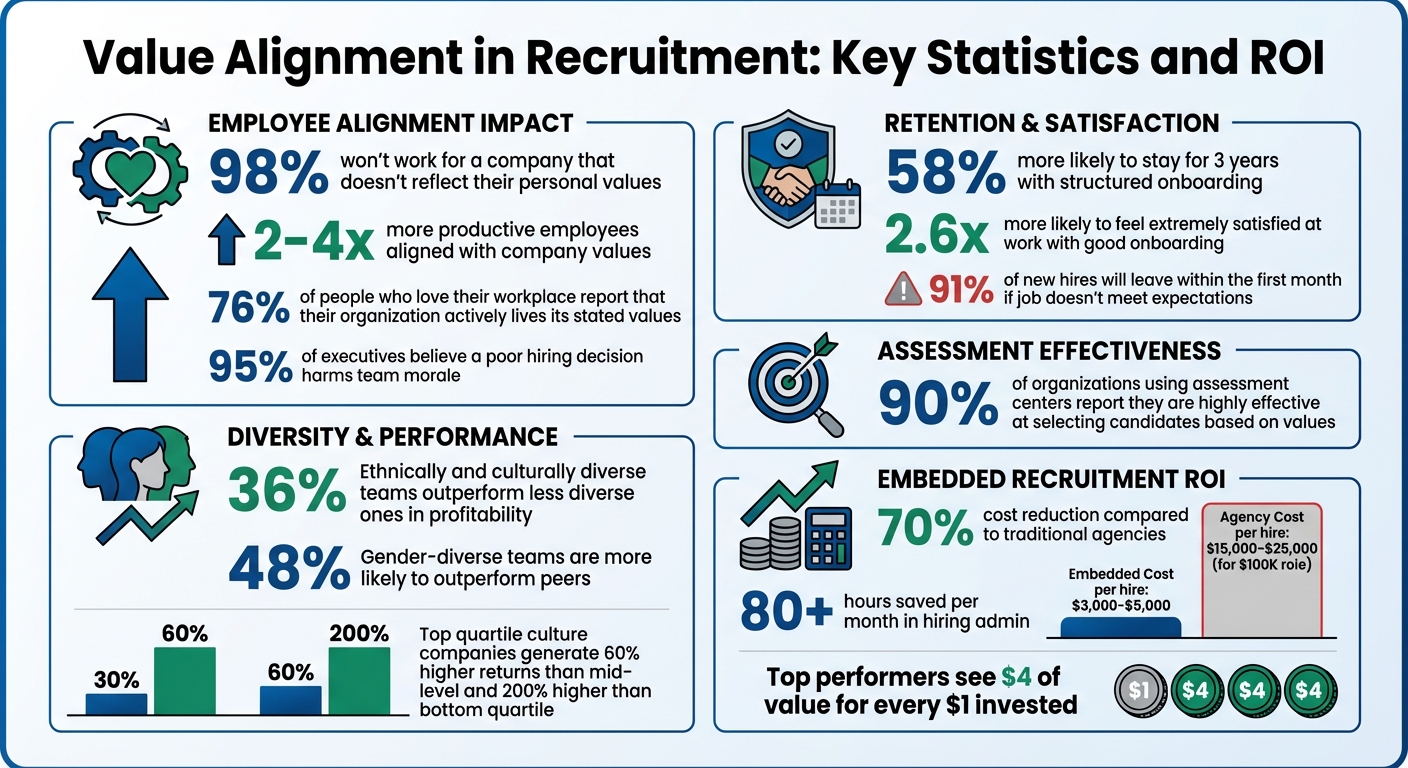
Value alignment in hiring isn’t just a buzzword – it’s a business priority. Employees who align with company values are 2-4x more productive, stay longer, and boost team morale. On the flip side, a bad hire can cost you time, money, and team cohesion. For scaling companies, this approach isn’t optional – it’s essential to growth.
Here’s what matters most:
- 98% of employees won’t work for a company that doesn’t reflect their personal values.
- Companies with aligned teams see higher retention and lower hiring costs.
- Value-based hiring builds not just teams, but teams that perform.
To make this work, you need to:
- Define your company’s values with clarity and tie them to measurable behaviors.
- Build a hiring process that evaluates candidates against these values with structured, consistent methods.
- Reinforce alignment post-hire through onboarding and feedback loops.
Scaling your hiring? Embedded recruitment providers help you maintain this focus while reducing costs by up to 70% compared to traditional agencies. They integrate directly into your team to ensure every hire fits your business goals and values.
The result? A hiring process that saves time, cuts costs, and delivers better outcomes.
Value Alignment in Recruitment: Key Statistics and ROI
Values-Based Hiring: Seeing People Beyond Their Skills
sbb-itb-a23bd6a
Step 1: Identifying and Defining Your Company Values
Before you can hire based on values, you need to clearly understand what those values are. This isn’t about picking buzzwords that look good on a careers page – it’s about pinpointing the beliefs and behaviors that genuinely drive success within your organization.
Analyzing Current Culture and Top Performers
Start by examining the people who are already excelling in your company. Look at Quality of Hire data – specifically, the traits and behaviors of employees who have achieved strong performance ratings in their first year. What sets these individuals apart? Is it their ability to take initiative? Their knack for solving problems without being asked? These recurring traits reveal the values your company already lives by, not the ones you wish it did.
Gather input from employees across all levels, not just leadership. For example, in January 2026, Wellstar Health System used Trust Index™ Survey data to uncover a disconnect: leadership focused on "caring for others", but employees were more concerned about their own physical safety. By addressing this gap with targeted safety investments, they reduced turnover and boosted patient satisfaction.
"Engagement is about enthusiasm; alignment is about direction." – Seth Willis, Business Advisor, Great Place To Work
The next step is turning these insights into actionable, measurable definitions.
Converting Values into Measurable Behaviors
Once you’ve identified your core values, you need to translate them into specific, observable actions. Abstract concepts like "integrity" or "ownership" are meaningless if they can’t be tied to real-world behaviors. For example, one company defined "integrity" through clear statements like: "I am honest and do what I say I will do", "I take responsibility for my actions", and "I learn from my mistakes". At Employment Hero, the value "Own It" is brought to life by emphasizing initiative and accountability for project outcomes.
This translation makes it easier to measure values during the hiring process. Instead of asking vague questions like, "Do you value teamwork?" you can evaluate candidates based on whether they’ve demonstrated specific collaborative behaviors in previous roles. It’s no coincidence that 76% of people who love their workplace report that their organization actively lives its stated values. That alignment only happens when values are clearly defined and reinforced through measurable actions.
Step 2: Building a Values-Focused Recruitment Process
Once your organization’s values are clearly defined and measurable, it’s time to weave them into every aspect of your recruitment process. This step goes beyond surface-level questions, creating a structured system that evaluates whether candidates genuinely align with the principles your company lives by.
Writing Values-Based Interview Questions
The best way to assess values is by focusing on real-life behavior rather than hypothetical answers. For example, instead of asking, "How would you handle a conflict with a teammate?" try, "Tell me about a time you disagreed with a colleague on an important decision. What did you do, and what was the outcome?" This approach gives insight into how candidates act under pressure, not just how they think they should act.
Tailor your questions to reflect your core values. If "ownership" is a key principle, ask candidates to share a time they took initiative to address a team-wide challenge without being prompted. Follow up with questions like "What did you learn?" or "What would you do differently?" to gauge their reasoning and self-awareness. Be mindful of red flags, such as blaming others, avoiding accountability, or compromising values for personal gain.
"The best answers often involve a situation where the candidate did not compromise a core value. They may have compromised on a secondary preference… to uphold a primary value." – MyCulture.ai
This approach also helps candidates self-evaluate. With 98% of employees stating they wouldn’t work for a company misaligned with their personal values, these questions can help both parties determine if the fit is right.
The next step is ensuring consistency in how you evaluate these responses.
Creating Standardized Evaluation Frameworks
Subjective gut feelings should never drive hiring decisions. To fairly and consistently assess value alignment, implement a scoring rubric with clear criteria for poor, average, and excellent responses. For instance, when evaluating "integrity", a strong answer might include a specific example where the candidate upheld a principle despite personal cost, explained their decision-making process, and reflected on what they learned.
Train interviewers to base their ratings on evidence, not personal impressions. Objectivity is key to ensuring consistency across all candidates. To streamline the process, assign specific values or competencies to each interviewer. For example, one person might evaluate "collaboration", while another focuses on "accountability". This minimizes overlap and ensures thorough coverage.
Tools like Situational Judgment Tests (SJTs) can also help identify value alignment early in the recruitment process, saving time before moving to interviews. In fact, 90% of organizations using assessment centers report they are highly effective at selecting candidates based on values.
A structured evaluation framework ensures every candidate is assessed fairly and comprehensively.
Including Multiple Team Members in Interviews
A new hire doesn’t just impact their manager – they influence the entire team. That’s why it’s critical to involve multiple team members in the interview process. This approach offers diverse perspectives on how a candidate’s decision-making might function in various scenarios. It also helps reduce the bias that often creeps into traditional "culture fit" interviews, which can rely too heavily on one person’s subjective opinion.
Cross-functional participation is also crucial for building teams that perform better. Ethnically and culturally diverse teams outperform less diverse ones by 36% in profitability, and gender-diverse teams are 48% more likely to outperform their peers. By focusing on shared values instead of superficial similarities, you create an environment that values diversity while maintaining alignment on what truly matters.
To ensure fairness, provide every interviewer with the same scoring rubric to evaluate candidates based on behavior rather than instinct. Train them to identify what a candidate can add to the culture from a values standpoint, rather than simply looking for someone who fits the existing mold. This approach ensures your hiring process remains inclusive, objective, and focused on long-term success.
Step 3: Maintaining Value Alignment After Hiring
Keeping employees aligned with your core values doesn’t stop at hiring – it’s about reinforcing those values from day one. A structured onboarding process is key to ensuring new hires stay connected to what made them a great fit in the first place. Without this follow-through, even the best hires can lose their connection to the company’s culture. Consider this: employees are 58% more likely to stay for three years if they experience structured onboarding, and they’re 2.6 times more likely to feel "extremely satisfied" at work when onboarding is done well. Onboarding isn’t a one-and-done task; it’s a long-term investment.
Onboarding for Cultural Integration
Think of onboarding as a year-long process, not just a few days of orientation. Start with preboarding – send a CEO welcome video and clear first-day instructions to set the tone. On day one, schedule a meeting with the new hire’s manager to go beyond role expectations and discuss how the company’s values play out in everyday work. Assign an onboarding buddy or mentor for the first three months to help them navigate team dynamics and cultural norms. Microsoft adopted this approach and saw impressive results: new hires who met with managers during their first week scored 8% higher on intent-to-stay metrics, and those paired with buddies were 36% more satisfied at work. Among those who met their buddy more than eight times in the first 90 days, 97% reached full productivity faster.
How you deliver onboarding matters as much as the content itself. If collaboration is a core value, for example, your onboarding should reflect that. Debi Chernak, CHRO at Intrado Life & Safety, explains:
"If we say that we are a company that values open communication and collaboration, and then we sit new hires by themselves in front of a computer for onboarding, we’re not supporting our culture".
Interactive, team-based sessions work better. Include executives and managers in live onboarding events, and open these sessions to existing employees as refreshers. Mix practical training with celebrations of company achievements to show what your culture looks like in action.
Onboarding shouldn’t stop at three months. Plan progress reviews at six months and one year to transition new hires from onboarding to full career integration. Use these reviews to ask employees about their experiences – where your culture matched their expectations and where it fell short. Megan Bickle, Global Head of Culture at Western Digital, suggests sending surveys after onboarding:
"Ask about what aligned, any disconnects and any questions they still have about the culture".
This feedback loop helps you address issues early and refine your approach for future hires. As your onboarding process evolves, so should your talent acquisition strategies to ensure values alignment remains strong.
Refining Your Recruitment Process Over Time
Onboarding is just one piece of the puzzle. To maintain long-term value alignment, your recruitment process needs to adapt as your business grows. Build feedback mechanisms for new hires and managers to evaluate how well your hiring process identifies cultural fit. Track retention rates specifically for value-aligned employees to measure the effectiveness of your strategy. Engagement surveys can also reveal shifts in team alignment. Companies that excel in culture consistently see better outcomes – those in the top quartile for culture generate 60% higher returns than mid-level companies and 200% higher than those at the bottom.
Regularly review your recruitment strategy—perhaps by adopting Recruitment as a Service—to ensure it aligns with your company’s growth and changing goals. What worked for a 20-person team might not scale to a 200-person organization. Start with simple processes and add complexity as needed. The stakes are high: 91% of new hires say they’ll leave within the first month if the job doesn’t meet their expectations. Getting this right isn’t just about avoiding turnover – it’s about building a stronger, more aligned team for the long haul.
Scaling Value-Aligned Recruitment with Rent a Recruiter
When your company is growing, keeping your recruitment process aligned with your core values can feel like a monumental challenge. You’ve already established a hiring framework, defined your values, and built an interview process – but as hiring speeds up, your internal team may struggle to keep up. Traditional agencies might fill positions quickly, but they often lack the cultural insight needed to find candidates who truly align with your values. And the cost of getting it wrong? High turnover, disengaged employees, and the time and money lost in rehiring efforts. This makes it critical to scale your hiring process without losing sight of cultural alignment.
How Rent a Recruiter Keeps Values Front and Center
Rent a Recruiter offers a fresh solution by embedding skilled recruiters directly into your team. Unlike traditional agencies that focus on job descriptions alone, these recruiters immerse themselves in your company culture. They take the time to understand what values like ownership, collaboration, or innovation look like in real, actionable terms. This deep integration ensures that the candidates they bring forward reflect the values that are central to your company’s identity.
The process starts with a collaborative values-mapping exercise. Here, recruiters work closely with your team to define how your values translate into day-to-day behaviors. These insights are then incorporated into job postings and career pages, helping attract candidates who already share your mission while discouraging those who don’t. During the interview stage, recruiters use structured behavioral questions like, “Can you share an example of when you took initiative?” to dig into how a candidate’s past actions align with your values. Tools like situational judgment tests and personality assessments further identify candidates whose priorities match your company’s ethos.
To maintain consistency, Rent a Recruiter uses standardized evaluation tools such as interview scorecards and rubrics. This ensures every candidate is assessed against the same value-based criteria by multiple team members. And the stakes are high: 98% of employees say they wouldn’t work for a company that doesn’t share their values, while 95% of executives believe that a poor hiring decision harms team morale. This approach isn’t just about filling roles – it’s about finding the team members who will raise the bar and drive your company forward.
Why Embedded Recruitment Makes Sense for SMEs
The embedded recruitment model doesn’t just align with your values – it also delivers measurable financial benefits. Companies using this approach often cut hiring costs by up to 70% compared to traditional commission-based agencies, while saving over 80 hours a month in hiring-related admin. For example, the typical cost per hire with an embedded recruiter ranges from $3,000 to $5,000. Compare that to agency fees, which can range from $15,000 to $25,000 for a $100,000 role. The ROI is clear: top-performing companies see up to $4 of value for every $1 invested.
But it’s not just about saving money. Embedded recruitment provides predictable costs, faster hiring timelines, and consistent results. Whether you’re scaling after a funding round, launching a new product, or handling a hiring surge, this model gives you the ability to grow without compromising the cultural alignment that has been key to your success. For SMEs in industries like technology, SaaS, fintech, engineering, and professional services, it’s a way to expand your team while safeguarding the values that set your company apart. This isn’t just recruitment – it’s a strategy for long-term success.
Conclusion: Growing Your Business with Value-Aligned Hiring
Hiring for value alignment does more than fill roles – it strengthens your business from the inside out. Employees who feel connected to their workplace values are 2 to 4 times more likely to perform at a high level, and 76% of them say their company actively lives by its stated values. This approach doesn’t just build a team – it builds a team that thrives.
The financial benefits are hard to ignore. With value-aligned hiring, you reduce turnover, minimize disruptions from rehiring, and foster stronger client relationships through engaged, reliable employees. While technical skills can be developed through training, qualities like accountability, dependability, and emotional intelligence are the bedrock of a cohesive, long-lasting team.
For small and medium-sized businesses in growth mode, the priority isn’t just speed – it’s making smart hiring decisions while keeping the culture that made you successful intact. Whether you’re scaling after securing funding or managing rapid hiring demands, focusing on value alignment ensures you stay competitive in a market where 98% of employees won’t stick with a company that conflicts with their values. The message is clear: value-aligned hiring is a strategic must.
Next Steps
Looking to integrate value-aligned hiring into your recruitment strategy? Start with Rent a Recruiter’s free Recruitment Health Check at https://rentarecruiter.com. This tool provides a customized PDF report with actionable recommendations to improve your employer branding, hiring processes, and diversity efforts – benchmarked against industry standards. Or, if you’re ready to bring experienced recruiters directly into your team to create a scalable, growth-ready hiring process, book a call to see how companies are cutting hiring costs by up to 70% and saving over 80 hours of admin time each month.
FAQs
How do I turn our values into behaviors we can measure in interviews?
To assess values during interviews, start by pinpointing the key behaviors that represent each of your core values. Then, craft behavioral questions that encourage candidates to share examples from their experience. For instance, if honesty is one of your values, you might ask, "Can you describe a time when you faced an ethical dilemma at work? How did you handle it?"
When evaluating responses, focus on traits like integrity, accountability, or decision-making that align with your values. Using structured questions and clear evaluation criteria ensures that value alignment becomes a measurable part of your hiring process.
How can we assess values fairly without slipping into “culture fit” bias?
To evaluate candidates without falling into the trap of "culture fit" bias, anchor your assessments in objective criteria that reflect your organization’s core values. Use structured interviews to explore how candidates have demonstrated these values through their past actions and decisions.
By shifting the focus from "culture fit" to "values fit," and relying on predefined criteria and behavioral questions, you create a fairer, more consistent process. This approach minimizes bias, promotes equity, and helps you build teams that are both diverse and aligned with your organization’s principles.
What metrics should we track to prove value-aligned hiring is working?
To demonstrate that hiring aligned with your company values works, focus on measurable outcomes. Track quality of hire through metrics like performance, retention rates, and ramp-up time. Gauge employee engagement by using surveys and gathering feedback. Keep an eye on hiring source effectiveness to pinpoint which channels bring in candidates who align with your values. At the same time, monitor time-to-fill and cost-per-hire to maintain efficiency. Regular reviews of these metrics will help fine-tune your approach, ensuring each hire strengthens your team and aligns with your company’s mission.