
When hiring remotely, every interaction with a candidate counts. From job postings to onboarding, the process shapes how your company is perceived. A poor experience leads to drop-offs, while a smooth one attracts top talent. For scaling companies, this isn’t just about reputation – it’s about saving costs and securing the right hires.
Key Takeaways:
- 61% of candidates report being ghosted post-interview, damaging your employer brand.
- 66% of candidates accept offers based on a positive hiring experience.
- Poor experiences can cost SMEs millions – Virgin Media lost $5.4M annually due to this.
- Streamlining processes, like reducing application complexity and improving communication, boosts efficiency and candidate satisfaction.
Quick Wins:
- Transparency: Share salary ranges, remote policies, and hiring timelines upfront.
- Speed: Automate updates and reduce delays – hiring cycles over 40 days lose 12% more candidates.
- Human Connection: Balance automation with personal touches, like manager video messages.
- Pre-boarding Engagement: Regular updates between offer acceptance and start date prevent disengagement.
Scaling hiring? Embedded recruitment can help maintain consistency while cutting costs by up to 70%. Learn how Rent a Recruiter can transform your hiring process.
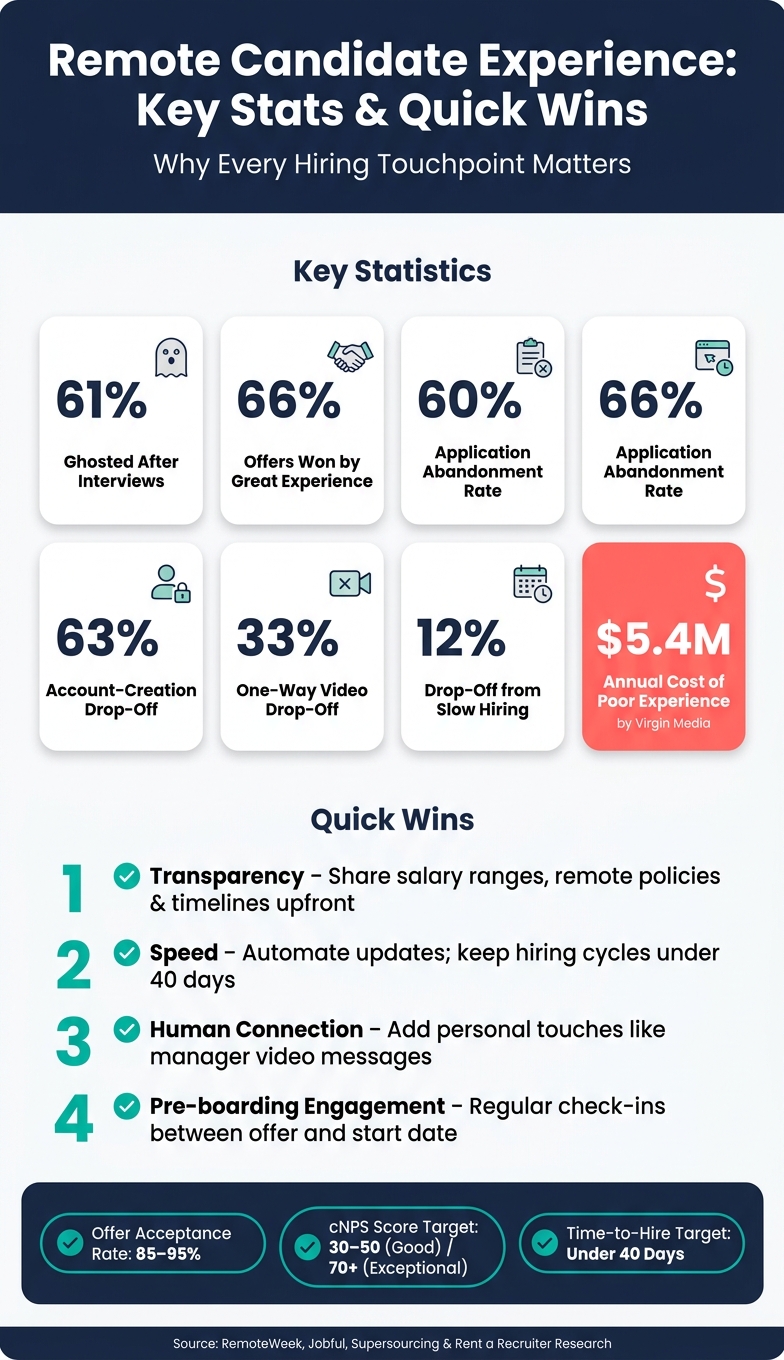
Remote Candidate Experience: Key Stats & Quick Wins
Foundations of a Strong Remote Candidate Experience
Core Principles for Remote Candidate Experience
Building a strong remote candidate experience hinges on a few key principles that directly influence how candidates perceive your company and, ultimately, whether they accept your offers.
Start with transparency. Sharing salary ranges, remote work policies, and a clear breakdown of the hiring process upfront removes uncertainty and builds trust right away. Alongside this, clarity is essential. Job descriptions should include 3–5 clear success metrics for the first 6–12 months, helping candidates decide if the role aligns with their goals before they even apply [1].
Speed is often underestimated but critical. Automating routine tasks like status updates and interview scheduling keeps the process moving smoothly, a core benefit of an embedded recruitment service. Combine this with respect for candidates’ time by ensuring interviews start on time, application forms are limited to 5–7 key fields, and unnecessary steps are eliminated. These small actions show that your company is organised and values people’s time [1][5]. While automation can handle repetitive tasks, human connection is irreplaceable. A personalised video message from a hiring manager, for instance, can make a big impact in an otherwise digital process [6].
"A positive, respectful, and efficient process signals a healthy company culture long before an offer is ever made." – RemoteWeek Team [1]
These principles lay the groundwork for a well-structured candidate journey, ensuring every step enhances engagement and reduces friction.
How to Map the Remote Candidate Journey
Mapping the candidate journey involves documenting every interaction from the job posting to the first week of onboarding. The aim is to identify where candidates experience confusion, frustration, or disengagement – and fix those issues.
An engagement signal map can help compare how candidates feel versus what your team assumes. For example, candidates might feel left in the dark while your team thinks, "We’re still reviewing applications." This disconnect can harm confidence. Common pain points in remote hiring include lack of updates after applying, unclear timelines between interview stages, and technical hiccups during video interviews [6]. Mapping these touchpoints ensures your process aligns with the principles of transparency and clarity, creating a consistent experience.
Here’s a breakdown of common friction points and practical solutions:
| Journey Stage | Pain Point | Practical Fix |
|---|---|---|
| Application | Long forms or mandatory account setup | Mobile-friendly forms that take under 5 minutes [3] |
| Screening | One-way video before human contact | Schedule async video after an initial human call [3] |
| Scheduling | Delays from back-and-forth emails | Use self-booking links with calendar sync [3] |
| Post-Interview | Lack of communication or ghosting | Commit to a 48-hour response SLA at every stage [3] |
| Offer to Start | Pre-boarding disengagement | Regular check-ins between offer and start date [8] |
Tracking candidate Net Promoter Score (cNPS) at each stage – rather than just after hiring – pinpoints exactly where the process falters, whether it’s the application form, interview experience, or communication gaps [3].
Defining Remote Candidate Personas
Not all candidates have the same needs. A senior engineering leader considering a strategic career move will have very different priorities compared to a mid-level marketer seeking flexibility. Defining candidate personas allows you to tailor your process to these unique profiles.
Just as transparency builds trust, well-defined personas enable more focused communication. Start by identifying remote readiness traits beyond technical skills, such as strong written communication, self-accountability, and the ability to work independently without constant oversight [9]. Then, consider whether the role demands real-time collaboration across specific time zones or if it’s primarily asynchronous. These factors will shape everything from interview scheduling to job description details [9].
Personas also guide sourcing strategies. For instance, technical candidates are often best reached through platforms like GitHub or developer forums, while senior leaders respond better to personalised LinkedIn outreach [9]. Once you’ve defined these personas, you can refine every stage of the process – screening questions, scorecards, and communication strategies – to resonate with each profile. For someone who values deep, focused work, highlighting "no-meeting" blocks could be a key selling point [1][7].
"Remote hiring is not harder than onsite hiring – it’s more process-driven." – Mayank Pratap Singh, Co-founder & CEO, Supersourcing [9]
sbb-itb-a23bd6a
Remote Candidate Experience at Each Hiring Stage
Attracting Remote Candidates with Better Job Postings
A strong remote job posting answers the key questions candidates care about: location flexibility, work hours, and how they’ll be evaluated.
Half of job seekers want to see compensation details before applying [2]. Including remote-specific perks like home office stipends, equipment allowances, or flexible scheduling can make your posting stand out.
Keep it concise. Job descriptions between 201 and 400 words attract the most applications [2]. Avoid long task lists. Instead, highlight 3–5 key outcomes you expect in the first year. This helps candidates gauge their fit without wading through vague or overly broad requirements. Separating "must-haves" from "nice-to-haves" in distinct lists can also encourage more qualified applicants to apply, even if they don’t tick every box.
"A remote JD is not an onsite JD with ‘remote’ added at the top." – Supersourcing [9]
Be specific about tools (e.g., Slack, Notion, Jira), collaboration expectations (e.g., core hours like 10 AM–3 PM ET), and eligible locations or time zones. These details prevent mismatched expectations and reduce candidate drop-off later. With a clear and engaging job description, you set the tone for a smoother hiring process.
Simplifying the Remote Application Process
The application stage can be a make-or-break moment. 60% of candidates abandon applications because forms are too long or complicated [2], and 63% drop off if they’re forced to create an account before even starting [2].
Keep mobile applications under five minutes. By 2025, 83% of applicants will apply via smartphone [2], so mobile optimization is a must. Stick to essentials: name, contact info, resume upload, and maybe two or three job-specific questions. Anything extra can be collected later if needed.
Automated confirmation emails are a small but critical touchpoint. An immediate acknowledgment with next steps and a realistic timeline reassures candidates they’re still in the process. Hiring cycles longer than 40 days increase candidate drop-off by 12% [4], so setting clear expectations early keeps the momentum going.
One-way video interviews can be a dealbreaker. 33% of candidates drop out when asked to complete one before any human interaction [3]. Moving this step after an initial screening call can help retain top talent through the early stages.
Running Better Remote Interviews
A smooth remote interview requires preparation. Before the call, send candidates a logistics pack with the video link, backup phone number, interviewer bios, and troubleshooting tips [7]. This reduces stress and shows your team is organised.
Structured interviews are three times better at predicting job performance than unstructured ones [10]. Use consistent questions and scoring rubrics to ensure fairness without losing the personal touch. Always end interviews with a clear next step, including when candidates can expect feedback.
"Speed signals respect." – Jobful [2]
Scheduling interviews within a week of advancing candidates creates a better experience [2]. Self-serve calendar links can eliminate scheduling delays. If you’re using AI tools during interviews, be upfront about it and offer a human review option [10]. Transparency builds trust, which is critical as candidates move closer to the offer stage.
Making Offers and Onboarding Remote Hires
The offer stage isn’t the time to ease up. A clear, well-structured offer letter covering compensation, remote work terms, equipment policies, and start date logistics helps avoid last-minute confusion.
Pre-boarding is just as important. The time between offer acceptance and day one is a delicate period where candidates might disengage or accept another offer. Stay connected with regular updates and practical details, like equipment setup instructions, first-day contacts, and a clear plan for their first week. These small but meaningful actions reinforce your commitment and ensure a seamless transition for your new hire.
Measuring and Improving Remote Candidate Experience
Key Metrics to Track Remote Candidate Experience
When it comes to remote hiring, tracking the right metrics is essential to identify strengths and weaknesses in your process.
One of the most insightful metrics is Candidate Net Promoter Score (cNPS), which measures how likely candidates are to recommend your company on a scale of 0–10. Scores between 30 and 50 are considered strong, while anything above 70 is exceptional [12]. Another critical metric is the offer acceptance rate. A healthy range falls between 85% and 95%. If it consistently drops below 80%, it’s a red flag that something in your process or offer isn’t aligning with candidate expectations [12].
For early-stage insights, application drop-off rate highlights points of friction in the application or interview process. Finally, time-to-hire is a crucial indicator of efficiency. Prolonged hiring cycles – over 40 days – can lead to a 12% increase in candidate drop-offs [4].
| Metric | What It Tells You | Target Benchmark |
|---|---|---|
| cNPS | Candidate sentiment and brand advocacy | 30–50 (Good), 70+ (Exceptional) [12] |
| Drop-off Rate | Friction points in the application process | Lower is better; spikes indicate issues [12] |
| Offer Acceptance Rate | Quality of the overall experience and offer | 85%–95% [12] |
| Time-to-Hire | Process efficiency and competitiveness | Under 40 days [4] |
Metrics provide a snapshot, but feedback uncovers the reasons behind the numbers.
Using Candidate Feedback to Improve the Process
Timing is everything when gathering feedback. For rejected candidates, send a survey within 24 hours of the decision while the experience is still fresh. For new hires, wait until after their first week – this gives them time to reflect on how the reality of the role matches what was promised during the hiring process [12].
Ask specific questions about the virtual interview experience, clarity in communication, and how well remote work policies – such as time zone expectations or home-office stipends – were explained.
Once the data is collected, segment it by hiring stage, recruiter, or department to pinpoint where breakdowns occur [12]. For example, if the interview-stage NPS is significantly lower than the application-stage NPS, the issue lies beyond the job posting. This kind of detailed analysis ensures your efforts are focused on fixing the right problems.
"To ensure a great candidate experience, we focus on clear communication, quick feedback, and a transparent selection process." – Denise Loschek, Head of HR, RSM Austria [11]
Practical improvements can make a big difference. Automating rejection emails for early-stage applicants saves time while maintaining professionalism. For candidates who reach the interview stage, provide personalized feedback. Research shows that 70% of candidates view a company more favorably when they receive a clear reason for rejection [11]. Additionally, offering specific feedback can boost candidates’ willingness to refer others by over 50% [3].
These actions set the foundation for a data-driven approach that continuously refines your hiring process.
How Recruitment Partners Can Support Data-Driven Hiring
Many SMEs struggle to consistently track these metrics due to limited resources. Hiring managers are often juggling recruitment alongside their primary responsibilities, and without a dedicated recruiter, data collection and analysis can easily fall by the wayside.
This is where an embedded recruiter, like Rent a Recruiter, can make all the difference. They bring tools like real-time dashboards, automated feedback surveys, and structured processes to identify bottlenecks. You’ll gain visibility into where candidates drop off, how long each stage takes, and whether your offer acceptance rates are improving.
Building this level of structure internally can be challenging, but it’s essential for turning hiring into a predictable, scalable function rather than a reactive scramble. With the right support, your team can make informed, data-backed decisions that enhance the candidate experience and drive better hiring outcomes.
Building a Consistent Remote Candidate Experience at Scale
Creating a Remote Hiring Playbook
When hiring ramps up, relying on ad hoc processes often leads to uneven candidate experiences. Without a clear system, hiring managers fill in the gaps their own way, leaving candidates with unpredictable interactions.
A remote hiring playbook solves this by compiling essential tools and standards into one go-to guide for your team. The point isn’t to impose strict rules but to create a process that’s fair and consistent.
"The structure isn’t about rigidity. It’s about fairness to everyone in the room." – Maren Hogan, CEO, Red Branch Media [13]
Your playbook should focus on transparency and speed. For instance, research shows that 34% of candidates assume they’ve been ghosted if they don’t hear back within a week [13]. Setting a clear feedback timeline – like committing to responses within five business days – removes uncertainty for both candidates and hiring teams. It should also outline how to assess remote readiness, emphasizing skills like clear written communication, accountability, and the ability to work asynchronously alongside technical expertise [9].
Another practical addition is a compliance checklist tailored by region. Deciding upfront whether a hire will be on a local contract or through an Employer of Record (EOR) can prevent legal issues from delaying the offer stage [9].
This structured approach also lays the groundwork for better interviewer training.
Training Hiring Teams for Remote Interviews
Even the best playbook is only as effective as the people using it. Remote interviews come with unique hurdles – time zone coordination and video fatigue, for example – that can lead to disorganized or biased interviews if not addressed.
Structured interviews are key. They’ve been proven to improve predictive accuracy, with validity rates between 0.42 and 0.51 [13]. Standardized questions and consistent scoring criteria ensure fairness while reducing bias. Briefing interviewers on the role’s goals and evaluation standards helps avoid situations where candidates are asked the same questions multiple times.
"I just know a good candidate when I see one" is the most dangerous sentence in hiring. Because what it usually means is: this person reminds me of someone I already trust. – Maren Hogan, CEO, Red Branch Media [13]
Every candidate should leave an interview knowing what’s next, the timeline for decisions, and who to contact with questions. Poor communication is a dealbreaker for many, with 47% of candidates saying it would cause them to drop out of the process [13].
Scaling Hiring Capacity with Embedded Recruitment
Once you’ve built a clear playbook and trained your teams, the next challenge is scaling. During hiring surges – whether driven by new funding, product launches, or expansion – internal teams can quickly become overwhelmed. That’s where embedded recruitment comes in.
Instead of turning to traditional agencies or overburdening your team, embedded recruiters become part of your company. They bring the tools, structure, and discipline needed to maintain a seamless candidate experience, even as hiring demands grow.
Rent a Recruiter specializes in this approach, embedding skilled recruiters into fast-growing companies in sectors like technology, SaaS, fintech, and engineering – often within days. Clients often cut hiring costs by up to 70% compared to commission-based models and save over 80 hours per month on hiring administration. This approach helps businesses scale efficiently without compromising on the candidate experience, turning hiring from a chaotic rush into a well-oiled process.
Conclusion and Next Steps
Key Takeaways from This Guide
Remote hiring often falters when consistency breaks down. Candidates lose interest when the process feels fragmented, slow, or unresponsive. Treating every interaction, from the job posting to the first day, as a critical part of the candidate journey is essential for a smooth experience.
Here’s the reality: 60% of candidates quit lengthy applications, hiring processes exceeding 40 days see a 12% increase in drop-offs, and just 26% of candidates rate their experience as "great" [13][14]. Each of these metrics represents missed opportunities to secure top talent.
To address this, focus on three actionable steps: identify where candidates are dropping off, standardize evaluation and communication processes, and bridge the gap between offer acceptance and day one with a structured pre-onboarding plan. A streamlined process makes a difference – candidates who enjoy the experience are 38% more likely to accept your offer [13].
With these insights, you’re equipped to refine and elevate your remote hiring strategy.
Take the Next Step with Rent a Recruiter
If your internal hiring capacity is stretched thin, inconsistency can creep in – and that’s when candidate experience takes a hit. This is where an embedded recruiter can make all the difference.
Rent a Recruiter places skilled recruiters directly into your team – often within days – ensuring speed, consistency, and transparency throughout the hiring process. Even during periods of high demand, this approach keeps the candidate experience intact.
"It costs nothing to be nice to a person. The candidate experience version of that is: it costs almost nothing to communicate." – Maren Hogan, CEO, Red Branch Media [13]
Clients working with Rent a Recruiter often see up to 70% cost savings and reclaim over 80 hours per month in internal admin time. Explore how our recruitment model works. Book a call or start with a free Recruitment Health Check to assess your hiring practices, employer branding, and candidate experience. Let us support your next growth phase with a recruiter who feels like part of your team.
How to Create a Positive Candidate Experience in the Remote Workforce
FAQs
What’s the best way to prevent candidate ghosting in remote hiring?
Speed and transparency are your best allies when it comes to minimizing candidate ghosting in remote hiring. Start by acknowledging applications within 48 hours to show candidates you value their time. Set clear expectations about timelines and next steps, and ensure feedback is provided within 72 hours of interviews.
Automating updates can keep candidates informed throughout the process, but don’t forget the human touch. Personalizing your communication helps build rapport and keeps candidates engaged.
Struggling with delays or inefficiencies? Rent a Recruiter embeds experienced recruiters into your team to deliver a seamless, professional candidate experience while cutting down on delays and unnecessary costs.
How can we shorten time-to-hire without lowering the quality of hires?
To cut down on time-to-hire while maintaining high standards, start with clear role requirements and structured hiring processes. Identify 4–6 key competencies for each role to ensure you’re attracting the right talent. Use standardized interviews with objective scoring to make quicker, fairer decisions.
Leverage tools like applicant tracking systems to streamline workflows and automate scheduling. Set feedback deadlines, such as a 48-hour turnaround, to keep the process moving and avoid unnecessary delays. These steps not only save time but also keep your hiring efficient and focused.
What should a remote pre-boarding plan include to keep new hires engaged?
Making remote hires feel connected and supported before their first day is key to easing any nerves and building excitement. Start with a personal welcome message from the hiring manager within 48 hours of signing the offer. It’s a simple gesture that goes a long way in showing they’re valued.
Assign an onboarding buddy to give them a go-to person for questions and guidance. Share resources that reflect the company’s values and ways of working, and invite them to join team communication channels so they can start feeling part of the group.
A personalized welcome kit can add a thoughtful touch – whether it’s branded gear, a handwritten note, or tools to help them get started. Be sure to provide clear documentation outlining their role, expectations, and a detailed schedule for their first week.
To build rapport and familiarity, use video messages or schedule virtual “meet-the-team” sessions. These small efforts can make a big difference in creating a positive and engaging pre-boarding experience.