
A bad hire can cost up to 30% of first-year salary, so if your interviews still run on gut feel, you are leaving cost, time, and hiring quality to chance.
I see the core point of this guide as simple: structured interview scoring gives you more control over hiring decisions. It helps your team judge people against the same job-based criteria, cuts wasted debrief time, and makes it easier to spot where decisions drift. For scaling companies in SaaS, Technology, IT, Fintech, Engineering, Security, Insurance, and Professional Services, that means fewer hiring mistakes, cleaner decision-making, and less admin drag.
Here’s the short version:
- Use scorecards built around role outcomes, not generic interview templates
- Keep scoring tight, with 4 to 6 competencies and 1 to 2 company traits
- Use behaviour-based scoring anchors, not vague labels like “good” or “strong”
- Require written evidence for every score
- Make interviewers submit scores before debriefs to limit group influence
- Track score gaps and stage pass rates to spot inconsistency early
- Move from spreadsheets to ATS scorecards as hiring volume grows
A few numbers stand out:
- Bad hires can cost up to 30% of first-year salary
- Structured scoring can save about 40 minutes of feedback time per interview
- 70% of employers now use skills-based hiring
- Fully structured interviews explain about 26% of job performance variance, versus 4% for unstructured interviews
If you are hiring at pace, the message is clear: do not wait for hiring demand to spike before putting structure in place. And if your internal team does not have time to build scorecards and train interviewers, embedded recruitment support can help you put the process in place while hiring keeps moving.
That is the big idea behind this guide, replace opinion-led interviews with a scoring system your team can use the same way every time.
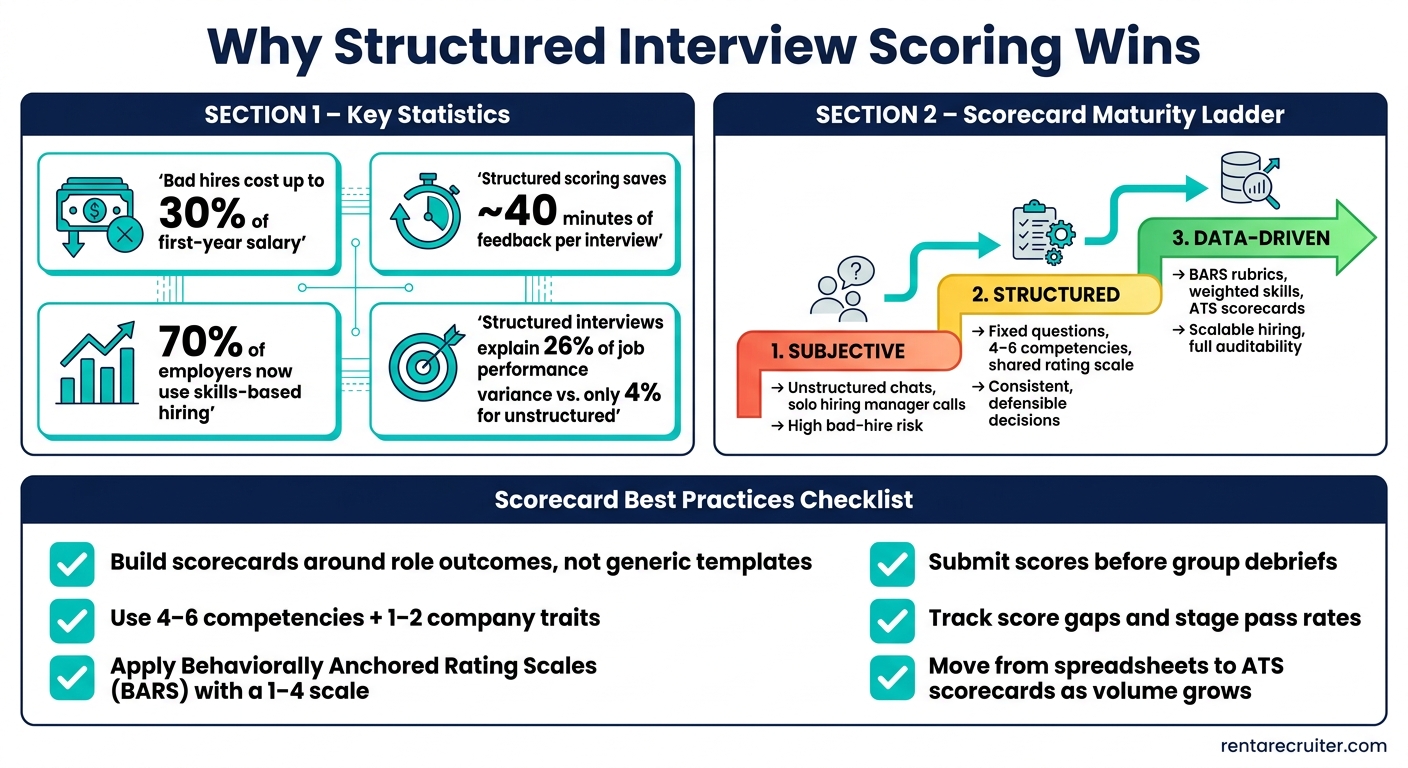
Structured vs Unstructured Interviews: Key Stats & Scorecard Maturity Levels
How to Build an Interview Scorecard That Produces Consistent Decisions
Start with role-based competencies and must-have outcomes
The most common scorecard mistake is simple: using a template that has little to do with the role.
Start with what this person must get done in the first 180 days. If you’re hiring a technical person, that might mean shipping core features. Those outputs should shape the scorecard.
From there, keep it tight. Use 4 to 6 role competencies and 1 to 2 company-wide attributes. Any more than that, and the signal gets muddy. Interviewers end up scoring too many things, and the scorecard turns into admin instead of a decision tool.
Write the competencies and scoring anchors before the first candidate is screened. That gives every interviewer the same yardstick from day one.
That matters because a scorecard only helps if people use it the same way.
Use behaviorally anchored rating scales instead of vague labels
The rating scale is where consistency is won or lost.
Labels like "good" or "strong" sound fine on paper. In practice, they create drift. Two interviewers can hear the same answer and give different scores because each person defines those words differently.
Behaviorally Anchored Rating Scales (BARS) solve that problem. Instead of abstract labels, you define what each score looks like in real behaviour.
Here’s an example for Technical Problem Solving:
| Level | Behavioral Anchor |
|---|---|
| 4 (Outstanding) | Forms hypotheses before touching code; verifies with evidence; finds root cause and regression test. |
| 3 (Solid) | Systematic narrowing of problem space; finds bug with minor dead ends; explains why the fix works. |
| 2 (Borderline) | Finds bug mostly by trial and error; cannot clearly explain the failure mechanism. |
| 1 (Poor) | Random changes; no hypothesis; declares victory when symptoms disappear. |
There’s another detail here that matters. The scale runs from 1 to 4, not 1 to 5. That’s deliberate. An even-numbered scale pushes interviewers to choose a side and reduces neutral middle-ground bias [3].
Yes, it takes more setup work. But that work pays off in cleaner decisions and fewer late-stage debates.
A practical way to use this:
- Use vague labels for early screens
- Use BARS for core interviews
- Use weighted scorecards for final-stage decisions
Once the scale is consistent, the next job is making sure the right competencies matter most.
Add weighting, evidence fields, and a clear recommendation
A scorecard is not just a list of traits. To work well, it needs competencies, weighted scoring, evidence notes, and a final recommendation.
Weighting is what turns the scorecard into a decision tool. Give each competency a percentage based on how much it matters in the role. For example, technical depth might be 30% of the total score, while communication might be 10%. That helps stop charisma from covering up a skill gap.
Evidence matters just as much. Every score should come with notes on what the candidate actually said or did, not a general feeling. "Cited a specific race condition and explained the fix" is useful. "Seemed technically sharp" is not. If there’s no evidence behind a score, treat it as an impression rather than an evaluation [3].
Then finish with a clear hire/no-hire recommendation. Each interviewer should write that recommendation on their own, before any group debrief happens. That step helps reduce the pull of the most senior person in the room and gives you a cleaner read on where people actually stand.
Once the scorecard is built, the next step is teaching interviewers to use it the same way.
How to Build the Hiring Scorecard That Stops You From Choosing the Wrong Candidate
How to Roll Out Interview Scoring Across a Growing Hiring Team
Once the scorecard is built, the next job is adoption. It only works if every interviewer uses it in the same way.
Train interviewers to score evidence, not impressions
Train interviewers to take notes during the interview, then score only after it ends using the defined behavioural anchors. Each score should link back to specific quotes, examples, or actions, not a vague sense of how the conversation went.
This is where calibration matters. Without it, scoring starts to drift. If two interviewers rate the same answer more than one point apart, that usually means the anchor needs to be clearer. Use debrief time to close those scoring gaps, not to go over where people already agree [4].
Structured interviews predict performance far better than unstructured chats. That’s why this discipline matters. It also makes debriefs faster, cleaner, and less subjective.
Use a debrief workflow that protects independent judgment
This is often the point where a structured process starts to slip. If people hear each other’s views before they’ve submitted their own scorecards, independent judgment goes out the window.
The fix is simple. Every interviewer should submit a completed scorecard, both scores and written evidence, before any group discussion starts [4]. Once those scores are in, keep the debrief short. Focus on the competencies where reviewers scored differently. Then tie the final decision back to the written evidence, not to what the room “felt” like.
Document the final decision and the reason behind it. That matters for governance as much as hiring quality. The EEOC requires employment records to be kept for at least one year, and a written scorecard trail is easier to defend than a verbal summary [1].
Move from spreadsheets to ATS-based scorecards as hiring volume grows
As hiring volume grows, discipline needs system support. There comes a point when spreadsheets stop giving you a clear audit trail and start creating admin work.
ATS-based scorecards fix the gaps that spreadsheets leave behind. Automated reminders cut out manual chasing. Independent scoring is enforced by the system, instead of relying on people to remember the process. Reporting also becomes much easier. You can see pass rates by stage, score patterns by role, and consistency gaps across interviewers in real time, instead of piecing it together by hand.
| Feature | Manual (Spreadsheets) | ATS-Based Scorecards |
|---|---|---|
| Speed | Slower; manual data entry and follow-ups | Faster; automated reminders and sync |
| Data Quality | High risk of rubric drift and vague notes | High; enforces independent scoring and evidence fields |
| Reporting | Difficult to aggregate across roles | Instant; surfaces pass rates and consistency gaps |
| Admin Time | High; requires manual coordination | Low; embedded in the hiring workflow |
| Bias Control | Lower; more prone to groupthink in debriefs | Higher; scores stay hidden until submission |
For teams hiring at pace, implementation speed becomes part of the business case. If your team is growing fast, getting this in place quickly can save hours of admin, tighten decision-making, and reduce hiring mistakes. For fast-growing SMEs, embedded recruitment support can help install scorecards, train interviewers, and standardise debriefs without slowing down hiring.
sbb-itb-a23bd6a
How to Reduce Bias and Improve Decision Quality Without Heavy Process
Once scoring is in place, the next risk is drift. Bias usually shows up when criteria are vague and people apply them differently, not because anyone means to be unfair. After rollout, the next job is keeping scores consistent and defensible when hiring pressure kicks in.
Keep scoring job-related, observable, and consistently applied
Every criterion on your scorecard should tie back to the job and be observable. If you can’t explain why a competency matters for the role, don’t score it. Use the same job-related criteria, questions, and anchors for every candidate.
The fastest way to cut bias is to design it out of the scorecard from the start.
Build bias reduction into the scorecard itself
Reducing bias is mostly a design issue. Structure matters more than unconscious-bias training, which often has weak, short-lived effects [1]. Three choices matter most.
First, keep competencies mutually exclusive. If two competencies overlap, a candidate who does well in one area can end up with inflated scores across both.
Second, require evidence fields for every score. A note like "seemed junior" is not evidence. A note saying a candidate explained how they isolated a race condition step by step is far more useful.
Third, use fixed scoring rules so interviewers judge the same behaviors against the same anchors every time.
Behavioral anchors, fixed questions, and independent scoring reduce subjectivity; subjective fit labels and unsorted group debriefs increase it.
Structured, anchored interviews can reduce the Black-White standardized mean difference in interview ratings from d = 0.56 to approximately d = 0.23. That’s a meaningful improvement that comes from process design, not from adding more steps [5].
Track scoring data to find gaps in consistency and pass rates
Once you’re running structured interviews, the data starts to work for you. Track score deltas first, cases where two interviewers rate the same competency more than one level apart. If that keeps happening on one competency, the anchor probably needs tightening.
Then look at stage-by-stage advancement rates. If one group of candidates keeps dropping out at the same stage and there’s no clear evidence-based reason, that’s a signal to investigate before it turns into a pattern. The goal is simple: make sure your process is measuring what it says it’s measuring, for everyone.
It also helps to review recent debriefs on a regular basis. Ask one plain question: can you reconstruct the hiring decision using only the written scores and evidence? If the answer is no, the scorecard is not driving the decision.
With bias controls in place, the next step is matching the scoring process to your hiring stage and volume.
How High-Growth SMEs Can Use Interview Scoring to Scale Hiring
Match your scoring approach to your current hiring stage
Once your scorecard is set and interviewers know how to use it, the next step is simple: match the level of process to your hiring volume.
Most SMEs begin with ad hoc interviews. That works for a while. Then hiring picks up, more people join the process, and decisions start to drift. One manager backs instinct. Another backs “fit”. A third scores harshly. That’s when hiring gets messy, slow, and expensive.
The fix is to use a scoring model that fits your current stage, then tighten it as your team grows.
Use the table below to line up process rigor with scale.
| Maturity Level | Process Characteristics | Governance Needs | Business Impact |
|---|---|---|---|
| Subjective | Unstructured chats and subjective fit calls | None; hiring manager makes solo calls | High bad-hire risk; inconsistent quality; high bias |
| Structured | Fixed questions, 4 to 6 competencies, shared rating scale | Independent scoring before debriefs | More consistent, defensible decisions |
| Data-Driven | BARS-anchored rubrics, weighted skills, ATS-based scorecards | Calibrated multi-reviewer scoring; audit trails | Scalable hiring and stronger auditability |
The big move here is from opinion-led interviews to a repeatable system your team can run without constant guesswork.
That shift has a clear business payoff. A fully structured interview explains about 26% of the variance in job performance, while an unstructured interview explains only about 4% [2].
If you’re scaling across SaaS, Technology, IT, Fintech, Engineering, Security, Insurance, or Professional Services, that gap matters. Better scoring means fewer bad hires, less rework, and more confidence in hiring decisions.
Use embedded recruitment support to put scorecards in place faster
When hiring needs to move fast, building scorecards internally can slip down the list. Open roles pile up. Managers stay busy. Process design gets pushed off until “later”.
That’s where embedded recruitment support helps.
An embedded recruiter can work inside your team to define competencies, build scorecards, and train interviewers without slowing live hiring. Instead of asking your leaders to build the whole system from scratch, you get hands-on support while roles keep moving.
Rent a Recruiter places experienced recruiters directly into your team to build scoring infrastructure, train hiring managers to score evidence rather than impressions, and keep the process consistent as hiring grows. Clients typically cut hiring costs by up to 70% and save over 80 hours per month in internal hiring admin time [2].
For CEOs, CFOs, and HR leaders, that means better hiring control without adding agency fees per hire or stretching your internal team further.
Conclusion: Build a structured scoring system before hiring demand spikes
Structured scoring makes hiring more consistent, defensible, and predictable.
The best time to build it is before demand spikes, not when your team is already under pressure.
If you’re ready to put that system in place, book a call with Rent a Recruiter.
FAQs
How do I choose the right competencies?
Start with the work this role must deliver in the first six months, not a generic template. Pick four to six observable, role-specific competencies tied to the outputs you expect.
Use clear behaviours instead of vague traits. Then force-rank the list, cut anything that is not core to success, and assign weights so the skills that matter most carry the most value.
When should we move from spreadsheets to an ATS?
Move from spreadsheets to an ATS when manual tracking starts breaking your hiring process. If pipeline stages are unclear, handoffs get messy, or candidates get a patchy experience, spreadsheets are usually the bottleneck.
When hiring starts to feel slow, inconsistent, or buried in manual data entry and duplicate work, an ATS gives you more structure, better visibility, and tighter control.
This matters because messy hiring doesn’t just waste time. It drags out time-to-hire, pulls internal teams into admin, and makes it harder to spot where roles are getting stuck.
Rent a Recruiter helps scaling companies bring more consistency and control to these processes.
How often should we calibrate interviewer scores?
Calibration should happen before live interviews start. There may not be a set schedule in the source material, but this step should be part of your hiring setup from day one.
A simple way to do it is to have interviewers score a mock interview, then compare their results. That gives you a clear view of how each person defines strong performance.
It also helps you:
- align on what good looks like
- reduce differences in interpretation
- keep scoring consistent and objective over time
Skip this step, and two interviewers can watch the same interview and come away with completely different scores. That creates noise in your process, slows decisions, and makes hiring harder to trust.