
We recommend matching recruiter support to your approved hiring plan, not adding headcount before fixing delays. Embedded recruitment gives you hiring support inside your team, usually for a fixed monthly fee. Start with a 3- to 6-month pilot, set clear responsibilities, and measure hiring speed, cost per hire, and hire quality against your baseline.
In this guide, we cover how to:
- Choose your setup: one recruiter, a team, or specialist support, through a project, long-term, or hybrid arrangement.
- Launch with clear ownership: use a 30-, 60-, and 90-day plan, agreed system access, and feedback deadlines.
- Check the numbers: track total costs and internal time, not just the monthly fee.
- Keep control: retain your hiring data, transfer skills, and set terms for scaling, renewal, or handoff.
Fixed fees do not guarantee lower costs. In the article’s example, cost per hire falls from $7,625 at two monthly starts to $3,104 at six, about 59% lower, because more hires share the fixed costs.
We start with <u>where hiring is getting stuck</u>, so you can choose support that fits your workload and budget.
Choose Your Embedded Recruitment Model
Match recruiter capacity to role complexity, your hiring timeline, and manager availability. Map the next 12 to 18 months before choosing a model. More recruiters won’t fix slow interviews or approvals. Your managers should return feedback within 24 to 48 hours. [3][5]
Your model should cover current demand while giving your team clearer ownership and better hiring habits. Identify the bottleneck first, then choose a setup that fits your workload and how fast your team can make decisions.
Single Recruiter, Team, or Specialist Support
Choose the smallest setup that can cover the workload. For hard-to-fill roles, put market knowledge and recruiter expertise ahead of headcount. If demand is low or irregular, keep the commitment in line with your hiring plan.
| Setup | Best fit | Strength | Constraint | Exit handoff |
|---|---|---|---|---|
| Single recruiter | Defined project or workload one recruiter can cover | One delivery owner | Best for one defined stream of hiring | Pipelines, open tasks, and role briefs |
| Embedded team | Several departments hiring during fast growth | Delivery across several roles at once | Needs enough internal interview capacity | Pipeline owners and shared processes |
| Specialist support | hard-to-fill or niche roles | Deep market knowledge | Requires fast approvals and clear screening criteria | Market maps, screening criteria, and scheduling workflows |
Match the engagement length to your hiring forecast once you’ve set the capacity.
Project, Long-Term, and Hybrid Engagements
A 3- to 6-month pilot lets you test delivery before making a longer commitment. Review scope against your hiring forecasts and whether managers are using the process, not just hiring volume. For hybrid arrangements, set clear boundaries so internal and embedded recruiters don’t duplicate work. [3]
| Engagement | Duration and fit | Internal ownership | Flexibility | Knowledge transfer and review triggers |
|---|---|---|---|---|
| Project | Time-limited launch, site opening, or hiring push | Employer owns priorities and final handoff | Define extension and reduction terms | Transfer documentation before close; review changes to deadlines or approved roles |
| Long-term | Year-round annual hiring plan | Internal HR oversees recruitment | Agree on capacity changes based on forecasts | Build skills throughout; review forecast changes and process adoption |
| Hybrid | Variable support for selected departments or tasks | Internal team retains agreed responsibilities | Adjust the division of work | Maintain shared workflows; review overlaps, gaps, and internal readiness |
With the model agreed, define who owns each step.
Set the Scope and Assign Hiring Responsibilities
Set up a responsibility matrix before work starts. Your business keeps final authority over hiring, compensation, eligibility, and compliance decisions. [1][2][3]
| Work | Embedded recruiter | Hiring managers | HR | Finance | Leadership |
|---|---|---|---|---|---|
| Hiring-plan alignment | Advise on delivery | Define team needs | Coordinate plan | Validate budget | Approve priorities |
| Role intake | Develop search brief | Define requirements | Review consistency | Confirm budget limits | Resolve priority conflicts |
| Sourcing and screening | Execute agreed scope | Clarify selection criteria | Oversee standards | Not assigned | Not assigned |
| Interviews | Coordinate process | Assess candidates | Oversee fair treatment | Not assigned | Join only for exceptions |
| Hiring decision and offer | Support communication | Select within delegated authority | Manage approvals and offer terms | Confirm budget | Approve exceptions |
| Reporting | Prepare progress reports | Explain decision delays | Review performance | Monitor spending | Resolve escalations |
| Eligibility and compliance | Complete documented admin tasks | Follow employer policy | Own employer process | Not assigned | Retain oversight |
| Onboarding handoff | Transfer candidate details and status | Prepare team onboarding | Own employee onboarding | Arrange payroll inputs | Not assigned |
Check that the provider can deliver the model you’ve selected.
Review Provider Experience and Contract Terms
Ask for evidence of relevant hiring results, experience with similar growth phases or niche roles, and a clear handoff plan. Check what the monthly fee covers, including dedicated capacity and tools. Review term length, replacement terms, data ownership, transition support, and terms for increasing or reducing capacity. [1][3][4][6]
sbb-itb-a23bd6a
Launch Embedded Recruitment and Build Internal Skills
Once you’ve agreed on the model, use the first 90 days to put the process in place and transfer ownership to your team.
Build a 30-, 60-, and 90-Day Plan
A fast start is not the same as a working process. Before sourcing begins, confirm hiring demand, system access, role criteria, and manager alignment. Ask managers to independently rate five anonymized profiles, compare their scores, and resolve differences before screening starts.
Adjust your talent acquisition strategies and roadmap to your hiring volume, system complexity, and manager availability. The first 30 days should focus on alignment and infrastructure, not just hires.
| Period | Priorities and deliverables | Owners | Readiness checks |
|---|---|---|---|
| Days 1-30 | Approve scope and priorities; test live access and permissions; create scorecards; add approval routes to the workflow; run intake and calibration sessions | Executive sponsor, HR or talent lead, embedded recruiter, hiring managers, systems administrator | Priority roles have approved headcount, compensation, job descriptions, scorecards, interview panels, and target dates; access works; managers understand feedback deadlines |
| Days 31-60 | Start sourcing and screening; run structured interviews; remove bottlenecks; train managers | Embedded recruiter, hiring managers, HR or talent lead | Candidates move through defined stages; feedback is complete and on time; rejected candidates receive consistent communication; reporting data is accurate |
| Days 61-90 | Review results; standardize what works; improve templates and automation; begin knowledge transfer; decide whether to scale, extend, or hand off | HR or talent lead, embedded recruiter, executive sponsor, internal hiring team | Internal staff can run core workflows; ownership and data-export plans are confirmed; capacity decisions use performance and cost data |
As sourcing begins, tighten reporting and decision rules so delays don’t hold up hiring.
Set Reporting, Access, and Escalation Rules
Use your ATS as the single source of truth for ownership, stage, next action, and disposition. Each week, review requisition status, sourcing activity, qualified candidates, time in each stage, feedback speed, offers, declines, and risks. Review capacity monthly.
Set a one-business-day deadline for candidate communication and a 24- to 48-hour deadline for interview feedback. Define who handles role decisions, process issues, conflicting priorities, access failures, and compliance questions.
| Risk | Control | Accountable owner |
|---|---|---|
| Access gaps | Test logins before launch; use role-based permissions; name a backup administrator and access-escalation contact | Systems administrator and talent lead |
| Unclear ownership | Name one decision-maker per role and document approval routes | Talent lead and executive sponsor |
| Interview inconsistency | Use scorecards, structured questions, interviewer training, and calibration reviews | Hiring manager and HR |
| Delayed feedback | Set a 24- to 48-hour deadline; send reminders; escalate missed deadlines | Hiring manager |
| Data exposure | Limit data collection; restrict access; use approved systems; define secure disposal and incident response | HR, IT, and privacy or legal lead |
| Adding recruiters too early | Review demand, stage conversion, manager capacity, quality, and cost per hire | Executive sponsor and talent lead |
Build compliance into the workflow before applications open. Use job-related criteria, support accessibility and accommodations, follow record-retention and privacy rules, and review state-specific requirements with counsel.[7][8][9][10][11][12]
Store the process in tools your internal team can run without help.
Transfer Hiring Tools and Knowledge
Keep a company-controlled library of intake forms, scorecards, interview guides, outreach templates, rejection templates, approval checklists, and escalation steps.
Maintain talent pools with a documented source, status, last-contact date, owner, and retention rules. Configure the ATS with standardized stages, required fields, disposition reasons, reporting definitions, permissions, and automated reminders.
Test knowledge transfer through actual work. At 30, 60, and 90 days, have internal staff complete intake, screening, interview scheduling, feedback, reporting, and escalation tasks without recruiter support. When you reduce support, make sure every active candidate and outstanding task has an internal owner.
Measure Hiring Results and Costs
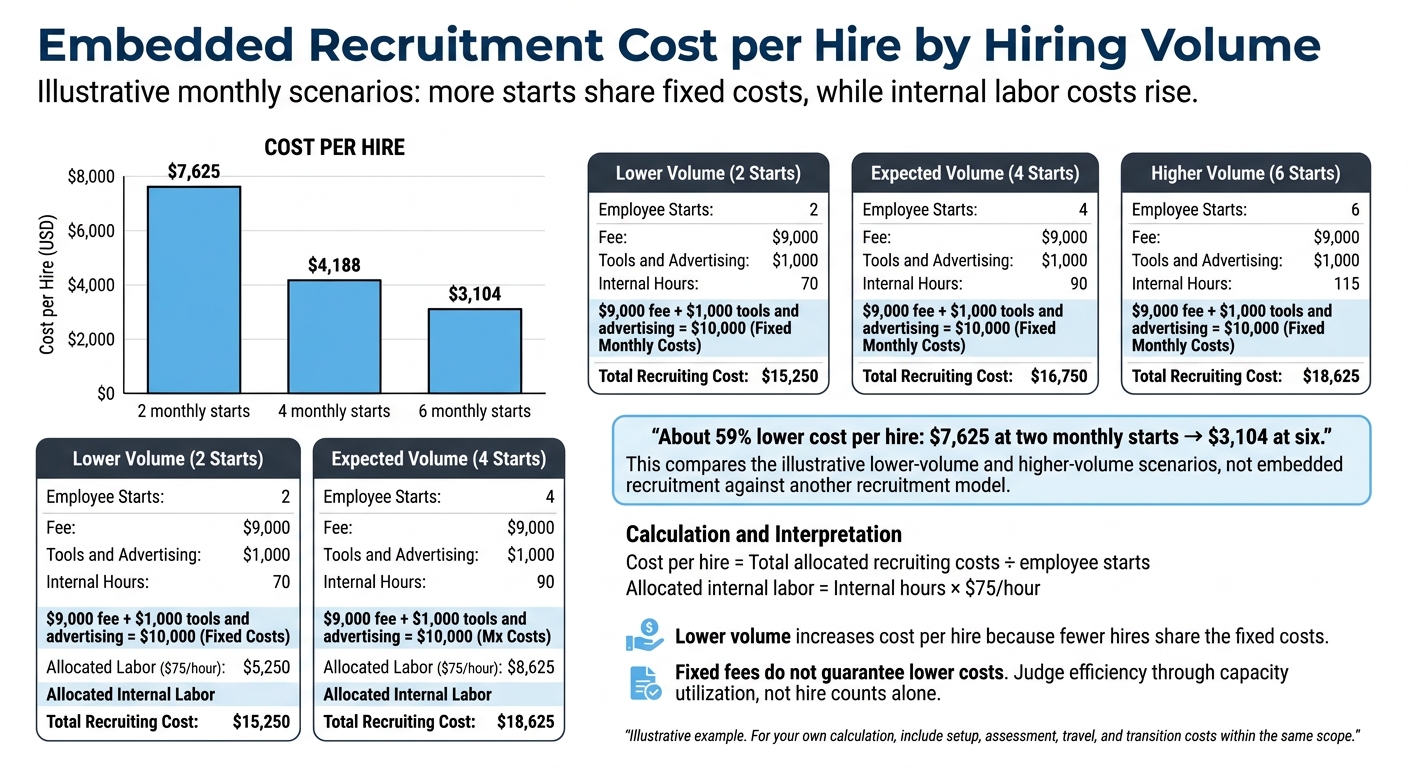
Embedded Recruitment Cost per Hire by Hiring Volume
Once embedded hiring is live, check whether it delivers faster hiring, better hires, and lower costs by performing a recruitment health check.
Build a baseline using 3 to 6 months of pre-launch data, split by role group, seniority, department, employment type, and location. Use the same time-to-fill definition throughout so your comparisons hold up.
Track Hiring Speed, Quality, and Pipeline Results
| Metric | Definition | Data source | Review | Owner |
|---|---|---|---|---|
| Time to fill | Calendar days from approved requisition to accepted offer | ATS and HRIS | Weekly/monthly | Recruitment lead |
| First qualified candidate | Days from approval to the first candidate meeting agreed requirements | ATS and scorecards | Weekly | Embedded recruiter |
| Stage duration | Median days spent in sourcing, screening, interviews, approval, and offer stages | ATS timestamps | Weekly | Recruiting operations |
| Pipeline conversion | Candidates progressing from one stage to the next | ATS | Weekly | Embedded recruiter |
| Offer acceptance | Accepted offers ÷ offers made | ATS offer records | Monthly | Recruitment lead |
| Withdrawals | Candidate withdrawals ÷ candidates entering the stage; exclude employer-initiated rejections | ATS and candidate feedback | Monthly | Recruiter and HR |
| Cost per hire | Total allocated recruiting costs ÷ employee starts | Finance records and ATS | Monthly/quarterly | Finance partner |
| Manager satisfaction | Consistent post-hire survey using the same rating scale | Manager survey | Monthly/quarterly | HR |
| New-hire retention | Percentage still employed at 90 days, 6 months, and 12 months | HRIS | Quarterly | People team |
Track outreach separately from conversion. More outreach does not mean better hiring. Assess hire quality through performance, time to productivity, retention, and manager feedback, while recognizing that recruitment is not the only factor affecting these results.
Calculate Monthly Costs and Time Savings
The example below shows how monthly hiring volume changes cost per hire. For your own calculation, include setup, assessment, travel, and transition costs within the same scope.
Monthly scenario Employee starts Fee Tools and advertising Internal hours Allocated labor ($75/hour) Total recruiting cost Cost per hire Lower volume 2 $9,000 $1,000 70 $5,250 $15,250 $7,625 Expected volume 4 $9,000 $1,000 90 $6,750 $16,750 $4,188 Higher volume 6 $9,000 $1,000 115 $8,625 $18,625 $3,104
Lower volume increases cost per hire because fewer hires share the fixed costs. Judge efficiency through capacity utilization, not hire counts alone.
Review Scale, Renewal, and Transition Triggers
Use monthly delivery reviews and quarterly planning reviews to compare speed, quality, cost, and internal readiness against your hiring forecasts.
Ask for underlying data, not just headline percentages. Agree on decision thresholds before changing the engagement, then use the results to decide whether to expand support, renew, or bring work back in-house.
| Choice | Decision triggers | Budget effect | Main risk | Required next step |
|---|---|---|---|---|
| Expand capacity | Forecast exceeds practical capacity; quality and service levels remain strong | Higher monthly commitment | Unused capacity if demand drops | Confirm workload limits and specialist needs |
| Renew | Demand is steady; targets are met; internal capacity remains insufficient | Predictable recurring spend | Dependency without skill development | Update scope, targets, and knowledge-transfer commitments |
| Hybrid model | Internal staff can own defined roles; embedded support covers spikes or specialist work | Combined internal and provider costs | Duplicated work or unclear ownership | Assign roles, handoffs, and spending limits |
| Internal delivery | Demand is predictable; internal owners can maintain service levels; full costs are competitive | Transition investment, then reduced provider fees | Slower hiring during handoff | Phase the transfer and verify candidate, system, and process ownership |
Conclusion: Prepare Your Hiring Capacity Plan
Before signing, confirm scope, fees, notice periods, replacement terms, data protection, and candidate ownership. Complete the launch check before work begins.
Six-point launch check:
- Roles with compensation ranges and target start dates
- Budget covering fees and additional costs
- Managers with interview time reserved
- Secure system access
- Baseline metrics
- Transition goal
Make knowledge transfer part of delivery, not a final task. Build it into your plan and use reverse-shadowing so internal employees practice running the process before taking ownership. Embedded recruitment should strengthen your internal hiring capability, not create long-term dependency.
Once the process is stable, compare results against your plan to decide whether to extend support.
Rent a Recruiter supports scaling SMEs in technology, SaaS, fintech, engineering, and professional services. Bring your approved role list, hiring timeline, and current recruiting costs. Compare projected savings against your baseline, including internal time and setup costs.
FAQs
Is embedded recruitment worth it for low hiring volumes?
For fewer than 10 hires a year, embedded recruitment is generally not the most cost-effective option. Industry benchmarks suggest that paying only when a role is filled is better suited to businesses hiring at this volume.
For scaling businesses making 10 to 24 hires annually, embedded recruitment offers a fixed monthly fee. That makes pricing more predictable and cost-efficient than paying a commission for each hire, which gets expensive as hiring volume grows.
What happens if our hiring plan changes mid-contract?
Embedded recruitment lets you scale hiring up, down, or pause it as your business needs change.
With a flexible monthly fee, you can adjust hiring capacity without renegotiating terms or paying extra fees. Your recruitment resources stay aligned with your current hiring plan and growth priorities.
How can we separate recruiter performance from internal delays?
Set clear, data-driven service level agreements (SLAs) for both parties. Agree on turnaround times for shortlists, hiring feedback, and candidate communication so everyone knows what they need to deliver and when.
Use your applicant tracking system (ATS) to track pipeline progress, time-to-fill, and candidate withdrawal rates. Review these metrics regularly to see where hiring slows down.
If your recruiter delivers qualified candidates but hiring stalls, the data can show whether internal feedback or decision-making, rather than sourcing, is causing delays.