Hiring top talent isn’t just about competing in your industry anymore. Companies across sectors are vying for the same skills, making it harder to attract and retain the people you need. That’s where competitive talent intelligence (CTI) comes in. It helps you anticipate hiring trends, spot competitor moves early, and make smarter recruitment decisions – all backed by data.
Here’s what CTI can do for you:
- Stay ahead of competitors: Track hiring trends, job postings, and talent flow to predict market shifts 6-12 months in advance.
- Save time and money: Reduce hiring costs by up to 70% compared to traditional agencies and cut time-to-hire significantly.
- Secure top talent first: Identify and approach key candidates before your competitors do.
- Adapt to changing roles: Spot emerging job trends like AI-related positions and avoid scrambling for talent later.
For scaling companies, CTI isn’t a luxury – it’s a necessity. Whether you’re launching new products, scaling post-funding, or navigating hiring surges, it gives you the edge you need to grow faster and smarter.
Looking for a scalable solution? Rent a Recruiter provides embedded recruiters who bring CTI strategies directly into your hiring process. They save you time, cut costs, and ensure your recruitment aligns with your growth goals.
Brainfood Live On Air Ep360 The State of Talent Intelligence 2026
Explore more industry insights in our recruitment videos archive.
sbb-itb-a23bd6a
Why SMEs Need Competitive Talent Intelligence
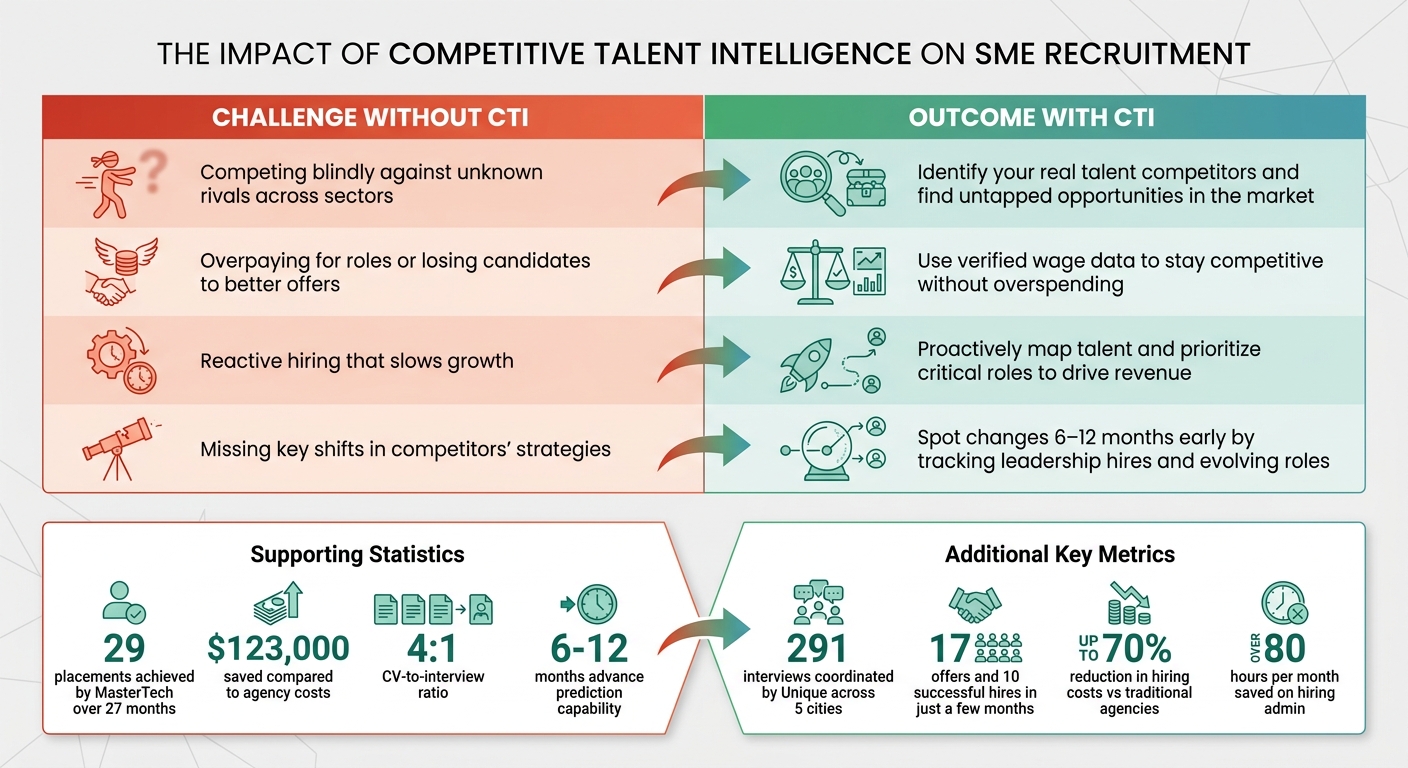
Competitive Talent Intelligence Impact: Challenges vs Outcomes for SMEs
Common Recruitment Challenges for Growing Companies
Scaling an SME comes with its own set of recruitment headaches. Limited budgets make it tough to compete with tech giants on salary alone. And your competition for talent isn’t just the usual suspects in your industry. For instance, healthcare providers might lose skilled data scientists to fintech startups [4]. The real challenge? Competing with businesses offering similar career growth and experiences, regardless of their sector.
Recruitment itself can feel like a roadblock. Without a dedicated hiring team, your internal staff could spend over 80 hours a month on admin-heavy hiring tasks, all while juggling their primary roles. A single bad hire hits small businesses harder, as tight margins leave little room for error. And let’s not forget how candidate priorities have shifted. By 2026, professionals are prioritizing flexibility, career development, and workplace wellbeing over traditional perks like prestige [4]. If your competitors are already tailoring their offers to these preferences while you’re still promoting “great leadership opportunities,” you might be losing ground.
The rapid advance of AI adds another layer of complexity. Roles like QA testers, legal researchers, and financial reporters are being replaced with positions such as "AI integration leads" and "prompt engineers." Without competitive talent intelligence (CTI), SMEs may not spot these shifts until it’s too late, leaving them scrambling for talent that’s already been snapped up.
Understanding these challenges highlights why CTI isn’t just helpful – it’s a game changer for staying ahead in the recruitment race.
Business Impact of Using Competitive Talent Intelligence
Competitive talent intelligence can turn these challenges into opportunities. Take MasterTech, which partnered with an embedded recruiter for 27 months, ending in 2025. The results? 29 placements, $123,000 saved compared to agency costs, and a 4:1 CV-to-interview ratio, cutting down on time wasted with unqualified candidates [6].
The secret lies in predictive planning. By tracking where competitors are hiring and mapping employee movements, you can identify “feeder” companies and secure top talent before the market becomes saturated [3]. For example, when Helsing brought on David Stampfli (formerly COO at NOKERA AG) as Director of Supply Chain Management in Germany in 2025, it signaled a strategic focus on operational efficiency – a shift visible to anyone monitoring workforce trends [2]. SMEs using these insights can adjust their hiring strategies 6–12 months ahead of public announcements.
The financial payoff goes beyond just cutting costs. Companies that align their talent strategies with business goals tend to perform better during economic uncertainty [6]. Between 2024 and 2025, Unique used an embedded recruitment model to coordinate 291 interviews across Berlin, Zurich, New York, London, and Singapore. This led to 17 offers and 10 successful hires in just a few months [6].
| Challenge Without CTI | Outcome With CTI |
|---|---|
| Competing blindly against unknown rivals across sectors | Identify your real talent competitors and find untapped opportunities in the market [4] |
| Overpaying for roles or losing candidates to better offers | Use verified wage data to stay competitive without overspending [1][4] |
| Reactive hiring that slows growth | Proactively map talent and prioritise critical roles to drive revenue [6] |
| Missing key shifts in competitors’ strategies | Spot changes 6–12 months early by tracking leadership hires and evolving roles [2][3] |
With CTI, SMEs can go from reacting to leading, ensuring their recruitment efforts directly support their growth goals.
What Makes Up Competitive Talent Intelligence
Competitive talent intelligence relies on data-driven methods to uncover your competitors’ workforce strategies. It’s a powerful approach that helps you stay ahead in recruitment by understanding hiring priorities. Let’s break down its key components, starting with a recruitment-focused SWOT analysis.
SWOT Analysis for Recruitment
A recruitment-focused SWOT analysis applies the same principles as a traditional SWOT but zeroes in on your talent acquisition capabilities compared to competitors.
- Strengths: Highlight areas where your Employee Value Proposition (EVP) stands out. For instance, maybe your company offers better flexibility than larger firms or fosters a mentoring culture that appeals to mid-career professionals seeking growth opportunities [4].
- Weaknesses: Use internal data to spot gaps. Pull reports from your Applicant Tracking System (ATS), review exit interviews, and check employee sentiment on platforms like Glassdoor. Issues like high turnover in engineering or slow time-to-hire for sales roles could signal areas to address [1][4].
- Opportunities: Look for external signals. If a competitor announces layoffs or a hiring freeze, it could be the perfect time to approach their top talent before they hit the open market [3][1]. Consider market gaps too. For example, if most tech firms in your area promote hybrid work, offering full location flexibility might set you apart [4].
- Threats: Monitor talent flow data. If employees consistently leave for specific competitors, those rivals may have a stronger EVP or better compensation packages. Tracking where competitors source their talent can also reveal critical insights into the competitive landscape.
Benchmarking Talent Metrics
Benchmarking helps you compare your hiring metrics, salaries, and benefits against industry standards to stay competitive while using Recruitment as a Service to avoid overspending. Reliable sources like the Bureau of Labor Statistics (BLS) Occupational Employment and Wage Statistics (OES) provide detailed wage benchmarks by role, industry, and geography, updated annually [5].
For small and medium enterprises (SMEs), federal data is especially useful since private revenue estimates can vary widely – by as much as 30% to 50% depending on the vendor [5]. For example, if you’re hiring a software engineer in Austin, Texas, BLS data can guide you on competitive salary offers.
But it’s not just about pay. Benchmark your entire EVP, including flexibility policies, learning and development budgets, diversity programs, and career progression opportunities. If competitors offer standard remote work but no professional development benefits, spotlighting your upskilling programs could attract ambitious candidates [4].
Additionally, monitor metrics like hiring velocity, cost-per-hire, and offer acceptance rates. Comparing these against industry averages can help identify bottlenecks in your recruitment process.
Analyzing Competitor Workforce Composition
Understanding your competitors’ workforce composition offers insights into their strategic priorities and potential vulnerabilities.
- Headcount Tracking: Examining headcount growth can reveal strategic shifts. For example, Nvidia’s rise from 42 employees in the 1990s to about 30,000 in 2024 aligned with its pivot to AI [3]. Similar patterns can indicate whether competitors are expanding aggressively or scaling back.
- Job Posting Analysis: Job postings can signal strategic intent. If a competitor suddenly advertises multiple roles for "AI Ethics" or "Logistics Coordinator", it may suggest upcoming product launches or operational changes 6–12 months before public announcements [3][1]. For example, McDonald’s hiring Paul G. as Senior Vice President for Global Supply Chain Digitalization in the UK in 2025 indicated a focus on digital transformation [2].
- Talent Flow Mapping: Mapping where competitors source their hires and where their employees go after leaving can help you build stronger pipelines. Identifying "feeder" companies – those your rivals frequently recruit from – can reveal valuable talent pools. High attrition at a competitor also creates opportunities to recruit experienced professionals before they are widely available [3][1].
- Organizational Structure Mapping: Analysing a competitor’s team structure can uncover their priorities. For instance, a focus on R&D over sales may indicate an emphasis on product development rather than market expansion. Conversely, if they’re top-heavy with executives but lack operational staff, you could attract candidates by offering better team support [3].
Modern talent intelligence platforms can process billions of employee profiles and millions of job postings to deliver real-time insights [3]. While SMEs might not need enterprise-level tools right away, understanding these components allows you to build a scalable competitive intelligence framework. Armed with these insights, SMEs can turn data into actionable recruitment strategies.
How to Implement Competitive Talent Intelligence
You don’t need a massive budget or a dedicated research team to integrate competitive talent intelligence into your hiring strategy. Even small to mid-sized companies can develop a systematic approach that delivers actionable insights in just a few weeks.
Data Collection and Analysis Methods
Start by identifying your talent competitors – any company hiring for the same skill sets as you. For instance, a healthcare provider might find itself competing with tech companies for data scientists, while a fintech startup could be vying with SaaS firms for product managers [4]. Narrow this down to 5-10 key competitors and set up automated LinkedIn Job Alerts to monitor their job postings [7].
Leverage resources like LinkedIn company pages, public ATS boards (e.g., boards.greenhouse.io/companyname), Glassdoor reviews, and company career pages for insights [3][8]. As Ibby Syed, Founder of Cotera, notes:
"A company can put whatever spin it wants on a press release… But a job description has to be accurate enough to attract the right candidates" [7].
Track competitor headcounts monthly by department using LinkedIn. Look at growth or shrinkage trends (the "delta") to understand which teams are expanding. For example, if a competitor hires three iOS engineers in one month, it could indicate a significant product launch [7]. Pay close attention to the recruiter-to-headcount ratio – a company with 200 employees and 15 recruiters is likely in growth mode, while one with 500 employees and only 3 recruiters may be scaling back [7].
Update your talent flow analysis to see where competitors are sourcing their hires and where their employees go after leaving. This provides a clear view of their talent pipelines and potential weak spots [3][4]. Job descriptions can also reveal internal priorities and strategic directions [7].
| Data Type | Source | Actionable Insight |
|---|---|---|
| Job Postings | LinkedIn, Company Sites | Highlights future product focus and required skills |
| Employee Reviews | Glassdoor, Indeed | Exposes cultural challenges and potential poaching opportunities |
| Talent Flows | LinkedIn Talent Insights | Shows which competitors are gaining or losing expertise |
| Leadership Changes | Press Releases, News | Indicates market shifts or new business strategies |
Use these insights to fine-tune your recruitment strategy.
Using Insights to Improve Recruitment
Once you’ve gathered the data, it’s time to turn those insights into action. Start by identifying gaps in your Employer Value Proposition (EVP). Compare your benefits, culture, and flexibility against competitors. For instance, if most tech companies in your area offer hybrid work, offering full remote flexibility could set you apart [4]. Similarly, if competitors don’t emphasize career development or mentoring, these could become key selling points in your employer branding.
Take advantage of competitor vulnerabilities. When a rival announces layoffs or leadership changes, they often experience a 3-6 month period of instability [2]. Act quickly by launching targeted recruitment campaigns to attract their top talent before they re-enter the market. For example, when McDonald’s hired Paul G. as SVP for Global Supply Chain Digitalization in 2024, it signaled a major focus on digital transformation – creating an opportunity for competitors to position themselves as more experienced in this area [2].
Adjust your compensation strategy using real-time data to align with competitor salary bands without overspending. Similarly, if job postings highlight competitors’ preference for certain tools (e.g., "Azure Synapse"), you can prioritise candidates with those skills or adapt your own tech stack to appeal to a broader talent pool [3].
Refine your job descriptions by studying what works for competitors. Look at how they structure roles, outline responsibilities, and present growth opportunities. For example, if a competitor posts multiple logistics coordinator roles, it could signal a shift towards direct distribution – insight you can use to anticipate market trends and adjust your hiring approach [3].
How Rent a Recruiter Supports Scalable Hiring
Effective talent intelligence requires consistent effort, and many SMEs struggle to maintain tracking systems during busy hiring periods. Automated tracking can help avoid missing critical insights [7][2].
Rent a Recruiter places experienced recruiters directly into your team within days, bringing the expertise to manage competitive talent intelligence frameworks while handling your hiring needs from start to finish. These embedded recruiters establish tracking systems, monitor competitor activity, and translate insights into recruitment actions – whether it’s refining job descriptions, targeting talent from specific sources, or launching campaigns when competitors are vulnerable.
For scaling companies managing hiring spikes, launching new products, or ramping up after funding, this approach delivers faster time-to-hire and structured processes without the steep learning curve of building internal capabilities. Businesses often save up to 70% on hiring costs compared to traditional agency fees and recover over 80 hours per month previously spent on internal hiring admin. Whether you need short-term support to meet hiring goals or a long-term partner to build a reliable recruitment function, embedded recruiters ensure your competitive intelligence translates into consistent hiring success aligned with your growth plans.
Measuring Results and Making Improvements
Once you’ve implemented actionable CTI strategies, the next step is measuring their impact. The value of CTI lies in achieving measurable outcomes, so tracking the right metrics is key. Focus on KPIs like time-to-hire (how quickly roles are filled), cost-per-hire (total recruiting expenses divided by hires), and quality of hire (evaluated through retention rates and hiring manager satisfaction). These metrics reveal whether your competitive insights are leading to faster, more cost-efficient, and higher-quality hiring decisions.
Start by establishing a baseline. For example, if your current time-to-hire averages 45 days and your cost-per-hire is $5,000, document these figures. After applying CTI strategies – such as targeting talent from competitors or adjusting salary bands – reassess the metrics. If you reduce the time-to-hire to 32 days and the cost-per-hire to $3,500, it’s clear evidence of ROI.
Key Performance Indicators for Recruitment
Beyond the basics, it’s essential to dig deeper into talent flow patterns. Understanding where your top candidates come from – and where they go when they leave – can uncover valuable insights. For instance, if a significant portion of your engineering hires consistently comes from a specific competitor, you’ve identified a talent pipeline worth nurturing.
It’s also critical to monitor attrition hot spots by department or role. A data science team with a 25% annual turnover rate, compared to a 15% industry average, might signal retention issues. This could point to compensation gaps, limited career progression, or other internal challenges that need addressing. Similarly, assessing the recruiter-to-headcount ratio can highlight whether your team is equipped for growth, or if you need a recruitment health check to identify hidden bottlenecks. A company with 200 employees and only two recruiters may struggle to scale, while eight recruiters for the same headcount suggests readiness for expansion.
Financial metrics like revenue-per-employee add another layer of understanding. For example, if your SaaS company generates $150,000 per employee while competitors average $200,000, it could indicate productivity issues or overstaffing. These insights can help you refine team structures and hiring strategies.
| KPI Category | Specific Metric | What It Reveals |
|---|---|---|
| Growth | Hiring velocity by department | Which teams are scaling fastest |
| Retention | Attrition by role and team | Potential cultural or compensation challenges |
| Capability | Skills gap analysis | Whether competitors are ahead in key areas (e.g., AI) |
| Efficiency | Revenue per employee | Productivity benchmarks compared to competitors |
| Movement | Talent flow patterns | Where talent is coming from and going to |
These KPIs align with the CTI methods discussed earlier, ensuring every adjustment you make is grounded in data.
Using Data to Improve Over Time
Once your KPIs are in place, use them to refine your hiring strategy continuously. Set up a review cycle: weekly for operational metrics like time-to-fill, monthly for hiring trends, and quarterly for strategic assessments. For example, if candidates sourced through competitive intelligence consistently convert at higher rates than other channels, allocate more resources to targeted research.
Conduct win-loss analyses for recruitment campaigns. If a candidate chooses a competitor, an exit interview can reveal why. Common themes in this feedback – such as compensation or career growth – can guide improvements. On the flip side, when you successfully hire from a competitor, document what tipped the scales in your favor. Was it your company culture, career development opportunities, or exciting projects? Use these insights to fine-tune your approach.
Quantify your improvements. For instance, reducing time-to-hire by 13 days across 20 hires at $50 per hour can recover around $104,000 in productivity. Combine this with cost savings from reduced agency fees or smarter compensation offers, and the financial impact becomes undeniable.
Nearly 60% of organizations globally measure the value of their intelligence efforts in some way [9]. To validate ROI, isolate metrics influenced by CTI. Compare hiring performance during periods of active competitive insight application versus periods without it. This trend analysis can establish a direct link between CTI strategies and improved results.
Finally, audit your intelligence sources regularly. If LinkedIn job alerts consistently deliver actionable insights while certain costly platforms remain underused, reallocate your budget. Similarly, if monitoring competitor reviews on Glassdoor reveals cultural weaknesses that help you acquire top talent, make this a permanent part of your process. The goal is to refine what works, eliminate inefficiencies, and scale your intelligence efforts as your business grows.
Next Steps
Competitive talent intelligence offers growing SMEs a way to stay ahead in hiring. Research shows that businesses with top-performing talent can achieve up to twice the results of those with average teams [10]. The gap becomes even more pronounced when competing for specialized skills.
Start by identifying your key talent segments – whether it’s AI integration leads, mid-level product managers, or engineers with niche expertise. Don’t just focus on direct competitors. For example, a healthcare tech startup might lose data scientists not only to other healthcare companies but also to fintech firms or remote-first SaaS platforms [4]. Keep a close eye on these trends with consistent monitoring. This groundwork sets the stage for meaningful, actionable insights.
Competitive talent intelligence isn’t just about gathering data – it’s about acting on it. Spot patterns like high attrition, hiring freezes, or weaknesses in a competitor’s employer value proposition (EVP) to target top talent who may be looking for a change [2][4]. Regular tracking can even help you anticipate market shifts 3–6 months ahead [2]. Once you’ve identified these opportunities, scaling your strategy becomes the next step.
Feeling daunted by the idea of building this capability internally? Rent a Recruiter can help. With our embedded recruitment service, we place expert recruiters directly into your team within days. They handle your hiring from start to finish while incorporating strategies like talent mapping and EVP benchmarking into your process. The result? Companies often cut hiring costs by up to 70% compared to traditional agencies and save more than 80 hours a month on recruitment admin.
Want to turn insights into hiring success? Book a consultation with Rent a Recruiter and see how embedded recruitment can revolutionize your talent acquisition strategy, giving you a real advantage in today’s competitive hiring landscape.
FAQs
What’s the difference between competitive talent intelligence and regular recruiting?
The key distinction lies in their approach and objectives. Regular recruiting is task-oriented, focusing on filling specific roles to meet immediate hiring needs. On the other hand, competitive talent intelligence adopts a broader, strategic perspective. It leverages data – such as hiring trends and workforce shifts – to analyze competitors’ talent strategies. This insight helps shape long-term recruitment plans, strengthen employer branding, and gain an edge in attracting and keeping top talent.
Which 5–10 talent competitors should we track first?
To get ahead in recruitment, start by monitoring organizations actively hiring for critical roles or expanding into markets that align with your goals. Pay close attention to major tech companies, businesses investing in areas like AI or cybersecurity, and those experiencing workforce shifts such as layoffs or rapid growth. Keep an eye on cross-industry competitors targeting the same talent pools. This strategy not only gives you a clearer picture of the talent landscape but also helps you stay ahead of emerging industry trends.
What CTI data should we collect on a small budget?
When budgets are tight, free, publicly available data can be a game-changer for gathering competitive talent intelligence. Start by analyzing competitor job postings. These can reveal critical insights into their hiring priorities, skill gaps they’re addressing, and even salary benchmarks.
Keep an eye on LinkedIn updates, hiring announcements, and company news. These sources often highlight growth trends or organizational changes that could signal shifts in strategy. Pair this with industry news to build a fuller picture of the talent landscape.
The best part? You don’t need to spend heavily to gain actionable insights. This approach helps you fine-tune your talent strategy while keeping costs low.