
Hiring delays cost money. Whether it’s unfilled roles slowing productivity or losing top candidates to competitors, understanding where your recruitment process is breaking down is critical. This is where time-to-hire and time-to-fill come into play.
- Time-to-hire measures how quickly a candidate moves through your pipeline, from application to offer acceptance.
- Time-to-fill tracks the entire hiring process, starting from job requisition approval to offer acceptance.
Both metrics reveal different bottlenecks. Time-to-hire focuses on candidate experience and speed, while time-to-fill highlights internal inefficiencies like approval delays. For scaling companies, choosing the right metric to prioritize depends on your business goals:
- Losing candidates mid-process? Focus on time-to-hire.
- Struggling with vacant roles impacting productivity? Focus on time-to-fill.
Key takeaway: Use time-to-hire to compete for talent in fast-moving markets. Use time-to-fill to improve planning and operational efficiency. If you’re unsure where to start, Rent a Recruiter can help you reduce hiring delays and take control of your process.
Time-to-Hire: Measuring Candidate Progression
What Is Time-to-Hire?
Time-to-hire tracks the number of days it takes for a candidate to progress from entering your recruitment pipeline – whether through an application or direct outreach – to accepting your job offer [1][2].
"Time-to-hire zeroes in on individual candidate progression." – Dover [2]
In the U.S., the average time-to-hire is approximately 36 days, compared to a global average of 44 days [4][1]. This quicker turnaround gives U.S. companies an edge in locking down top talent before competitors can make their move.
What Time-to-Hire Tells You
While time-to-fill measures the entire hiring process, time-to-hire focuses specifically on how efficiently candidates move through the pipeline. A high time-to-hire often points to bottlenecks like slow interview scheduling, delayed feedback from hiring managers, or an overly complex interview process [1][5].
Common delays stem from lengthy feedback cycles or overly rigorous vetting procedures.
"A shorter time-to-hire signifies an efficient recruitment process, showcasing the ability to swiftly move from the initial application phase to the contract-signing stage." – Intervue [5]
When candidates start dropping out of your pipeline, examining time-to-hire can help pinpoint where the process is falling short.
When to Focus on Time-to-Hire
Time-to-hire becomes critical when candidate drop-off is a recurring issue. High-demand professionals, particularly in tech and engineering, often receive multiple offers within 30 days of starting their job search [2]. If your hiring process drags on longer than this, you risk losing top talent to faster competitors. When sourcing efforts are strong but conversion rates lag, take a closer look at the stages after candidates enter your pipeline. Consider these steps to tighten your process:
- Respond to candidates within 24–48 hours to maintain momentum.
- Establish internal SLAs to ensure hiring managers provide timely feedback.
- Leverage self-scheduling tools to simplify interview coordination [2][7].
sbb-itb-a23bd6a
Time-to-Fill: Tracking the Full Hiring Timeline
What Is Time-to-Fill?
Time-to-fill offers a broader perspective on the recruitment process, covering the entire timeline from the moment a job requisition is approved to when a candidate accepts the offer [1]. This metric highlights delays that often occur before a job is even posted.
"Time-to-fill takes a much broader view of your hiring timeline than time-to-hire does. It measures the complete recruitment cycle from the moment you get approval for a new position until someone accepts your offer and starts working." – Dover [2]
What Time-to-Fill Tells You
Unlike time-to-hire, which focuses on the candidate’s journey, time-to-fill captures the internal steps that happen before candidates even see the job posting. These include budget approvals, drafting job descriptions, and obtaining sign-offs. Studies reveal that nearly three weeks of the hiring process are often spent on these pre-posting tasks [6]. As Alex Oliver from iCIMS points out:
"A longer time to fill often signals back-end problems, such as approval delays or ineffective workflows." – Alex Oliver, iCIMS [1]
On average, time-to-fill for non-executive roles is about 54 days, climbing above 60 days for senior-level positions [1]. In tech and engineering, the average hovers around 50 days [5]. Understanding these numbers is critical for resource planning and ensuring operational efficiency.
When to Focus on Time-to-Fill
Time-to-fill becomes a key metric when your priority is workforce planning and operational efficiency rather than just the candidate experience. If roles remain unfilled for extended periods or onboarding is delayed, this metric can uncover bottlenecks and rate your recruitment process for optimization. It’s especially important during high-volume hiring, where the cost of vacancies – measured in lost productivity and revenue – can escalate quickly [5].
For scaling companies, tracking time-to-fill by department or role type can sharpen forecasting and ensure recruitment capacity aligns with business needs [3]. As Fahad Ahmed Shah from TurboHire explains:
"Time to fill helps leaders forecast capacity, manage hiring inventory, and plan resources." – Fahad Ahmed Shah, TurboHire [6]
A practical example of this is Isagenix, which in 2025 cut its time-to-fill by 50% after adopting the iCIMS platform to automate background checks and simplify administrative workflows [1].
What Is TIME-TO-FILL?! How to CALCULATE Time-to-Fill? | Talent Acquisition & Recruitment (2021)
Time-to-Hire vs Time-to-Fill: Key Differences
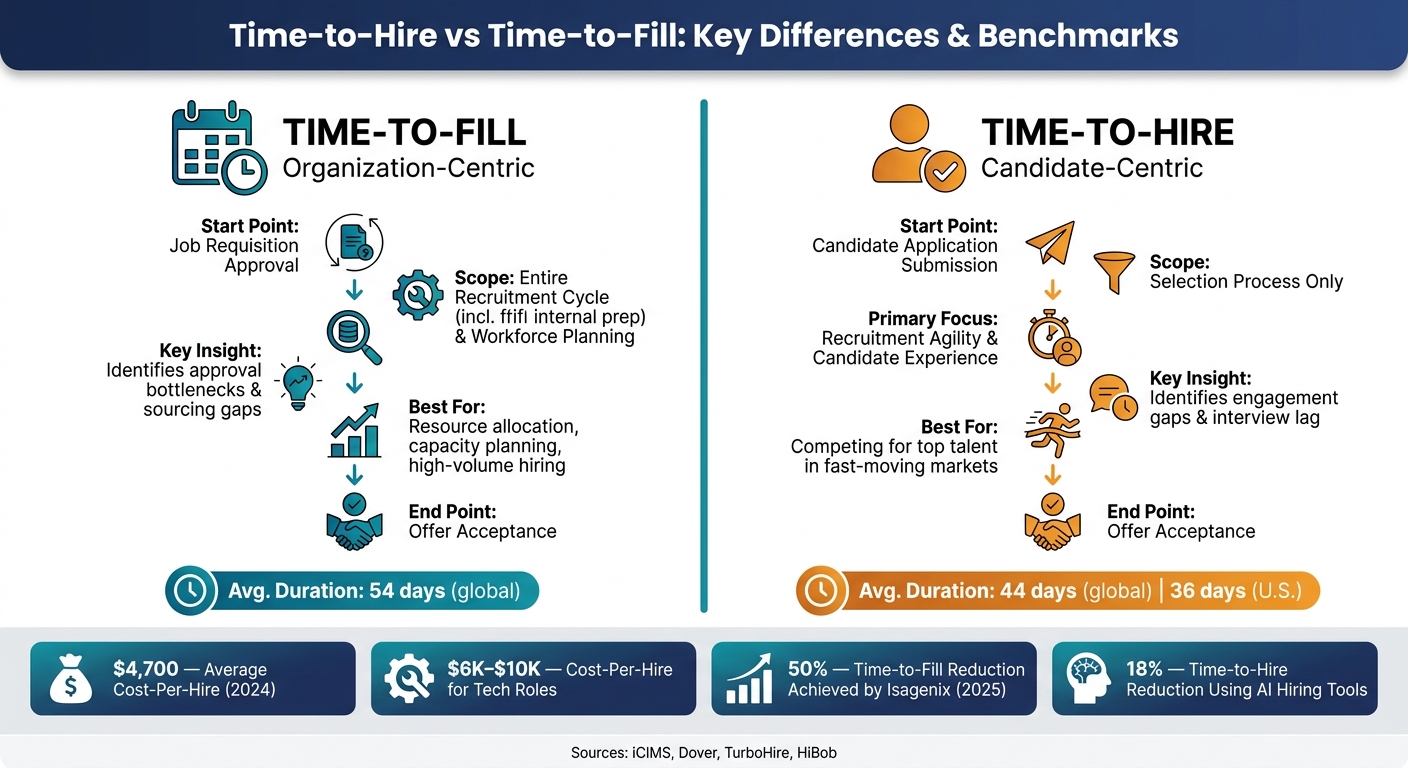
Time-to-Hire vs Time-to-Fill: Key Differences & Benchmarks
The difference between time-to-hire and time-to-fill lies in where each metric begins and what it measures. Time-to-fill starts from the moment a job requisition is approved, while time-to-hire begins when a candidate submits their application. This distinction helps pinpoint inefficiencies in different parts of the recruitment process. For more insights on optimizing your hiring strategy, explore our recruitment blog.
Time-to-fill gives an organization-focused perspective, showing how long it takes to move from internal approval to a hire. On the other hand, time-to-hire reflects the candidate’s experience, measuring how quickly your team acts once someone applies.
"Time-to-hire measures the candidate journey (application to offer), while time-to-fill tracks the complete process (job approval to start date)." – Dover
Comparison Table: Time-to-Hire vs Time-to-Fill
| Factor | Time-to-Fill | Time-to-Hire |
|---|---|---|
| Start Point | Job requisition approval | Candidate application submission |
| End Point | Offer acceptance (or start date) | Offer acceptance |
| Perspective | Organization-centric | Candidate-centric |
| Scope | Entire recruitment cycle, including internal prep | Selection process only |
| Primary Focus | Internal efficiency and workforce planning | Recruitment agility and candidate experience |
| Key Insight | Identifies approval bottlenecks and sourcing gaps | Identifies gaps in engagement and interview lag |
| Key Use Case | Resource allocation and business impact | Securing talent in competitive markets |
Choosing the Right Metric for Your Hiring Goals
Matching the Metric to Your Business Goals
The right hiring metric depends on the specific bottleneck slowing your recruitment process. For instance, if delays stem from internal approvals or capacity planning, time-to-fill is the key metric to monitor. This metric reveals where back-end inefficiencies exist – roles can sit in limbo for nearly three weeks before even being approved [6]. By addressing this, leadership can better allocate resources and streamline hiring.
On the other hand, if the issue lies in losing candidates mid-process or competing for high-demand talent, time-to-hire takes priority. For technology roles, the average time-to-hire can reach 49 days [2]. Meanwhile, top engineers often receive multiple offers within 30 days of starting their job search [2]. A drawn-out selection process in such cases can mean losing top-tier candidates.
Generally, talent acquisition leaders focus on time-to-fill for resource planning [6], while recruiters and hiring managers look to time-to-hire to gauge how smoothly candidates move through the pipeline [1].
Steps to Improve Your Recruitment Metrics
Once you’ve pinpointed the main delay, you can make targeted changes to improve your metrics.
For reducing time-to-fill:
- Standardize your job requisition process with pre-approved templates and clear approval workflows.
- Use a Candidate Relationship Management (CRM) tool to build proactive talent pipelines, so you’re not starting from scratch every time a role opens [1].
- Hold a kickoff meeting with all stakeholders before posting a role. Align on the ideal candidate profile and salary range upfront to avoid late-stage delays [1].
For reducing time-to-hire:
- Replace multiple individual interviews with structured panel interviews to cut down on unnecessary touchpoints [2].
- Set internal KPIs, such as requiring hiring managers to provide feedback within 24 hours of an interview, to speed up decision-making [1].
- Leverage AI-powered hiring tools. Companies using these tools have reduced time-to-hire by 18% while also improving candidate quality scores by 23% [2].
Even with these strategies, stretched internal resources can make it hard to achieve meaningful improvements. That’s when external support becomes critical.
How Rent a Recruiter Can Help

Scaling businesses often face challenges in improving these metrics due to limited HR capacity.
Rent a Recruiter places experienced recruiters directly into your team in just a few days. These embedded recruiters handle the entire hiring process, ensuring smoother internal alignment to reduce time-to-fill and stronger candidate engagement to improve time-to-hire.
The impact? Clients typically cut hiring costs by up to 70% compared to traditional commission-based agencies. Plus, they save over 80 hours per month on internal hiring and admin tasks – freeing up time and resources to focus on scaling.
Conclusion: Picking the Right Metric to Improve Hiring
Key Takeaways
Every hiring metric sheds light on a different aspect of your recruitment process. Time-to-fill measures the entire hiring journey, from requisition approval to offer acceptance, making it ideal for workforce planning and identifying internal delays. On the other hand, time-to-hire focuses on how quickly candidates move through your pipeline, offering insights into candidate experience and your ability to compete for top talent.
Globally, the average time-to-fill is 54 days, while time-to-hire averages 44 days [1]. These delays come with tangible costs. The average cost-per-hire across industries reached $4,700 in 2024, with tech roles costing between $6,000 and $10,000 [2]. Choosing the wrong metric to focus on means solving the wrong problem.
"A shorter time-to-hire demonstrates a streamlined process and keeps candidates engaged, while delays at this stage can lead to losing top talent to other opportunities." – Tali Sachs, Senior Content Manager, HiBob [8]
These metrics aren’t just numbers – they’re a roadmap for action.
Next Steps for Scaling Companies
Start by pinpointing where your process slows down. Match your recruitment strategy to your growth needs. If roles sit vacant for weeks before interviews even begin, focus on time-to-fill. If candidates drop out or accept other offers, shift your attention to time-to-hire.
Need to act fast? Rent a Recruiter can place an embedded recruiter within your team in just days, helping you cut delays and take control of your hiring process.
FAQs
How do I calculate time-to-hire vs time-to-fill?
Time-to-hire refers to the period between when a candidate applies and when they accept the job offer. To calculate it, subtract the application date from the offer acceptance date. This metric highlights how quickly your team moves candidates through the hiring stages.
Time-to-fill, on the other hand, starts earlier. It measures the time from when a job is posted or approved to when the position is officially filled. To determine this, subtract the posting or approval date from the hire’s start date.
Both metrics are essential for spotting bottlenecks and improving efficiency in your hiring process.
Should I measure offer acceptance or start date as the endpoint?
The metric you choose should align with your hiring objectives. Time-to-hire measures the period from application to offer acceptance, making it a great indicator of candidate engagement and process efficiency. On the other hand, time-to-fill tracks the journey from job approval to the new hire’s start date, offering a more comprehensive picture of recruitment timelines and onboarding. Decide on the endpoint based on your focus – offer acceptance if candidate experience is your priority, or start date if you’re evaluating overall recruitment performance.
What’s a good time-to-hire and time-to-fill for my roles?
A typical time-to-hire falls between 30–36 days, while time-to-fill ranges from 30–60 days, varying by role and industry. These benchmarks aim to balance speed with a positive candidate experience. For high-priority roles, shorter timelines are crucial to attract and secure top talent. On the other hand, less urgent positions can afford longer hiring cycles. Adjust these metrics to align with your business priorities and industry norms for the best outcomes.