
If you scale hiring without vendor control, you lose time, spend more, and leave your hiring process exposed.
I see this issue come up fast in scaling SaaS, IT, Fintech, Engineering, Security, Insurance, and Professional Services teams. The fix is simple: know every hiring vendor, rank the risk, check access before go-live, review vendors on a set schedule, and shut access down cleanly when a contract ends. That cuts wasted admin, avoids delays, and gives you more control over cost, data, and hiring output.
Here’s the short version:
- Every hiring vendor adds risk, not just cost
- You still own the outcome if a vendor mishandles applicant data or slows hiring
- A six-step process works best: identify, classify, assess, approve, monitor, offboard
- High-risk tools need more scrutiny, especially ATS, payroll, and screening vendors
- Access control matters as much as contract terms
- 35.5% of breaches in 2024 were third-party related, up from 29% in 2023
- Embedded recruitment providers can add hiring capacity while keeping work inside your systems and controls
If you are growing headcount across the US, Ireland, Australia, or the Middle East, this is not just a risk issue. It is a hiring cost and control issue that requires strategic talent acquisition.
The Third Party Risk Management Lifecycle: Managing Vendor Risk From Start to Finish Webinar
sbb-itb-a23bd6a
Build a Simple Third-Party Risk Framework for Recruitment Operations
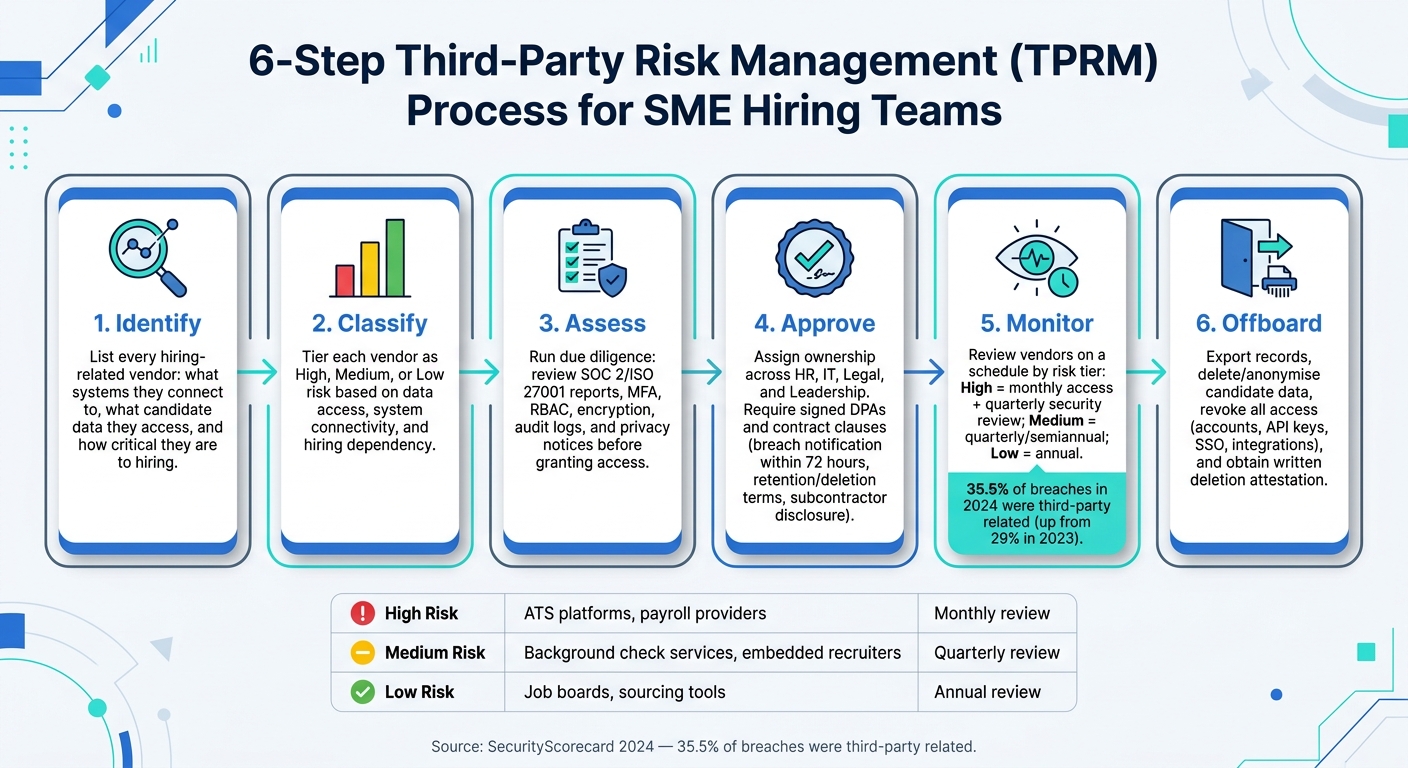
6-Step Third-Party Risk Management Process for SME Hiring Teams
SMEs need a lightweight process they can run without turning hiring into admin overload. A practical TPRM process has six phases: identify, classify, assess, approve, monitor, and offboard. That gives you a clear path from first intake to final access removal.
Remote hiring makes this more urgent. Vendors often get access to candidate data, hiring systems, and internal tools. Without a simple framework, control slips fast. Build vendor checks into your structured hiring model so oversight happens by default, not as a last-minute scramble. Start with inventory and tiering, then assign owners before any vendor is approved.
Third-party breaches and supply-chain attacks are common, so even a small hiring team needs a process it can repeat.
Create a Vendor Inventory and Risk Tiering Model
Start with a simple spreadsheet or shared document. List every hiring-related vendor, what systems they connect to, what candidate data they can access, and how much your hiring process depends on them. Keep it practical. If a vendor touches hiring, it goes on the list.
Three questions help you tier each vendor fast:
- Does it access sensitive candidate data?
- Does it connect to internal systems?
- Would hiring stop if the vendor failed?
Use those answers to assign a risk tier and decide how much review each vendor needs. That keeps your team from overchecking low-risk tools while still giving proper attention to vendors that could disrupt hiring or expose data.
| Risk Tier | Recruitment Vendor Examples | Data/Access Level | Required Review |
|---|---|---|---|
| High | ATS platforms, payroll providers | Access to candidate data and internal systems | SOC 2 review, security questionnaire, leadership approval |
| Medium | Background check services, embedded recruiters | Limited candidate data or temporary access to internal tools | Privacy policy review, Data Processing Agreement (DPA) required |
| Low | Job boards, sourcing tools, training platforms | No internal access; public data only | Terms of Service review, basic performance tracking |
Once vendors are tiered, assign a single owner for each approval path. That cuts delay, avoids back-and-forth, and makes it clear who has to act before a vendor is brought into the hiring stack.
Assign Ownership Across HR, IT, Security, and Leadership
A vendor inventory only works if someone owns each part of it. In most SMEs, that ownership usually splits across four groups.
HR or talent leads own the business relationship. They know whether a vendor is helping you hit hiring goals or just adding cost.
IT or security owns technical checks, multi-factor authentication requirements, and access permissions. If a tool connects to internal systems, this step matters.
Legal or operations owns the contract lifecycle, including data processing agreements and liability clauses. That keeps data terms and risk terms from being missed in the rush to start hiring.
Leadership makes the final call on high-risk vendors that are tied to business growth. That matters when a vendor could affect hiring speed, compliance, or spend.
Shared ownership across HR, IT, security, legal, and leadership keeps reviews fast and gaps visible. Clear owners move vendors through intake, review, and approval faster. With ownership in place, vendors can move into review without slowing hiring.
Assess Hiring Vendors Before They Become a Risk
Run due diligence before any vendor gets access to your systems or candidate data. For lean SME teams, this does not need to turn into a long audit. It needs to be consistent and repeatable.
Use the same tiering logic each time so you can judge how much review each vendor needs. That keeps the process tight, saves time, and helps you avoid treating every tool like a major security event.
Review Security, Privacy, and Remote Access Controls
The aim is clear: keep candidate data, system access, and hiring decisions under your control.
On the security side, confirm the basics are in place:
- MFA
- SSO
- RBAC
- Encryption in transit and at rest
- Audit logs for logins, exports, and permission changes
- Secure VPN or zero-trust access for vendor staff
- Company-approved devices with endpoint protection
You should also ask for a current SOC 2 Type II report or ISO 27001 certificate. Check that it covers access control, logging, incident response, and data protection.
Privacy needs the same level of scrutiny. Ask for a clear privacy notice that spells out what candidate data is collected, why it is collected, how long it is kept, and who it is shared with. Look closely at any use beyond hiring, such as marketing or model training. If a vendor handles candidate PII, including resumes, contact details, or background-check results, they should sign a Data Processing Agreement (DPA) before go-live.
Once those controls are in place, the next step is simple: put them in the contract.
Put the Right Terms Into Vendor Contracts
Contracts need to match how your hiring process works in practice. A signed DPA is only the starting point. The contract itself should include clauses that protect you when things go wrong.
The biggest one is breach notification. Require the vendor to notify you within 72 hours of discovering a security incident affecting candidate data.[1][2][3]
Retention and deletion terms matter too. Unsuccessful candidate data should generally be deleted within about six months after the recruitment process ends, unless you have clear consent to keep it longer in a talent pool.[4] Your vendor contracts should reflect that timeline.
You should also require subcontractor disclosure. If a vendor uses third parties, you need to know who they are and make sure the same standards apply to them. Audit rights matter as well. The right to request security questionnaires and review reports gives you cover if concerns come up later.
The table below shows the clauses that should not be left out for the vendor types SMEs use most in remote hiring:
| Vendor Type | Must-Have Clauses |
|---|---|
| ATS Platforms | Breach notification within defined hours; data retention/deletion post-termination; subcontractor disclosure; RBAC and access restrictions; geography-based data storage limits |
| Interview Tools | Breach notification; limits on recording retention; candidate consent for recordings; access restrictions on stored media; data localization for recordings |
| Background-Check Providers | FCRA-compliant handling (for the U.S.); breach notification; explicit retention limits for criminal/identity data; subcontractor oversight; geography-based storage |
| Assessment Tools | Breach notification; purpose limitation on assessment data; retention/deletion terms; restrictions on sharing scores beyond authorized roles |
For lower-risk vendors, a standard data protection addendum is often enough. For high-risk vendors, especially background-check providers handling criminal history and identity documents, push for tighter audit rights and clearer incident response cooperation terms.
This becomes even more important when recruiters work inside your systems every day.
How Embedded Recruitment Partners Fit a Controlled Hiring Environment
Rent a Recruiter and other embedded recruitment partners work inside your existing systems and follow your workflows. That means they are provisioned through your company’s SSO, assigned RBAC roles limited to the right teams or regions, and required to follow your approval steps for job sign-offs, candidate submissions, and offers.
The upside is straightforward. Pipeline data, candidate communications, and status changes stay in your systems. Leadership can pull reports without chasing external spreadsheets. Documentation also stays consistent because embedded partners use your job brief templates, interview scorecards, and feedback forms instead of bringing in their own versions.
For growing SMEs, that setup gives you more hiring capacity while keeping spend more predictable and cutting internal hiring admin.
Monitor Vendors, Respond to Incidents, and Offboard Cleanly
Once a vendor is live, you still need control. That means regular monitoring, a clear incident path, and a proper offboarding process. Approval is only the start. After that, the job shifts to keeping risk in check, protecting data, and making sure access does not linger longer than it should.
Set a Monitoring Schedule by Risk Tier
Use the same vendor tiers from your inventory to set review timing. High-risk vendors need closer attention. Low-risk tools can be checked less often.
Third-party breaches are still a live issue. SecurityScorecard found that 35.5% of all breaches in 2024 were third-party related, up from 29% in 2023.[5][6][7]
The table below gives you a practical starting point:
| Risk Tier | Example Vendors | Access Review | Security Review | Breach/News Check | Trigger for Immediate Reassessment |
|---|---|---|---|---|---|
| High | ATS platforms, embedded recruiters, or RPO providers | Monthly | Quarterly, with a full-scope annual review | Continuous/daily | Breach, new subprocessor, expanded data access, ownership change |
| Medium | Assessment tools, background-check providers, interview scheduling software | Quarterly or semiannually | Every 12–18 months | Weekly or biweekly | Material contract change, service outage, performance drop |
| Low | Job boards, generic communication tools | Annually | Every 24–36 months or on renewal | Event-driven | Public incident, significant system change |
Bundle these checks into one quarterly review packet. That makes the process easier for lean HR and IT teams, and it cuts the risk of missing something important.
Prepare a Basic Incident Response Playbook for Hiring Vendors
A breach or outage needs a response path before it happens. Assign a main incident lead and a backup in advance.
Keep the playbook short and clear. It should spell out the incident lead, escalation path, access shutoff point, affected systems, and internal notification flow.
Treat data protection and hiring continuity as two separate calls. IT should suspend vendor access and review integrations. HR should map which hiring workflows are affected and what recruiters or other internal teams need to know. Leadership needs a short update on what happened, what data was involved, and what actions are underway, not a deep technical report.
Stick to confirmed facts. If the vendor is still working out scope, internal messaging should stay tight and factual.
Prewrite templates for:
- Employee updates
- Recruiter instructions
- Leadership alerts
That saves time during an incident and helps stop mixed messages from spreading across teams.
Offboard Vendors Without Leaving Data or Access Open
Offboarding is where many SMEs leave loose ends. When a contract ends, access does not always end with it. API keys, calendar integrations, and shared logins often stay live long after the relationship is over.
Work through four steps before you close a vendor relationship.
First, export any records you need for compliance, audits, or internal reporting. Make sure the vendor can provide them in a format your team can actually use.
Second, delete or anonymise candidate data that no longer needs to be kept, in line with the retention terms already set in your contract.
Third, revoke all access. That includes user accounts, API keys, SSO connections, and any linked integrations.
Fourth, get written confirmation, such as a deletion attestation or certificate of destruction. That gives you proof the vendor handled data properly after exit.
Finish with a short offboarding checklist signed by both HR and IT. It gives you a clean paper trail if questions come up later.
During periods of fast hiring, leadership reporting should stay tight. Track a small set of metrics: active vendors by risk tier, overdue reviews, open incidents, access exceptions, and vendors pending offboarding.
Implement a Scalable TPRM Program That Supports Faster Hiring
Once you’ve inventoried and tiered your vendors, the next 90 days should turn those controls into a process your team can actually use.
Most SMEs do not need a full compliance function to manage vendor risk. They need a repeatable process that fits the way hiring already happens, with clear ownership across HR, IT, security, and leadership.
The aim is simple: more control, less uncertainty, and no extra drag on hiring decisions.
A 90-Day Rollout Plan for SME Hiring Teams
Three focused phases are enough to move from scattered vendor decisions to a working TPRM program.
Days 1 to 30: Know what you have. Use the inventory and risk tiers already defined to assign owners and confirm your current vendor list. This inventory becomes the control record for every later review. It also gives you the baseline for the intake checklist and approval rules in the next phase.
Days 31 to 60: Standardize how you bring vendors in. Introduce a lightweight intake checklist for every new hiring vendor. Use the same checklist each time so teams are not making it up as they go. Define which vendors can be fast-tracked and which need legal or IT review. Set one minimum bar before access is granted. Once intake is standard, you can move into monitoring and offboarding with far less friction.
Days 61 to 90: Add monitoring and clean exits. Put the review cadence and offboarding checklist onto a calendar and make it part of the normal workflow. This matters even more in remote hiring, where orphaned accounts and shared access can slip through the cracks.
Ad Hoc Vendor Management vs. Structured Recruitment Risk Management
Once the process is live, the difference is hard to miss.
| Dimension | Ad Hoc Vendor Management | Structured TPRM Model |
|---|---|---|
| Cost control | Unpredictable; contracts vary widely | Standardized terms reduce surprises |
| Access governance | Often forgotten after onboarding | Tracked and reviewed on a set schedule |
| Scalability | Breaks down as vendor count grows | Designed to scale with hiring volume |
A structured model can pay back fast. The business case is straightforward: structured TPRM cuts internal admin time, reduces repeated one-off decisions, and gives leadership a clearer view of where risk sits.
That is not just a compliance gain. It’s a hiring operations gain too.
Conclusion: Reduce Risk Without Slowing Growth
For SMEs scaling remote hiring, start with the vendors already in use. Classify them, standardize the review process, and put monitoring and offboarding on a calendar.
If you’re building hiring capacity fast, whether after funding, a product launch, or a spike in demand, fractional recruitment services like Rent a Recruiter can help you scale. Rent a Recruiter places experienced recruiters into your team within days, helping you scale hiring with more structure, visibility, and consistency.
Structured TPRM helps SMEs hire faster without losing control.
FAQs
Which hiring vendors are highest risk?
Vendors carry the most risk when they sit close to core operations, touch sensitive data, or run hiring across large, regulated, or multi-state environments.
That usually means vendors with access to candidate personal information, vendors filling revenue-critical roles, and vendors managing complex contingent labour arrangements. In those cases, the stakes are higher. You are not just buying hiring support, you are taking on exposure tied to compliance, cost, and business continuity.
The biggest pressure points tend to be:
- Access to candidate data and other sensitive records
- Hiring for roles that directly affect revenue or delivery
- Contingent workforce programmes with co-employment risk
- Worker misclassification exposure
- Tax liability across states or regions
These vendor relationships need strict annual audits and ongoing performance tracking. A light-touch review is not enough when poor oversight can lead to delays, compliance issues, or avoidable cost.
How often should SMEs review vendors?
SMEs should review vendors based on risk, hiring volume, and how much your business depends on them, not by sticking to a fixed calendar.
A simple way to handle it:
- High-risk vendors: full audits every 12 to 18 months, plus quarterly or twice-yearly monitoring
- Medium-risk vendors: every 18 to 24 months
- Low-risk vendors: every 24 to 36 months or at contract renewal
You should also review vendors straight away after data incidents, leadership changes, major fee increases, or repeated performance issues.
That matters because vendor risk can shift fast. A supplier that looked fine six months ago can become a cost, compliance, or delivery problem if service drops or internal changes hit the account team.
What should vendor offboarding include?
Vendor offboarding needs to do two jobs at once: protect your business and keep hiring moving.
If this step is rushed, you can end up with old system access still live, candidate data sitting in the wrong place, and key hiring context walking out the door. That creates risk you do not need, especially when you’re scaling.
Key steps include:
- Remove access to internal systems, repositories, and collaboration tools.
- Securely transfer candidate data, then confirm documented deletion or destruction in line with your Data Processing Agreement.
- Settle outstanding obligations, recover company property, document processes and candidate history, and complete a final performance review.