
Talent segmentation helps you make smarter hiring decisions by dividing your talent pool into specific groups based on skills, performance, and potential. For scaling companies, this approach reduces costs, speeds up hiring, and ensures you’re focusing on roles that drive business growth.
Key Benefits:
- Save up to 70% on hiring costs by reducing reliance on expensive job ads and external agencies.
- Fill roles 40–60% faster by maintaining pre-qualified talent pools.
- Prioritize critical hires to avoid disruptions in operations or revenue.
By using tools like the nine-box grid or focusing on role criticality and skills clustering, you can align hiring with business goals, close skill gaps, and retain top talent. If your team lacks the resources to implement this, Rent a Recruiter can embed experienced recruiters to build scalable, cost-effective hiring systems for you.
Bottom line: Talent segmentation helps you hire better, faster, and for less. Ready to transform your recruitment process? Talk to us today.
Unit 3: Segmentation in Talent Acquisition Analytics
Effective segmentation relies on robust talent insights and HR reporting to track performance across different workforce categories.
sbb-itb-a23bd6a
Talent Segmentation Models for SMEs
Not every segmentation model fits every business. The right approach depends on your company’s growth stage and the decisions you’re tackling. For SMEs, these models provide practical frameworks to streamline hiring and workforce planning. Here are three effective options for scaling businesses.
Performance and Potential-Based Segmentation
The nine-box grid is a simple yet powerful tool that maps performance against potential within a 3×3 matrix. It creates a shared language for discussing talent and is widely used for succession planning – 64% of large companies rely on it for this purpose [3].
This grid categorizes talent into four key groups, each requiring specific actions:
| Talent Category | Performance / Potential | Strategic Action |
|---|---|---|
| Stars | High / High | Develop for leadership roles, mentoring, succession planning |
| Core Players | Moderate / Moderate | Focus on retention, skill mastery, and engagement |
| Enigmas | Low Performance / High Potential | Provide coaching, monitor closely |
| Risks | Low / Low | Implement performance improvement plans or consider exit strategies |
However, the model only works when it drives meaningful action. As Belinda Pondayi from The Human Capital Hub highlights:
"A nine-box talent grid that does not lead to action is a waste of time." [3]
To make it effective, ensure every category has a clear action plan. Use calibration sessions with managers to challenge assumptions and base ratings on objective metrics like OKRs, sales data, or 360-degree feedback. This ensures decisions are grounded in reality, not bias.
From here, think about how critical roles impact your business continuity.
Role Criticality-Based Segmentation
Which roles, if left unfilled, would disrupt your business? This model focuses on identifying revenue-critical positions and operational bottlenecks – the roles essential for maintaining delivery capacity and meeting customer commitments.
For SMEs with limited resources, this framework helps prioritize hiring. It ensures you fill roles that protect revenue and operations before expanding leadership or adding new layers. As Mark Loughnane from Rent a Recruiter explains:
"Future bottlenecks are capability-based, not title-based." [2]
Before opening a position, ask yourself: what outcome does this hire enable, and what would break if it’s delayed by three months? This clarity ensures you’re investing in roles that directly impact your bottom line.
Finally, consider grouping talent by their skills and competencies.
Skills and Competency Clustering
Instead of relying on traditional job titles or seniority, this model organizes talent by capabilities – what people can actually do. By 2026, many growth-focused SMEs will prioritize skills like AI literacy, adaptability, and decision-making over rigid role definitions [2]. This method aligns workforce capabilities with evolving business needs.
Start by identifying 5–7 critical skills your business will need over the next 12–24 months. Then, map your current team against these capabilities to uncover gaps. Decide whether those gaps are best addressed through internal development, mobility, or external recruitment. With a projected global talent shortage of 85 million workers by 2030 [4], understanding your skill gaps now will give you a competitive edge.
How to Implement Talent Segmentation: A Step-by-Step Guide
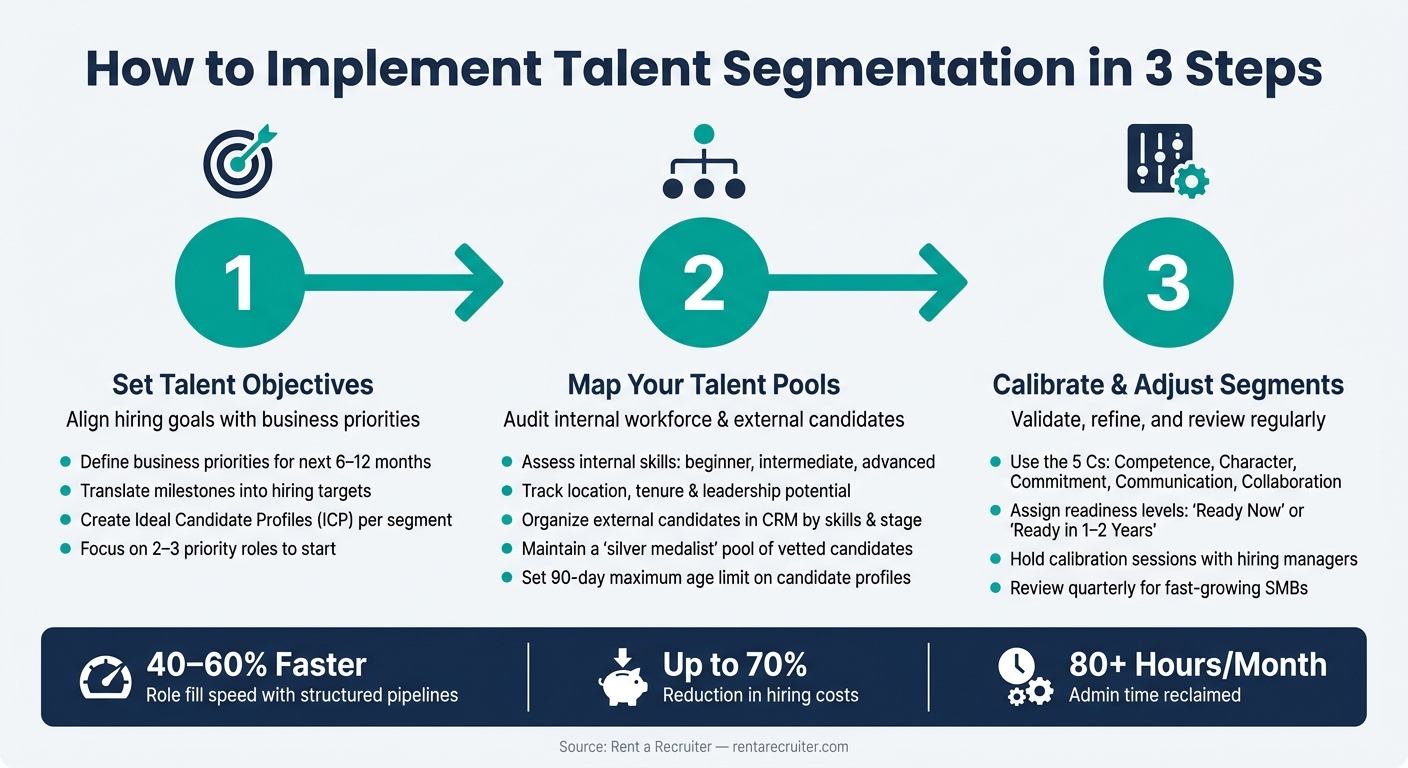
How to Implement Talent Segmentation: 3 Steps to Smarter Hiring
With the right approach, you can implement talent segmentation in three straightforward steps.
Set Talent Objectives That Align with Business Goals
Start by defining your business priorities for the next 6–12 months. Are you planning a market expansion, launching a new product, or scaling up your team? Each of these goals comes with specific talent requirements.
Translate these milestones into hiring targets. For instance, expanding into a new region might mean recruiting sales leaders with deep knowledge of that market. From there, create an Ideal Candidate Profile (ICP) for each key segment. This should include details like required skills, experience, location, and salary expectations. As Anja Zojceska from TalentLyft explains:
"The general rule for segmenting your talent pool is to segment your talent pools based on your current and future hiring needs." [6]
Start small – focus on two to three priority roles [7]. Companies that take this structured approach to talent pipelines often fill roles 40–60% faster than those relying on reactive sourcing [7].
Once your objectives are clear, take stock of your internal and external talent to identify how these needs can be met.
Map Your Internal Workforce and External Talent Pools
With objectives in place, the next step is understanding your current talent landscape – both within your organization and in the broader market.
For your internal workforce, concentrate on the elements most relevant to your goals: skill levels (beginner, intermediate, advanced), location, tenure, and leadership potential. Workforce analytics tools can simplify this process, automating data collection and reducing the risk of manual errors or bias [8]. Be transparent with your team about what you’re tracking and why – it builds trust and ensures alignment.
For external talent pools, organize candidates in your CRM by factors like hiring stage, skills, location, and source. A helpful strategy is to maintain a "silver medalist" pool – candidates who were strong contenders but not hired. These individuals are already vetted and can be fast-tracked for new opportunities [6]. To keep your data fresh, set a maximum age limit (e.g., 90 days) for candidate profiles and actively re-engage cold segments when needed [7].
Once you’ve mapped your talent pools, it’s time to fine-tune and validate your segments.
Calibrate and Adjust Your Segments
With objectives defined and talent pools mapped, the final step is refining your segmentation to match shifting business needs. Bring together hiring managers and team leads to review current placements, challenge any assumptions, and ensure evaluations are consistent.
Use the "5 Cs" framework – Competence, Character, Commitment, Communication, and Collaboration – to standardize evaluations. Base these assessments on measurable data like performance metrics, skills evaluations, and 360-degree feedback. Assign readiness levels such as "Ready Now" or "Ready in 1–2 Years" to prioritise actions [1].
Remember, segmentation is not a one-and-done process. As Rippling highlights:
"As your organization’s needs evolve, so should your talent mapping approach." [1]
Set a regular review cadence – quarterly works well for fast-growing small and medium-sized businesses (SMBs) – to ensure your segments stay aligned with your evolving priorities. Adjustments will keep your talent strategy agile and effective.
Turning Talent Segmentation Insights into Action
Once your talent segments are defined and validated, the next step is putting that data to work. Segmentation only delivers results when it informs practical decisions around hiring, employee development, and resource allocation. Here’s how to channel these insights into focused efforts, personalized development strategies, and seamless integration into your recruitment processes.
Focus Hiring Efforts on High-Impact Roles
Not every role carries the same weight when it comes to driving business success. For fast-growing SMEs, the biggest risk isn’t a lack of candidates – it’s failing to secure the right talent for critical positions. As Jim Collins famously said:
"People are not the most important asset in a company; the right people are." [10]
Use segmentation to pinpoint roles that are essential to your core operations – those where a vacancy could cause significant disruption. These are often key supervisory or frontline positions [9]. Direct the bulk of your recruiting resources toward filling these roles.
For segments where you may not be able to compete on salary with larger companies, focus on non-monetary benefits. Flexible work options and a strong emphasis on work-life balance can be powerful incentives [10]. Additionally, activate top performers within these segments as internal ambassadors. A well-structured referral program tailored to critical segments often delivers higher-quality hires and improved retention [10].
Build Tailored Development and Retention Strategies
Generic development programs often fall short because they fail to address the unique needs of different employee groups. Segmentation enables you to design upskilling and retention plans that align with the specific needs of each segment.
For example, segment employees by skill level – beginner, intermediate, or advanced – and potential. Then, offer tailored initiatives such as structured mentorship, clear paths to promotion, and proactive measures to prevent burnout. For essential frontline roles, use engagement-based segmentation to identify early signs of burnout. Addressing these issues early can prevent them from escalating into turnover problems.
By directing your development budget toward high-impact segments, you ensure that your investment delivers measurable results where it matters most.
Embed Segmentation into Everyday Recruitment
Segmentation shouldn’t just sit in a report – it needs to be part of your day-to-day recruitment strategy. Start at the requisition stage by applying segment criteria to shape job descriptions. Use frameworks like the 5 Cs – Competence, Character, Commitment, Communication, and Collaboration – to attract candidates who are the right fit for each role, not just a high volume of applicants [5].
During busy hiring periods or when budgets are tight, segmentation provides clarity on which roles to prioritise, helping you avoid reactive decisions. Configure your Applicant Tracking System (ATS) to reflect your segment structure. This allows you to monitor pipeline health, track conversion rates by role type, and quickly identify bottlenecks [10].
Finally, leverage exit interview data from critical segments to understand why employees leave. These insights can help refine your approach and improve retention over time. By integrating segmentation into daily processes, you create a standardised approach to hiring that reduces guesswork and improves outcomes.
Tools and Governance for Talent Segmentation
Effective talent segmentation relies on two key pillars: robust tools and clear governance. These ensure that insights are both actionable and reliable.
Data Sources and Quality Standards
Accurate segmentation starts with dependable data. For most small to medium-sized businesses (SMEs), this data typically comes from systems like your HRIS (covering job titles, tenure, and performance records), ATS (tracking pipeline data and candidate sourcing), performance reviews, 360-degree feedback, employee surveys, and external labor market reports. These sources allow you to benchmark your talent pools against broader industry trends [8].
The tricky part? Keeping your data clean and consistent. When information is scattered across multiple systems, it’s easy to end up with incomplete talent profiles, which can derail segmentation efforts [1]. Centralizing this data through an integrated HRIS reduces manual errors and keeps everything aligned. As TalentLyft aptly puts it:
"Segmenting and managing your talent pool using Excel tables and email is an extremely dreadful and time-consuming process." [6]
Once your data is reliable, the next step is ensuring governance to protect sensitive information.
Governance and Legal Considerations
Managing workforce data comes with its challenges. In fact, two-thirds of executives admit to feeling uneasy about using this data [8]. That discomfort is understandable, given the legal and ethical complexities involved. Clear governance policies are essential for ensuring fairness, consistency, and compliance with legal standards.
Start with a privacy-first mindset: encrypt employee data, implement strict access controls, and provide training for everyone involved in the segmentation process to meet data privacy requirements [1]. Regularly review your segmentation criteria to ensure they don’t unintentionally disadvantage protected groups, adhering to laws like Title VII or the ADA.
Transparency is just as critical. Employees are more likely to support segmentation efforts when they understand the purpose and how the data will be used. ActivTrak highlights this point well:
"When you’re upfront with employees about how and why you plan to segment, they’re less inclined to push back – and may even volunteer to help." [8]
Metrics to Track Segmentation Performance
To ensure your segmentation strategy is delivering results, you need to track the right metrics. Here are some of the most effective ones for SMEs:
| Metric | Insight |
|---|---|
| Time-to-Fill (Critical Roles) | Tracks whether high-priority roles are being filled quickly to avoid costly delays [11][13] |
| Quality of Hire | Evaluates if your segmentation efforts are attracting the right candidates, not just a larger volume [11][13] |
| Segmented Turnover Rate | Identifies if specific high-value groups are leaving at higher rates than others [11][12] |
| Internal Mobility Rate | Measures how well you’re moving internal talent into new opportunities [12] |
| Cost Per Hire by Segment | Breaks down spending for specialised versus general roles [11][13] |
| Skills Gap Closure Rate | Assesses how quickly skill gaps are being addressed through hiring or training [12][1] |
These metrics should be analysed at the segment level – not just across the company as a whole. A strong overall retention rate, for instance, might hide significant risks in a specific critical segment. Review these numbers quarterly and ensure your HR systems reflect current realities to keep your segmentation efforts on track [12].
Conclusion: Using Talent Segmentation to Scale Smarter
Talent segmentation isn’t just a one-off exercise; it’s a continuous process that aligns your hiring strategy with your business objectives. When done right, it transforms hiring from a reactive scramble into a well-planned, proactive approach, allowing you to address workforce gaps before they impact your growth.
Key Takeaways for Scaling Companies
The main benefit of talent segmentation is clear: it ensures you have the right people in the right roles at the right time. As Vanessa Kahkesh of Rippling explains:
"When you have the right people in the right place, your HR budget goes further, driving your future success." [1]
For fast-growing SMEs, where every hire has a direct impact, talent costs typically make up 50% to 70% of overall spending [14]. This means poor hiring decisions can be a serious drain on resources. Talent segmentation reduces this risk by clearly defining the skills and attributes needed for each role.
By integrating segmentation into your hiring processes, you’ll improve succession planning, focus on high-priority development needs, and create a talent pipeline that speeds up hiring. This proactive approach supports sustainable growth and helps your business adapt to changing demands.
Next Steps: Work with Rent a Recruiter
Turning strategy into action is the next step. If your team lacks the bandwidth to implement talent segmentation, Rent a Recruiter can step in. Their embedded recruiters integrate directly with your team – often within days – to streamline and prioritize your hiring efforts. With their help, clients cut recruitment costs by up to 70% and reclaim over 80 hours monthly in admin and hiring tasks. Book a call to see how embedded recruitment can bring your segmentation strategy to life.
FAQs
Which roles should we segment first?
When deciding where to focus your hiring efforts, begin with the roles that directly influence your company’s growth and performance. These are often mission-critical positions such as sales, engineering, or leadership. Additionally, pay attention to jobs with high turnover rates or those that consistently attract a large number of applicants. By prioritizing these areas, you align recruitment with business objectives, streamline processes, and improve the quality of hires – all while cutting down on time-to-fill.
What data do we need to start talent segmentation?
To start with talent segmentation, you’ll need to gather key data points such as candidate source, location, skills, current position, hiring stage, last contact date, rejection reasons, campaign engagement, experience level, generation, education, and language. These details help create a clear picture of your talent pool.
On top of that, using internal workforce data like headcount, attrition trends, and recruitment metrics ensures your segmentation aligns with business priorities. Predictive tools can also play a role by refining hiring strategies and improving workforce planning, giving you a sharper edge in meeting your goals.
How often should we update our segments?
Regularly revisiting your talent segments is crucial to ensure they stay relevant and effective. Ideally, you should review them every 6 to 12 months or whenever your organization undergoes significant changes. For high-growth SMEs, syncing these updates with strategic planning cycles or major hiring drives can lead to more accurate talent pools, sharper targeting, and smoother recruitment processes. During periods of rapid expansion, biannual reviews – or even more frequent updates – can make all the difference.