Hiring success isn’t just about finding candidates; it’s about equipping your team to make smarter decisions. Untrained stakeholders – hiring managers, CEOs, interviewers, and HR teams – often create delays, risks, and costly mistakes. With structured training, you can improve decision-making, reduce hiring time, and avoid expensive missteps.
Why It Matters:
- 54% of candidates report facing discriminatory questions, leading to reputational and legal risks.
- Structured interviews are 33% more effective at predicting job performance than unstructured ones.
- A bad hire can cost 1.5 to 2 times their annual salary.
Key Solutions:
- Define roles early: Clear responsibilities prevent miscommunication and delays.
- Use structured processes: Interview rubrics, scorecards, and hiring charters ensure consistency.
- Train stakeholders: Teach interview skills, reduce bias, and align on metrics like time-to-fill and quality of hire.
- Leverage embedded recruitment: Experienced professionals streamline hiring and provide immediate support.
Training isn’t optional. It’s a direct way to cut costs, speed up hiring, and build better teams. Partnering with embedded recruitment providers like Rent a Recruiter can save up to 70% on hiring costs while delivering faster, more reliable results.
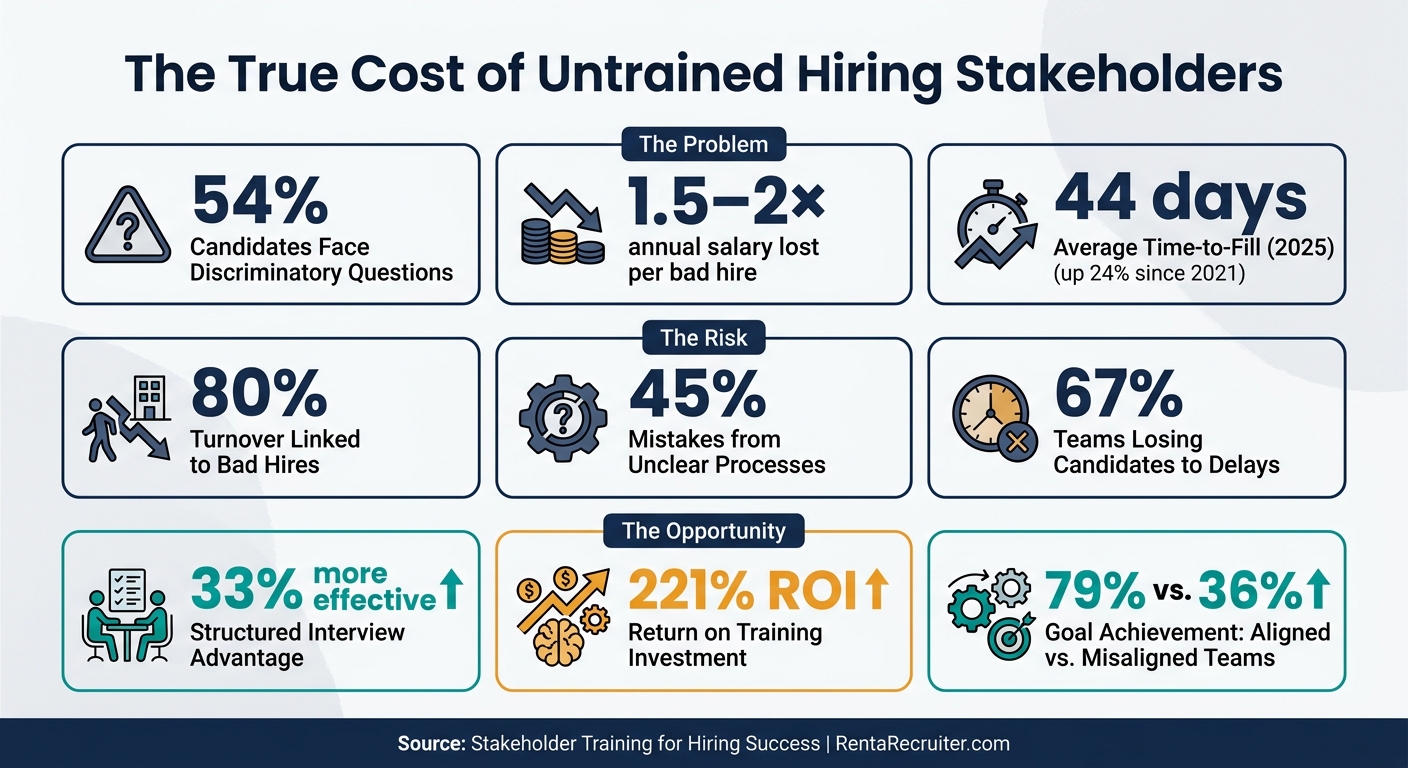
The True Cost of Untrained Hiring Stakeholders: Key Stats
Collaborative Hiring Tips: How to Engage Stakeholders Beyond Your Hiring Managers
sbb-itb-a23bd6a
Defining Stakeholder Roles and Responsibilities
Hiring challenges often stem from unclear roles, not individual shortcomings. By defining responsibilities upfront – before sourcing even begins – you can avoid delays, miscommunication, and costly errors.
Mapping Key Recruitment Stakeholders
Each stakeholder plays a distinct role in recruitment, and understanding these roles helps streamline the process. Here’s a breakdown:
- Hiring managers: Define success criteria and make the final hiring decision.
- Recruiters: Handle sourcing, screening, scheduling, and pipeline management.
- HR business partners: Ensure alignment with workforce planning, pay structures, and legal requirements.
- Leadership and finance teams: Set hiring priorities and budgets.
- Marketing teams: Shape employer branding to attract talent.
- Employees: Contribute through referrals, which boast about a 45% quality-of-hire rate [4].
"Recruiting works best when it becomes a coordinated effort across leadership, hiring managers, marketing, employees, and even operations." – NAACP Job Finder [4]
With these roles clearly defined, the next step is assigning specific responsibilities for each stage of the hiring process.
Clarifying Responsibilities at Each Hiring Stage
Assigning precise responsibilities at every stage ensures smooth collaboration. The table below outlines how tasks are divided:
| Hiring Stage | Recruiter Responsibility | Hiring Manager Responsibility | Primary Decision Authority |
|---|---|---|---|
| Intake | Provide market data & feasibility | Define "must-haves" vs. "nice-to-haves" | Hiring Manager |
| Sourcing | Execute multi-channel search | Approve external-facing job description | Recruiter |
| Screening | Conduct initial screens & shortlist | Review and approve candidate slates | Recruiter |
| Interviews | Design structured rubric & schedule | Conduct substantive evaluation | Hiring Manager |
| Offer | Manage negotiation & logistics | Approve final terms within budget | Hiring Manager |
This alignment begins with the intake meeting. Spending just 45 minutes upfront to clarify role requirements, evaluation criteria, and timelines can prevent downstream delays. Consider this: the average time-to-fill in the U.S. reached 44 days in 2025 – a 24% rise since 2021 [6]. Early alignment is one of the most effective ways to reduce that number.
Creating a Hiring Charter
A hiring charter, or recruitment SLA, formalizes these agreements in writing. The key? Building it collaboratively. As Calvin Botez of Treegarden notes:
"An SLA that feels imposed will always be resented and eventually abandoned." [5]
A practical charter outlines four key metrics:
- Time-to-shortlist: Typically 5 business days for standard roles.
- Feedback turnaround: Within 48 hours post-interview.
- Interview scheduling: Completed within 3 business days.
- Offer approval: Finalized within 3 business days.
This agreement is two-sided. For example, if a recruiter commits to delivering 3–5 qualified candidates within 5 days, the hiring manager agrees to complete the intake briefing within 2 days. Organizations that adopt such charters report a 23% faster time-to-fill and a 20% higher offer acceptance rate [5]. For a simple one-page document, that’s a measurable impact. For more insights on optimizing your hiring process, explore our recruitment blog.
Key Skills Recruitment Stakeholders Need
Having clear role definitions and a solid hiring charter is just the start. To truly execute effective hiring, stakeholders need to develop specific skills. Without these, even the best frameworks can fall short, leading to increased hiring risks and unnecessary costs.
Understanding Hiring Goals and Metrics
The biggest challenge in most hiring processes isn’t a lack of effort – it’s misalignment. When stakeholders don’t share the same vision of what success looks like for a role, decisions tend to drift toward personal preferences instead of meeting business needs.
"If your whole team does not know how to interview, you do not have a hiring process. You have a guessing game." – Tenille Childers, The Metiss Group [2]
Understanding metrics like time-to-fill, quality of hire, and retention rates is essential. These metrics should guide interview practices. For instance, a hiring manager who knows that a bad hire can cost 1.5 to 2 times the employee’s annual salary [1] will approach interviews with far more care than one who doesn’t. The key is to define success before sourcing even begins – documenting what strong performance looks like and identifying the must-have Knowledge, Skills, and Abilities (KSAs) for the role.
By aligning on these metrics, stakeholders can introduce structured, objective processes that reduce bias and improve hiring outcomes.
Running Structured, Fair Interviews
Interviewing isn’t an innate skill – it’s something you learn.
"Interviewing is often treated as a natural skill, when in reality it is learnt." – Sohini Banerjee, Assess Candidates [1]
Structured interviews, using techniques like behavioral STAR questioning and maintaining an 80/20 candidate-to-interviewer talk ratio, can increase predictive accuracy by over 30% and improve quality-of-hire by 20%. Research shows that structured methods, with a predictive validity coefficient of 0.44, outperform unstructured interviews, which sit at 0.33 [1].
One common pitfall is mistaking personal rapport for job-relevant signals.
"I mistook chemistry for signal." – Tenille Childers, The Metiss Group [2]
The solution isn’t to ignore instincts altogether but to balance them within a structured framework. Pre-approved question banks help interviewers avoid veering into irrelevant or legally risky territory. This is crucial, as 54% of job applicants report encountering discriminatory questions during interviews [1]. Proper training ensures stakeholders stay focused on job-relevant criteria, reducing both legal risks and reputational damage.
Evaluating Candidates and Making Data-Driven Decisions
Structured interviews are just the beginning. To truly refine hiring decisions, stakeholders need to rely on objective data. Standardized scorecards, completed immediately after interviews, are a powerful tool. A simple four-tier rating system (poor, borderline, solid, outstanding) combined with evidence-based notes helps separate true capability from surface-level confidence.
The focus should be on identifying patterns of behavior rather than being swayed by how well a candidate "sells" themselves. A polished storyteller isn’t always the best performer, and quieter candidates may have the skills that matter most. Teaching stakeholders to spot these nuances ensures a more reliable hiring process.
"Better interviewers build better teams. And better teams build better companies." – Sohini Banerjee, Assess Candidates [1]
How to Design and Run Stakeholder Training
Identifying the skills your team needs is just the beginning. The real challenge is creating a training program that bridges those gaps effectively.
Assessing Training Needs
Before jumping into designing the program, take a step back and pinpoint where the gaps are. A good place to start is by reviewing completed interview scorecards. Watch for signs of "evaluation drift", where interviewers rely on gut instincts rather than concrete evidence. If interviewers are scoring the same candidate wildly differently, that’s a clear warning sign.
Another valuable approach is to gather direct feedback from hiring managers. Ask them where they feel less confident. Often, the issue isn’t about ability but a lack of training.
"The problem isn’t that hiring managers are bad at their jobs. Nobody ever taught them that interviewing is a different skill than managing, and most companies don’t treat it like one until something goes wrong." – HireTruffle [8]
Pay close attention to why candidates are rejecting offers. If nearly 20% of candidates decline due to poor interview experiences [7][8], it’s a clear indicator that your team needs training. Yet, only 30% of companies offer formal interviewer training today [8]. This leaves many hiring teams operating on guesswork instead of proven techniques. Once you’ve identified the gaps, you can implement talent acquisition strategies and training tailored to meet the specific needs of each role.
Building a Role-Specific Training Plan
A generic training session won’t cut it. Different roles require different approaches. New managers, for example, need to focus on legal compliance and structured techniques, while experienced leaders may need to unlearn bad habits like over-relying on gut feelings.
"Interviewing experience is not interviewing skill. A VP who has sat through 500 interviews may still be using gut feel, asking different questions every time, and anchoring on first impressions." – HireTruffle [8]
Start with a phased 30-day training plan. Use the first week to align on what success looks like and define clear competencies for each stage of the interview process. In week two, focus on building tools like role-specific interview guides, weighted scorecards, and messaging templates for candidates. Weeks three and four should be hands-on, with mock interviews, calibration sessions, and scorecard reviews. The goal is to address bad habits before they take root.
Integrating Training Into Hiring Workflows
To make training stick, weave it into your hiring process. Provide practical tools like one-page interviewer briefs, question banks, and scorecard templates that interviewers can use during live sessions.
Timing is everything. Deliver training before a manager conducts their first interview, during any process changes, and on an annual basis. Automate reminders using your ATS or tools like Zapier to ensure training doesn’t fall through the cracks during busy periods. Combine these reminders with a standard debrief process that requires interviewers to submit independent scores. This approach not only reinforces training but also keeps everyone aligned with your hiring objectives.
Making Stakeholder Training Part of Your Hiring System
One-off training sessions won’t deliver long-term hiring success. For SMEs aiming to scale, the goal is to weave training into the very structure of your hiring process, ensuring it becomes a continuous and integral part of your recruitment system.
Standardizing Processes and Documentation
Consistency is the backbone of effective hiring. To achieve this, every interviewer should use the same tools: role-specific interview guides, a centralized question bank tailored by competency and seniority, and standardized scorecards with a 1–5 rating scale and weighted competencies. Without these tools, even the most experienced interviewers can fall back on inconsistent, ad hoc methods.
Implementing a 48-hour rule for feedback submission ensures evaluations remain accurate and evidence-based. Interviewers should submit scorecards and feedback within 24–48 hours of the interview. Regular audits of these scorecards can also help identify vague feedback like "not a fit" and encourage more specific, job-relevant observations.
Once these tools are in place, the next step is reinforcing their use over time to maintain high-quality interviewing standards.
Building a Continuous Training Program
While standardized processes set the foundation, ongoing training is what keeps your hiring system effective. Research shows that the benefits of a single training session fade quickly. For example, improvements in scorecard quality can drop from an initial 35% to just 12% after six months without reinforcement [9].
The solution? A four-stage certification program that builds skills progressively:
| Certification Stage | Activity | Exit Criterion |
|---|---|---|
| Stage 1: Foundations | Self-paced modules covering theory, competencies, and bias | Passing score on written assessment |
| Stage 2: Shadowing | Observe 2+ interviews led by senior interviewers | Achieve a score within 0.8 points of the senior interviewer’s rating |
| Stage 3: Reverse-Shadow | Lead an interview while being observed by a senior | Calibration gap < 0.7 points; qualitative sign-off |
| Stage 4: Certified | Conduct independent interviews | Maintain scorecard quality above the team median; annual recalibration |
Amazon’s "Bar Raiser" program is a great example of this approach in action. Since 1999, their trainees have undergone between 12 and 40+ shadowed interviews before earning certification. By 2024, Amazon will have over 10,000 certified Bar Raisers who play a critical role in hiring decisions [3].
"If someone is trusted to influence a hiring decision, they should be trusted enough to be trained. If your whole team does not know how to interview, you do not have a hiring process. You have a guessing game." – Tenille Childers, The Metiss Group [2]
Using Data to Improve Training Over Time
Instead of relying on scheduled refreshers, use data to pinpoint when retraining is needed. Track each interviewer’s calibration gap – the average difference between their scores and those of a certified interviewer. If the gap exceeds 1.0 point, it’s a clear signal that targeted retraining is necessary [9].
Beyond individual scores, monitor broader metrics like offer acceptance rates and candidate experience feedback. Over 50% of candidates decline offers due to a negative experience during the hiring process [8]. Additionally, linking interview ratings to performance outcomes at 90 days and six months can reveal whether your training efforts are improving hiring decisions. For instance, reducing bad hires by 15% across 50 hires can save your business $420,000–$480,000 annually [9]. That’s a strong argument for treating training as an ongoing investment rather than a one-time expense. For more tools to support your hiring strategy, explore our recruitment resources.
Conclusion and Next Steps
Key Takeaways
Effective stakeholder training is a cornerstone of successful hiring. When hiring managers, interviewers, and recruiters lack shared skills, processes, or accountability, the result is often high turnover, delays, and missed growth opportunities.
The numbers speak for themselves. 80% of employee turnover stems from poor hiring decisions [10], and 45% of these missteps are tied to undefined processes [10]. On the flip side, teams with strong alignment between recruiters and hiring managers outperform their goals at a rate of 79%, compared to just 36% for less aligned teams [11].
"An untrained hiring team is your single biggest operational liability." – Renowned Hiring Solutions [10]
The financial impact is just as compelling. Recruitment training delivers a 221% return on investment [10], while manager satisfaction improves by 30 points after training [10]. A structured, ongoing training approach enhances interviewing and decision-making, creating lasting improvements. These figures highlight why integrating training into your hiring process is essential, especially in high-growth environments where robust systems make all the difference.
Build Your Hiring Capacity
Stakeholder alignment and continuous training are not optional – they are the building blocks of a scalable hiring process. With 67% of hiring teams losing qualified candidates to competitors each month due to internal bottlenecks and delays [11], the urgency to address these issues cannot be overstated.
Rent a Recruiter offers a solution by embedding skilled recruiters directly into your team. This approach ensures consistency, streamlines processes, and aligns stakeholders, cutting hiring costs by up to 70% compared to traditional commission-based models. Plus, it saves over 80 hours per month on internal hiring and admin tasks, giving your managers the time to focus on initiatives that drive business growth.
FAQs
What should a hiring charter include?
A hiring charter is an essential document that lays out roles, responsibilities, and decision-making authority, ensuring the hiring process moves efficiently without unnecessary delays. It should clearly list all key stakeholders – hiring managers, recruiters, executives, finance teams, and technical leads – along with their specific duties.
The charter should also define who has the authority to make decisions and the level of involvement required from each stakeholder, such as budget approvals or providing feedback. Including Service-Level Agreements (SLAs) is crucial, as these set clear expectations for timelines on reviews, approvals, and other key steps, keeping the process on track.
How can we identify interviewer bias or ‘gut feel’ scoring?
Interview bias, often disguised as ‘gut feel,’ becomes apparent when interview ratings lack clear, behavioral evidence to back them up. Warning signs include ambiguous phrases like "culture fit", inconsistent feedback across interviewers, or the absence of a structured scoring system. When interviewers can’t explain their scores with concrete examples or observable actions, it’s a strong indication that subjective judgment is taking over – pointing to a process that may be unstructured and biased.
When should we bring in embedded recruiters like Rent a Recruiter?
When your team faces a hiring surge – whether it’s due to scaling after funding, a major product launch, or seasonal demand – embedded recruiters can be a game-changer. They provide the extra hiring capacity you need without the delays or inflated costs of traditional agencies.
By embedding a recruiter directly into your team, you not only speed up the hiring process but also cut down on agency fees and ensure specialized roles are filled efficiently. Plus, you retain full control over your recruitment process, saving both time and money while keeping everything aligned with your business goals.