
Hiring without structure costs time, money, and quality. Scaling companies lose up to 30% of a bad hire’s first-year salary and waste hours on manual tasks like resume screening and interview scheduling. The solution? Scalable recruitment workflows.
A well-built workflow transforms hiring into a predictable, efficient process. By centralizing data, standardizing evaluations, and automating repetitive tasks, you can reduce time-to-hire by 20–30% and save thousands in hiring costs.
Here’s what you need to know:
- Why it matters: Rapid growth overwhelms traditional hiring methods, leading to inefficiencies and costly mistakes.
- Core stages: Job planning, sourcing, screening, interviewing, and offer management – all structured for speed and consistency.
- Key tools: Applicant Tracking Systems (ATS), AI-powered sourcing, and automation for scheduling and assessments.
- Business impact: Companies with structured workflows hire 61% more candidates per recruiter and cut reliance on expensive agencies.
Ready to fix your hiring bottlenecks and build a workflow that grows with your business? Let’s dive in.
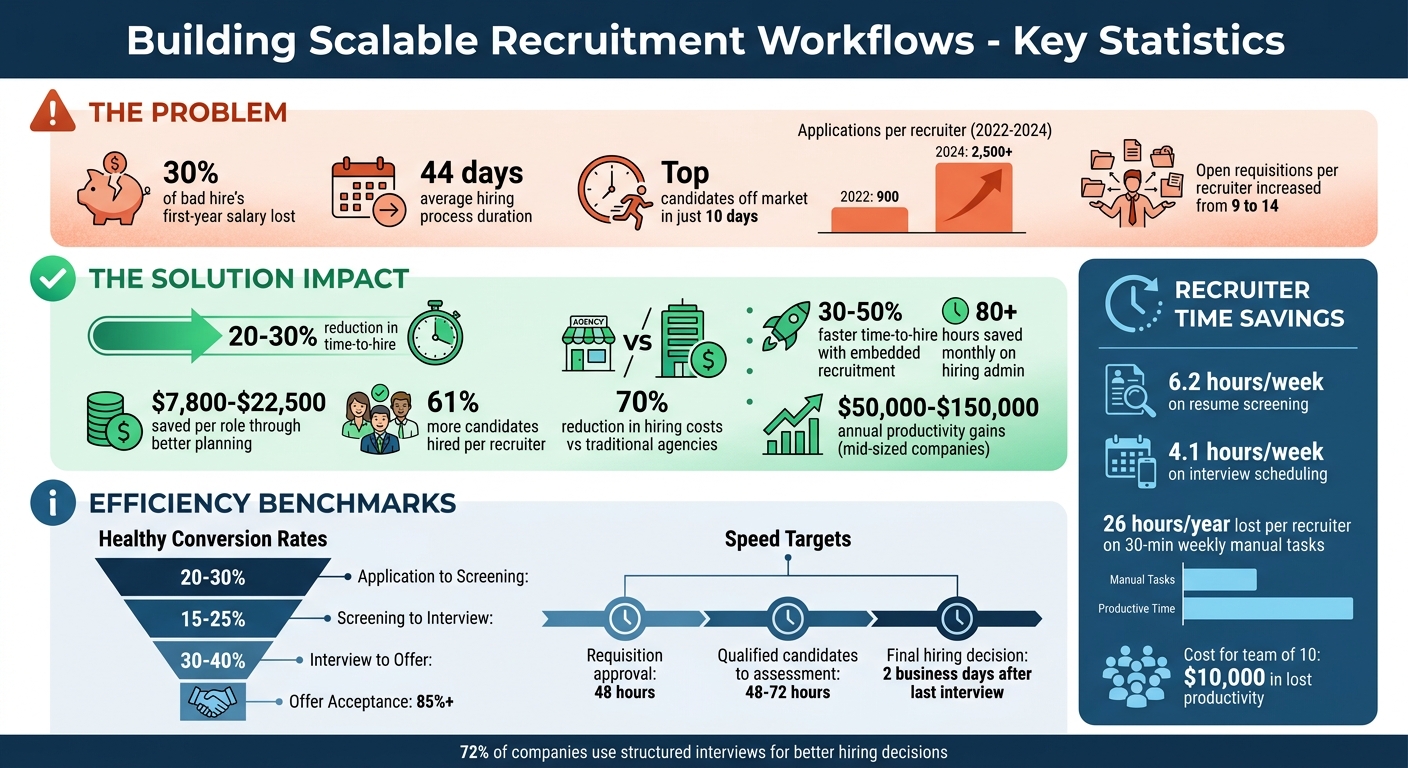
Key Metrics and ROI of Scalable Recruitment Workflows
How to Build a Structured Recruiting Process for Startups
sbb-itb-a23bd6a
Core Stages of a Recruitment Workflow
A recruitment workflow that scales effectively involves clear, structured stages designed to speed up hiring while maintaining quality [5].
Job Planning and Role Definition
Job planning sets the foundation for successful recruitment. It includes job analysis, working with department leaders to align on needs, and benchmarking compensation to attract the right candidates at the right price [7]. The best teams use standardized intake forms to gather role details, success metrics, and timelines before sourcing begins [8].
This structured approach isn’t just about clarity – it saves money. Companies that invest in thorough planning can save between $7,800 and $22,500 per role by avoiding costly mis-hires [7]. To keep things moving, setting a 48-hour service level agreement (SLA) for requisition approvals ensures no time is wasted before sourcing starts [5]. A clearly defined role is the first step toward a streamlined hiring process.
Candidate Sourcing and Screening
Once roles are well-defined, the next step is building a strong candidate pipeline. This involves proactive outreach, employee referrals, and leveraging AI tools to go beyond traditional job boards [7]. Automation plays a big role here, helping match candidates to roles without the need for manual searches.
Efficiency in screening is critical. A tiered process – starting with basic qualifications, followed by automated assessments, and ending with focused human review – ensures only the best candidates move forward. This approach aims to push qualified candidates to the assessment stage within 48–72 hours [5]. With top candidates often off the market in just 10 days, speed is everything, yet the average hiring process still takes 44 days [6].
Interviews, Evaluations, and Offer Management
Once candidates are identified, the focus shifts to structured interviews and fast offer management. Using standardized questions and scoring rubrics during interviews reduces bias and improves decision-making. In fact, 72% of companies now rely on structured interviews to make better hiring decisions [6]. For technical roles, automated assessments allow recruiters to evaluate skills at scale, saving time and effort.
Pre-approved salary bands streamline negotiations, cutting delays and enabling faster offers [5]. Final hiring decisions made within two business days after the last interview help maintain momentum [5]. As Paycor highlights:
"A structured hiring process helps employers attract better candidates, reduce time-to-fill, and stay compliant across every stage of recruiting" [7].
If your offer acceptance rate drops below 80%, it could signal issues like a slow process or a mismatch with market expectations [5].
| Stage | Key Action for Efficiency | Scalability Contribution |
|---|---|---|
| Planning | Standardized intake forms | Aligns stakeholders early to avoid mid-process changes [8] |
| Sourcing | AI-powered sourcing tools | Expands reach to passive talent pools automatically [7] |
| Screening | Automated skills assessments | Processes high volumes without extra recruiter hours [5] |
| Interviewing | Structured scorecards | Enables fast, data-driven decisions across teams [1] |
| Offer | Pre-approved salary bands | Speeds up verbal offers and reduces negotiation time [5] |
Key Components for Building Scalable Workflows
Creating workflows that can handle growth requires the right infrastructure. Between 2022 and 2024, the number of applications per recruiter surged by 177%, from 900 to over 2,500 [11]. During the same period, open requisitions per recruiter also increased from 9 to 14 [11]. Without the right tools and processes, these rising demands can lead to inefficiency and confusion. Below, we explore the essential components that support scalability in recruitment workflows.
Centralized Data and Automated Processes
Centralizing and automating processes is essential to managing growing recruitment volumes. At the heart of this setup is your Applicant Tracking System (ATS), which acts as the central hub for requisitions, candidate information, and compliance documents [10]. By storing everything in one place, an ATS eliminates the need for scattered spreadsheets or fragmented communication across platforms like Slack. This ensures everyone on the team has a clear view of the pipeline and candidate statuses, eliminating repetitive questions like, "What’s the update on that candidate?"
Automation tools add another layer of efficiency. For instance, GoodTime simplifies interview scheduling by automatically managing time zones and panel coordination, removing the need for endless email exchanges [11]. High-volume hiring benefits from AI screening tools like Tenzo AI, which use autonomous voice agents to handle thousands of initial interviews at once, solving the "first-round capacity" bottleneck [11]. Even small inefficiencies add up – recruiters spending just 30 minutes weekly on manual tasks lose roughly 26 hours annually, costing a team of 10 about $10,000 in productivity [10].
Customizable and Integrated Workflows
To scale effectively, workflows need to be both flexible and interconnected. Instead of creating unique processes for every team or department, focus on building "base workflows" that cover most hiring scenarios. These can then be adapted with additional modules – such as compliance checks or executive approvals – for specific needs [10]. This modular approach keeps processes adaptable without adding unnecessary complexity.
Integration is equally important. Your ATS should seamlessly connect with scheduling tools, job posting platforms, and onboarding systems. For example, multiposting tools automate job advertisements across multiple boards, increasing visibility without extra manual work [1]. When workflows are integrated, pre-hire data flows smoothly into onboarding systems, maintaining momentum all the way through the hiring process [10].
To ensure workflows remain relevant, continuous monitoring and updates are crucial. This keeps your system aligned with evolving recruitment needs.
Data-Driven Reporting and Continuous Optimization
Workflows should never remain static. If left unchanged, they can develop process debt, where outdated systems force recruiters to rely on manual workarounds [10]. To avoid this, schedule quarterly reviews to examine key metrics like time spent in each hiring stage. Gathering recruiter feedback during these reviews can help identify and resolve inefficiencies. Every day saved in filling a $100,000 role translates to over $400 in recovered productivity [10]. These efficiencies are further demonstrated in our embedded recruitment case studies.
Testing changes before implementation is another critical step. Use a sandbox environment to experiment with workflow updates without disrupting live operations [10]. If your ATS doesn’t offer a sandbox, create a separate test group within the system to safely trial adjustments [10]. Establish clear governance for workflow changes by categorizing them as "Minor" (handled by admins) or "Major" (requiring leadership and compliance review) to avoid unintended disruptions [10].
Steps to Build Your Recruitment Workflow
Designing a recruitment workflow that scales isn’t about copying what others do or squeezing your process into off-the-shelf software. It starts with understanding what’s actually happening in your hiring process – not just what the official documents say. Let’s break it down.
Assess Current Processes and Define Goals
Start by mapping out the real path a candidate takes from application to hire. Look at a recent hire’s journey in detail – from their first interaction to onboarding – to uncover the true flow of your process [3]. This analysis often reveals surprising inefficiencies, which you can identify by rating your recruitment process with a dedicated audit tool. For instance, recruiters spend an average of 6.2 hours a week screening resumes and 4.1 hours scheduling interviews [3]. On top of that, manual workarounds – like tracking candidates in Slack or Excel – can highlight gaps between your documented process and what’s really happening [10].
Keep an eye out for bottlenecks, such as candidates waiting too long for responses or low conversion rates at critical stages. Healthy benchmarks include:
- 20–30% conversion from application to screening
- 15–25% from screening to interview
- 30–40% from interview to offer
- Offer acceptance rates of 85% or higher [3]
If your numbers are falling short, it’s time to redesign. Bring your recruiting team together for a brainstorming session. Ask them, "If we were starting from scratch, what would the ideal process look like?" [10].
Select and Implement the Right Tools
"The biggest mistake companies make? Buying software first, then trying to force their process into it." – Augtal [3]
Your tools should support your workflow – not the other way around. Start with a solid Applicant Tracking System (ATS) that integrates with scheduling tools, job boards, and onboarding platforms. Before committing, test everything. Use a vendor-provided sandbox or a small test group within your ATS to refine workflows without disrupting active hiring [10].
Rather than creating unique workflows for every team, focus on 3–5 core workflows for categories like full-time, part-time, contractor, and internal hires [10]. Use features like conditional logic to handle variations while keeping the system streamlined. And don’t forget to document the reasoning behind each step – this ensures your process evolves without losing its purpose [10].
Once your tools are in place, make sure your team knows how to use them effectively.
Train Teams and Monitor Performance
Training isn’t just about how to use the tools; it’s about understanding why each step matters. When recruiters see the business logic behind the process, they’re better equipped to make smart decisions and spot areas for improvement [10].
Set up a governance system for updates. Small changes, like adding custom fields, can be handled by system admins. Larger changes – such as new integrations or compliance updates – should go through a committee that includes your Talent Acquisition leader, system administrator, and compliance officer [10].
Schedule quarterly reviews to evaluate key metrics like stage durations, manual overrides, and drop-off rates [10]. For a mid-sized company hiring 50 people annually, refining workflows can lead to $50,000–$150,000 in annual productivity gains [10].
Here are some metrics to keep an eye on:
| Metric | What It Reveals | Warning Sign |
|---|---|---|
| Time-in-Stage | Where candidates stall in your process | Any stage exceeding 48–72 hours [3] |
| Override Frequency | How often recruiters bypass steps | Frequent manual skips of required stages [10] |
| Drop-off Rate | Where candidates lose interest | Low conversion from interview to offer [3] |
| Source Effectiveness | Which channels produce hires | High application volume with zero hires [3] |
Using Embedded Recruitment for Scalability
What Is Embedded Recruitment?
Embedded recruitment changes the way businesses approach hiring. Instead of relying on external agencies, this model places experienced recruiters directly within your team. They join your stand-ups, work with your internal systems, and collaborate with hiring managers as if they were part of your core staff [12].
"Embedded recruiting is not just outsourced hiring with a shinier wrapper. It’s a fully integrated talent solution where recruiting professionals become part of your team. Not alongside it. Not supporting it. In it." – ZRG Partners [12]
This approach focuses on building a sustainable talent infrastructure rather than simply filling roles. While traditional agencies prioritise placements, embedded recruiters take a more comprehensive role, handling tasks like talent mapping, employer branding, and implementing talent acquisition strategies for growth [12]. Whether your company is in hypergrowth mode, expanding into new markets, or navigating layoffs, embedded recruiters adapt quickly, avoiding the delays often associated with external vendors [12].
Benefits of Embedded Recruitment for Scaling Companies
Embedded recruitment delivers tangible benefits that help businesses grow efficiently. For one, it can significantly cut costs. Traditional agency fees typically range from 15% to 25% of a hire’s first-year salary, but embedded recruitment can reduce hiring expenses by up to 70% [13]. Instead of unpredictable per-hire fees, you pay a consistent monthly rate.
Time is another major advantage. Embedded recruitment can shorten time-to-hire by 30–50% [14]. Structured role briefs alone can speed up time-to-offer by 24% on average [4]. Additionally, internal teams save over 80 hours each month on hiring and administrative work, giving leadership more bandwidth for strategic priorities.
Another key strength is the deeper understanding embedded recruiters develop of your company culture. This allows them to communicate it authentically to candidates. Research shows that 72% of candidates report a better experience when structured screening processes are used early in hiring [4]. Unlike traditional agencies that move on after filling a role, embedded recruiters stay focused on long-term success, ensuring quality and consistency in your hiring processes.
How Rent a Recruiter Supports Scalable Hiring
Rent a Recruiter integrates seamlessly into your team, offering the expertise and structure needed for scalable hiring. Within days, experienced recruiters are embedded into your workflows, managing everything from sourcing to onboarding. Whether you’re scaling after securing funding, launching a new product, or dealing with a hiring surge, this model provides the flexibility and speed your business needs.
The pricing model is simple: fixed monthly fees replace unpredictable per-hire commissions. This makes it an ideal solution for high-growth companies in sectors like technology, SaaS, fintech, engineering, and professional services. Some businesses use Rent a Recruiter for short-term hiring goals, while others rely on it as a long-term partner to build a scalable recruitment function aligned with growth objectives.
Embedded recruitment also addresses a common challenge for in-house teams. Managing 30 to 50 open roles simultaneously often stretches internal recruiters thin [13]. Instead of adding permanent headcount or juggling multiple agency contracts, embedded recruitment provides the extra capacity you need without the added complexity [13].
Measuring Success and Optimizing Workflows
Key Metrics to Track Recruitment Efficiency
Tracking the right metrics transforms recruitment from a guessing game into a strategic advantage. 82% of companies acknowledge the critical role of data in talent acquisition decisions [15], yet many still focus on the wrong metrics or fail to act on their findings.
Start with velocity metrics like Time to Hire and Time to Fill. Time to Hire measures how quickly candidates move through your recruitment funnel, while Time to Fill captures the total days from posting a role to securing an accepted offer. Considering the average cost per hire across industries is $4,129 [16], tracking Cost per Hire is equally important. These metrics help you determine whether your recruitment workflow is streamlined or wasting resources.
Next, explore scalability metrics to assess your team’s ability to handle growth. Metrics like Recruiter Capacity, Fill Rate, and Sourcing Channel Effectiveness are key here. For instance, leveraging automation in high-volume hiring can boost recruiter capacity from managing 30–50 candidates per week to 120–160 [2]. But this is only possible if you’re actively measuring recruiter output.
Speed is important, but quality is non-negotiable. A bad hire can cost up to 30% of the employee’s first-year salary [17]. Monitor Quality of Hire through metrics like performance ratings, First-Year Attrition, and Offer Acceptance Rates. If your Offer Acceptance Rate drops below 85%, it may signal issues with compensation, role clarity, or candidate experience [3]. These metrics ensure that your efforts to scale don’t come at the expense of hiring standards.
Lastly, identify bottlenecks by tracking time spent at each step of your process. For example, if candidates wait more than 48 hours between screening and interviews, or if your Application Completion Rate is unusually low, you’ve uncovered inefficiencies. In high-volume hiring, 85–90% of applicants often prove to be poor fits [2], making early-stage screening a critical area to optimise.
By focusing on these metrics, you can balance efficiency with quality, setting the stage for scalable growth.
Strategies for Continuous Improvement
Metrics are just the beginning – continuous improvement keeps your recruitment process effective as your business evolves. Regular audits and feedback loops are essential. Start by mapping the journey of a recent hire. Follow every email, handoff, and update to pinpoint delays or unexpected drop-offs in the process.
Use conversion benchmarks to identify weak spots in your pipeline. For instance, if your application-to-screening conversion rate falls below 20–30%, or your screening-to-interview rate is under 15–25%, it’s time to investigate. Low early-stage conversion might indicate that your job descriptions are attracting unsuitable candidates, while poor interview-to-offer rates could highlight inefficiencies in your screening process.
"If your recruiters are constantly switching between prospecting, selling, scheduling, and reporting, you’re losing on quality output." – Ayusmita, B2B Storyteller, Recruiterflow [9]
Streamline workflows by automating repetitive tasks. Automating tasks like application confirmations, status updates, and interview reminders allows recruiters to focus on relationship-building and sourcing top talent strategically.
Gather feedback directly from candidates to uncover hidden inefficiencies. Survey both successful and unsuccessful candidates, asking them to rate your process on a scale of 1 to 10. Any score below 8 signals a potential problem [3]. This kind of feedback can reveal overlooked issues, such as confusing application steps or slow responses.
Finally, treat your recruitment system as a dynamic tool that evolves with your needs. Review its performance quarterly, and ensure it remains the central source of truth for placement data and metrics. Make system adoption a priority by tying it to visibility – when recruiters know their work is only recognized if it’s tracked, adoption becomes second nature.
Conclusion and Next Steps
Key Takeaways for Scalable Recruitment
Building scalable recruitment workflows turns chaos into a streamlined process. By consolidating candidate data, automating repetitive tasks, and monitoring essential metrics, you move from a reactive approach to a structured system with clear accountability at every step. This shift often distinguishes companies that grow efficiently from those that overburden their teams [8].
Three core principles stand out: centralize all candidate data to eliminate redundancy, automate repetitive tasks like screening and scheduling while leaving room for human interaction where it matters, and track key metrics to pinpoint and fix bottlenecks before they cause delays.
"A well-oiled recruiting workflow is not just about efficiency; it’s the invisible force that drives consistent hiring success, elevates the candidate experience, and ultimately shapes the quality of your organization’s talent." – Loxo [18]
The most successful companies don’t just adopt tools – they refine their processes continuously. By analyzing the hiring journey of recent recruits, they identify and resolve inefficiencies. For example, if your screening-to-interview conversion rate drops below 15–25% or your offer acceptance rate falls under 85%, these are clear signals of areas needing attention [3]. Applying these principles can help you build a recruitment process that supports sustainable growth.
Call-to-Action: Book a Call with Rent a Recruiter
Turn these insights into action and streamline your hiring process today. Whether you’re scaling after a funding round, launching a new product, or facing a surge in hiring needs, building this structure from scratch can be a daunting task. Rent a Recruiter offers a solution by embedding skilled recruiters directly into your team within days, delivering the efficiency and structure that high-growth companies require.
Companies using embedded recruitment often cut hiring costs by up to 70% compared to traditional commission-based models and save over 80 hours of internal hiring and admin time every month. Whether you need short-term support or a long-term solution, Rent a Recruiter helps you scale your hiring without the burden of assembling a full in-house team.
Ready to improve your recruitment process? Book a call with Rent a Recruiter and see how embedded recruitment can help you scale with ease and efficiency.
FAQs
What should I automate first in my hiring workflow?
Start by taking a close look at your current hiring process. Identify where things slow down or where repetitive manual tasks are eating up time. Activities like data entry, interview scheduling, and candidate follow-ups are prime candidates for automation. By focusing on these areas, you can cut down on errors, save valuable time, and accelerate your hiring timeline. This initial step not only delivers quick wins but also sets the stage for more advanced automation down the line.
Which recruiting metrics matter most as we scale?
As your company grows, keeping an eye on key recruiting metrics is essential to maintain efficiency and support your expansion. Start with time-to-fill and cost-per-hire – these measure how quickly you can fill roles and how much it costs to do so. Both are critical for balancing speed and financial efficiency.
Beyond that, metrics like source of hire, quality of hire, and offer acceptance rate reveal how well your recruitment strategies align with your talent needs. They help you understand which channels bring in the best candidates and whether those candidates meet your business expectations.
For process optimization, focus on pipeline conversion rate and interview-to-offer ratio. These numbers shed light on how smoothly candidates move through your hiring funnel and where potential bottlenecks might exist. By tracking these, you can streamline your workflows and secure top talent faster.
When does embedded recruiting make sense for my team?
Embedded recruiting shines when your business is scaling quickly, juggling multiple open roles, or facing challenges with maintaining a smooth and reliable hiring process. It’s particularly effective when you need recruiters who can fully integrate into your team, align with your objectives, and introduce the structure needed to make hiring scalable. This approach is especially valuable during high-growth phases or when launching new products.