
Poor onboarding costs you money fast, often within the first 90 days.
If you are scaling in SaaS, tech, fintech, engineering, security, insurance, or professional services, the fix is simple in principle: map the process, standardise the repeatable parts, assign owners, automate admin, and track a small set of business metrics. Done well, this cuts wasted manager time, lowers early turnover, and helps new hires contribute sooner.
Here is the short version:
- Ad hoc onboarding does not scale. It leads to missed handoffs, delayed access, uneven manager support, and slow ramp time.
- A repeatable onboarding system gives you control. You can run the same core process across low and high hiring volume. This is how companies like Unique scale globally while maintaining process integrity.
- Clear ownership matters. HR, hiring managers, IT, and team leads each need set tasks and due dates.
- Measurement matters. Track 90-day retention, time to productivity, task completion, and new-hire confidence.
- The recruiting handoff matters too. If role details, success measures, and setup needs are incomplete at offer stage, onboarding starts behind.
A few numbers make the business case clear. Around 24% of employees leave within the first 90 days, while structured onboarding can improve new-hire retention by up to 82%. In the U.S., replacing an employee often costs 20% to 40% of salary (you can calculate hiring cost savings to see the impact), so losing an $80,000 hire can cost $16,000 to $32,000.
Below, I break down what this looks like in practice, from process mapping and first-week structure to ownership, systems, and review cadence.
The SME Advantage: Mastering onboarding for growth
sbb-itb-a23bd6a
Assess your current onboarding process before you scale it
If you want to cut onboarding costs, start by writing down how the process works today. In a lot of SMEs, onboarding still depends on the manager. One team does it one way, another team does it another way, and HR ends up filling gaps as they appear.
That might work when you’re making the odd hire. It starts to cost you once hiring volume picks up.
Map every step from offer acceptance to Day 90
List every step from offer acceptance through Day 90. Don’t tidy it up yet. Just record what happens now.
Include everything: contract completion, background checks, laptop and account setup, policy acknowledgements, manager introductions, first-week training, goal-setting, check-ins, and productivity milestones.
Split the process into five phases:
- Pre-boarding
- Days 1 to 7
- Days 8 to 30
- Days 31 to 60
- Days 61 to 90
For each task, record the owner, timing, handoff point, and scope.
This matters when you scale because not every task should sit with the same team. Universal tasks such as I-9 and W-4 completion, payroll setup, system access, employee handbook review, and company culture orientation apply to everyone. Role-specific tasks such as sales tool training, engineering environment setup, customer support scripts, or leadership expectations should sit with the department or function.
That split keeps HR focused on the baseline. It keeps managers focused on the training that drives job performance.
Once the map is in place, track average completion times for each milestone. If system access takes five business days and your target is two, you’ve found a clear bottleneck. That kind of delay doesn’t just frustrate new hires, it slows productivity and adds hidden cost.
Find gaps in ownership, timing, and consistency
The same issues show up again and again: late system access, missing equipment, unclear first-week plans, irregular manager check-ins, and uneven training. Most of these problems show up in the first week, then carry into Day 30.
Look at the handoffs closely. Who owns onboarding after HR orientation ends? Do all new hires get the same core company experience, no matter which team they join?
If the answer depends on the manager, that’s the gap to fix before you add more hiring volume.
These gaps lead to uneven ramp times and mixed outcomes across hires. One person gets up to speed fast. Another loses a week waiting for tools, direction, or support. Over time, that hits manager time, team output, and retention.
| Area | Ad hoc onboarding | Scalable onboarding |
|---|---|---|
| Consistency | Varies by manager or team | Standardized core experience |
| Admin workload | High manual coordination | Reusable templates and workflows |
| Manager clarity | Unclear responsibilities | Defined owners and due dates |
| New-hire experience | Uneven and confusing | Consistent and clear |
| Visibility | Minimal | Trackable metrics and milestones |
Scalability isn’t just about speed, it’s about repeatability and visibility. A process that works for one hire but starts to crack when hiring volume grows isn’t built to scale.
Set measurable onboarding targets
Once you’ve mapped the workflow, define what it needs to deliver. Track 90-day retention, time to productivity, task completion rates, and new-hire confidence at Day 7, Day 30, and Day 90.
Set phase-based benchmarks:
- By Day 7: full access, completed paperwork, and clear priorities
- By Day 30: core training complete and one manager review
- By Day 90: measurable contribution and defined next-step goals
A simple confidence score can also tell you a lot. Ask new hires to rate their confidence in succeeding on a 1 to 5 scale at each checkpoint. That gives you a human signal alongside task completion data.
When confidence drops between Day 7 and Day 30, it often points to weak manager support or unclear role goals. Both can be fixed, but only if you can see where the process starts to slip.
Build a repeatable onboarding framework for any role or hiring volume
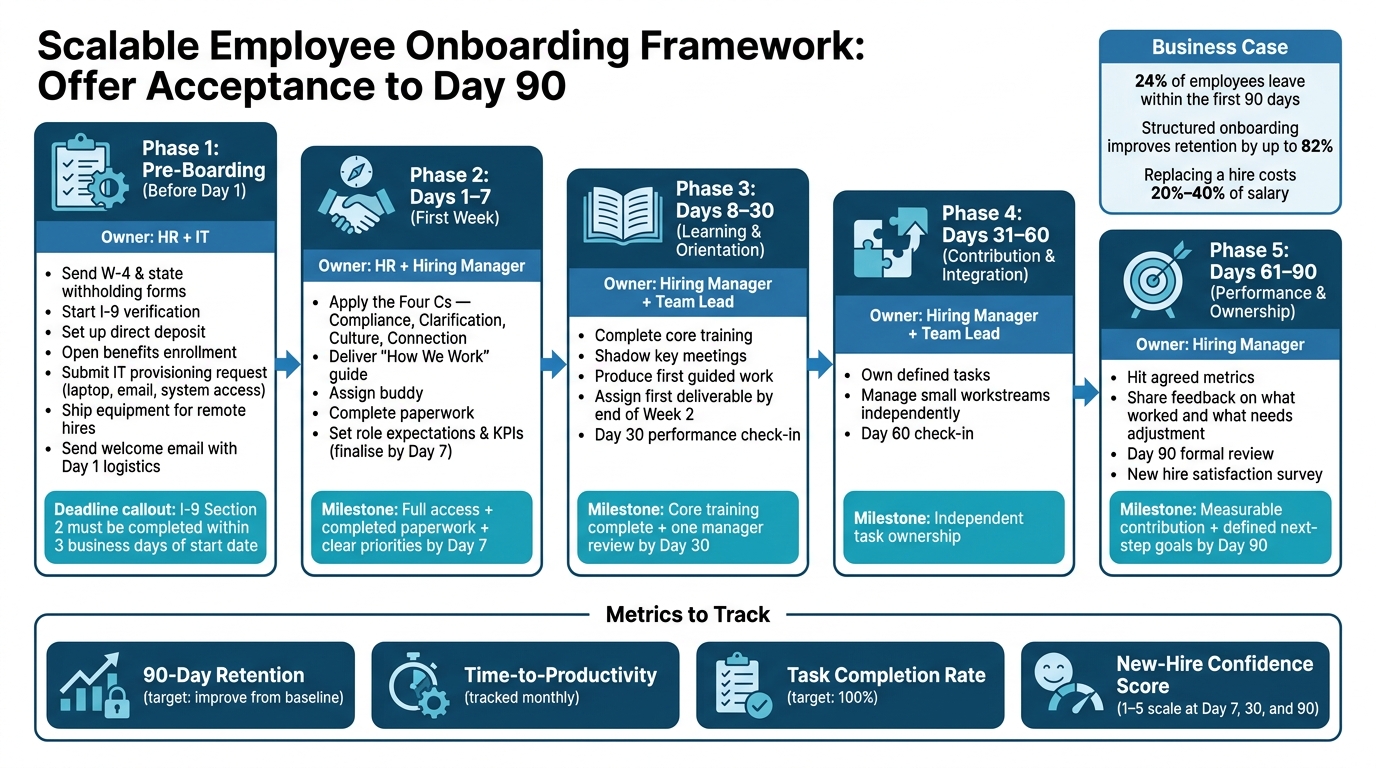
Scalable Employee Onboarding Framework: From Offer to Day 90
Once you know where your process starts to slip, put a simple, documented onboarding framework in place.
Keep one core process for every hire. Then add role-specific steps only where the job changes the work.
That gives you consistency across hiring volumes without turning onboarding into admin overload. It also makes ownership clear. Each phase should have one owner, one deadline, and one measurable output.
Use one core process for every hire, then layer in role-specific tasks only where they change the work.
Pre-boarding: complete critical setup before Day 1
Pre-boarding should cover everything that can be finished before Day 1.
That includes sending and collecting the federal Form W-4 and any required state withholding forms, starting Form I-9 employment eligibility verification, setting up direct deposit, and opening benefits enrollment with a deadline [2][3]. Section 2 of Form I-9 must be completed within three business days of the start date [2][3].
On the IT side, submit provisioning requests early enough so the new hire’s laptop, email, and system access are ready before Day 1. For remote employees, ship and configure equipment in advance.
If access or equipment is missing on Day 1, you’re paying for time the new hire can’t use well. That slows ramp-up and puts extra pressure on managers and IT.
Finish pre-boarding with a welcome email that covers first-day logistics: start time, who to contact, what to bring, and what the first week looks like.
Once paperwork and access are done, week one should focus on clarity, culture, and connections.
First week: give new hires clarity on role, tools, culture, and connections
Use the Four Cs, Compliance, Clarification, Culture, and Connection, to shape week one.
This keeps the first few days from becoming a random mix of meetings, links, and policy documents.
Culture should include a short "How We Work" guide covering communication norms, decision-making style, and meeting etiquette. Connection should mean planned introductions and a buddy, not a mass email.
The goal in week one is simple: help the new hire understand how work gets done, who matters, and what good looks like.
After week one, shift the manager’s focus from orientation to measurable output.
Days 1–90: move from orientation to measurable output
The 30–60–90 day plan is the backbone of this phase. Each stage has a clear focus:
| Phase | Focus | Example milestones |
|---|---|---|
| Days 1–30 | Learning and orientation | Complete core training, shadow key meetings, produce first guided work |
| Days 31–60 | Contribution and integration | Own defined tasks, manage small workstreams independently |
| Days 61–90 | Performance and ownership | Hit agreed metrics and share feedback on what worked and what needs adjustment |
Start with a company-wide baseline, HRIS access, core policy and security training, and stakeholder introductions. Then add role-specific checklists for each job family.
Store these centrally so teams can reuse them and update them in one place. That cuts duplicated effort and makes onboarding easier to run at scale. For many SMEs, integrating talent acquisition services ensures these frameworks are built into the hiring process from the start.
Use Day 30, 60, and 90 check-ins to keep the plan on track. Use the check-ins to review the Day 7, Day 30, and Day 90 targets already set.
Put onboarding into practice with systems, ownership, and process alignment
Once the process is set, the next step is simple: make it run without constant chasing. Your onboarding framework should become a repeatable workflow, not a string of manual follow-ups.
Standardize templates, workflows, and reminders
Move checklists and task assignments into your HRIS or project management tool. When a new hire record is created at offer acceptance, the system should trigger pre-boarding tasks, notify IT to start provisioning, and set compliance deadlines on its own.[4][5]
Put that framework into one workflow so it runs the same way every time. Automated reminders take care of follow-up. HR gets alerts when compliance documents are overdue. Managers get prompts to schedule check-ins and assign early deliverables. IT gets notified before Day 1 to finish equipment and access setup.
Use one shared dashboard so HR, IT, and managers can see delays before Day 1, not after it.[4][8][9]
Assign clear ownership across HR, hiring managers, IT, and team leads
Dropped tasks usually come back to one issue: no clear owner. If nobody owns a step, it often gets missed. Every part of onboarding needs a named owner and a fixed deadline.
The table below maps the main steps so you can slot it straight into your onboarding playbook.
| Onboarding Component | Primary Owner | Deadline |
|---|---|---|
| Offer letter & acceptance | HR | At offer stage |
| Background check | HR | Before Day 1 |
| I-9 verification & W-4 completion | HR | I-9 by Day 3; W-4 before first payroll |
| Equipment ordering | IT | 5 business days before Day 1 |
| Email & system access setup | IT | 2 business days before Day 1 |
| Welcome email & Day 1 agenda | HR | 2 to 3 business days before Day 1 |
| Role expectations & KPIs | Hiring Manager | Discuss Day 1, finalise by Day 7 |
| Initial training schedule | Hiring Manager / Team Lead | Plan by Day 3, start by Day 5 |
| First deliverable or project | Hiring Manager / Team Lead | Assign by end of Week 2 |
| Day 30 performance check-in | Hiring Manager | By Day 30 |
| New hire satisfaction survey | HR | Around Day 30 and Day 90 |
| Day 90 formal review | Hiring Manager | By Day 90 |
Embed this table into your HRIS workflow and share it during manager onboarding sessions. When everyone can see what they own and when it is due, missed steps are far easier to stop.[6][9][10]
Align recruiting handoff and onboarding with support from Rent a Recruiter
Even with clear ownership, one risk still causes problems: a poor recruiting handoff. If the move from recruiting to HR is incomplete or inconsistent, onboarding ends up filling in the gaps. That costs time and creates confusion from the start.
Recruiters should pass over a standard handoff package at offer acceptance. That should include the confirmed start date, role profile, success metrics, tool and access needs, and any candidate-specific context such as training needs or remote work arrangements. With that in place, onboarding workflows can start at once, and HR and managers do not need to rebuild role expectations after the hire is made.[4][10]
Rent a Recruiter helps scaling SMEs keep the recruiting-to-onboarding handoff structured, visible, and consistent.[7]
Measure results, improve the process, and scale with confidence
Track the metrics that show onboarding is working
Once you’ve set onboarding targets, the next step is simple: track a small scorecard that tells you if the process is doing its job.
Focus on a mix of leading and lagging indicators. Leading indicators include task completion, tool access, and early satisfaction. Lagging indicators include retention and time-to-productivity. Used together, they show what’s happening now and whether onboarding is driving better business results over time.[11][12][13]
Start with your baseline. Then set specific targets with a clear timeframe, tied back to business outcomes like retention, ramp time, and manager load.[11][12][13]
| Metric | Baseline | Target | Review Frequency | Data Source |
|---|---|---|---|---|
| 90-Day Retention | Current % | Improve from baseline | Quarterly | HRIS / Payroll |
| Six-Month Retention | Current % | Improve from baseline | Quarterly | HRIS / Payroll |
| Time-to-Productivity | Current days | Defined by role | Monthly | Output tracking |
| New-Hire Satisfaction | Survey score | Improve from baseline | Monthly | Day 30 / Day 90 surveys |
| Manager Satisfaction | Survey score | Improve from baseline | Monthly | Manager check-in surveys |
| Task Completion Rate | % complete | 100% | Monthly | HRIS / Onboarding checklist |
A good scorecard does two things. It shows where the process is slipping, and it gives you a clear way to prove whether onboarding is cutting ramp time, easing admin, and helping new hires settle into the role faster.
Use monthly and quarterly reviews to improve the system
A scorecard only helps if you review it on a fixed cadence. The point of these reviews is to spot problems in ownership, timing, and consistency before they turn into bigger issues.
Monthly reviews should focus on day-to-day performance. Look at task completion rates, first-30-day survey feedback, manager comments, and any bottlenecks in the first few weeks. If completion drops, fix the handoffs. If satisfaction falls, look at role clarity, manager support, or tool access.
Quarterly reviews should look at the bigger picture. Review patterns across teams and roles, including retention, time-to-productivity, and consistency across the onboarding experience. Use that data to update manager playbooks, trim checklists, revise training content, and tailor role-based plans where needed. Give each review a single owner, so actions don’t stall after the meeting.[1][14][15]
This is where onboarding shifts from admin to performance management. You’re not just checking whether tasks got done. You’re checking whether the system is helping people get productive, stay longer, and put less pressure on managers and HR.
Conclusion: Build onboarding that supports growth, not admin overload
Once onboarding is live, the work becomes keeping it visible and improving it on a regular basis.
The core principle running through this entire guide is straightforward: map the process, standardise what repeats, assign clear owners, automate where it makes sense, and measure outcomes that matter to the business.
Onboarding is an operating system, not a one-time event. When it’s documented and repeatable, it supports growth at scale. Managers spend less time repeating ad hoc explanations. HR spends less time chasing missing tasks. New hires get productive in less time.
For SMEs growing fast, the handoff from recruitment into onboarding also needs to stay tight. Structured hiring and structured onboarding need to work together. If that handoff breaks, gaps at the start can undo the work that follows. If you need more hiring capacity or a steadier handoff into onboarding, Rent a Recruiter can help.
FAQs
How do I know if our onboarding process is broken?
Look closely at your key hiring indicators and early warning signs.
A major red flag is a 90-day retention rate below 80%. It’s even more serious if more than half of new hires leave within that period. At that point, the cost isn’t just turnover. You’re losing manager time, team output, and money spent on hiring people who never get up to speed.
The warning signs usually show up before attrition does. You might see slow productivity, frequent errors, missed service-level agreements, and managers re-teaching basic tasks instead of moving work forward. New hires may also feel unclear about role expectations, which often leads to poor performance and early exits.
If those patterns keep showing up, the issue usually isn’t one bad hire. It’s a hiring and onboarding process that isn’t setting people up to perform.
What should we automate first in onboarding?
Start with admin work before the new hire’s first day:
- Compliance paperwork, such as W-4 and I-9 forms, with e-signatures
- Provisioning systems, hardware, and account access
- Scheduling 30-, 60-, and 90-day milestone reviews
This cuts manual errors, helps you avoid federal fines, gets the new hire set up for day one, and keeps manager check-ins on track.
Who should own onboarding across HR, IT, and managers?
Onboarding works best when each team owns a clear part of the process. That removes confusion, cuts delays, and helps new hires get up to speed without putting all the pressure on one person.
- Manager: owns the 30-60-90-day plan, role expectations, goals, and weekly one-on-ones
- HR: owns program design, culture, benefits, payroll, and compliance
- IT/Admin: owns hardware, email, and system access
- Peer buddy: gives informal guidance on company norms
When this split is clear, you get a smoother start for new hires and less back-and-forth across the business.