
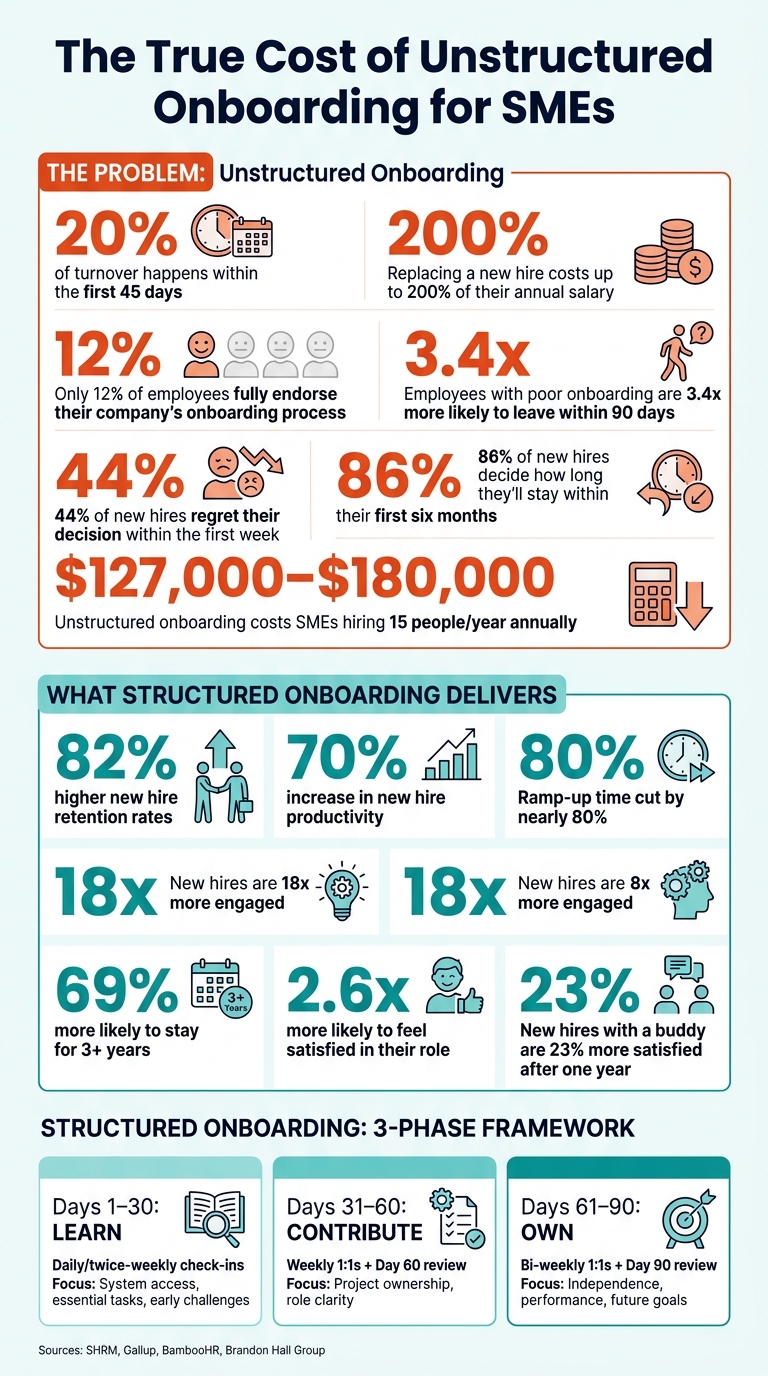
Structured onboarding isn’t just a process; it’s a business advantage. SMEs that neglect onboarding often face high turnover, slow productivity, and increased costs. In fact, replacing a new hire can cost up to 200% of their annual salary, and 20% of turnover happens within the first 45 days. A structured approach solves these issues, helping new hires become productive faster and stay longer.
Key Takeaways:
- Retention boost: Firms with strong onboarding see 82% higher retention rates.
- Productivity gains: A structured process increases new hire productivity by 70%.
- Cost savings: Avoid turnover costs that can drain $127,000–$180,000 annually for SMEs hiring 15 people a year.
The solution? A clear 30-60-90 day plan, pre-boarding preparation, and consistent check-ins. Companies like Rent a Recruiter can bridge hiring and onboarding, ensuring seamless transitions and measurable results.
The True Cost of Unstructured Onboarding for SMEs
Employee Onboarding: Key to Long-Term Success & Retention
sbb-itb-a23bd6a
The Hidden Costs of Unstructured Onboarding
Most onboarding problems don’t surface immediately. They creep in over time through missed steps, vague expectations, and small coordination failures. By the time a manager steps in, the damage is often done, and the new hire is already disengaged.
Inconsistent Handoffs and Unclear Roles
Onboarding is a shared responsibility across HR, IT, finance, and hiring managers. Each team has a role to play, and their efforts need to follow a specific sequence. Without a clear structure, this coordination often falls apart. Tasks are either delayed or skipped entirely, leaving gaps in the process.
Take system access as an example. HR might assume the manager is handling it, while the manager assumes HR has it covered. The result? New hires end up without the tools they need to start working effectively [3].
"Onboarding breaks when accountability is centralized but execution is distributed." – Amy Vidor, Synthesia [3]
These small lapses can have a big impact. They create early frustrations and doubts, which can snowball into disengagement.
Consider this: in March 2026, a newly hired account manager at a 28-person marketing agency in Portland spent nearly half of her first two weeks waiting for access to essential tools. The delay happened because HR and IT failed to coordinate. The cost? About $4,200 in lost productivity. By her eighth day, she was already questioning whether she’d made the right decision to join the company [5].
These kinds of coordination issues don’t just slow down progress; they send a clear signal of disorganization to new hires.
How Poor Onboarding Drives Early Turnover
When onboarding starts off on the wrong foot, the negative effects on retention are hard to ignore. Employees who go through poor onboarding are 3.4x more likely to leave within 90 days [5].
The risk of turnover is especially high during the second and third weeks, as the initial excitement of a new job begins to fade. If the onboarding experience doesn’t match what was promised during the hiring process, trust starts to erode. Gaps like unclear expectations, lack of feedback, or an absent manager can quickly lead to disengagement.
"This silence isn’t a sign of competence; it’s a sign of disengagement. The first two weeks are a blur of adrenaline, but once the dust settles, the doubt creeps in." – CrewHR Resources [6]
The financial impact of poor onboarding is staggering. For a small or medium-sized business hiring 15 people a year, unstructured onboarding can result in $127,000 to $180,000 in preventable turnover costs annually [5]. And that’s before factoring in the time and effort spent re-hiring and re-training for the same position.
The pattern is clear: 86% of new hires decide how long they’ll stay with a company within their first six months [9]. Unstructured onboarding doesn’t just slow down productivity – it actively drives employees out the door.
The Key Components of a Structured Onboarding Program
Laying the groundwork for scalable onboarding is critical for long-term success. Here’s how to ensure your program is designed for impact.
Pre-Boarding: Setting the Stage Before Day 1
Pre-boarding bridges the gap between offer acceptance and the new hire’s first day. The aim? Eliminate unnecessary hurdles so Day 1 can focus on connections, not admin.
Start by handling all essential paperwork ahead of time. Collect tax forms (W-4, I-9 Section 1), direct deposit information, and NDAs digitally. For remote hires, ship their laptop 2–3 days before their start date. Pre-configure tools like email, Slack, and project management software so they’re ready to dive in right away.
Send a detailed first-day agenda 3–5 days before they start. Include meeting times, links, and any materials they’ll need. This small step reduces the anxiety many new hires feel as they prepare for their first day [12].
"With our highest area of attrition being within the first six months, we couldn’t afford not to review the preboarding experience." – Georgina Huntley, Head of Employee Career & Development, ManpowerGroup UK [7]
Assigning a peer buddy can make a significant difference. Research shows that new hires with a formal buddy are 23% more satisfied with their onboarding experience after one year [12].
Day 1: Focus on Connection and Clarity
Building on a strong pre-boarding process, Day 1 is about making the new hire feel welcome and confident in their decision to join.
"Day one is not an orientation day. It is a relationship day." – FirstHR [13]
Start with a warm welcome and ensure all systems are functioning. Provide a concise company overview (no more than 90 minutes) that ties their role to the broader mission. Walk them through essential tools, assign a starter task, and end the day with a 1:1 check-in.
The starter task is more impactful than it might seem. It boosts confidence and gives the new hire a sense of early contribution. This is crucial, as 44% of new hires report regretting their decision within the first week [6]. A quick win can help turn that around.
"The goal for day one is not to transfer maximum information – it’s to make the new hire feel welcomed, clear on what they’re doing tomorrow, and confident they made the right choice." – Maya Patel, Editor, PeopleOpsClub [14]
Ongoing Check-ins and Feedback Loops
Effective onboarding doesn’t stop after Day 1. Consistent follow-up is key to retaining new hires and ensuring their success.
Regular check-ins are vital. 20% of employee turnover occurs within the first 45 days [2][6], often due to issues that could have been addressed with early intervention.
- Week 1: Daily 15-minute check-ins catch any blockers or concerns right away.
- Weeks 2–4: Twice-weekly touchpoints help new hires navigate the "Doubt Dip", a period when initial enthusiasm may wane.
- Months 2–3: Weekly 1:1s support the shift from learning to contributing.
Formal milestone reviews at 30, 60, and 90 days anchor the process. These aren’t just performance evaluations – they’re an opportunity to adjust expectations, address concerns, and ensure the new hire is on track. Companies that implement this structure report 82% better new hire retention and 70% higher productivity compared to those that don’t [2][12].
| Phase | Timeline | Check-in Cadence | Focus |
|---|---|---|---|
| Learning | Days 1–30 | Daily (Week 1), then twice weekly | Essential tasks, system access, early challenges |
| Contributing | Days 31–60 | Weekly 1:1s + Day 60 review | Project ownership, role clarity |
| Owning | Days 61–90 | Bi-weekly 1:1s + Day 90 review | Independence, performance, future goals |
The Business Impact of Structured Onboarding
Structured onboarding isn’t just a nice-to-have; it delivers measurable results that directly impact your business.
Faster Time-to-Productivity
On average, new hires without a structured onboarding process don’t hit full productivity until their fifth or sixth month on the job [15]. For scaling SMEs, that kind of delay can be costly. A structured onboarding program can increase productivity by over 70% and cut ramp-up times by nearly 80% [2][16][1].
By guiding new hires through distinct phases – Learning, Contributing, and Owning – structured onboarding ensures they hit clear milestones at each stage. Pre-boarding takes care of admin tasks before Day 1, freeing up the first week for role-specific activation instead of drowning in paperwork.
"Organizations that treat onboarding as a structured, measurable system consistently outperform those that approach it as a checklist." – Dipti Pawar [15]
But it’s not just about getting new hires up to speed faster. A structured approach also drives stronger engagement and retention.
Better Engagement and Retention Rates
The first 45 days are critical – 20% of turnover happens during this window [1]. A well-structured onboarding process is your best chance to secure long-term retention.
Employees who experience structured onboarding are 18 times more engaged and 69% more likely to stay with your company for at least three years [8][2]. They’re also 2.6 times more likely to feel satisfied in their new role compared to those onboarded through an unstructured process [11]. This not only reduces turnover costs but also helps you build a more committed, high-performing team.
Scalability for Growing Teams
As you navigate hiring as you scale, the need for a scalable onboarding process becomes clear. Without structure, onboarding can become inconsistent, with knowledge trapped in silos and processes reinvented for each new hire.
A standardized onboarding framework solves this by creating repeatable processes. Whether you’re onboarding two employees or twenty, everyone receives the same training, compliance guidance, and role clarity [1][11]. Managers can lean on established playbooks while automated workflows handle repetitive tasks like setting up accounts, collecting documents, and assigning training modules – lightening the load for your HR team.
"Onboarding is no longer just about welcoming employees; it is about constructing a repeatable, data-informed system that reliably converts talent into high-performing, culturally aligned contributors at scale." – BusinessReadr [4]
How to Build a Structured Onboarding Program in Your SME
Understanding why structured onboarding matters is one thing. Putting it into action is another. The good news? You don’t need a massive HR team or fractional recruitment services to make it work. By following a clear framework with consistent workflows and defined responsibilities, you can boost productivity and improve retention – while avoiding the pitfalls of unstructured onboarding.
Standardizing Pre-Boarding and First-Day Workflows
The time between offer acceptance and Day 1 is critical, yet it’s often mishandled. Half of all candidates who accept job offers risk backing out before their first day if they aren’t engaged during this pre-boarding phase [19]. A simple communication plan can make all the difference. Start with a "what to expect" email within 24 hours of signing, followed by a personal note from their manager the day before they start [19][6]. These small gestures keep new hires confident and committed.
Streamline compliance by collecting federal and state forms (like I-9, W-4, and direct deposit) digitally before Day 1. This can save up to 90 minutes, allowing the first day to focus on introductions, company culture, and role context [18].
"Preboarding is the runway before the plane takes off. It is not orientation. It is not training. It is the logistical and emotional preparation that makes Day 1 productive rather than chaotic." – FirstHR [19]
For Day 1, consider this structure: complete compliance tasks in the first 90 minutes, then move on to a manager 1:1, a team lunch, and a walkthrough of the role. By front-loading paperwork, you can spend the rest of the day on activities that help the new hire feel welcomed and informed [18].
Once the basics are covered, the focus shifts to setting clear expectations and goals.
Defining Role Expectations and Milestones
One of the top reasons new hires disengage early is unclear expectations. The solution? A 30-60-90 day roadmap built around SMART goals for each phase [2]. Break onboarding into three phases – Learn (Days 1–30), Contribute (Days 31–60), and Own (Days 61–90) – with specific, measurable goals at every stage [17][2]. Each phase should culminate in a milestone, such as explaining the role independently, completing work with minimal guidance, or fully owning responsibilities.
For instance, a goal might be: "Complete product training and pass certification with 80% or higher by Day 30." This provides a clear target for the new hire and an objective benchmark for the manager’s 30-day check-in. During this check-in, ask the new hire to rate their preparedness on a scale of 1–10. If they score below 6, it’s a clear signal to provide additional support [16][18].
Assigning Clear Ownership Across Teams
Even with standardized workflows and clear goals, onboarding often fails at the handoff points – whether it’s from recruiting to HR, IT to the manager, or the manager to the new hire [3]. The fix? Assign explicit ownership for each phase of onboarding, often managed through an embedded recruitment service.
| Stakeholder | Primary Responsibilities |
|---|---|
| Direct Manager | Role clarity, 30-60-90 goals, weekly 1:1s, first assignment brief [17][3] |
| HR / Owner | Compliance paperwork, benefits, culture overview, program design [17][10] |
| IT / Admin | Hardware provisioning, email setup, system access credentials [17][10] |
| Peer Buddy | Informal guidance, unwritten norms, social connection [17][3] |
Managers should lead the initial expectations discussion themselves, as this signals the importance of the new hire’s role [16]. Delegating this to a peer sends the wrong message – that leadership isn’t invested.
"Onboarding breaks when accountability is centralized but execution is distributed. HR sets the system. Managers, IT, and teams deliver it." – Amy Vidor, Synthesia [3]
Assign a peer buddy at least one week before Day 1. This person can handle informal questions new hires might hesitate to ask their manager [18][6]. Finally, pre-schedule 30, 60, and 90-day reviews before the hire’s start date. If these meetings aren’t locked in early, they’re likely to be delayed when schedules get busy [16][17].
How Rent a Recruiter Supports Structured Onboarding
To complete a structured onboarding framework, recruitment must align seamlessly with onboarding. This requires a solid hiring process that integrates smoothly into onboarding efforts. Rent a Recruiter embeds skilled recruiters directly into your team to ensure this connection is both effective and efficient.
Bringing Recruitment Expertise In-House
With Rent a Recruiter, experienced recruiters join your team in just a matter of days. Unlike traditional external agencies, these embedded recruiters work hand-in-hand with your managers, HR, and leadership. From sourcing top talent to supporting new hires during their critical first 90 days, they’re involved in every stage of the hiring and onboarding journey. Often, the structure built during recruitment breaks down once the offer is signed. Embedded recruiters close that gap by carrying recruitment insights into the onboarding process, ensuring a smooth transition for new hires. This approach not only simplifies onboarding but also significantly reduces recruitment costs.
Reducing Costs and Freeing Up Time
Unstructured hiring can be expensive, with hidden onboarding costs making up 60–70% of the total expense [20]. These hidden costs include reduced manager productivity and longer ramp-up times for poorly prepared new hires. For small businesses, replacing just one employee can cost between $600 and $1,800 in direct expenses, with total costs equating to 20–30% of the employee’s first-year salary [20]. Rent a Recruiter’s embedded model helps cut hiring costs by up to 70% compared to traditional agency fees. It also saves small businesses over 80 hours of admin time each month, allowing teams to focus on retention strategies like 30-60-90 day reviews and building strong relationships with new employees.
Bridging Recruitment and Onboarding for Growing SMEs
One of the biggest challenges for scaling businesses is the disconnect between hiring and onboarding. When recruiters pass new hires to managers without proper context, important information – such as strengths, development needs, or promises made during the offer process – can fall through the cracks. Rent a Recruiter eliminates this issue by standardizing the handoff between recruitment and onboarding. For growing SMEs, this consistency is a game-changer. Companies with structured onboarding see 82% better new hire retention rates and over 70% higher productivity from their employees [16][20].
Conclusion: Why Structured Onboarding Is Non-Negotiable for Scaling SMEs
Structured onboarding isn’t just a nice-to-have – it’s essential. Without proper support from the start, new hires are more likely to leave, and replacing them can be expensive. The cost to replace an employee often ranges between 50% and 200% of their annual salary, and 20% of turnover happens before Day 45 [22][2]. For scaling SMEs, this can quickly become a financial and operational burden.
Key Takeaways for Scaling SMEs
A strong onboarding program directly impacts your bottom line. Companies with structured onboarding see 82% better retention rates and 70% higher productivity among new hires [22][2][21]. A clear 30-60-90 day plan, combined with active manager involvement, peer mentorship, and regular check-ins, ensures new team members feel supported and productive early on.
Yet, only 12% of employees fully endorse their company’s onboarding process. For SMEs, this is an opportunity to stand out and build a competitive advantage by implementing a structured approach that resonates with employees.
The message is clear: structured onboarding isn’t just a process – it’s a growth enabler for your business.
Next Steps: Improving Onboarding in Your SME
If more than half of your new hires leave within 90 days, it’s time to reassess your onboarding process. The problem likely isn’t the hires – it’s the lack of structure. Start by automating admin tasks before Day 1, pre-scheduling milestone reviews at 30, 60, and 90 days, and assigning a peer buddy to help new hires navigate informal challenges.
As your hiring scales, pay close attention to the transition between recruitment and onboarding. This handoff is often where processes falter. Rent a Recruiter can help bridge this gap by embedding experienced recruiters into your team, ensuring a seamless connection between hiring and onboarding.
FAQs
What should be in a 30-60-90 day onboarding plan?
A well-structured 30-60-90 day onboarding plan breaks down the journey into three focused phases, each with specific objectives to guide new hires toward success.
Days 1-30: Laying the Groundwork
The first month is all about learning the ropes. New hires dive into company policies, get familiar with their role, and explore the tools they’ll be using daily. Building relationships with teammates and understanding the company culture are also key priorities during this phase.
Days 31-60: Stepping into Action
By the second month, it’s time to move from observation to contribution. New hires start handling tasks and taking on projects, applying what they’ve learned while continuing to refine their skills. This is where they begin to demonstrate their value and integrate into the team’s workflow.
Days 61-90: Achieving Independence
In the final phase, the focus shifts to autonomy. Employees take full ownership of their responsibilities, set performance goals, and actively contribute to the company’s objectives. Regular feedback during this period ensures they stay aligned with expectations and continue to grow.
This phased approach not only sets clear expectations but also helps new hires build confidence, integrate effectively, and deliver results from day one.
How can small teams prevent Day 1 access and setup delays?
Small teams can sidestep Day 1 hiccups with a well-organized preboarding process. Make sure equipment, system access, and necessary paperwork are ready at least a week before the start date. A checklist can help you stay on top of tasks like setting up email accounts and system logins. Sending a welcome email, scheduling team introductions, and assigning a buddy ahead of time helps new hires feel welcomed and prepared to hit the ground running.
Which onboarding metrics should SMEs track to prove ROI?
Small and medium-sized businesses (SMEs) should focus on tracking specific metrics to evaluate the return on investment (ROI) of their onboarding process. Key metrics to monitor include:
- 90-day retention rate: Measures how many new hires stay beyond their first three months, offering insight into the success of initial engagement efforts.
- Time to productivity: Tracks how quickly new employees reach full performance, directly impacting business efficiency.
- Onboarding satisfaction scores: Gathering feedback at intervals like Day 7 and Day 30 helps assess the employee experience and identify areas for improvement.
- Check-in completion rate: Ensures regular follow-ups with new hires, fostering communication and addressing concerns early.
- Training completion rate: Tracks how effectively new employees complete required training, which ties directly to their readiness and confidence in the role.
By analyzing these metrics, SMEs can better understand how their onboarding process influences employee engagement, productivity, and long-term growth.