Scaling quickly? Don’t let engagement fall behind. Companies that prioritize employee connection during growth outperform competitors in revenue, profitability, and retention. But rapid hiring often leads to "culture debt", where employees feel disconnected, morale dips, and turnover rises.
Here’s how to avoid it:
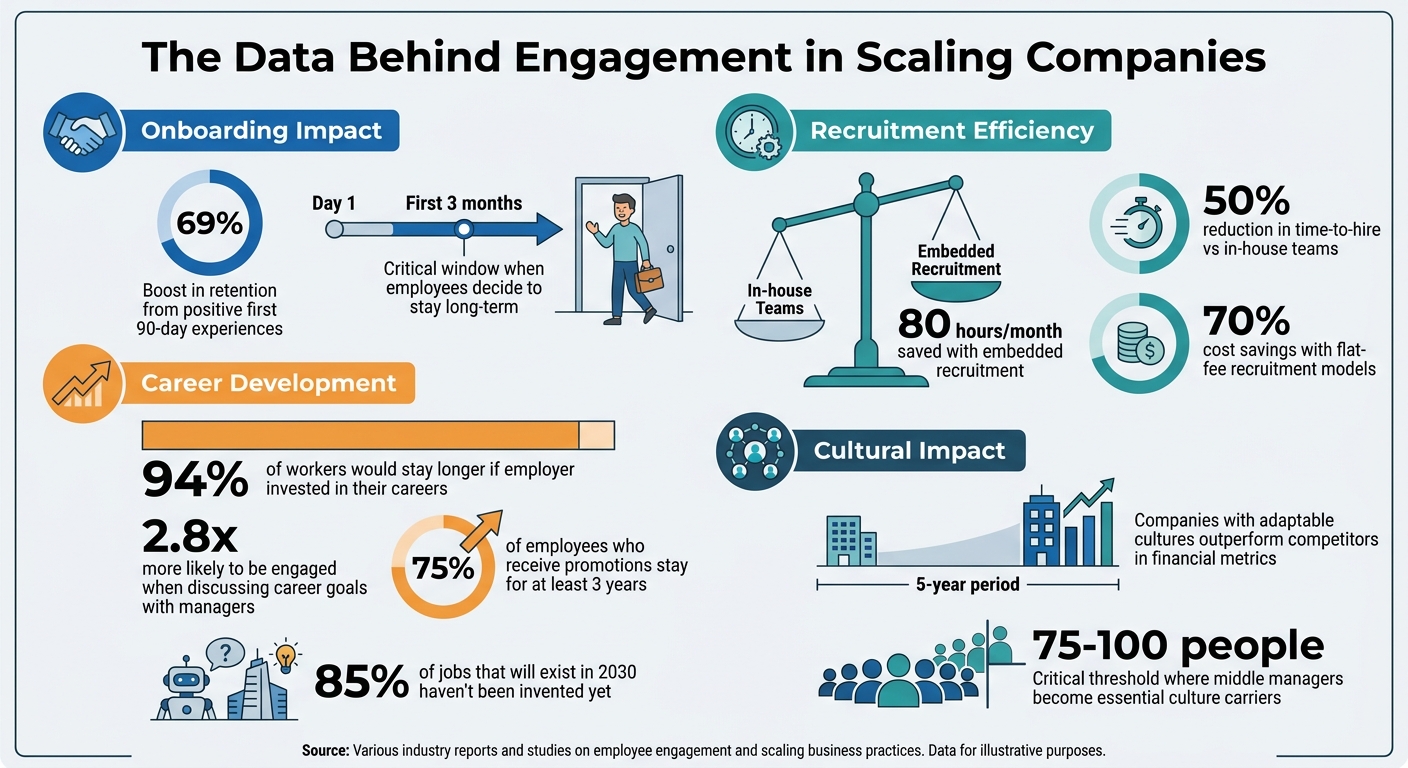
- Focus on onboarding: The first 90 days are critical. Positive experiences boost retention by 69%.
- Communicate your mission: Align daily operations with core values, ensuring employees feel part of the bigger picture.
- Invest in feedback: Use tools like pulse surveys to identify and solve engagement issues early.
- Support growth: Offer clear career paths, mentorship, and recognition to keep employees motivated.
- Leverage recruitment solutions: Services like Rent a Recruiter reduce hiring stress and ensure new hires align with your team.
Fast-growing companies succeed when they connect employee goals with business objectives. Prioritize engagement now to save costs, improve performance, and build a thriving team.
Employee Engagement Statistics for Fast-Growing Companies
How to Boost Employee Engagement and Retention: Strategies for Leaders
sbb-itb-a23bd6a
Connecting Company Goals with Employee Values
When you’re scaling fast, it’s easy for the mission that once felt crystal clear to start fading into the background. New employees don’t automatically absorb the founding values, and that disconnect only grows as leadership becomes more removed from the day-to-day operations.
"Culture is not what happens when you are small; it is the choices you make as you get big."
- ExpressWithACard [2]
The fix? It’s not overly complex, but it does require a deliberate approach. Instead of letting culture evolve by chance, you need to document it and make it part of your processes. This involves recording core values in employee handbooks, incorporating them into performance reviews, and weaving them into daily decision-making [1].
Sharing the Mission Clearly
To keep your mission front and center, it needs to be visible in how you operate every day. Leaders should regularly ask, “Does this align with our mission?” during both big-picture planning and routine decisions. This helps prevent the mission from drifting off course.
Once your team grows past 75–100 people, founders can no longer be the sole torchbearers of the company’s values. At this stage, middle managers become critical "culture carriers", ensuring values are reinforced during one-on-one meetings and team discussions [1].
Here’s how different communication methods can help as your company expands:
| Communication Method | Purpose during Growth | Scalability |
|---|---|---|
| All-Hands Meetings | Keep everyone aligned on strategic goals and progress. | High (Virtual/Hybrid) |
| Skip-Level Meetings | Provide leaders with direct insights from the frontlines. | Medium (Time-intensive) |
| Department Huddles | Keep smaller teams aligned without overwhelming them. | High (Decentralized) |
| Executive AMAs | Promote transparency by addressing anonymous questions. | High (Asynchronous) |
Adjusting daily rituals is just as important. For example, morning stand-ups might work well for a ten-person team, but they can become draining for larger groups. In those cases, smaller huddles or asynchronous updates can maintain engagement without burning people out.
By clearly communicating the mission, you create a foundation for effective feedback and ensure that values stay aligned as the company grows.
Using Employee Feedback
Actively listening to employees is critical for ensuring that your stated values match what’s happening on the ground. In fast-growing companies, it’s easy for leaders to assume they understand the root of emerging issues. But as Bidhan Baruah, Co-founder and COO of Taazaa Inc., puts it:
"Don’t think you know why a problem is occurring or how you can fix it. Instead, explore the issue with an open mind. Sit with an underperforming team and listen to what they have to say."
- Bidhan Baruah [5]
Pulse surveys can offer measurable insights into how well your culture is holding up. Platforms like Culture Amp or Lattice allow you to track employee sentiment more frequently than annual reviews, helping you gauge whether new hires understand the "unwritten rules" and feel connected to the company [1][2].
Anonymous tools like suggestion boxes and Executive AMAs give employees a safe space to share ideas or concerns, keeping the culture adaptable [1].
Engaging employees in defining core values is another powerful step. Get input from both founding team members and newer hires to ensure the values reflect actual behaviors, not just lofty ideals. Instead of vague statements like "integrity", make them actionable – such as, "We always disclose potential conflicts of interest openly" [1].
When you act on employee feedback, you strengthen the connection between company goals and employee values, which ultimately drives better performance [1].
Creating a Culture That Lowers Stress and Builds Confidence
Rapid growth can bring its fair share of stress – new hires, changing responsibilities, and constant shifts in priorities can leave teams feeling stretched.
"High-growth environments are naturally stressful; a strong culture acts as the shock absorber that allows your team to navigate that stress without breaking."
- ExpressWithACard [2]
The goal isn’t to eliminate stress entirely – that’s not realistic when scaling. Instead, it’s about creating systems that allow employees to breathe, feel appreciated, and stay engaged. By focusing on flexibility, recognition, and connection, you can build a culture that helps your team thrive under pressure.
Flexible Work Options
Asynchronous communication is a game-changer for reducing burnout. Instead of filling calendars with back-to-back video calls, companies can use digital platforms to share updates or celebrate wins. This approach avoids "Zoom fatigue" and accommodates team members across different time zones.
Another effective tactic? Implementing "Focus Fridays" – dedicated no-meeting days that give employees uninterrupted time to tackle complex tasks. When leaders also model healthy work habits, like setting clear boundaries for personal time or avoiding late-night emails, it sets the tone for the rest of the team.
"If leaders brag about answering emails at midnight, the team follows suit. If leaders block a 30-minute walk on their calendar and keep it sacred, the team sees that as permission to do the same."
- Ryan Nead, Independent Recruiter and Business Owner [4]
During high-demand periods, such as hiring surges, simplifying processes can make a big difference. For example, limiting interview panels to five participants not only saves time but also prevents burnout for everyone involved.
Recognition and Mentorship Programs
Recognition matters more than ever as teams grow. Simple initiatives like peer-to-peer Kudos or weekly shout-outs ensure contributions are celebrated, even as management layers increase.
Mentorship is another powerful tool for building confidence. Pairing new hires with "Culture Buddies" during their first 90 days creates a safe space for questions and helps them feel supported. This early connection is critical – research shows that an employee’s decision to stay long-term often happens within their first three months.
Public recognition also strengthens cultural alignment. Highlighting employees who exemplify company values not only celebrates their contributions but also reinforces what the organization prioritizes. These efforts, combined with clear communication of the company’s mission and regular feedback, help employees see how they can grow within the business.
Building Social Connections
While flexibility and recognition are key, fostering social bonds is equally important. Remote and hybrid teams often miss out on the casual "watercooler" moments that naturally build relationships. To fill this gap, companies can set up interest-based Slack or Teams channels where employees can connect over shared hobbies like cooking, gaming, or pets. These spaces help people see each other as more than just job titles.
Structured groups, like Employee Resource Groups (ERGs), can deepen these connections by uniting individuals with shared backgrounds or interests. Pairing new hires with Culture Buddies from different departments can also encourage cross-functional collaboration and reduce information silos.
Leadership accessibility plays a big role here too. Regular skip-level meetings and anonymous Executive Ask Me Anything (AMA) sessions help senior leaders stay connected to the frontlines, breaking down any "us vs. them" barriers as the company scales.
| Strategy | Practical Implementation | Primary Benefit |
|---|---|---|
| Flexible Work | Use asynchronous tools and "Focus Fridays" | Reduces Zoom fatigue and burnout |
| Recognition | Implement peer-to-peer digital Kudos | Ensures consistent recognition as teams grow |
| Mentorship | Pair new hires with 90-day "Culture Buddies" | Provides early support and psychological safety |
| Social Connection | Create interest-based channels on Slack/Teams | Builds community within remote/hybrid teams |
Supporting Employee Development and Career Growth
When companies grow quickly and need to scale hiring, employees can sometimes feel left behind. Yet, 94% of workers say they’d stay longer if their employer invested in their careers [6]. This isn’t just about promotions – it’s about providing a clear path forward and the resources to help employees reach their goals.
Sustaining engagement during rapid growth depends on offering meaningful career development opportunities. The challenge? Roles evolve faster than annual reviews can keep up. Development needs to be part of daily work, not just something addressed once a year. Below, we’ll explore training, career pathing, and reward systems that align with fast-paced growth.
Training and Skill Development Programs
Effective training becomes second nature when it’s part of the company’s DNA. Businesses that prioritise learning as a core value, rather than a nice-to-have, see better outcomes. This means allowing employees to dedicate time during work hours to webinars, online courses, or even shadowing colleagues in other departments.
"As a manager, my top tip for prioritizing employee development would be to foster an environment of continuous learning… by providing meaningful training opportunities, offering career development resources, and encouraging employees to take initiative."
Start by conducting a needs analysis. What skills does your team need right now to succeed? What’s the best way to deliver that knowledge – workshops, coaching, or self-paced courses? Cassandra Naji, VP of People Development at Animalz, explains it well:
"It’s important to do a good needs analysis. So, what kinds of skills or knowledge do people need to be successful in a situation? What’s the best vehicle for giving them that information?"
- Cassandra Naji [7]
Platforms like Salesforce’s Trailhead let employees earn certifications at their own pace, which is especially useful for teams balancing multiple priorities [8]. Pairing training programs with mentorship can further enhance learning while fostering stronger internal connections.
Another emerging trend is manager-led training. Managers often have a better understanding of their team’s strengths and gaps than HR, making them ideal leaders for development initiatives [7]. This approach also avoids the outdated practice of reserving training for "high performers", which can create inequities and undermine diversity goals.
Defined Career Paths
Career progression is a major factor in retention. Without clear paths, employees are more likely to leave [6]. Providing well-defined career paths shows employees exactly what’s needed to advance, whether that’s a promotion, a lateral move to gain new skills, or a diagonal shift blending different roles.
Flexibility is key. As 85% of the jobs that will exist in 2030 haven’t been invented yet [6], rigid career structures won’t work. Start the career pathing process during onboarding by discussing new hires’ long-term goals. Then, create Professional Development Plans (PDPs) that outline the skills and qualifications required for growth. These plans should be revisited regularly – ideally during one-on-one meetings – to ensure they align with both the employee’s ambitions and the company’s evolving needs.
Employees who discuss career goals with their managers are 2.8x more likely to be engaged [6]. These conversations show that the company values individual growth, not just filling roles.
To make these career paths effective, tangible support is critical.
Time and Financial Rewards
For employees to stay motivated, companies must back their development efforts with time and resources. If learning is treated as something employees must do "on their own time", it sends the wrong message about its importance.
Blocking out a few hours each week for professional development ensures it doesn’t get lost in the shuffle of daily tasks [8]. When leaders model this behavior, it reinforces the idea that learning is part of the job, not an extra.
Financial incentives also play a big role. These could include tuition reimbursement, bonuses tied to skill acquisition, or pay increases for earning certifications. 75% of employees who receive promotions stay with their company for at least three years [6], proving that investing in advancement boosts retention.
In 2023, Shuo Wang, Co-Founder and CRO of Deel, introduced a "kudos channel" where team members shared successful pitches and templates. This public recognition encouraged skill sharing and cross-regional collaboration. Wang noted:
"One of the things that we’ve started to do is build a kudos channel… we really encouraged that incentive-wise, that support internally and then the cross-regional teamwork. It kind of brings a lot of value and efficiencies."
- Shuo Wang [6]
Public recognition – whether through Slack, all-hands meetings, or even an extra day off – creates social rewards that complement financial ones. These gestures make employees feel valued, which strengthens their commitment during periods of rapid growth.
| Reward Type | Example | Impact |
|---|---|---|
| Time | Dedicated weekly learning hours, "Focus Fridays" | Reinforces that development is a priority, not an afterthought |
| Financial | Tuition reimbursement, certification bonuses | Shows a tangible investment in employee growth |
| Social | Kudos channels, public recognition at meetings | Boosts morale and encourages desired behaviors |
Using Recruitment Solutions to Maintain Engagement
How Embedded Recruiters Support Engagement
When companies scale quickly, hiring demands can overwhelm founders and HR teams. This pressure often leads to burnout, making it harder to focus on keeping employees engaged.
Embedded recruiters step in as part of your team, using behavioral questions and structured rubrics to ensure new hires align with your company culture and thrive long-term [9][3]. By taking over the hiring workload, they reduce administrative stress and help create a workplace where every new hire strengthens overall engagement.
For instance, embedded recruitment can save up to 80 hours per month in hiring tasks [9]. This extra time allows leaders to prioritise morale and address engagement concerns. Beyond hiring, embedded recruiters design onboarding experiences that go beyond the basics, immersing new employees into your company culture. Take Kingspan, for example: Senior HR Officer Amy Joy McConville collaborated with Rent a Recruiter to fill 37 roles in seven months, saving €130,000 while ensuring cultural alignment [9].
Speed also matters. Embedded recruitment models typically reduce time-to-hire by 50% compared to in-house teams [3]. Faster hiring means new employees can contribute sooner, easing the burden on current staff and maintaining team morale.
This approach sets the foundation for tailored recruitment solutions, which you can explore further on our recruitment blog.
Using Rent a Recruiter for Growth
Rent a Recruiter specialises in embedded recruitment services designed for high-growth SMEs in industries like technology, SaaS, fintech, engineering, and professional services. Their recruiters join your team in just a few days, managing the entire hiring process with consistency and structure.
The service operates on a flat monthly fee, with no hidden charges or long-term contracts [9]. This model can cut hiring costs by up to 70% and save over 80 hours of admin work per month [9]. For example, VicReturn’s embedded team filled 18 senior roles in just four months, screening 1,481 applicants and saving their HR team over 600 hours [9]. Similarly, Neil Spellman, Senior Recruiter at Nitro, shared how Rent a Recruiter "exceeded our expectations", placing 15 hires while saving €37,000 and engaging over 3,000 passive candidates with a 2:1 CV-to-interview ratio [9].
Rent a Recruiter also offers a Recruitment Health Check, which evaluates employer branding, candidate experience, and diversity [9]. This audit identifies challenges that could harm your employer brand or lead to "culture debt" during rapid scaling [2].
With flexible recruitment options, Rent a Recruiter adapts to your needs – whether you’re scaling post-funding, launching a new product, or managing a hiring surge. The focus remains on efficient hiring without sacrificing employee engagement.
Rent a Recruiter Service Comparison
| Service | Best For | Key Features | Engagement Benefits |
|---|---|---|---|
| Embedded Recruitment | Scaling teams quickly | Integrated recruiter working as part of your team; flat monthly fee; end-to-end hiring | Preserves cultural alignment; saves 80+ hours/month; reduces leadership stress |
| Contract Staffing | Short-term or immediate needs | Vetted professionals for temporary projects; no long-term commitment | Reduces workload on permanent staff during busy periods |
| One-off Placements | Strategic single hires | Focused search for critical roles with long-term fit | Secures high-quality "culture carriers" for leadership positions |
These flexible options ensure your recruitment strategy supports engagement and growth as your company scales.
Conclusion: Maintaining Engagement as You Grow
To scale effectively, companies need to move from accidental culture to intentional, scalable processes. This means formalizing values, designing structured onboarding programs, building peer-to-peer recognition systems, and ensuring leadership remains accessible [2][1].
The benefits of planning ahead are clear. Companies with well-defined and adaptable cultures consistently outperform competitors in financial metrics over a five-year period [1]. Moreover, first impressions during onboarding have a lasting impact on retention [2], highlighting how the quality of hiring and onboarding directly influences employee loyalty during periods of rapid growth.
"Culture is not what happens when you are small; it is the choices you make as you get big." – ExpressWithACard [2]
Aligning your culture with a strong hiring system is key to sustaining employee engagement. By connecting company values with employee experiences, you create a foundation for long-term success. Choosing the right recruitment partner plays a critical role in this. Rent a Recruiter provides embedded recruiters who integrate into your team, manage hiring end-to-end, and save you time and money – up to 70% in costs and over 80 hours per month. These savings can be reinvested into development programs, recognition efforts, and strengthening your cultural framework.
Whether you’re scaling after funding, launching a new product, or experiencing a hiring surge, maintaining engagement requires both thoughtful planning and reliable support systems. Investing in the right strategies and recruitment solutions now ensures your team stays engaged and retention remains strong as you grow.
FAQs
What are the earliest signs of ‘culture debt’?
The earliest indicators of culture debt often emerge when informal, unwritten norms start to fall apart. This is particularly noticeable in remote or hybrid workplaces, where fast-paced hiring and expansion can weaken the company’s core values. Over time, the culture may begin to feel less genuine and more surface-level.
Which engagement metrics should we track during rapid hiring?
During periods of rapid hiring, keeping an eye on key engagement metrics is essential to ensure morale stays high and new team members integrate smoothly. Start with onboarding participation – this helps you understand how well new hires are aligning with your company’s values and ways of working.
Next, look at peer recognition to measure how effectively new employees are connecting with their teams. Are they being acknowledged for their contributions? This can be a strong indicator of team cohesion. Don’t forget to track employee retention rates, particularly for those who’ve recently joined. High turnover in this group could signal deeper issues with integration or satisfaction.
Engagement surveys are another valuable tool. They provide direct feedback on how employees feel about their roles, satisfaction levels, and alignment with company values. Lastly, if your team operates in remote or hybrid setups, monitor communication effectiveness through collaboration tools. This ensures teams stay connected and engaged, even across distances.
When should we use embedded recruiters like Rent a Recruiter?
Embedded recruiters, such as those from Rent a Recruiter, are a smart choice for businesses looking to scale hiring efficiently without the hefty price tags or delays tied to traditional recruitment agencies. This model works particularly well during periods of rapid expansion or sudden hiring surges, where your internal HR team might struggle to keep up. By placing recruiters directly within your team, you gain flexible, on-demand hiring expertise that streamlines processes and aligns seamlessly with your growth objectives.