Hiring doesn’t end with an offer letter. The real challenge? Ensuring your new hire becomes a productive, long-term contributor. Recruitment and onboarding are often treated as separate, but the truth is, they’re deeply connected. Misalignment between these processes leads to higher turnover, slower ramp-up times, and wasted resources.
Here’s what you need to know:
- Recruitment focuses on finding and hiring talent. Metrics like time-to-fill and cost-per-hire dominate this phase.
- Onboarding starts after the offer is accepted, integrating new hires into the team and setting them up for success. Companies with structured onboarding see 82% higher retention and 70% faster productivity gains.
- The disconnect? Insights from recruitment (like motivations or career goals) rarely transfer to onboarding, creating gaps that cost time and money.
The fix: Align recruitment and onboarding by sharing data, standardizing handoffs, and tracking recruitment metrics like time-to-perform and early attrition. Companies that get this right save thousands in hiring costs and prevent avoidable turnover.
Want a recruitment process that integrates seamlessly into onboarding? Rent a Recruiter embeds recruiters into your team, ensuring every hire transitions smoothly from candidate to contributor.
Recruitment: Process and Outputs
The Main Stages of Recruitment
Recruitment typically involves 7 to 10 steps, starting with identifying the need and drafting the job description, and ending with conditional offers, background checks, and a critical pre-boarding phase. One common mistake companies make is treating the offer letter as the endpoint. It’s not. The pre-boarding period – the time between offer acceptance and the new hire’s first day – is crucial for keeping momentum. Simple actions, like sending a welcome email within 24 hours of acceptance or sharing a detailed Day 1 schedule a week in advance, can significantly impact how prepared and engaged a new hire feels before even stepping into the office.
To improve recruitment and onboarding outcomes, define what success looks like at the 90-day mark before even posting the job. When hiring managers agree on success criteria upfront, everything improves: job descriptions attract stronger candidates, interviews become more focused, and onboarding has clear goals to aim for.
Every stage of the process builds candidate confidence. When done right, this confidence becomes a strong predictor of the new hire’s future commitment to the company.
The Candidate Experience
How candidates are treated during recruitment directly shapes their perception of the company and impacts their performance on Day 1. Data shows that candidates are 38% more likely to accept an offer when the recruitment process is quick and communicative. On the flip side, drawn-out cycles (over 40 days) increase drop-off rates by 12% [8], and 42% of candidates withdraw if scheduling takes too long [10]. Poor communication can be particularly damaging – 26% of candidates declined job offers in 2024 due to unclear expectations or broken communication [6]. These aren’t just hiring inefficiencies; they reflect how an organization operates, and candidates take notice.
"The candidate experience doesn’t stop paying dividends at the offer stage – it compounds into long-term employee commitment." – Jobful [6]
Structured interviews are a critical part of creating a positive candidate experience. They are nearly twice as effective at predicting job performance compared to unstructured ones [7]. Using consistent behavioral questions and a scorecard not only ensures fairness but also sets a professional tone that carries into onboarding. When candidates see a clear, structured process, they feel more confident that the company will support their success after they’re hired.
These practices are especially important for scaling companies aiming to create a repeatable, high-quality hiring process.
Structured Recruitment for High-Growth SMEs
For SMEs experiencing rapid growth, recruitment needs to be both efficient and scalable. Without structure, hiring becomes chaotic: roles stay open too long, interviews lack consistency, and important candidate insights fail to make it to onboarding. This kind of disorganization can derail growth plans.
Embedded recruitment offers a solution. With Rent a Recruiter, experienced recruiters integrate directly into your team, managing the entire hiring process from start to finish. This includes everything from initial intake meetings and crafting job descriptions to handling offers and transitioning candidates to onboarding. Companies using this model often cut hiring costs by up to 70% compared to traditional agency fees and save over 80 hours per month on internal hiring tasks.
For SMEs juggling rapid headcount growth, product launches, or funding rounds, this kind of consistent, scalable recruitment process is invaluable. It not only helps fill roles faster but also ensures new hires are set up for success from Day 1, creating a smoother transition into their new positions.
sbb-itb-a23bd6a
Onboarding: Getting New Hires Ready to Perform
The Core Phases of Onboarding
Onboarding is more than just ticking off administrative tasks. It’s a structured journey that transitions new hires from accepting the offer to becoming confident contributors. Each phase plays a key role in ensuring a smooth integration into the company.
| Phase | Timing | Primary Focus | Risk if Skipped |
|---|---|---|---|
| Preboarding | Offer → Day 1 | Compliance & logistics | Disengagement, absenteeism, and operational issues |
| Orientation | Day 1 → Week 1 | Culture & connection | Early regret, overwhelm |
| Immersion | Week 2 → Day 30 | Role competency | Disengagement, uncertainty |
| Integration | Day 31 → Day 90 | Performance & feedback | Slow ramp-up, preventable turnover |
Skipping any of these steps can lead to serious consequences, from operational disruptions to increased turnover.
The preboarding phase is particularly critical but often underestimated. The time between offer acceptance and the first day is a vulnerable period, especially for high-growth SMEs using talent acquisition strategies to scale while stretched thin.
"The gap between offer and Day 1 is not dead time. It is one of the highest-risk moments in the entire employee lifecycle." – FirstHR [5]
Shockingly, 64% of new hires receive no structured preboarding [5]. Simple actions like completing I-9 forms, W-4s, and setting up direct deposit before Day 1, along with sharing a clear first-week schedule, can keep new hires engaged and prevent no-shows.
What Good Onboarding Delivers
When done right, onboarding doesn’t just help employees settle in – it drives measurable business outcomes. Structured onboarding can improve retention by 82% and boost productivity by over 70% [11][12]. Companies with structured onboarding also see a 58% higher three-year retention rate compared to those without it [11].
The stakes are high: 80% of employees who quit within their first year blame poor onboarding [11], and 86% of new hires decide how long they’ll stay within their first six months [12]. Engaging employees early isn’t optional – it’s essential.
Manager involvement is a game-changer. New hires are 3.4 times more likely to rate their onboarding as exceptional when managers take an active role, rather than leaving it entirely to HR [12]. Adding a peer buddy system – where a more experienced colleague helps with informal questions and social integration – further enhances both performance and a sense of belonging.
Onboarding Challenges for Scaling Companies
Despite its importance, only 12% of employees strongly agree their employer excels at onboarding [12]. The gap between understanding and execution often boils down to recurring challenges.
One of the biggest issues is siloed ownership [13]. When HR, IT, and hiring managers operate independently without a unified system, critical details are missed. New hires may arrive without access to necessary systems, delayed equipment, or unclear role expectations. Losing a single hire in the first 45 days can result in a 10% capacity loss, potentially derailing quarterly goals [5].
Inconsistency across teams is another common problem. As companies scale, some managers deliver thorough onboarding while others leave new hires to figure things out. This inconsistency creates uneven experiences and performance gaps that are harder to address later. The solution? Standardize core elements like compliance, IT setup, and role expectations, while allowing teams to tailor specifics to their needs.
What Onboarding Actually Is – And How to Build It
Recruitment vs. Onboarding: Differences and Overlaps
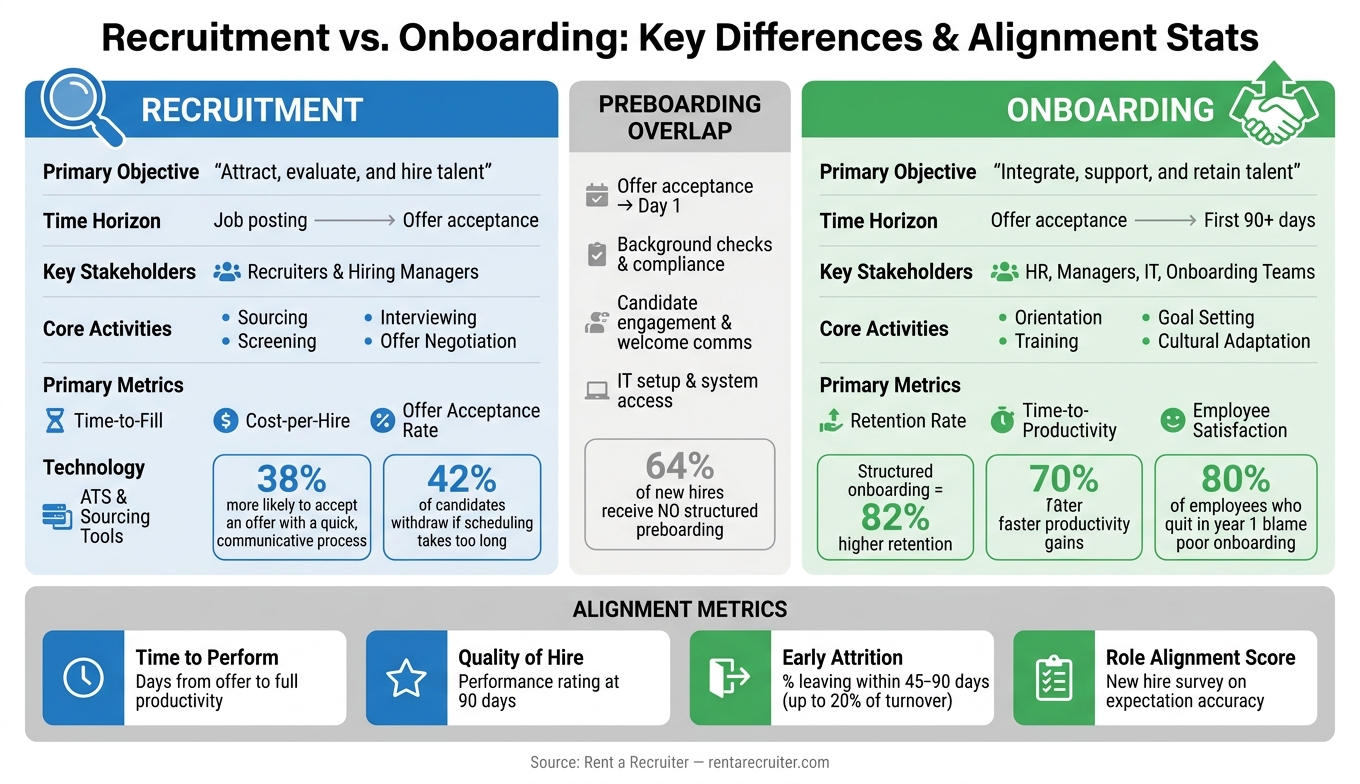
Recruitment vs. Onboarding: Key Differences, Metrics & Alignment Stats
Side-by-Side Comparison
Recruitment and onboarding play distinct roles in the hiring journey, yet they complement each other. Recruitment focuses on identifying and securing the right talent, often through recruitment as a service models,, while onboarding ensures that new hires are set up for success once they join the team.
| Dimension | Recruitment | Onboarding |
|---|---|---|
| Primary Objective | Attract, evaluate, and hire talent | Integrate, support, and retain talent |
| Time Horizon | From job posting to offer acceptance | From offer acceptance to the first 90+ days |
| Key Stakeholders | Recruiters and hiring managers | HR, managers, IT, and onboarding teams |
| Core Activities | Sourcing, screening, interviewing, and offer negotiations | Orientation, training, goal setting, and cultural adaptation |
| Primary Metrics | Time-to-fill, cost-per-hire, and offer acceptance rates | Retention rates, time-to-productivity, and employee satisfaction |
| Technology Used | Applicant tracking systems (ATS) and sourcing tools | HR information systems (HRIS) and onboarding platforms |
This side-by-side breakdown highlights the distinct responsibilities of each phase, setting the stage to explore their intersection.
The handoff between recruitment and onboarding typically happens at key milestones: offer letter signing, post-background check clearance, or an employee’s first day. As Rich, an organizational design expert, explains:
"The recruiter vs. HR function distinction is best understood as a timeline. Recruiters operate pre-onboarding. HR operates post-onboarding. The overlap is a narrow window between offer acceptance and the employee’s first day." – Rich, Organizational Design Expert [15]
Where Recruitment and Onboarding Meet
Despite their differences, recruitment and onboarding overlap in vital areas, particularly during the preboarding phase. This transitional period, spanning from offer acceptance to the new hire’s first day, is where both teams collaborate. Recruiters often handle final steps like background checks and candidate engagement, while HR prepares for Day 1 by arranging equipment, completing compliance tasks, and setting up systems.
Recruitment data plays a crucial role here. Details such as interview feedback, competency scores, and learning styles can guide HR in tailoring onboarding experiences. Sharing this information helps streamline training and avoids redundant activities that could frustrate new hires.
Consistency in communication is another critical factor. A seamless transition from recruitment to onboarding builds trust and ensures that the positive candidate experience continues into the employee experience. Kate Pavlina, HR Business Partner at Amazon, sums this up effectively:
"Recruiters provide continuity as the thread connecting candidate experience to employee experience." [14]
The objective isn’t to merge these functions but to align them effectively. By sharing context, data, and maintaining open communication, businesses can ensure that no new hire feels overlooked during this critical transition. Next, we’ll dive into actionable strategies for achieving this alignment.
How to Align Recruitment and Onboarding
Bridging the gap between recruitment and onboarding is essential for ensuring a smooth transition for new hires. The strategies below outline how to create a seamless connection between these two critical processes.
Linking Metrics Across Both Processes
In many companies, recruitment and onboarding metrics operate in silos. Recruiters focus on metrics like time-to-fill and offer acceptance rates, while HR tracks retention and satisfaction scores. This disjointed approach makes it hard to see the full picture.
The key is to integrate metrics across both phases. One standout metric is Time to Perform – the number of days from offer acceptance to when a new hire starts contributing meaningfully. As Matt Gainsford from Titus Talent Strategies explains:
"The metric that determines whether your investment in talent pays off isn’t how fast you made the hire. It’s Time to Perform." [4]
Another critical metric is Quality of Hire, assessed at 30, 60, and 90 days. This provides a feedback loop that connects recruitment decisions with on-the-job performance. Additionally, tracking early attrition – the percentage of new hires leaving within the first 45 days – offers insights into where onboarding may have fallen short. It’s worth noting that up to 20% of employee turnover occurs during this period [4].
| Metric | What It Measures | Why It Matters for Alignment |
|---|---|---|
| Time to Perform | Days from offer acceptance to full productivity | Highlights how well recruitment transitions into onboarding [4] |
| Quality of Hire | Performance rating at 90 days | Validates if recruitment decisions align with job performance [2] |
| Early Attrition | % of hires leaving within 45–90 days | Identifies gaps between recruitment promises and onboarding delivery [3][4] |
| Role Alignment Score | New hire survey on role expectations | Measures how accurately the job was previewed during recruitment [1][14] |
These metrics provide a shared framework for both recruitment and onboarding teams, ensuring alignment and accountability.
Building a Clean Handoff Process
A poor handoff between recruitment and onboarding can undermine even the best hiring efforts. Too often, recruiters simply pass along a name and start date, leaving HR to fill in the gaps.
Bharat Sigtia from Ninjahire highlights this issue:
"Onboarding should begin with everything the hiring process learned. Instead, it usually begins with nothing more than a name, a start date, and a job title." [3]
A structured handoff brief can solve this problem. Recruiters should document key details such as candidate motivations, career goals, and work preferences. A concise two-page summary ensures HR and hiring managers have the insights they need to tailor the onboarding experience.
Preboarding also plays a critical role. Sending first-day logistics, introducing team members, or even a simple welcome message can bridge the silence gap that might cause new hires to second-guess their decision. Jon-Paul Jaramillo, Talent Acquisition Manager at Sundt, shared:
"We spend a ton of time, energy, and resources on giving our candidates a great recruiting experience… But once our candidates signed their offer, that experience started to fade away leading up to their first day on the job. We knew immediately we needed to fix that." [14]
Using Integrated Recruitment Workflows
Technology can further streamline the transition from recruitment to onboarding. When applicant tracking systems (ATS) and human resource information systems (HRIS) don’t communicate, manual data entry slows the process and creates room for error. For example, a new hire unable to access necessary systems on Day 1 is a clear sign of disjointed workflows [3].
Integrating these systems can automate onboarding tasks, such as IT setup, payroll registration, and document collection, triggered by events like offer acceptance [16]. This eliminates administrative delays, allowing HR teams to focus on building relationships rather than chasing paperwork.
For scaling companies managing rapid hiring, achieving this level of consistency can feel daunting. Rent a Recruiter offers a solution by embedding experienced recruiters directly into your team. These recruiters design end-to-end hiring workflows that seamlessly integrate into onboarding. Unlike traditional approaches, they stay involved throughout the process, ensuring continuity and alignment. This approach not only reduces inefficiencies but also enhances the new hire experience, guiding employees from offer acceptance to full productivity with ease.
Conclusion: Better Results Through End-to-End Alignment
Recruitment and onboarding are two sides of the same coin. When they don’t align, the fallout is clear: higher turnover, slower productivity, and wasted resources. But when they work together, the payoff is both measurable and long-lasting.
Key Takeaways
Here’s the challenge: too many companies see the offer letter as the finish line for recruitment. In reality, it should be the starting point for a seamless onboarding journey. Research highlights that replacing an employee can cost anywhere from 50% to 200% of their annual salary. And often, early turnover isn’t about hiring the wrong person – it’s about failing to set them up for success during the transition[18].
Bridging this gap takes more than good intentions. It requires shared goals, clear handoff processes, and tools that connect hiring decisions to onboarding outcomes. Companies that excel in this area leverage solutions like integrated ATS platforms, cohort-based onboarding, and end-to-end recruitment strategies. These approaches ensure hiring scales without sacrificing quality[9][17].
"Scalable onboarding infrastructure – not individual manager effort – [is] a core capability distinguishing high-growth companies that sustain performance during rapid hiring from those that experience quality degradation." – Deloitte’s Global Human Capital Trends (via Rework)[17]
This insight underscores the importance of creating a seamless connection between recruitment data and onboarding execution. It’s about turning plans into actionable improvements.
Next Steps
Start by auditing your recruitment and onboarding processes to pinpoint where handoffs are breaking down. From there, develop a structured briefing process, align metrics between teams, and automate workflows to ensure smoother transitions.
For companies looking to scale quickly without compromising on quality, Rent a Recruiter offers a solution. By embedding experienced recruiters directly into your team, we handle hiring from start to finish while building processes that integrate seamlessly into onboarding. Our clients often cut hiring costs by up to 70% compared to traditional agency fees and save over 80 hours a month on internal admin. Whether you’re navigating a hiring surge or creating a more reliable recruitment framework, the goal stays the same: bring in the right talent and get them contributing, fast.
FAQs
What should a recruiter-to-onboarding handoff brief include?
A recruiter-to-onboarding handoff brief is crucial for ensuring a seamless transition from hiring to onboarding. It should address four main areas:
- Candidate insights: Share interview notes, competency evaluations, assessment outcomes, and observations about how well the candidate aligns with the company’s values and environment.
- Role context: Provide detailed information about the job, team structure, reporting relationships, and performance expectations.
- Compliance documents: Confirm the status of background checks and I-9 verification to meet legal requirements.
- Candidate experience: Highlight the communication history, preferred interaction styles, and rapport built during the recruitment process.
Rent a Recruiter helps scaling companies create structured hiring systems that make this transition smoother and more efficient.
Which metrics best link hiring speed to new-hire performance?
To link hiring speed with the quality of new hires, it’s essential to track metrics that measure both efficiency and outcomes. These include:
- Time-to-productivity: Measures how quickly new employees achieve their expected performance levels.
- First-year retention: Identifies early turnover, often a sign of poor fit or misaligned expectations.
- Performance scores: Evaluates contributions through metrics like performance reviews or promotions.
- Hiring manager satisfaction: Captures feedback on whether new hires meet the role’s requirements and expectations.
By focusing on these metrics, you can ensure fast hiring processes lead to strong, long-term results.
How do you reduce early attrition in the first 45–90 days?
To cut down early attrition within the first 45–90 days, it’s crucial to connect recruitment with onboarding seamlessly. Start by aligning expectations, keeping communication open, and actively involving managers in the process.
Begin with pre-boarding: complete paperwork digitally, send out equipment ahead of time, and share a clear agenda for the first day. Follow this with a structured 30-60-90 day plan that includes regular check-ins. These check-ins should focus on removing obstacles, setting clear goals, and boosting the new hire’s confidence.
Rent a Recruiter ensures clarity around roles and provides a smooth handoff from hiring to onboarding, setting your team up for success.