
Hiring delays cost businesses time and money. Recruitment SLAs (Service Level Agreements) solve this by setting clear expectations, timelines, and responsibilities for everyone involved in hiring.
Scaling companies often face chaotic hiring processes, with missed deadlines and unfilled roles slowing growth. SLAs bring structure by defining measurable goals, accountability, and performance metrics for recruiters and hiring managers.
Why Recruitment SLAs Matter:
- Faster hiring: Defined timelines prevent bottlenecks, ensuring roles are filled promptly.
- Clear accountability: Everyone knows their role, reducing blame and confusion.
- Improved results: Metrics like Time-to-Fill and Quality of Hire track progress and drive performance.
- Cost control: Delays in hiring can cost thousands per unfilled role. SLAs help avoid these losses.
SLAs turn hiring into a predictable, results-driven process. If your company is scaling and struggling with hiring inefficiencies, implementing SLAs is a practical way to align embedded recruitment with business goals.
Need help creating and enforcing SLAs? Rent a Recruiter provides embedded recruiters who integrate into your team to manage hiring end-to-end, saving time and reducing costs.
Recruiting and Hiring SLA’s | No BS Hiring Advice
sbb-itb-a23bd6a
Core Elements of Recruitment SLAs
Three Core Elements of Effective Recruitment SLAs
A strong recruitment SLA rests on three main pillars: timelines, roles, and metrics.
Timelines and Milestones
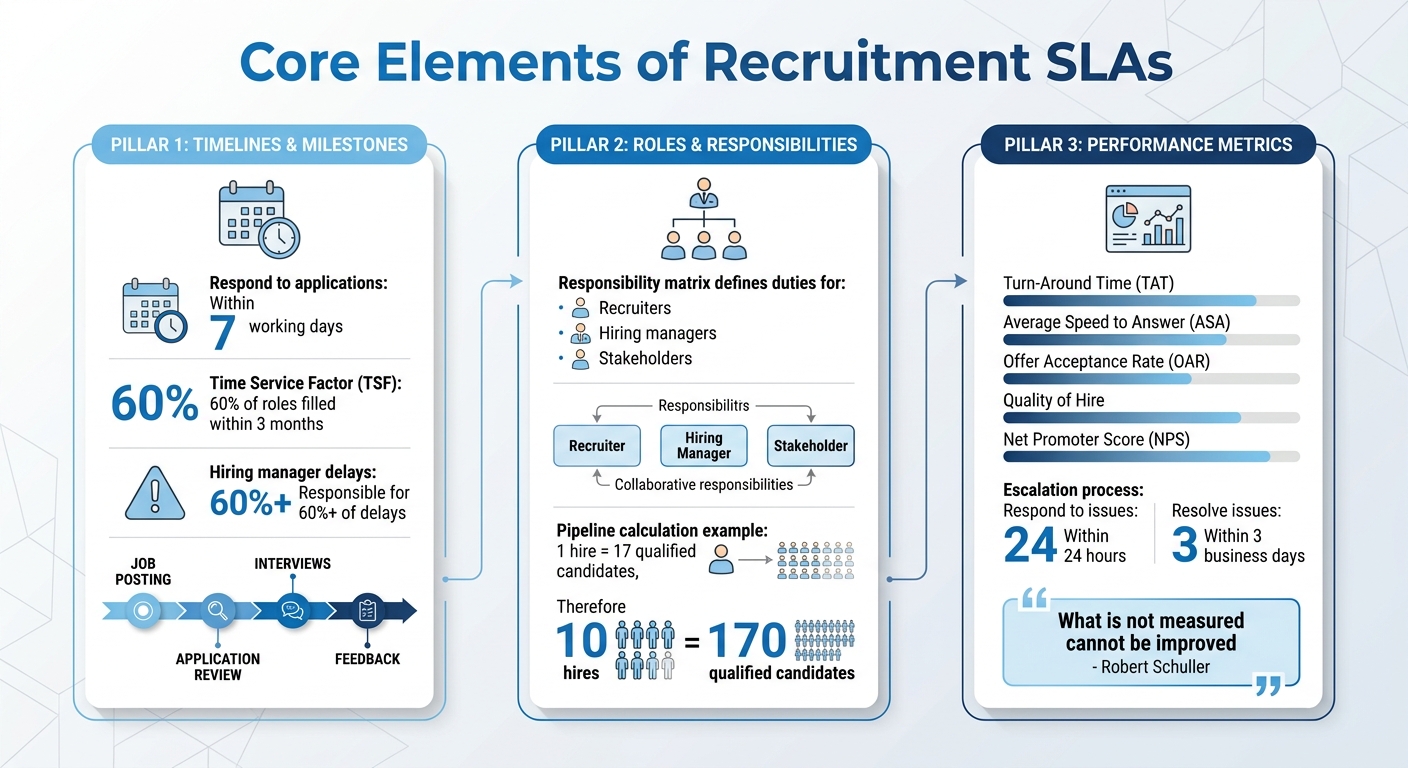
Setting clear timeframes helps avoid delays. Your SLA should outline minimum and maximum timelines for every stage – posting jobs, reviewing applications, conducting interviews, and providing feedback [3]. For instance, a typical expectation might be to respond to candidate applications within 7 working days [2]. Another common benchmark is the Time Service Factor (TSF), which aims to fill 60% of roles within a 3-month period [2].
Defined timelines create urgency and accountability, making it easier to spot and address bottlenecks. This is especially critical since hiring managers are often responsible for over 60% of delays and errors in the hiring process [3]. With timelines in place, the next step is to establish clear roles.
Roles and Responsibilities
An effective SLA includes a responsibility matrix that outlines the duties of recruiters, hiring managers, and other stakeholders. This could involve tasks like reviewing applications, scheduling interviews, assessing candidates, and responding to queries [2]. For example, recruiters might be tasked with delivering a specific number of qualified candidates within a set timeframe, while hiring managers are expected to review those candidates promptly.
Defining what qualifies as a "qualified candidate" is equally important. If your team determines that one hire requires 17 qualified candidates, then hiring 10 people would demand a pipeline of 170 qualified candidates [2]. This level of precision eliminates confusion and ensures everyone shares responsibility for outcomes. Once timelines and roles are established, the focus shifts to tracking performance.
Performance Metrics and Reporting
With timelines and responsibilities in place, monitoring performance becomes crucial for improvement. The right metrics turn your SLA into a powerful management tool. Track indicators that reflect both efficiency and quality, such as Turn-Around Time (TAT) for tasks, Average Speed to Answer (ASA) for candidate queries, Offer Acceptance Rate (OAR), and Quality of Hire [2]. Including candidate experience metrics, like Net Promoter Score (NPS), can also boost your employer brand.
Your SLA should specify how data will be collected (e.g., through your ATS or Google Forms), who will track it, and how often it will be reported [2][3]. Many companies now offer 24/7 access to performance dashboards, allowing stakeholders to monitor progress in real time. Additionally, establish clear escalation processes – for example, responding to issues within 24 hours and resolving them within 3 business days [2].
As Robert Schuller famously said:
What is not measured cannot be improved [2].
How to Create and Implement Recruitment SLAs
Building effective SLAs starts with early collaboration between recruiters and hiring managers. The best agreements bring everyone to the table from the very beginning.
Develop SLAs with Input from All Parties
Work together with recruiters, hiring managers, and department heads to draft SLAs. As Stella Ngugi puts it:
For an SLA to be successful, all parties have to be involved in creating it and promise commitment to its follow-through [2].
Start by gathering feedback on common bottlenecks or using a tool to rate your recruitment process, like delays in scheduling or slow feedback loops. Create a responsibilities matrix to clearly outline who handles tasks such as reference checks, interview scheduling, or documentation. For example, you might agree that hiring managers will provide interview feedback within 48 hours [4], while recruiters commit to acknowledging all applications within 24 hours [3]. This level of clarity helps prevent confusion and avoids duplicated work that can drag out the hiring process.
Start with Pilot Programs
Before rolling out the SLA across the company, test it with a controlled pilot.
Choose one department or a specific role type to trial the agreement. This allows you to identify potential issues and gather practical feedback without disrupting the entire recruitment process. Teams can then adapt the SLA to address their specific challenges [2]. Use the pilot to collect data on what worked and what didn’t. Once you’ve made adjustments based on this feedback, the SLA will be more refined and ready for broader implementation.
Train Stakeholders and Maintain Communication
Scaling the SLA requires proper training and open communication channels.
Even a well-designed SLA can fall apart without the right support. Provide teams with tools and workflows to make the process seamless – dedicated Slack channels for hiring updates, ATS training sessions, or regular check-ins between recruiters and hiring managers [2]. Training should focus on not just the "what" but the "why." When stakeholders understand how their actions influence the hiring process and, ultimately, the company’s growth, they’re more likely to stay committed to their responsibilities.
Reviewing and Adjusting Your SLAs
SLAs need regular attention to stay in sync with performance metrics and changing business priorities [1]. The most effective recruitment SLAs follow a "continuous improvement cycle" – a process of assessing current results, identifying areas for improvement, and deciding where to focus next [1]. This ensures your SLA framework grows alongside your business.
Quarterly Reviews and Feedback
Plan formal SLA reviews every quarter, bringing together recruiters, hiring managers, and department heads. These meetings should evaluate what’s working, what’s not, and how to prepare for market shifts, regulatory updates, or new company goals [1]. If a process fails, conduct a failure analysis to uncover the root cause and prevent similar issues in the future [3]. This approach promotes a culture of "failing forward", where teams can openly learn from mistakes instead of concealing them.
Use Data to Make Changes
Let AAA Reporting – data that is Accessible, Accurate, and Actionable – guide your SLA updates [1]. Monitor key metrics like pipeline pass-through rates, interview hours per hire, candidate NPS scores, and recruiter activity to identify pain points and test SLA feasibility. For instance, if outreach response rates drop, you might need to revise your SLA targets for initial engagement. Dr. John Sullivan highlights this as transforming recruitment into a data-driven function [3].
Adjust SLAs During Growth Periods
As your company evolves, so should your SLA priorities. During hyper-growth, prioritise speed and volume metrics, such as progress against hiring plans and on-demand recruiter capacity. In steady growth phases, shift focus to efficiency metrics like candidate NPS scores and interview hours per hire. During consolidation, quality metrics like internal mobility and team efficiency take centre stage [1]. Jim Miller, VP of Talent & People at Ashby, captures the urgency of adapting SLAs:
The talent space is changing so fast, the world won’t wait for you to get to maturity [1].
Your SLAs must be agile enough to adjust within days – not months – especially during critical moments like funding rounds or product launches that drive sudden spikes in hiring demand.
How Rent a Recruiter Supports SLA Implementation
Creating recruitment SLAs is one thing; ensuring they’re consistently upheld is another. As Boundee pointed out:
A service level agreement is only as strong as the mechanism that enforces it [6].
Without a clear system to track accountability and manage follow-ups, even the best SLAs risk becoming little more than guidelines. Here’s how Rent a Recruiter’s embedded recruiters and data-driven tools ensure SLAs turn into actionable results.
Embedded Recruiters for SLA Execution
Rent a Recruiter places skilled recruiters directly into your team to manage SLA enforcement and handle tasks that often drain internal resources. Did you know talent teams spend nearly 38% of their time just on interview scheduling? [6]. Additionally, 27% of talent acquisition leaders cite repetitive coordination tasks as a major contributor to unmanageable workloads [6].
By managing the full hiring process, embedded recruiters eliminate the back-and-forth often seen between hiring managers and internal teams [5]. They bring clarity to responsibilities like interview scheduling, feedback deadlines, and documentation at every stage [3]. On top of that, they use automated mobile alerts to cut through delays. For example, when hiring managers receive task requests directly on their phones, they respond within 48 hours on average – compared to a 14-day delay when they need to log into an ATS [6].
Recruitment Health Check for SLA Benchmarks
Rent a Recruiter’s free Recruitment Health Check highlights gaps between SLA goals and actual performance. For instance, your team might aim for a 3-day review period, but in reality, it could be taking 14 days [6]. This analysis tracks who is responsible for each stage of hiring and how long candidates remain in each phase, offering a clear picture of where delays occur. These insights enable targeted actions to keep SLAs on track.
The Health Check also calculates the financial impact of delays by multiplying the number of overdue days by the daily cost of an unfilled role. This creates a compelling business case for prioritizing SLA compliance [6].
Measurable Results with Rent a Recruiter
By addressing operational inefficiencies, Rent a Recruiter’s model delivers measurable savings in both time and money. Companies typically cut hiring costs by up to 70% compared to traditional agency fees, while saving over 80 hours per month on internal hiring and admin work. These efficiencies come from eliminating redundant tasks, reducing reliance on external agencies, and streamlining coordination processes.
The model is flexible enough to adapt to your growth stage. Whether you’re scaling quickly and need to prioritise speed, focusing on cost control during steady growth, or emphasising quality and retention during consolidation, embedded recruiters align SLA priorities with your business needs [1]. This ensures your team focuses on what matters most for your current goals, rather than spreading resources too thin [1].
Conclusion
Key Takeaways
Recruitment SLAs turn hiring chaos into an organized, results-driven process. By clearly defining who is responsible for what, by when, and how it gets done, these agreements help create accountability and drive better outcomes – faster hires, higher-quality candidates, and lower costs.
Consider this: over 60% of delays and mistakes in the hiring process are caused by hiring managers [3]. That’s where accountability makes all the difference. As Dr. John Sullivan puts it:
By spelling out responsibilities, timelines, deliverables and success measures in advance, you can reduce the blame game and improve your recruiting results [3].
SLAs also bring transparency to the table. From setting service levels for various roles to measuring the business cost of missed deadlines, they align everyone involved. This alignment turns recruitment into a strategic business function rather than a reactive, tactical one [1][3].
The bottom line? SLAs are a game-changer for companies looking to build a reliable, scalable hiring process.
Next Steps
Ready to bring structure to your hiring? Rent a Recruiter’s embedded recruiters take care of SLA execution from start to finish, offering the consistency and visibility that scaling businesses demand. Many companies see up to a 70% reduction in hiring costs and save over 80 hours a month in admin time.
Start by taking advantage of a free Recruitment Health Check. This tailored report will highlight where delays happen, identify bottlenecks, and show the financial impact of unfilled roles. From there, you can explore how embedded recruiters can support your goals – whether you need short-term help to meet hiring targets or a long-term solution to build a scalable recruitment function. Book a consultation and see how SLAs can reshape your hiring process for the better.
FAQs
What should a recruitment SLA include?
A recruitment SLA outlines the responsibilities, expectations, and performance benchmarks between your recruiting team and hiring managers. It should detail:
- Roles and responsibilities: Who handles what across the hiring process.
- Timelines: Clear deadlines for critical recruitment activities.
- Deliverables: Specific outputs expected at each stage.
- Success metrics: Measurable criteria to track and evaluate performance.
By defining these elements, you can minimize delays, maintain compliance, and deliver a consistent hiring experience while keeping all stakeholders aligned.
Which hiring metrics matter most in an SLA?
Key hiring metrics in an SLA cover responsibilities, timelines, deliverables, and success measures. By clearly defining these elements, all parties involved know what to expect, which drives accountability and leads to better hiring results.
How do you enforce an SLA when hiring managers delay?
To handle delays from hiring managers effectively, start by setting clear expectations with a formal Service Level Agreement (SLA). This should detail timelines, responsibilities, and measurable success criteria. Regularly track adherence to the SLA and address any delays by clearly explaining how they affect the hiring process. If issues continue, revisit the agreement with the hiring manager to reinforce accountability and stress the importance of prompt feedback and decisions. This approach keeps the process on track and ensures accountability.