
Once funding lands, founder-led hiring stops working fast. If you plan 15 to 20 hires a year, or your founders are still spending 8 to 15+ hours a week on recruiting, you need clear ownership, hiring capacity, and reporting tied to budget.
Here’s the short version. After funding, recruitment moves from an ad hoc founder task to a business function. Founders should keep final say on senior hires and team fit, but recruiters, coordinators, and hiring ops should own delivery, scheduling, funnel control, and reporting. That shift helps you protect time, control cost-per-hire, and hit hiring targets linked to revenue and product plans.
For most scaling firms in SaaS, Technology, IT, Fintech, Engineering, Security, Insurance, and Professional Services, the pattern is simple:
- Before funding: hiring runs on referrals, founder time, and spreadsheets
- After funding: hiring needs owners, a stage-by-stage process, and metrics
- At scale: one recruiter can only handle so much load, often 6 to 10 open roles at once
- When capacity breaks: delays grow, offer acceptance drops, and agency spend climbs
- Where support fits: embedded recruitment adds delivery capacity without long-term headcount
If you are funding growth in the US, Ireland, Australia, or the Middle East, the business question is not just who approves hires. It is who owns output, who tracks performance, and who adds capacity before hiring slips.
That is the shift this article explains.
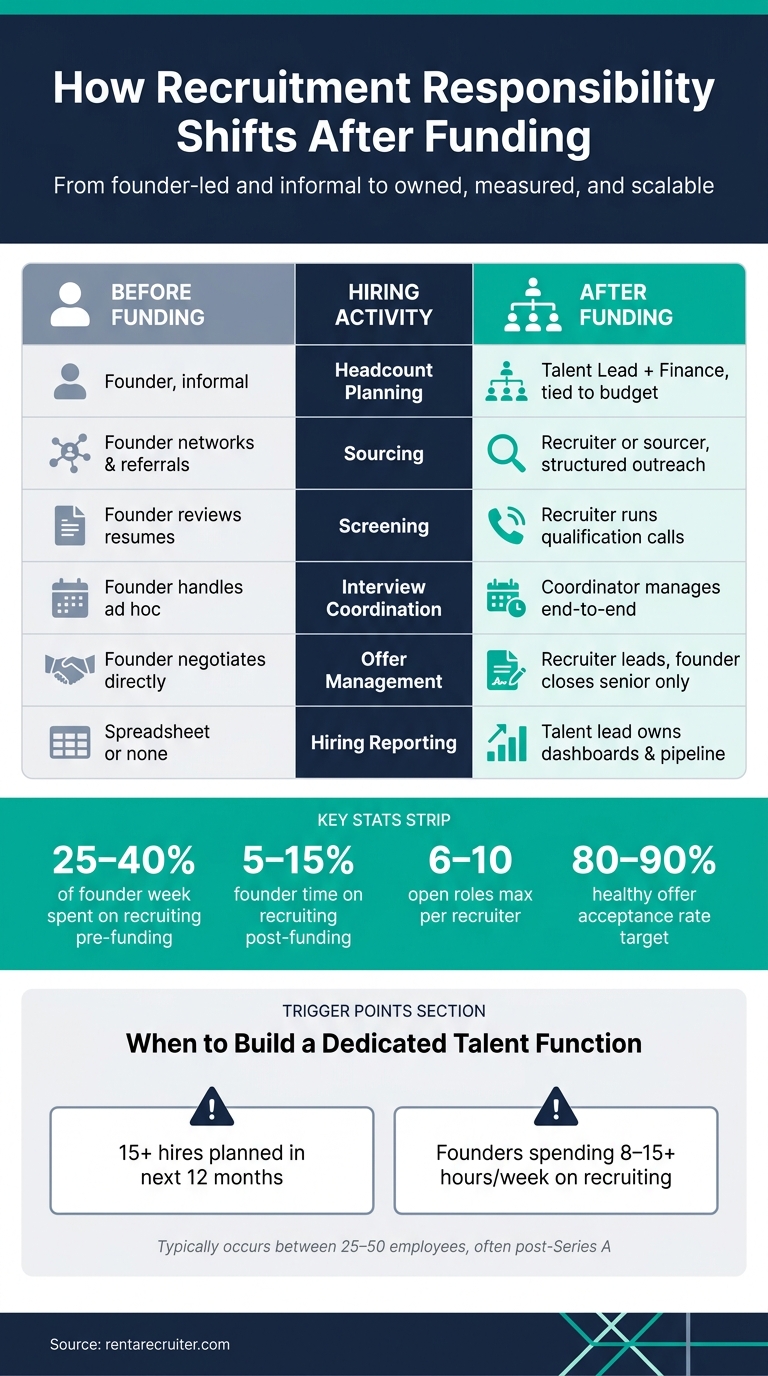
Recruitment Ownership Before vs. After Funding: Key Shifts
How Hiring Ownership Moves From Founders to a Dedicated Function
Before funding, founders usually are the hiring function. They source, screen, schedule, and close candidates, often spending 25–40% of their working week on recruiting tasks alone.[6] That works out at roughly 10–25 hours per week not spent on product, customers, or fundraising.[8] At some point, that stops being efficient. The first handoff usually starts with the repeatable parts of recruiting.
What Founders Keep Versus What They Hand Off
Founders should still stay close to executive searches, culture-critical hires, and final approvals. They are often the strongest person to close a senior candidate.
What should move off their desk is the rest of the hiring admin and delivery work: sourcing pipelines, CV screening, interview scheduling, candidate communications, process management, and hiring reports. These tasks take time, repeat every week, and don’t need founder-level attention once a recruiter or talent lead is in place.
As the talent function gets more mature, founder time spent on hands-on recruiting can drop from 30–50% of their week to 5–15%.[1][2] That gives you time back where it matters most.
When to Hire Your First Recruiter or Head of Talent
The trigger point is usually clear. If founders are spending 8–15+ hours a week on recruiting and the business plans 15+ hires in the next 12 months, it’s time to put ownership with a dedicated hire.[7][9] Either signal on its own should get attention. Both together make the case hard to ignore.
Most companies hit this stage somewhere between 25 and 50 employees, often just after a Series A. That’s usually when investors and operators push for an experienced in-house recruiter or Head of Talent, someone with 5–7 years of experience who can build structure.[3][4][5]
This isn’t just about adding headcount. It’s about putting in place clear ownership before hiring volume outruns internal capacity. Without that, you get slow decisions, patchy follow-up, and wasted founder time.
Who Owns What: Pre-Funding vs. Post-Funding
The table below shows how ownership of core hiring work shifts once a dedicated talent function is in place.
| Hiring Activity | Pre-Funding (Founder-Led) | Post-Funding (Talent-Led) |
|---|---|---|
| Headcount planning | Founder, informal | Talent lead + Finance, tied to budget |
| Sourcing | Founder networks and referrals | Recruiter or sourcer, structured outreach |
| Screening | Founder reviews resumes | Recruiter runs qualification calls |
| Interview coordination | Founder handles scheduling ad hoc | Coordinator manages scheduling end-to-end |
| Offer management | Founder negotiates directly | Recruiter leads, founder closes only for senior roles |
| Hiring reporting | Spreadsheet/none | Talent lead owns dashboards and pipeline updates |
This shift is not only about who does the work. It changes hiring from reactive and informal to defined and accountable. When each part of the process has a clear owner, you get better visibility, less bottleneck risk, and a hiring model you can budget for instead of scrambling through. Once that ownership is in place, the next move is to split the work into specialist roles and track it with clear metrics.
sbb-itb-a23bd6a
How Recruitment Teams Become More Specialized and More Measurable After Funding
Once founders stop running hiring day to day, volume changes the shape of the team.
At that point, one person usually can’t manage everything from sourcing to scheduling to reporting. Work starts to split, and that’s where hiring gets more accountable. You get clear ownership across sourcing, delivery, coordination, and process control.
For scaling companies, that matters because more hiring volume without role clarity usually leads to slower decisions, missed candidates, and poor visibility on cost.
How Tasks Split Across Recruiters, Sourcers, Coordinators, and RecOps
A modern recruiting team often grows into a set of specialist roles. For post-funding SMEs, four roles matter most: sourcers, recruiters, coordinators, and recruiting operations, or RecOps.
Sourcers own the top of the funnel. They build candidate pipelines through proactive outreach, market mapping, and targeted search strings, especially for hard-to-fill roles where inbound applications aren’t enough.
Recruiters run each search from intake to offer. That includes intake meetings, candidate assessment, interview management, and offer closing. They’re usually the role closest to hiring managers and the clearest owner of delivery.
Coordinators handle the moving parts in between. They manage scheduling, calendar coordination, candidate communication, and ATS updates. If this work slips, the whole process slows down.
RecOps keeps workflows, data, and SLAs consistent. That’s the role that helps the team stay organised as hiring volume climbs. Specialisation only works when someone owns the process behind it.
Which Hiring Metrics Matter After Funding
Once hiring is tied straight to growth plans and a funded budget, informal tracking stops working. You need metrics that show whether the team is hiring on time, within budget, and with enough control.
The core metrics to track are:
- Time-to-hire: Days from first contact to signed offer.
- Time-to-fill: Days from approval to accepted offer.
- Cost-per-hire ($): Total internal and external recruiting costs divided by the number of hires.
- Offer acceptance rate: The percentage of offers candidates accept.
- Pipeline conversion rates: The percentage of candidates moving from one stage to the next.
- Hiring manager turnaround time: How quickly managers review resumes or provide feedback.
- Early retention (3 to 6 months): The percentage of new hires still in role after a set period.
If you only focus on a couple first, start with cost-per-hire and time-to-fill. Those two tell you fast whether hiring is staying lined up with budget and plan.
Metrics and Accountability: Before Funding vs. After Funding
Once roles are split, leadership can attach each metric to a clear owner. That’s when hiring data starts to become useful, not just interesting.
| Metric | Pre-Funding | Post-Funding | Accountable Role |
|---|---|---|---|
| Time-to-hire | Loosely tracked, if at all | Actively monitored per requisition | Recruiter |
| Time-to-fill | Not formally measured | Tied to headcount plan and forecasts | Talent Lead + RecOps |
| Cost-per-hire ($) | Unknown or estimated | Tracked against budget | CFO + Talent Lead |
| Offer acceptance rate | Noted informally | Reviewed in pipeline meetings | Recruiter |
| Pipeline conversion | No stage-level data | Tracked by funnel stage | Recruiter + RecOps |
| Hiring manager turnaround time | Not measured | Monitored with SLAs | RecOps |
| Early retention (3 to 6 months) | Rarely tracked | Reviewed in talent reviews | HR/People Lead |
This is the point where hiring shifts from an informal founder-led task to a business function with owners, targets, and visible bottlenecks.
That gives you a much better shot at adding capacity without losing control.
What Case Studies Show About Building Hiring Capacity Without Losing Control
Once hiring ownership moves beyond the founders, the next issue is simple: does your team have enough delivery capacity to hit the hiring plan? When ownership is clear, capacity becomes the constraint.
Why Post-Funding Hiring Plans Break Down Without Added Capacity
The problem is throughput, not planning.
A recruiter can usually handle 6 to 10 open requisitions at once. Push past that, and hiring speed starts to slip. Offer acceptance tends to fall too.
That matters because when the process drags, candidates drop out or say no at offer stage. About 1 in 6 offers is rejected [10], and a healthy acceptance rate sits between 80% and 90% [10]. At the same time, traditional recruitment agencies often charge 15% to 30% of first-year salary per placement [10], and those fees do nothing to build hiring capability inside your business.
So the next pressure point is obvious: who takes on the extra hiring load without slowing everything down even more?
How Embedded Recruitment Shifts Responsibility Allocation
An embedded recruiter joins your team directly and takes ownership of agreed roles from intake to offer close.
That includes:
- sourcing
- candidate management
- interview coordination
- offer closing
The gain is more hiring capacity with clear accountability. Leadership still controls headcount priorities and final hiring decisions, but you are not dragged into every step of day-to-day delivery.
That is where embedded recruitment starts to make commercial sense.
Where Rent a Recruiter Fits for Post-Funding Growth
Rent a Recruiter places recruiters into funded teams within days when immediate hiring capacity is needed.
The model covers end-to-end hiring, with fixed monthly pricing that keeps cost planning simple [10]. Companies working with Rent a Recruiter typically cut hiring costs by up to 70% and save over 80 hours per month in internal hiring and admin time [10].
For high-growth SMEs that need capacity now, but are not ready to build a permanent talent team, this adds delivery power without permanent overhead. It also gives you a cleaner ownership setup for the next hiring cycle.
Conclusion: A Clear Model for Post-Funding Recruitment Responsibility
Post-funding recruitment comes down to three moves: assign owners, add capacity, and track delivery. Hiring as you scale works when ownership, metrics, and capacity are clear before the plan speeds up.
Build internal hiring capacity once you hit 15 to 20 hires per year or 40 to 50 employees [10].
Key Shifts Leaders Should Plan for in the Next Hiring Cycle
Before your next hiring cycle, assign ownership, set metrics, and test capacity. An offer-accept rate below 80% is a warning sign [10]. A dedicated recruiter can usually manage 3 to 4 roles per month [10]. If your funded hiring plan goes past that per-head capacity, you need more support before the cycle starts, not once it slows down.
Responsibility Map for Scaling Recruitment Teams
Use this map to turn the earlier role split into day-to-day ownership.
| Responsibility | Founder / CEO | HR Generalist | Recruiter / Sourcer / Coordinator / RecOps | Embedded Recruiter Support (Rent a Recruiter) |
|---|---|---|---|---|
| Strategy & Culture | Primary Owner | Contributor | Supports | Advisor |
| Workforce Planning | Primary Owner | Supports | Contributor | Contributor |
| Sourcing (Passive) | Minimal | Low | Primary Owner | Supports |
| Process Management | None | Supports | Primary Owner | Supports |
| Reporting & Metrics | Reviews reports | Supports | Primary Owner | Supports |
| Executive Hiring | Primary Owner | Coordinator | Supports | Supports |
| Closing Candidates | Final Closer | Supports | Primary Owner | Supports |
If sourcing, process management, and reporting still sit with the founder or an HR generalist, that’s the first gap to fix. That’s where recruiters, sourcers, coordinators, and RecOps shift from task support to full ownership.
For teams below the 15 to 20 hire threshold, or teams dealing with uneven hiring volume, embedded recruitment support from Rent a Recruiter will often deliver faster hiring outcomes at a lower total cost than a full-time hire [10].
Book a Call to map your post-funding hiring plan.
FAQs
When should we hire our first recruiter?
Consider hiring your first full-time in-house recruiter when hiring reaches about 20 to 25 roles per year. That’s usually the point where a permanent hire starts to make financial sense.
If demand is uneven, comes in spikes, or stays below 15 to 20 roles a year, embedded recruitment is often a better fit. You get hiring support when you need it, without paying full-time salary costs during slower periods.
It’s also time for dedicated support when a founder or senior leader is spending 20+ hours a week on hiring. That’s half a working week pulled away from growth, revenue, or product delivery.
The same applies when internal capacity is stretched. If hiring is slowing down the rest of the business, you don’t just have a recruitment issue. You have a time and cost problem inside the leadership team.
What hiring tasks should founders keep?
Founders should keep the big hiring calls that shape the company’s direction and the quality of the team.
That means owning headcount decisions, workforce planning, final hiring sign-off, and the last-round call on core culture fit.
The rest does not need to sit on the founder’s desk.
Sourcing, screening, scheduling, and pipeline admin can be handed off so you can spend more time on product delivery, sales, and team leadership.
That shift matters. Every hour a founder spends chasing interview slots or sorting CVs is an hour not spent moving the business forward. Delegate the admin. Keep control of the decisions that affect growth, team quality, and where the company goes next.
How do we know when recruiting capacity is overloaded?
Your recruiting capacity is likely overloaded when the workload moves past what your team can sustain. In plain terms, that often looks like one recruiter carrying 13.4 to 30 open roles at the same time, hiring managers or founders losing 15 to 20 hours a week to recruiting admin, or senior roles sitting open for more than 3 months.
At that point, the cost is not just pressure on the team. It shows up in missed hiring targets, slower delivery, and more time pulled away from work that drives revenue.
You’ll usually see it in the day-to-day process first:
- Rushed screening that lets weak-fit candidates move forward
- Inconsistent assessments across teams and interviewers
- Delayed interview scheduling that slows momentum
- Declining hiring quality, even when activity stays high
That’s the trap. On paper, the team looks busy. In practice, busy does not mean effective. When recruiting capacity is stretched too far, output may stay high, but hiring outcomes start to slip.