In the hiring world, compliance isn’t optional. For SMEs, noncompliance can mean costly lawsuits, fines, or reputational damage. The stakes? 82% of startups face employment law issues within three years, with average settlements hitting $160,000. But here’s the good news: following these 10 recruitment compliance tips can save you time, money, and headaches.
Key Takeaways:
- Document decisions: Keep detailed hiring records to avoid discrimination claims.
- Clear job descriptions: Define roles using measurable, bias-free criteria.
- Standardized interviews: Use consistent questions and scoring to reduce bias.
- Verify eligibility: Properly complete and store Form I-9s.
- Bias-free ads: Avoid discriminatory language in job postings.
- Protect candidate data: Secure and limit access to sensitive information.
- Wage compliance: Classify roles correctly and meet pay transparency laws.
- Eliminate bias: Use blind resume screening and structured processes.
- Provide disclosures: Follow FCRA and state-specific notice requirements.
- Centralize records: Use ATS tools to organize and retain hiring data.
Why it matters? Compliance isn’t just about avoiding fines. It builds trust, protects your business, and ensures fair hiring practices. If managing this feels overwhelming, consider Rent a Recruiter. Their embedded recruitment service handles hiring from start to finish, saving you over 80 hours per month while ensuring compliance.
Let’s break down each tip in detail.
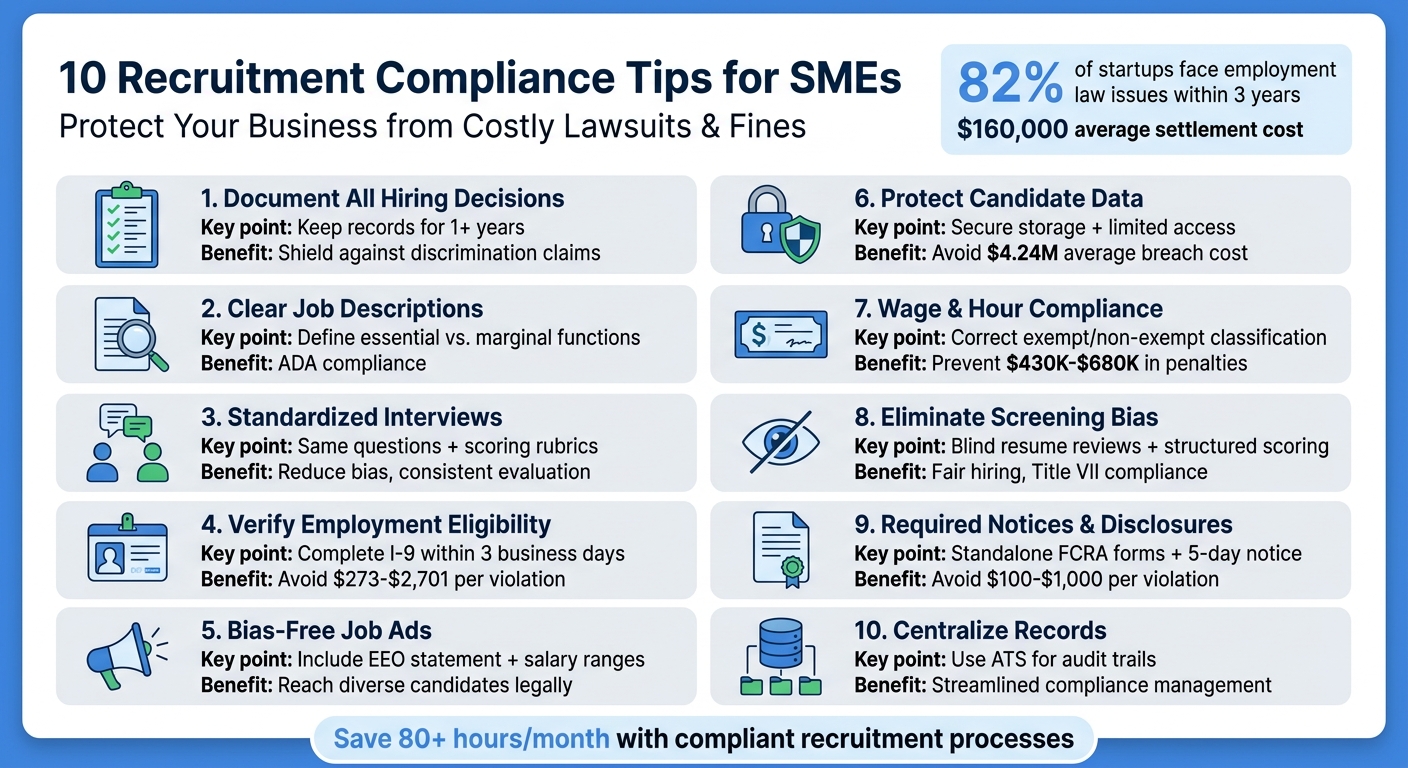
10 Essential Recruitment Compliance Tips for SMEs – Quick Reference Guide
Hiring Compliance Basics Tutorial for Beginners
Before implementing these compliance steps, consider performing a recruitment process audit to identify existing gaps in your strategy.
sbb-itb-a23bd6a
1. Document All Hiring Decisions and Selection Criteria
Keeping a detailed record of all hiring decisions is more than just good practice – it’s a legal requirement. Federal law mandates that employers with 15 or more employees retain applications and interview notes for at least one year from the hiring decision date [7][1]. Even if your company is smaller, proper documentation can serve as a shield against potential discrimination claims.
To ensure consistency and compliance, document the job-related reasons behind each hiring decision. Use standardized interview questions, detailed candidate notes, and a uniform scoring system. Focus exclusively on job-related qualifications in your notes, steering clear of any mention of protected characteristics such as age, race, or disability. Avoid writing directly on resumes; instead, use separate sheets for interview notes to eliminate any perception of bias. This structured approach not only supports unbiased hiring but also lays the groundwork for compliance.
For example, in 2024, Zenith Robotics, a robotics startup, adopted an automated Applicant Tracking System (ATS) to streamline reviews and meet equal opportunity regulations. By meticulously documenting every hiring stage and applying standardized scoring, they boosted hiring efficiency by 20% while reducing legal risks [4].
Your hiring documentation should include key elements such as:
- A thorough job analysis
- Standardized interview questions and scoring rubrics
- Clear rejection reasons
- Standalone background check authorizations
- Form I-9 with verification documents
Remember, I-9 forms must be retained for three years after the hire date or one year after employment ends, whichever is longer [6]. Proper documentation isn’t just about compliance; it’s a cornerstone of fair and efficient hiring.
2. Create Clear Job Descriptions and Role Requirements
Building on thorough documentation, clear job descriptions are essential for maintaining both legal compliance and operational clarity. A legally sound hiring process starts with a well-constructed job analysis that identifies essential functions [1]. This involves separating core responsibilities – those fundamental to the role – from secondary tasks performed occasionally. This distinction is crucial for meeting the requirements of the Americans with Disabilities Act (ADA) [1][10].
Here’s how to craft job descriptions that are both compliant and precise. Use measurable, objective criteria when detailing qualifications. For instance, specify requirements like "Must have a bachelor’s degree" or "Proficient in QuickBooks" instead of ambiguous terms such as "good fit." Avoid language that could imply bias toward protected characteristics. Phrases like "young", "energetic", "recent graduate", or "digital native" could lead to age discrimination claims under the Age Discrimination in Employment Act (ADEA) [6][9]. Similarly, replace gender-specific terms like "salesman" with "sales professional", and use "fluent in written and spoken English" instead of "native English speaker" to avoid potential national origin discrimination.
"Job descriptions are often overlooked, but they become critical when you have to explain why someone was or wasn’t hired, or why a role was classified a certain way." – Charles Krugel, Law Offices of Charles Krugel [10]
Make sure your job descriptions include an Equal Opportunity Employer (EEO) statement and a disclaimer clarifying that the listing is not a guarantee of employment [9]. When outlining physical requirements, include the phrase "with or without reasonable accommodation" to align with ADA guidelines [6]. Post salary ranges to comply with pay transparency laws in states like California, New York, and Colorado [6][10][11].
To ensure your requirements are fair, apply the "Would I Reject?" test: if you wouldn’t disqualify an otherwise excellent candidate for lacking a specific qualification, list it as "preferred" rather than "required" [11]. This not only widens your talent pool but also keeps your job description legally compliant. Regularly review and update job descriptions to ensure they accurately reflect current responsibilities and adhere to evolving legal standards [9].
3. Use Standardized Interview Processes
A structured interview process is key to ensuring fairness for every candidate. By standardizing your approach, you not only reduce the risk of bias claims but also create consistent documentation that can protect your business in the event of discrimination allegations [1].
Focus your questions on job-related skills, experience, and qualifications. Let your job description guide you – identify the critical functions of the role and design talent acquisition strategies that use open-ended questions to explore relevant behaviors. For example, instead of asking, "Do you work well under pressure?" try something like, "Can you describe a time when you had to meet a tight deadline with limited resources? What steps did you take?" This approach reveals how candidates have handled real challenges.
"Remember to be objective. Ask questions that tell you how a candidate would handle real situations or may have in the past." – Heather Whitney, HRRT Program Manager, Paychex [6]
To ensure consistency, use a scoring rubric that assigns numerical values to responses for each question. This provides an objective framework for evaluating candidates and strengthens compliance efforts [8]. Additionally, diverse interview panels can help minimize unconscious bias [8]. Keep your notes clear and separate from resumes, avoiding any mention of protected characteristics such as age, race, or disability [9].
Federal anti-discrimination laws generally apply to companies with 15 or more employees (20 for the Age Discrimination in Employment Act), but some states, like California, extend these protections to businesses with as few as five employees [1]. No matter your size, retain all interview notes for at least one year after making a hiring decision, as required by EEOC regulations [7][1].
If managing this process feels overwhelming, consider partnering with Rent a Recruiter. Their embedded recruitment service places experienced recruiters directly in your team to handle hiring from start to finish, ensuring compliance and efficiency.
4. Verify Employment Eligibility and Run Background Checks Correctly
Ensuring compliance during recruitment starts with verifying employment eligibility thoroughly. Every new hire must complete Form I-9: employees fill out Section 1 on their first day, and employers must review original documents within three business days. Accept either one document from List A (proving both identity and work authorization) or a combination of one document from List B (identity) and one from List C (work authorization). Keep these forms stored separately from personnel files to protect privacy and simplify audits.
As of 2023, penalties for I-9 violations range from $273 to $2,701 per violation for first offenses [12]. Under 2026 ICE guidance, even minor errors – like missing birth dates or signatures – can lead to immediate fines [15]. Conducting annual audits is essential to catch issues like missing signatures or expired documents. For employees with temporary work authorization, set up a tracking system with reminders at 90, 60, and 30 days before expiration to ensure timely reverification. Staying updated on the latest guidance and penalties will help you avoid costly mistakes. For more guidance, explore our recruitment resources.
When it comes to background checks, the Fair Credit Reporting Act (FCRA) has specific requirements if you use third-party agencies. You must provide a standalone written disclosure and obtain written candidate authorization – don’t bury this in a job application. If a background check reveals negative information, issue a "Pre-Adverse Action Notice" and allow at least five business days for the candidate to dispute the findings [13]. Between 2020 and 2025, companies paid over $825 million in FCRA settlements for non-compliance [14].
"If a background check is relevant to a role, apply it consistently to every candidate for that role. This helps reduce bias risk and ensures your process is easier to defend." – Jenna Phipps, Author, Checkr [13]
Consistency is key to avoiding discrimination claims under Title VII. For roles requiring criminal background checks, document an individualized assessment that considers the nature of the offense, time elapsed, and the role’s requirements. For instance, in 2017, Costco Wholesale Corp. settled a class action lawsuit (Terrell v. Costco) for $2.5 million after including unnecessary information on FCRA disclosure forms [16]. Similarly, BMW Manufacturing Co. paid $1.6 million after the EEOC found its criminal background policy disproportionately impacted Black workers – 80% of those terminated were Black [16]. When federal and state regulations overlap, always follow the stricter rule to stay compliant.
5. Promote Equal Opportunity in Job Advertising
Your job postings are often the first interaction candidates have with your company, and they can also be a source of compliance issues. Federal anti-discrimination laws under Title VII apply to businesses with 15 or more employees [8], making it essential for even smaller teams to review their job ads for potential bias. The way you advertise roles sets the tone for a fair and inclusive recruitment process.
Clear, unbiased language in job postings can help reduce legal risks while making your openings more accessible to a diverse range of candidates. Avoid language that could imply age or gender bias. For example, replace terms like "recent college graduate" or "digital native" with "entry-level position." Similarly, swap gendered terms like "salesman" for neutral ones such as "salesperson."
Certain adjectives, like "aggressive" or "ambitious", may discourage candidates from underrepresented groups. Instead, use performance-focused descriptions like "proven track record of exceeding sales goals" or "career-minded professional." When language proficiency is required, specify it objectively – phrases like "fluent in English" or "professional-level English proficiency" are better alternatives to "native English speaker", which could unintentionally exclude candidates based on national origin. These adjustments not only reflect a commitment to fair hiring but also help protect your business from discrimination claims.
Including an Equal Opportunity Employer (EEO) statement in every job ad is another step toward demonstrating your dedication to fair hiring practices. Broaden your recruitment efforts by leveraging channels like minority-focused job fairs, technical schools, and local community publications to reach a wider audience.
For companies using AI tools to draft job ads or screen candidates, keep in mind that jurisdictions like New York City now mandate independent bias audits for such tools [8]. Lastly, focus on the role’s essential functions and state prerequisites clearly. For example, "Must be proficient in Excel" is specific and compliant, whereas phrases like "good fit with company culture" can introduce unconscious bias and open the door to potential legal challenges.
6. Protect Candidate Information and Privacy
Safeguarding candidate data isn’t just about ticking a compliance box – it’s about maintaining trust and avoiding costly mistakes. Candidate data includes everything from resumes and interview notes to background check results and medical records. Mishandling this information can lead to legal penalties and tarnish your reputation. For example, the Fair Credit Reporting Act (FCRA) requires employers to provide a standalone disclosure and get written consent before conducting any background checks [13]. This means you can’t bury the authorization in a general application form – it needs to be a clear, separate document.
Privacy laws also set strict limits on what you can ask and when. The Americans with Disabilities Act (ADA) prohibits medical or disability-related questions until a conditional job offer is made [19]. Similarly, "Ban the Box" laws – enforced in 37 states and over 100 cities – prevent employers from asking about criminal history on initial applications [20]. Ignoring these rules could lead to discrimination claims.
If you’re using AI tools for screening, California law requires you to retain data for four years [13]. And with the average cost of a data breach sitting at $4.24 million [5], secure data storage is non-negotiable.
Here are some practical steps to stay compliant:
- Collect only what you need: Avoid gathering unnecessary data during the hiring process.
- Use an ATS with compliance features: Look for tools that offer automated data deletion, consent tracking, and encryption [21].
- Be transparent: Share a clear privacy notice with candidates, explaining what data you collect, how it’s used, and how long it’s stored [22].
Compliance doesn’t stop there. You also need workflows for handling candidate rights requests under laws like the CCPA, which require responses within 45 days [22]. Equip your hiring team with the training to recognize and manage these requests. And don’t underestimate the risks of non-compliance – failing to meet GDPR standards could cost you up to €20 million or 4% of your global annual turnover [21].
Protecting candidate data isn’t just a legal requirement – it’s a smart business move that safeguards both your reputation and your bottom line.
7. Follow Wage and Hour Laws in Job Offers
Ignoring wage and hour laws when making job offers can lead to hefty financial penalties. In fiscal year 2023, the Department of Labor recovered over $274 million in back wages for workers [23]. Misclassifying just 10 employees could cost you anywhere from $430,000 to $680,000 in back wages, taxes, penalties, and legal fees [2]. The rules may seem straightforward, but they’re strictly enforced, and the penalties for mistakes are steep.
Start by understanding your minimum wage obligations. The federal minimum wage is $7.25 per hour, but 30 states and Washington D.C. have set higher rates [23]. When federal and state laws differ, you must follow the standard that benefits the employee most [23][24]. For example, Washington state’s minimum wage is $16.66 per hour, regardless of the federal rate. If you employ remote workers, you’ll need to comply with the wage laws of their state, always applying the stricter standard.
Misclassifying employees as exempt from overtime is another common and costly error. To legally withhold overtime pay, the position must meet three criteria:
- Salary basis test: The employee must receive a fixed salary.
- Salary level test: The salary must be at least $35,568 annually (as of 2026).
- Duties test: The role must involve executive, administrative, professional, computer, or outside sales work [23][2].
A job title like "Manager" isn’t enough. If the role fails to meet all three tests, you’ll owe overtime at 1.5 times the regular hourly rate for any hours worked beyond 40 in a week [23].
"Being salaried does not automatically make someone exempt. The employee must also perform executive, administrative, professional, computer, or outside sales duties." – FirstHR [3]
Clarity in your offer letters is just as important. Clearly state whether the position is exempt or non-exempt from overtime, include the exact salary or hourly rate, and use at-will language to avoid unintentionally creating an implied employment contract [17][2]. If you’re hiring in states with pay transparency laws – such as California, New York, Washington, or Illinois (effective January 2025) – you’re required to disclose salary ranges in job postings [17]. Additionally, over 20 states now ban salary history questions to help prevent pay inequities from carrying over into new roles [17].
For startups, it’s critical to remember that you can’t pay employees with equity alone. The Fair Labor Standards Act (FLSA) mandates that employees receive at least the minimum wage in cash, except for owners holding at least 20% equity [2]. Keep comprehensive payroll records for at least three years and time-tracking data for at least two years to safeguard against audits [23]. Civil penalties for repeated or willful violations can reach up to $2,374 per infraction [23], and with the Department of Labor increasing wage and hour investigations by 20% recently [2], staying compliant is non-negotiable.
8. Eliminate Bias in Screening and Selection
Unconscious bias doesn’t just affect workplace diversity – it can also open your business to legal risks. Under Title VII of federal anti-discrimination laws, companies with 15 or more employees must comply with strict hiring practices [8]. Studies show that resumes with names like "Latisha" and "Jamal" often receive fewer callbacks compared to those with names like "Emily" and "Greg." Similarly, first impressions during interviews can heavily sway hiring decisions [25]. These issues highlight the importance of creating structured, bias-reducing hiring processes.
The key to reducing bias lies in standardization. Moving from subjective judgments to data-driven methods ensures fairer outcomes. One effective step is blind resume screening. This involves using software or assigning a non-decision maker to redact identifying details like names, photos, and graduation years before resumes are reviewed. Not only does this approach promote fairness, but it also helps businesses stay compliant with Title VII. For example, in 2018, Dawn Smith, VMware’s Chief Legal Officer, introduced a "diverse slate" requirement for a high-level legal role. By focusing job descriptions on measurable qualifications – such as specific degrees and years of experience – rather than subjective traits, she successfully hired a minority woman for the position [25] [9].
Structured interviews are another critical tool in minimizing bias. Using a consistent set of predetermined questions for all candidates, paired with a numerical scorecard for evaluation, ensures objectivity [8] [25]. Jill Koob, VP of Sales Solutions at Employer Flexible, demonstrated this in 2018 while hiring an operations analyst. Her process included blind resume reviews, technical skill testing (via Prove It for Excel and Word), a structured interview with 10 identical questions scored on a 1–5 scale, and a 36-hour work sample presentation. This method led to hiring Christy, a female candidate who later earned a promotion [25].
"Awareness training is the first step to unraveling unconscious bias because it allows employees to recognize that everyone possesses them and to identify their own." – Francesca Gino, Professor, Harvard Business School [25]
Finally, revisit your job descriptions. Replace gendered terms like “aggressive” or “competitive” with neutral phrases like “proven track record” or “collaborative.” Avoid age-related language such as “recent college graduate,” which can unintentionally exclude older candidates [8]. For those using AI screening tools, be aware that New York City now mandates independent bias audits for these systems [8].
9. Provide Required Notices and Disclosures to Candidates
Handling background checks securely is just one part of staying compliant. The next step? Ensuring candidates receive the proper notices and disclosures. Missing or mishandling this paperwork can lead to hefty fines. For instance, a healthcare company in Tennessee with fewer than 200 employees was hit with a $420,000 settlement for failing to present its background check disclosure as a standalone document. Another staffing company faced a class-action settlement of $5.75 million for a similar oversight [26].
Under the Fair Credit Reporting Act (FCRA), you must provide candidates with a separate disclosure form before initiating a background check. This form cannot be bundled with job applications or liability waivers – it must stand alone. After the candidate signs this document, you are required to obtain their written consent before proceeding with the report. If the background check reveals adverse information, you must:
- Send a pre-adverse action notice along with a copy of the report.
- Allow five business days for the candidate to respond before issuing a final notice, which must include details about the screening company [26][17].
Beyond background checks, don’t overlook other disclosure requirements. For example, job postings in states like California, Colorado, New York, Washington, and, starting January 2025, Illinois, must include salary ranges to comply with pay transparency laws. Additionally, some states now require specific disclosures when using AI-based screening tools [13]. Under the Americans with Disabilities Act (ADA), medical exams or questions can only be conducted after a conditional job offer is made [1][2].
"FCRA is not a law most small business owners think about until they run their first background check." – FirstHR [26]
Keep hiring records for at least one year, while consent forms and background check reports should be retained for up to five years. If you’re hiring remote workers, remember that the disclosure rules of the candidate’s home state may apply. FCRA violations can result in statutory damages ranging from $100 to $1,000 per violation, plus attorney fees [26]. By adhering to these practices, you reduce risks and maintain compliance throughout your hiring process.
10. Centralize Recruitment Data and Keep Compliance Records
After addressing disclosures, the next priority is consolidating all recruitment data. Fragmented systems can lead to compliance headaches. Many legal issues in hiring, such as discrimination claims or disputes, arise from poor recordkeeping – think missing interview notes, misplaced applications, or incomplete hiring documentation.
A well-implemented Applicant Tracking System (ATS) solves this by creating a searchable audit trail. It securely stores applications, communications, and hiring decisions, ensuring you’re prepared for audits or challenges. For context, in 2020, the EEOC recovered $439.2 million in monetary benefits for victims of workplace discrimination [5].
Your ATS should maintain the following compliance-critical documents:
- Job descriptions
- Applications and resumes
- Candidate communications
- Interview evaluations
- Documented hiring decisions
- Background check consents
- Form I-9 documents
- EEO-1 reports [18]
This centralization not only ensures compliance with regulations but also simplifies your recruitment operations.
To protect sensitive information, implement role-based access controls and integrate your ATS with your HRIS. This minimizes risks during data transfers. With 68% of startups now working remotely [4], a centralized system also makes it easier to manage hiring across varying state laws.
Finally, establish data retention policies that align with federal and state requirements. Agencies like the OFCCP and EEOC outline specific timelines for keeping records [20]. For example, California mandates storing data from automated decision systems for four years [13]. Regular audits of your recruitment records can help identify and address gaps before they escalate into compliance issues [18].
Compliance Checklist Table
Use the table below to assess recruitment compliance by linking practical tips to key actions, required documentation, and common mistakes.
This checklist condenses the previous ten tips into a quick-reference guide for aligning your recruitment process with compliance priorities.
| Recruitment Tip | Primary Compliance Area | Key Action | Required Documentation | Common Pitfall |
|---|---|---|---|---|
| 1. Document Decisions | Litigation Defense / EEOC | Record job-related reasons for hiring decisions using standard scoring rubrics. | Interview evaluations, selection notes, scoring rubrics. | Using vague terms like "not a culture fit" instead of objective criteria. |
| 2. Clear Job Descriptions | ADA / EEO | Differentiate "essential functions" from "marginal" tasks in job descriptions. | ADA-compliant job descriptions with function classifications. | Overstating physical requirements (e.g., "must lift 50 lbs") unnecessarily. |
| 3. Standardized Interviews | Title VII / ADEA | Use identical, job-related questions for all candidates with scoring guides. | Interview question templates, evaluation forms. | Asking irrelevant personal questions during casual conversation. |
| 4. Eligibility & Background Checks | I-9 / FCRA | Verify work authorization documents within three business days; issue separate FCRA disclosures. | Form I-9, FCRA authorization forms, background check records. | Accepting photocopies instead of original documents. |
| 5. Equal Opportunity Ads | Pay Transparency / EEO | Include salary ranges (in states like CA, NY, CO, WA) and EEO statements in job postings. | Job posting records with salary data and EEO taglines. | Using gender-coded terms like "salesman" or "ninja." |
| 6. Protect Candidate Info | GDPR / CCPA / HIPAA | Restrict access to sensitive candidate data and establish deletion schedules. | Secure folders with role-based access, retention policies. | Storing medical or background check data in general personnel files. |
| 7. Wage & Hour Laws | FLSA | Ensure correct classification of roles as exempt or non-exempt and pay at least the minimum wage in cash. | FLSA classification analysis, offer letters with status details. | Paying employees solely in equity without providing cash wages. |
| 8. Eliminate Bias | EEOC / ADEA | Use blind resume screening and avoid age-related terms in job requirements. | Fair chance assessment records, diverse interview panel logs. | Setting experience caps like "maximum 5 years’ experience." |
| 9. Required Notices | FCRA / Ban-the-Box | Provide pre-adverse action notices and a "Summary of Rights Under FCRA" for background checks. | FCRA disclosure forms, pre-adverse action notices. | Conducting background checks before a conditional offer in Ban-the-Box areas. |
| 10. Centralize Records | Federal/State Recordkeeping | Report new hires within 20 days and retain I-9 forms for the required period. | ATS audit trails, compliance calendar, new hire reports. | Missing I-9 retention deadlines or new hire reporting windows. |
For more detailed guidance, revisit the complete tips provided earlier in the article.
Conclusion
Scaling your recruitment efforts starts with getting compliance right from the beginning. By establishing compliant systems early, you avoid costly retroactive fixes and set up a solid foundation for rapid team growth. The stakes are clear: 82% of startups encounter at least one employment law issue within their first three years, with average settlements hitting $160,000 [4]. For growing SMEs, these risks can stall progress at the worst time.
Beyond compliance, having streamlined, standardized processes boosts efficiency across the board. A structured approach not only minimizes legal risks but also improves hiring speed and ensures every candidate is treated fairly. As highlighted earlier, businesses that adopt these systems often see measurable improvements in both hiring performance and risk management.
However, navigating complex employment laws and evolving regulations – like multi-state compliance or pay transparency rules – can overwhelm many SMEs. This is where external expertise becomes a game-changer. Rent a Recruiter places experienced recruiters directly within your team, ensuring your hiring processes are both structured and compliant. On average, companies save over 80 hours per month in internal hiring tasks, freeing up valuable time to focus on growth and revenue-driving initiatives.
FAQs
What hiring records should I keep, and for how long?
You should keep hiring records – such as job applications, resumes, interview notes, and screening tools – for at least one year after the hiring decision or an employee’s termination, whichever comes later. If you’re a federal contractor, the retention period extends to two years. Be sure to review state-specific laws as well, since retention requirements can differ depending on your location.
What are the most common FCRA mistakes with background checks?
The most frequent mistakes under the FCRA include failing to provide a standalone written disclosure before conducting a background check, not giving candidates a copy of their report before making a rejection decision, and skipping the adverse action process entirely. These missteps can result in hefty statutory damages, making it essential to follow the correct procedures to stay compliant with FCRA requirements.
How do I stay compliant when hiring remote employees in multiple states?
To ensure compliance, it’s crucial to understand and adhere to each state’s employment laws, tax rules, and registration requirements. For instance, if you have remote employees in California, you’ll need to follow California labor laws, which cover areas like minimum wage and paid leave.
Additionally, many states require businesses to register if they employ workers within their borders. Seeking advice from state-specific legal resources or consulting compliance experts can help you manage these obligations and steer clear of potential legal issues.