
If your best people leave, the problem is often leadership, not pay.
I’d sum the article up like this: manager habits drive retention, and retention drives cost, output, and hiring pressure. When strong managers give people clarity, growth, trust, and regular feedback, teams stay steadier. When they do not, you pay for it in lost output, backfill time, and another hiring cycle.
Here’s the short version:
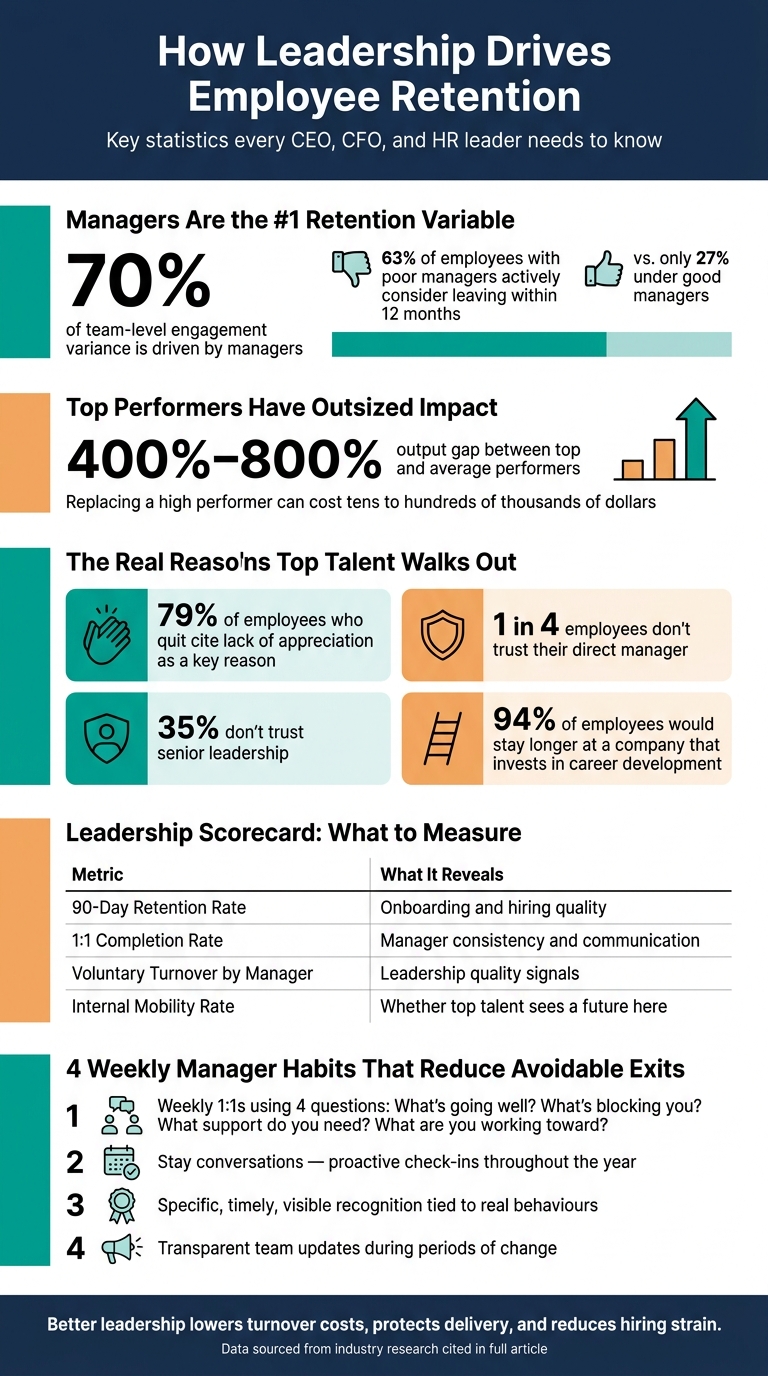
- Top performers have outsized impact, with output gaps that can reach 400% to 800% versus average performers
- Managers shape engagement, accounting for 70% of team-level variance
- Poor leadership shows up early through missed 1:1s, weak recognition, low trust, and stalled growth
- Simple routines cut avoidable exits, including weekly 1:1s, stay conversations, stretch work, and direct updates during change
- The right data helps you act sooner, such as regrettable attrition, manager-level turnover, 90-day retention, and internal mobility
For CEOs, CFOs, HR leaders, and Talent leaders, the commercial point is clear: better leadership lowers turnover costs, protects delivery, and reduces hiring strain. The rest of the article shows where leaders lose people, and what you can do each week to keep them.
How Leadership Drives Employee Retention: Key Stats & Metrics
Good Morning, HR #256 Seven Leadership Habits That Improve Employee Retention
sbb-itb-a23bd6a
Leadership Behaviors That Directly Affect Retention
Managers account for 70% of the variance in team-level engagement [5]. That gives line managers a direct hand in whether people stay, switch off, or leave. In a growing SME, day-to-day leadership habits can steady the team or push attrition higher. This is where retention becomes practical, not theoretical.
Coaching, Recognition, and Fair Treatment
One of the biggest shifts a leader can make in a fast-growing SME is moving from managing to coaching. Managing is about output. Coaching is about building capability. It means asking better questions, helping people think through problems, and clearing blockers before they slow progress.
"The more answers a leader gives, the less the team thinks for itself. Over time, leaders become overwhelmed while employees become disengaged." – Andy Hall, Founder, Andy Hall Coaching [3]
That matters for retention because people don’t stay where they feel managed like a task list. They stay where they feel they are growing.
Recognition has a direct effect too. 79% of employees who quit cite a lack of appreciation as a key reason for leaving [6]. The fix is not vague praise. It is specific, timely feedback that names the behaviour and explains the result. A quick, clear thank you after strong work lands far better than generic praise at the end of the quarter.
Fair treatment matters just as much. Once people see praise going to the same few voices, or standards changing depending on who is involved, trust starts to slip. And when trust drops, retention usually follows.
Autonomy, Psychological Safety, and Clear Expectations
Support alone is not enough. People also want room to own their work. Strong performers tend to disengage when they feel interchangeable or boxed in. Giving people ownership of outcomes, not just tasks, keeps them tied to the work and more likely to stay.
Trust is still a problem in many teams. 1 in 4 employees don’t trust their direct manager, and 35% don’t trust senior leadership [6]. That is a big warning sign for any scaling business trying to hold onto key people.
Psychological safety plays a big part here. If people can raise concerns, question a decision, or admit a mistake without worrying about fallout, they stay more engaged and contribute more openly.
"The people most likely to notice [the lack of psychological safety] first, and to go quiet, are usually the most thoughtful and most capable." – Dr. Mary-Clare Race, CEO, Talking Talent [1]
Clear expectations matter just as much. If one of your best people cannot explain what success looks like six months from now, drift sets in fast. And once that happens, the cost is not just morale. It is lost output, manager time, and another backfill process you did not plan for. For more insights on managing growth, explore our hiring resources.
How Leaders Keep Top Performers Through Growth and Communication
Career Paths, Stretch Work, and Internal Mobility
Once coaching and trust are in place, growth becomes the next big retention lever. If your best people can’t see a future with you, they’ll start looking for one somewhere else. The data is clear: 94% of employees say they would stay longer at a company that invests in career development [7].
That does not always mean a promotion. It means a path.
One of the main reasons people leave is stalled growth [7]. So career discussions can’t sit in a once-a-year review and gather dust. They need to become part of how managers lead. Ask your top performers what skills they want to build. Ask what kind of work they want more of. Then tie that back to what the business needs next.
This is where stretch assignments do a lot of heavy lifting. Give someone a project that sits just beyond their current comfort zone, then let them own it. That can mean leading a new initiative, taking on cross-functional work, or stepping into a higher-stakes problem. Pair that with coaching, or an internal move if there’s room for one.
Done well, these moves send a clear message: you have a future here.
For scaling companies, that matters even more during periods of fast change. When teams are growing, structures are shifting, and priorities are moving, people pay close attention to whether their role is still going somewhere.
Transparent Communication During Growth and Change
Growth can keep people engaged. Change can push them out.
Restructures, hiring spurts, and strategy shifts often bring uncertainty with them. When leaders go quiet, people fill in the blanks themselves, and that’s when attrition starts to creep in.
Top performers are more likely to stay when they can see two things clearly: their own path and the company’s direction. Transparent communication does not mean sharing every detail. It means explaining the reason behind decisions, saying what is hard, and acting on feedback when you ask for it.
Simple management habits help here:
- Weekly 1:1s that go beyond task updates
- Quarterly career conversations
- Direct team updates during periods of change
But the format is only half the story. What matters is whether those conversations are honest and useful. One question can surface issues before they turn into resignations: What is frustrating you that we have not discussed?
These habits do not cost much. But they do save time, protect team stability, and reduce avoidable turnover. What they ask for is consistency.
The next step is building these habits into day-to-day management.
Practical Retention Systems for SME Leaders
Simple Management Routines That Prevent Avoidable Attrition
Once leaders set the right behaviours, they need routines that make those behaviours stick.
Good intentions do not keep people. Daily management habits do. Most avoidable attrition comes from the gap between what leaders mean to do and what managers do each week.
Managers account for 70% of the variance in team-level engagement [5]. That sounds big, but the fix is not a full HR rebuild. It comes down to a small set of routines used with discipline: structured 1:1s, stay conversations, timely recognition, and fast friction removal.
In weekly or biweekly 1:1s, use four simple questions [5]:
- What’s going well?
- What’s blocking you?
- What support do you need?
- What are you working toward?
This gives managers a repeatable rhythm. It also helps you spot issues before they turn into resignations.
Stay conversations should happen across the year, not only when someone looks ready to leave. Ask what keeps your top performers engaged and what might push them out. These are proactive check-ins, not performance reviews, which gives leaders time to act early [2].
Recognition matters too, but only if it is specific, timely, and visible. A vague "good job" rarely changes much. Clear praise tied to a piece of work shows people that their effort is seen.
The same principle applies to data. You need to track the signals that point to retention risk before someone hands in notice.
Remove friction before it turns into a resignation risk. High performers often carry bureaucracy without saying much. That is why managers should ask about blockers directly and deal with them fast [8].
Using Hiring and Talent Data to Support Retention
Most SMEs track lagging indicators, like turnover rates after people have already left. By then, the damage is done. The better move is to track signals that show up weeks or months earlier.
Three metrics are worth watching on a steady basis: voluntary turnover by manager, 90-day new hire retention, and 1:1 completion rates [5]. Voluntary turnover by manager is one of the clearest signals. Teams with poor managers have 63% of employees actively considering leaving within 12 months, compared with 27% for those with good managers [5]. If one manager keeps showing worse numbers than the rest, that points to a leadership issue, not a hiring issue.
| Metric | Why It Matters | Early Warning Signal |
|---|---|---|
| 90-Day Retention | Measures onboarding and hiring quality | High early turnover suggests role misalignment |
| 1:1 Completion Rate | Measures manager consistency | Dropping rates correlate with disengagement |
| Recognition Frequency | Measures whether people feel valued | Long gaps often precede quiet quitting |
| Internal Mobility Rate | Measures growth opportunities | Low rates suggest top talent feels stuck |
This is also where an embedded recruiter can help. They can bring more structure and visibility into hiring and talent data, so leaders can spot retention risk earlier and act before it affects cost, delivery, and team output.
"If your organization is spending money on engagement surveys… but your managers haven’t changed how they work – you’re solving the wrong problem." – Tamalika Biswas Sarkar, HR Cloud [5]
Track these signals on a steady basis, then review them in leadership meetings.
Measuring Results and Next Steps for Leadership Teams
What to Track to Measure Leadership Impact
Company-wide turnover moves too slowly to help leaders act in time. Team-level signals give you a much clearer read on what’s happening, and they show whether manager habits are helping or hurting.
Once those habits are in place, leaders need a simple scorecard to check if the work is paying off.
Track high-performer loss, not just total turnover. When you lose a high performer, the hit is immediate. Output drops, pressure shifts to the rest of the team, and replacement costs stack up fast.
A small leadership scorecard can help you spot risk early, before resignations start to pile up.
| Metric | What Leadership Behavior It Exposes |
|---|---|
| Regrettable attrition rate | Whether coaching, recognition, and growth conversations are working |
| Manager-level engagement scores | Which managers are losing team trust before people start leaving |
| 1:1 completion rate | Whether managers are maintaining consistent communication rhythms |
| Internal mobility rate | Whether top performers see a future inside the company |
Review these metrics in leadership meetings on a regular cadence. This is not about reporting for the sake of reporting. It is about seeing which managers need a better operating rhythm, before the cost shows up in turnover.
If one manager keeps posting weaker numbers than the rest, that’s not random noise. It’s a leadership issue worth looking into.
Conclusion: Better Leadership Lowers Turnover and Protects Growth
The business case for stronger leadership is straightforward. The cost of replacing a high performer, recruiting fees, onboarding time, and lost institutional knowledge, can run into the tens or hundreds of thousands of dollars [3].
"Retention isn’t something you fix – it’s something you earn through the decisions you make every day." – Sarah Holcombe, Chief People Officer, Maxwell Locke & Ritter [4]
When leaders provide coaching, clarity, growth opportunities, and psychological safety, retention tends to improve as a result. Lower turnover protects growth by cutting backfills, reducing lost knowledge, and freeing up manager time for work that drives the business forward.
Track the signals. Fix the management habits. Then measure the change.
FAQs
Why do top performers leave good companies?
Top performers rarely leave for one reason alone. In most cases, the problem builds over time.
Limited career growth, unsustainable workloads, and a gap between personal values and company culture are common triggers. Pay still matters, of course. But for many high performers, poor manager relationships, unclear priorities, and feeling overlooked carry even more weight.
This usually is not a sudden exit. It is a slow drift.
People start to disengage when their work goes unnoticed, their input has little impact, or their career path feels blocked. By the time they resign, the warning signs have often been there for months.
How can managers spot retention risk early?
Managers can spot early retention risk by paying attention to small shifts in behaviour, especially in high performers.
Often, the first signs are easy to miss. A top employee updates their LinkedIn profile. They speak up less in meetings. They stop putting their hand up for extra projects. They start taking more sick days or more PTO than usual.
On their own, these signals do not always mean someone is about to leave. But taken together, they can point to growing frustration or disengagement. For hiring leaders, that matters. Losing a strong performer costs time, money, and momentum.
That’s why routine check-ins are not enough on their own. Managers should also run regular stay interviews to get ahead of issues before they turn into resignations.
Direct questions tend to work best:
- What’s getting in the way of your best work?
- What would make your role better over the next six months?
- Is there anything making you think about leaving?
These conversations give you a clearer view of what’s going on beneath the surface, and a better chance of fixing problems before you lose someone hard to replace.
What leadership habits improve retention fastest?
Leaders improve retention fastest when they coach well, hold consistent one-to-ones at least once a month, and keep communication clear, open, and two-way.
That matters because people stay when they feel seen, heard, and backed by their manager, not left guessing. A regular one-to-one gives you a simple way to spot issues early, clear blockers, and keep high performers engaged before frustration turns into attrition.
It also helps to recognize good work, give people room to own decisions, build a sense of belonging, and manage workloads in a way people can sustain. Add clear development paths, and your best people are far more likely to feel valued, supported, and energised.