
Instagram is no longer just for photos; it’s now a key tool for finding top talent. With 60% of users under 35 and 73% of 18-to-34-year-olds finding jobs through social platforms, it’s the perfect match for companies hiring Millennials and Gen Z. Instagram’s features make it easier to connect with both active and passive candidates, boosting hiring outcomes.
Key Instagram Tools for Hiring:
- Business Profiles: Add contact buttons and track performance with Instagram Insights.
- Hashtags & Geotags: Increase visibility by targeting specific industries and locations.
- Stories & Highlights: Showcase jobs and workplace culture in a way that stays visible.
- Reels: Reach new audiences with engaging, short-form videos.
- Direct Messages: Start personalized conversations with candidates.
- Live Videos: Host real-time Q&A sessions to connect with potential hires.
- Targeted Ads: Reach passive candidates with precise audience targeting.
Instagram isn’t a complete hiring solution, but when paired with a strong strategy or an embedded recruiter, it can help you save time, cut costs, and hire better people. To see how this approach can reduce hiring costs by up to 70%, visit Rent a Recruiter.
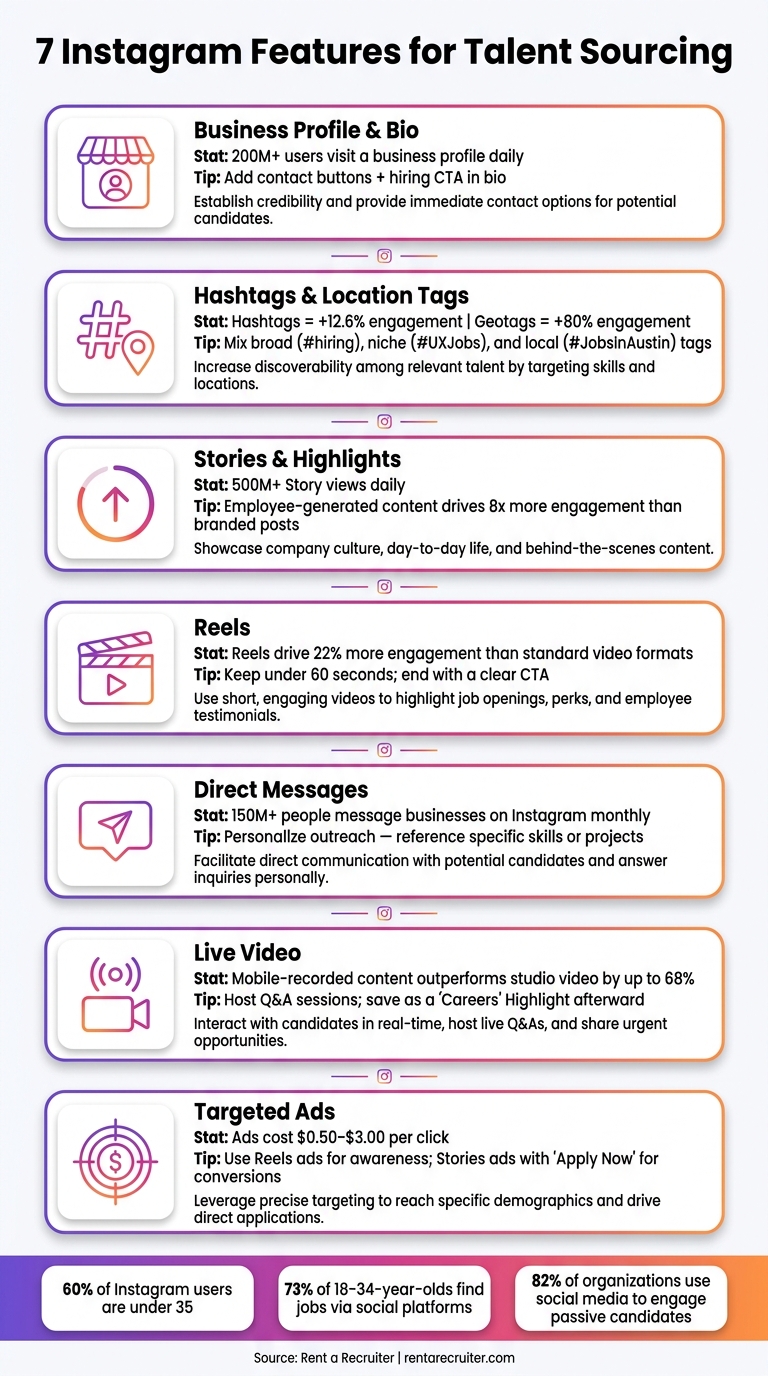
7 Instagram Features for Talent Sourcing: Tools, Stats & Tips
Instagram Features That Help Candidates Find You
Understanding how candidates stumble upon your Instagram profile is key. Whether it’s through hashtags, location tags, or the Explore page, your profile needs to immediately communicate that you’re hiring.
Start by switching to a Business account. This unlocks Instagram Insights, contact buttons, and category labels that make your profile more professional and functional. Use your bio wisely: highlight your mission, mention hiring (e.g., "We’re hiring across the U.S. – check out open roles below 👇"), and include a direct link to current job openings. This simple setup can turn casual browsers into serious applicants. For more hiring tips, explore our recruitment resources.
Hashtags and geotags are your visibility powerhouse. Posts with hashtags see 12.6% more engagement, while geotagged posts can boost engagement by nearly 80% [10]. To maximize reach, use a mix of:
- Broad hashtags like
#hiringor#nowhiringto attract active job seekers - Industry-specific tags such as
#TechJobsor#FintechCareersfor niche talent - Local tags like
#JobsInAustinor#NYCTechto connect with candidates in specific markets
"Hashtags and geotags help more people find your content even if they don’t follow you yet. When used right, they can bring job seekers straight to your posts." – Teamlease Digital [2]
Take it a step further with a branded hashtag, such as #LifeAtAcme. Encourage employees to use it when sharing moments from their work life. This creates a searchable, authentic archive of your company culture, offering job seekers a genuine glimpse into your workplace.
sbb-itb-a23bd6a
1. Optimized Business Profile and Bio
Your Instagram profile is often the first touchpoint for potential candidates, making it essential to leave a strong impression. A polished profile not only builds trust but also signals that your company is active and approachable, which is vital when hiring as you scale.
Switching to a Business account is a smart move. It allows you to add contact buttons like Email, Call, or Message, making it easy for candidates to connect with you directly. Considering that over 200 million Instagram users visit at least one business profile every day [10], this accessibility can make all the difference.
"Before you can even go out on your search, you definitely have to build up your bio. So if we are going to be potentially reaching out to people or engaging with people, they know who we are essentially and maybe why we would be reaching out to them." – Angela Bortolussi, Recruiting Manager, Recruiting Social [12]
Your bio is prime real estate – 150 characters to define who you are and what you offer. Use keywords like "Tech Jobs" or "We’re Hiring" to increase visibility, not just on Instagram but also on Google, as these profiles are indexed. Including a clear call-to-action, such as "We’re hiring across the U.S. – apply via the link below 👇", directs candidates to take the next step [2][6].
Don’t underestimate the power of Story Highlights. Unlike regular Stories that disappear after 24 hours, Highlights stay on your profile permanently. Create Highlights like "Open Roles" or "Life at [Company]" to showcase job opportunities and company culture. For businesses hiring in multiple U.S. regions, this feature ensures your profile works for you 24/7 with minimal effort [2][6].
2. Hashtags and Location Tags
Once your profile is optimized, the next step is to make your posts discoverable. Hashtags and location tags are powerful tools to connect with the right talent. As Teamlease Digital points out:
"Hashtags and geotags help more people find your content even if they don’t follow you yet. When used right, they can bring job seekers straight to your posts." [2]
The trick lies in choosing hashtags wisely. Broad tags like #hiring or #nowhiring can reach a large audience, but niche tags such as #FintechCareer, #UXjobs, or #travelrn are better for targeting specific skill sets. With 82% of organizations using social media recruiting strategy to engage passive candidates [3], hashtags can be your direct line to professionals who aren’t actively job hunting but could be intrigued by the right opportunity.
Location tags add another layer of precision. For instance, if you’re hiring in Austin, tagging your office location and using tags like #HiringAustin or #TechJobsATX can help attract local talent. For tech hubs like New York or San Francisco, combining geotags with city-specific hashtags such as #AIJobsNYC or #TechJobsSF ensures your reach extends to both map-based and hashtag-based searches.
To refine your approach, use Instagram Insights to track which hashtags perform best. Over time, this data-driven strategy can help you fine-tune your sourcing efforts and consistently connect with the right candidates.
3. Stories for Real-Time Culture and Job Spotlights
Instagram Stories offer a dynamic way to highlight your company culture and job openings, building on optimized profiles and strategic hashtags.
Since Stories disappear after 24 hours, they create a natural sense of urgency, encouraging candidates to act quickly on job updates. As Recruitics explains:
"Short-lived stories enhance employer branding by creating a sense of urgency, fostering personal connections, and showcasing a company’s culture in its rawest form." [13]
With over 500 million views daily [7], Stories are a prime spot for visibility. Their placement at the top of the app ensures your hiring posts won’t get lost in crowded feeds.
Unpolished, authentic content performs exceptionally well. Whether it’s a short video of the engineering team solving a tough challenge, which is a great way to showcase engineering recruitment solutions in action, a sales rep celebrating a big win, or a peek into a Friday team lunch, these moments resonate. Employee-generated content, in particular, drives 8x more engagement than traditional branded posts [9]. Candidates value the honesty and the human element.
Some companies amplify this approach with employee takeovers. These give team members the reins to document their workday through the company’s Story, offering candidates a genuine, unfiltered look at the role [2]. For job spotlights, make sure to include a link sticker that directs viewers straight to the application form or careers page – making it easy for them to take the next step.
Interactive features like polls can also enhance engagement. Asking something like, "What’s more important to you: flexibility or growth opportunities?" not only sparks interaction but also offers valuable insight into what candidates care about.
Instagram Stories, with their real-time nature, are a powerful addition to your overall Instagram strategy and broader talent acquisition strategies for attracting top talent.
4. Reels for Employer Branding
Reels are a game-changer for reaching new audiences. Unlike Stories, which primarily connect with your existing followers, Instagram’s algorithm actively promotes Reels on the Explore page and the Reels tab. This means your employer brand can land in front of passive candidates – those who aren’t actively job hunting but might be open to the right opportunity [2][6].
Short, engaging Reels (under 60 seconds) showcasing your team, office, or culture consistently outperform static job posts. As Matthew Jeffrey, Global Head of Sourcing & Employment Brand at SAP, famously said:
"Recruitment IS marketing. If you’re a recruiter nowadays and you don’t see yourself as a marketer, you’re in the wrong profession." [8]
This marketing mindset is what makes Reels so effective. Reels drive up to 22% more engagement than standard video formats on Instagram [1]. To maximize impact, keep the videos concise, include key details like job roles and salary ranges, and always end with a direct call-to-action – something like "DM us ‘APPLY’ for more info" or "Check the link in our bio for open roles" [2][5].
Mixing up your content is crucial. Office tours, "day in the life" clips, team highlights, or even quick interview tips can all perform well (see our recruitment videos for inspiration) [2][1][14]. Candidates respond better to authentic, unpolished videos than to anything overly polished or corporate-looking [4][14].
Finally, don’t let the engagement stop at views and likes. Use direct messaging to turn interest from Reels into meaningful, personalized conversations.
5. Direct Messages for One-to-One Outreach
Instagram Direct Messages (DMs) provide a smooth way to transition from public posts like Reels or Stories into private, one-on-one conversations, making your recruiting process faster and more personal. With over 150 million people messaging businesses on Instagram every month [15], it’s clear that candidates are already comfortable using this platform for communication. This shift to a private channel allows for more tailored and engaging interactions with potential talent.
DMs are especially effective for reaching passive candidates – those who aren’t actively searching job boards but could be open to the right role. Recruitment expert Manisha Saini puts it perfectly:
"Instagram is perfect for reaching passive candidates who aren’t actively job hunting but would be open to the right opportunity." [11]
The key here is personalization. A generic "We’re hiring!" message won’t cut it. Instead, reference something specific from their profile, like a standout project or skill, to show genuine interest. This approach not only grabs attention but also increases the chances of a meaningful response.
Begin the conversation with two or three quick, targeted questions about their expertise, availability, or interest level. Keep the dialogue on Instagram until it feels productive, then guide them toward a formal application or your ATS. Tools like Instagram’s Saved Replies and Labels can help you respond efficiently while keeping interactions personal.
For managing these conversations at scale, Instagram Business accounts offer features that make life easier. Use Labels to track where candidates are in your hiring process (e.g., "Screening", "Interested", or "Scheduled"). Additionally, integrating your Instagram inbox with a CRM or ATS ensures no conversation slips through the cracks. This combination of direct outreach and organizational tools can transform Instagram into a powerful recruitment channel by revamping your recruitment process.
6. Live Video for Q&A and Virtual Events
Instagram Live Video offers a powerful way to connect with potential candidates through real-time Q&A sessions and virtual hiring events, adding a personal and interactive touch to your recruitment services.
One standout benefit of Live Video is its relatability. Mobile-recorded content tends to outperform polished studio videos by up to 68%, as it feels more genuine and unscripted [10]. This resonates particularly well with Millennials and Gen Z, who value honest, unfiltered interactions. Featuring real employees answering questions in real time can make your company feel more approachable and relatable.
"The response is always positive when the content features real people, as it gives the company a human touch and makes it feel more approachable." – Talkpush [10]
To make your Live session impactful, preparation is key. Use Instagram Stories with a "Question" sticker to gather candidate queries ahead of time. Schedule your session for high-engagement times, like Wednesdays or Thursdays, to maximize visibility [10]. Including team members such as department leads or even your CEO adds credibility and helps candidates picture themselves as part of your team.
After the session, save the video as a "Careers" or "Meet the Team" Highlight on your profile. This ensures passive candidates can access the content later. Wrap up each Live with a clear call to action, such as directing viewers to apply via your bio link or encouraging them to send a direct message. Follow up promptly to maintain momentum and keep the conversation going [2][6].
7. Targeted Ads for Hard-to-Reach Talent
Relying solely on organic content limits your reach to current followers, but embedded recruitment services use paid ads to break through that barrier. They allow you to showcase roles to highly specific audiences based on factors like age, location, interests, job titles, and even browsing habits.
This is especially effective for reaching passive candidates – those who aren’t actively job hunting but might be intrigued by the right opportunity. As recruitment expert Manisha Saini explains:
"Instagram is perfect for reaching passive candidates who aren’t actively job hunting but would be open to the right opportunity." [11]
Paid ads work as a powerful complement to organic efforts by targeting individuals beyond your immediate network.
The level of targeting is impressive. Imagine a fintech company in Austin, Texas, looking for tech-savvy professionals. They could run ads aimed at users aged 25–34 who follow finance-related accounts and engage with software tools. Or take a healthcare system recruiting travel nurses – they could focus on users interacting with hashtags like #travelrn or #nurselife.
Ad formats also play a critical role. Reels ads are ideal for building awareness, while carousel ads let you dive into specifics like salary, shift options, or team dynamics. Stories ads, featuring an "Apply Now" button, are particularly effective for mobile users – over 90% of Instagram users browse on their phones [9]. This reduces the steps from interest to application, making the process seamless.
To measure success, tag candidates in your ATS with an "Instagram Ads" label. Monitor metrics like click-through rates, DM responses, and cost-per-placement to gauge the effectiveness of your campaigns. Instagram Insights also provides real-time data on audience engagement and ad performance [7], helping you refine your strategy by doubling down on what works and cutting what doesn’t.
Paid Features and Analytics for Smarter Sourcing
Running ads is only part of the equation – tracking performance is what separates efficient sourcing from wasted budgets. Instagram’s native analytics, paired with Meta Ads Manager, give recruiters a clear view of what’s working and what’s not.
Instagram Insights (available with Business profiles) handles the organic side, offering data on metrics like reach, engagement rates, and audience demographics. For paid campaigns, Meta Ads Manager dives deeper, tracking key performance indicators like click-through rate (CTR), cost per click (CPC), and application conversion rates. Together, these tools map the entire journey, from the first impression to the final application, helping you optimize campaigns and avoid overspending.
One crucial metric to monitor is ad frequency. If a candidate sees your ad more than five times without taking action, your budget is being wasted [16]. Regularly refreshing your ad creative – every 21 days, for instance – can help combat ad fatigue and maintain healthy engagement levels.
Here’s a quick breakdown of key metrics, their purpose, and where to find them:
| Metric | What It Tells You | Where to Find It |
|---|---|---|
| Reach | Number of unique users who saw your content | Instagram Insights |
| CTR (Click-Through Rate) | How engaging your ad is to candidates | Meta Ads Manager |
| Application Conversion Rate | Percentage of clicks that turn into applications | Meta Ads Manager / ATS |
| Cost Per Hire (CPH) | Total ad spend per hire | Meta Ads Manager / ATS |
| Ad Frequency | How many times the same user sees your ad | Meta Ads Manager |
To make these insights actionable, tag every candidate sourced from Instagram in your ATS with a label like "Instagram_Paid." This method allows you to calculate the true cost-per-hire for Instagram and compare it against other sourcing strategies. For more insights on optimizing your talent pipeline, explore The Talent Fix recruitment blog. Instagram ads generally cost between $0.50 and $3.00 per click [16]. Using UTM tags and source tracking ensures you know whether that spend is translating into hires.
As Matthew Jeffrey, Global Head of Sourcing & Employment Brand at SAP, says:
"Recruitment IS marketing. If you’re a recruiter nowadays and you don’t see yourself as a marketer, you’re in the wrong profession." [8]
Treat Instagram sourcing like a marketing campaign. Focus on clear KPIs, refresh your creative regularly, and adjust based on data to turn Instagram into a reliable hiring channel.
Conclusion
Instagram has reshaped job discovery by turning casual browsing into active engagement. By combining tools like Reels, hashtags, Stories, Live sessions, DMs, and targeted ads, it moves beyond passive scrolling, creating real opportunities for talent interaction and connection.
That said, Instagram is a discovery and engagement platform, not a standalone hiring solution.
"Instagram is a powerful sourcing tool. It is not a complete talent acquisition solution on its own." – RecruitBPM [5]
The key to success lies in tracking interest and ensuring consistent follow-up. For high-growth SMEs, partnering with an embedded recruiter like Rent a Recruiter can transform Instagram’s reach into measurable hiring outcomes. With this approach, businesses can cut hiring costs by up to 70% compared to traditional agency fees.
"The future of HR lies in transparent, engaging, and data-backed communication, and platforms like Instagram are at the forefront of this transformation." – Team DigitalDefynd [1]
When paired with a strong recruitment strategy, Instagram’s features can become a powerful part of your hiring toolkit.
FAQs
What should I include in my Instagram bio to attract applicants?
Your Instagram bio is prime real estate to showcase your brand and connect with your audience. Keep it clear, professional, and concise – you’ve only got 150 characters to make an impression.
Use your company logo as your profile picture to ensure instant recognition. In your bio, briefly highlight who you serve and the roles you typically fill, giving visitors a quick snapshot of your focus. If you’re hiring, make it obvious with a direct mention like: "We’re hiring – check out open roles below."
Include just one link, such as your careers page or a Linktree, to guide users to more information. Finally, switch to a business account to unlock features like contact buttons, making it easier for potential candidates or clients to reach out. A polished bio sets the tone for your brand and ensures you’re making the most of every visitor.
How many hashtags should I use on hiring posts?
There’s no hard-and-fast rule for the number of hashtags on hiring posts, but quality and relevance should always come first. Stick to a mix of widely-used job-related hashtags, industry-specific terms, and a branded hashtag unique to your company. Focus on tags your ideal candidates are likely to search for, and steer clear of generic or unrelated ones. This approach ensures your posts connect with the right audience.
How can I track Instagram applicants in my ATS?
To effectively track Instagram applicants in your ATS, use a centralized application page linked in your bio. Enhance this link with UTM tracking parameters to pinpoint which posts, Stories, or Reels are driving traffic. This approach ensures all candidates are directed into your ATS, giving you a clear, organized record of applicants. It also helps you measure recruitment success while keeping your hiring process consistent and streamlined.