Inclusive interviewing isn’t just about fairness; it’s a business advantage. Companies with diverse teams outperform others by up to 36%, and 87% of diverse teams make better decisions. For SMEs, creating structured, bias-free hiring processes can drive better results, reduce turnover, and save costs. Yet, limited resources, unconscious bias, and unstructured interviews often stand in the way.
Key Takeaways:
- Structured interviews are twice as effective at predicting job performance.
- Diverse panels and objective scoring reduce bias and improve hiring outcomes.
- SMEs can implement these changes without the high costs of enterprise-level DEI tools.
Solution: Train interviewers to recognize bias, use standardized questions with clear scoring rubrics, and track diversity metrics throughout the hiring process. For SMEs needing support, Rent a Recruiter offers embedded recruitment services that streamline hiring, cut costs by up to 70%, and ensure a fair, effective process.
Ready to build better hiring practices? Start with structured processes and expert support to attract the right talent while saving time and money.
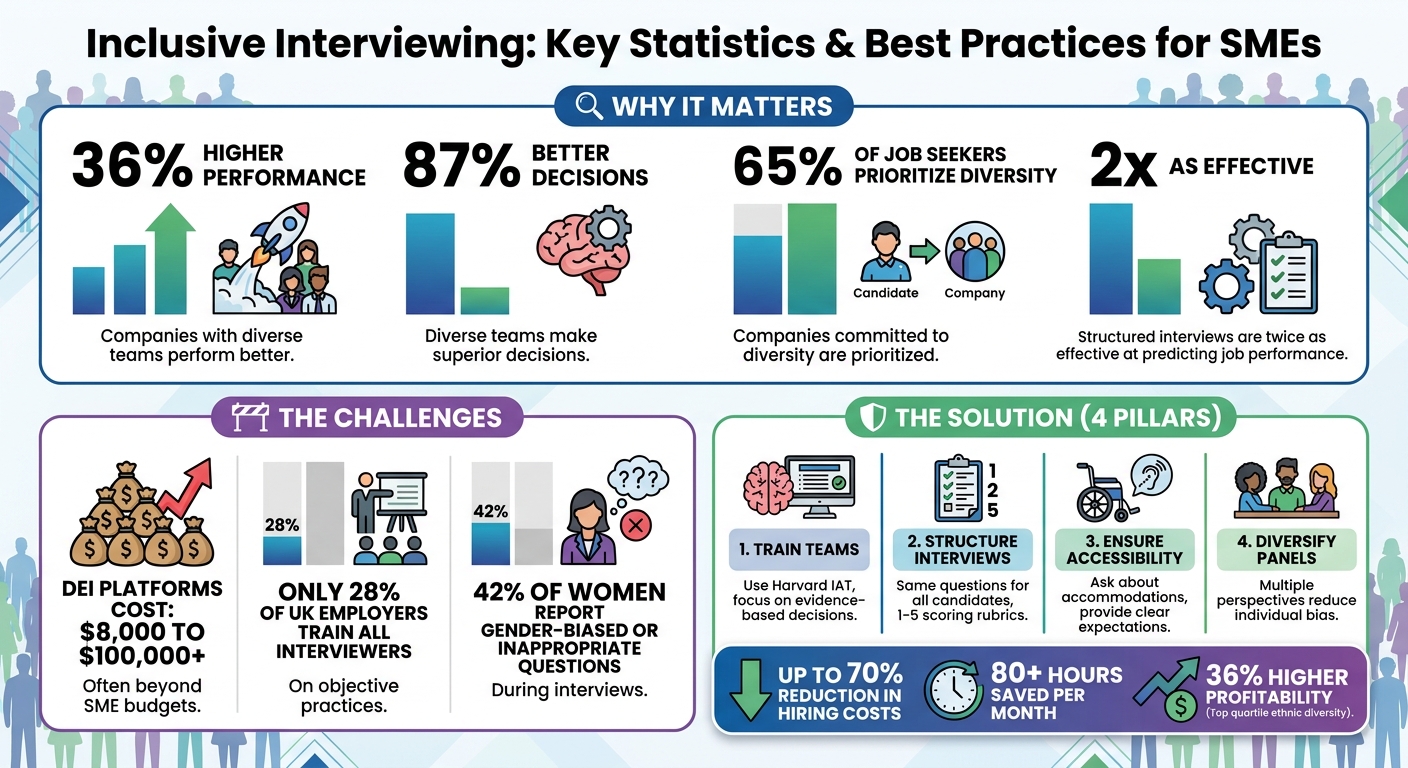
Inclusive Interviewing Statistics and Best Practices for SMEs
Inclusive Hiring | How to Craft Interview Scenarios
sbb-itb-a23bd6a
Common Challenges SMEs Face with Inclusive Interviewing
While inclusive hiring offers clear advantages, SMEs often encounter hurdles that make it tough to put into practice. Recognizing these challenges is the first step to addressing them.
Limited Resources and Budget Constraints
Many diversity hiring strategies assume access to enterprise-level HR departments, something SMEs simply don’t have. Diversity, Equity, and Inclusion (DEI) platforms and services often come with hefty price tags, ranging from $8,000 to six figures – well beyond the reach of most SMEs.
Unlike larger organizations, SMEs rarely have dedicated DEI teams or resources to ensure inclusive hiring practices are followed [1][5]. Instead, hiring often falls on a single manager, leaving little time to audit processes or assemble diverse interview panels. This lack of resources often pushes SMEs to rely on employee referrals, which can unintentionally reinforce a homogeneous workforce [5][2]. Yet, with 65% of job seekers prioritizing companies that show a genuine commitment to diversity, SMEs face mounting pressure to compete with larger firms despite their financial and operational limitations [5].
These constraints often pave the way for another significant challenge: unconscious biases in hiring decisions.
How Unconscious Bias Affects Hiring Decisions
Unconscious bias doesn’t stem from ill intent – it’s a natural byproduct of the brain’s tendency to make quick, automatic judgments. In smaller teams, this often manifests as affinity bias, where hiring managers gravitate toward candidates who resemble themselves in background or experience.
"When every candidate gets different questions and there’s no standardized evaluation rubric, hiring decisions default to ‘gut feel’ – which is just unconscious bias wearing a business suit." – Augtal [1]
The issue worsens with decision fatigue. Small teams often conduct multiple interviews back-to-back or at the end of long, exhausting workdays. As Annie Snyman, Partner and Product Marketing at Hireful, explains: "A tired brain is a brain prone to UB [Unconscious Bias]" [6][4]. Even seemingly harmless small talk during interviews can introduce bias – questions about weekend plans, for example, might inadvertently reveal details about a candidate’s lifestyle or socioeconomic status, influencing the hiring decision.
When interviews lack structure, these biases are even harder to avoid.
Problems with Unstructured Interview Processes
Unstructured interviews are a breeding ground for inconsistency and unfairness. When interviewers ask different questions based on their subjective impressions of each candidate, it becomes impossible to make fair, apples-to-apples comparisons. Research shows that structured interviews are twice as effective as unstructured ones at predicting job performance [3], yet many SMEs stick with informal, conversational approaches due to time constraints.
These unstructured formats, including abstract or puzzle-style questions, often favor candidates who’ve had the privilege to prepare for such scenarios – leaving underrepresented candidates at a disadvantage. Without clear rubrics or scoring systems, hiring decisions often default to subjective judgments rather than objective, evidence-based criteria. This creates what some experts call "bias factories", where unconscious prejudices shape hiring outcomes, excluding capable candidates before they’ve had a fair chance [1][3].
Practical Steps to Create Inclusive Interview Processes
Building fairer interviews doesn’t require a big corporate budget. With some thoughtful and cost-effective strategies, small and medium-sized enterprises (SMEs) can make real improvements without overspending. Here’s how.
Train Your Interview Teams on Bias Recognition
Awareness of bias is just the beginning. While only 28% of UK employers train all interviewers on objective practices [9], effective training goes further than ticking a compliance box. Start with tools like the Harvard Implicit Association Test (IAT) [7] to help your team uncover hidden biases, and then create action plans to address them. Dr. Chelsea Chang from UT Rio Grande Valley highlights this need:
"Awareness through the IAT is not enough; it is important to actively work (via an action plan) to combat and address these biases" [7].
Focus on practical techniques. Teach interviewers to rely on evidence from candidate responses rather than gut instinct through active listening [8]. Build accountability by encouraging team members to challenge each other’s scoring and ensure decisions are grounded in facts. Avoid scheduling interviews back-to-back or at the end of long days, as fatigue can amplify bias [8]. Finally, keep small talk neutral – stick to topics like the candidate’s journey rather than personal details.
Once your team is trained, the next step is to create consistency with structured interviews.
Use Structured Interview Methods
Structured interviews level the playing field by asking every candidate the same job-relevant questions. Research shows they’re twice as effective as unstructured interviews at predicting job performance [3].
Design your interviews around competency-based questions tailored to the role. Combine situational questions (e.g., "How would you handle X?") with behavioral ones (e.g., "Tell me about a time you did Y"). Use scoring rubrics with clear rating scales – typically 1 to 5 – and include examples of what strong and weak responses look like [8]. Sheri Soliman, Senior Software Developer at Shopify, puts it simply:
"When it comes down to it, the question you are really aiming to answer is: who aces your interview? And the work you are really aiming to accomplish is to eliminate all aspects of that answer that are not relevant to your job’s requirements" [10].
Blinded interviews can also help. Ensure at least one panel member doesn’t see demographic details like schools or hometowns [7]. Let candidates know the session follows a scripted format to minimize bias, and replace vague "cultural fit" judgments with measurable criteria.
Make Interviews Accessible and Welcoming
Accessibility ensures every candidate has the opportunity to perform at their best. Start by asking candidates about accommodation needs when scheduling [8]. Offer flexible formats and avoid times that could present logistical challenges [10].
Set a welcoming tone from the start. Greet candidates warmly, offer refreshments, and, if possible, provide a quick office tour [8]. Be clear about what they can expect – who they’ll meet, the tools they’ll use, and the types of questions they’ll face [10]. This transparency reduces anxiety and allows candidates to focus on showcasing their abilities. It’s also essential to avoid inappropriate or biased questions; 42% of women report encountering gender-biased or inappropriate questions during interviews [10]. Proper training on off-limits topics protects both candidates and your company [8].
Finally, consider the makeup of your interview panel to further reduce bias.
Build Diverse Interview Panels
Diverse panels don’t just reduce individual bias; they show a genuine commitment to inclusion. By involving people with varied genders, ethnicities, and backgrounds, you gain multiple perspectives and uncover blind spots.
That said, be mindful of not overburdening employees from underrepresented groups by asking them to serve on every panel [10]. Rotate panel members and distribute responsibilities to keep it fair.
Using Data to Track and Improve Inclusive Hiring
Tracking key metrics can help you pinpoint strengths and weaknesses in your inclusive hiring efforts. Focus on key stages of your hiring funnel to uncover actionable insights.
Monitor Diversity Metrics in Your Hiring Process
Start by examining where candidates enter and exit your hiring process. The diversity sourcing ratio measures the percentage of candidates sourced from channels like HBCUs or women-in-tech groups, helping you gauge how well your outreach efforts reach underrepresented talent [11]. Next, assess the diversity interview ratio – the percentage of underrepresented candidates advancing to interviews. A low ratio may indicate bias during resume screening [11][12].
Pass-through rates are another critical metric. These show how different demographic groups progress through each interview stage. If a particular group consistently drops out during later stages, it could point to bias in your interview panel or evaluation criteria [11]. Finally, track your diversity hiring rate – the percentage of underrepresented candidates who receive and accept offers. A high number of applicants but few hires often signals systemic barriers in your process [12].
To maintain privacy, use an ATS to separate demographic data from hiring decisions [11]. Make demographic questions optional and keep them separate from the main application to build trust with candidates [11]. Establish baseline measurements and set clear goals – for example, increasing women in leadership roles by 15% within two years. Regularly review your diversity dashboard, ideally on a quarterly basis, to identify trends and adjust strategies as needed [11].
Pair these metrics with direct feedback from candidates for a more complete understanding of your hiring process.
Collect Feedback to Refine Your Process
While metrics provide a numerical view, qualitative feedback offers insights into the candidate experience. Use anonymous pulse surveys to ask candidates about their interview experience and whether they perceived the process as fair [11][12]. This feedback can highlight issues that metrics alone might miss, such as inappropriate questions or an unwelcoming interview environment.
Don’t wait for exit interviews – conduct stay interviews with current employees from underrepresented groups. These conversations can reveal why they choose to stay and flag potential issues like isolation or lack of support early on [11]. For example, Nehemiah Manufacturing has embraced this approach. As of November 2025, the company boasts an average employee tenure of 5.5 years, largely due to its focus on "second chance" hiring. Around 80–85% of its 150–180 employees are ex-convicts, leading to significantly lower turnover rates compared to industry norms [12].
Review feedback alongside your metrics on a quarterly basis. If candidates repeatedly report bias at specific stages or if pass-through rates show underrepresented talent dropping off, you’ll know where to focus. Small changes – like providing interview questions in advance for neurodiverse candidates or offering flexible scheduling for caregivers – can have a noticeable impact [11]. Combining data with feedback allows you to make meaningful adjustments and stay aligned with your inclusive hiring goals.
How Rent a Recruiter Helps SMEs Build Inclusive Hiring Processes
Our embedded recruitment approach takes the inclusive strategies outlined earlier and integrates them directly into your hiring process, making them actionable and scalable.
For small and mid-sized companies, building inclusive hiring practices can feel overwhelming, especially without a dedicated recruitment team. Rent a Recruiter solves this by embedding experienced recruiters into your organization within days. This hands-on approach not only brings structure and expertise but also eliminates the hefty overhead of traditional hiring methods. The result? A seamless extension of your inclusive interview practices into a robust recruitment solution.
Embedded Recruiters for Consistent and Fair Hiring
By partnering with Rent a Recruiter, you get a recruiter who becomes part of your team, working to establish standardized interview processes. These processes ensure every candidate is assessed using the same set of questions, reducing bias and focusing on skills and competencies rather than subjective "culture fit" [4][13].
Your embedded recruiter also introduces objective rating scales to evaluate candidates fairly and consistently [4][13]. Beyond setting up these systems, they coach your team on maintaining objectivity, ensuring compliance, and fostering panel diversity. This creates an environment where interviewers can openly challenge decisions and scores, ensuring they are backed by evidence rather than assumptions [4].
Cost-Effective Hiring with Better Outcomes
The embedded model doesn’t just improve processes; it delivers measurable financial benefits. Companies using this approach often see hiring costs drop by up to 70% while saving over 80 hours of internal admin work each month. For SMEs, this fixed monthly cost structure allows for predictable budgeting – critical when managing tight resources while scaling.
Whether you need short-term recruitment support after securing funding or a long-term partner to build a scalable hiring function, this model adapts to your needs. It enables you to meet hiring targets without delays while embedding inclusive practices that attract diverse talent. Research supports this approach, showing that companies in the top quartile for ethnic diversity enjoy 36% higher profitability [14].
With Rent a Recruiter, you gain more than just hiring support – you gain a recruitment function designed to grow with your business.
Conclusion
Inclusive interviewing is more than just a nice-to-have – it’s a game-changer that directly impacts success. For SMEs, where every new hire can shape the company’s culture and growth, getting this right is critical.
Ditch the unstructured "gut feel" approach. Instead, implement standardized processes with clear questions, objective scoring, and diverse interview panels. Equip your team to recognize bias, create accessible interview experiences, and recruit a diverse workforce at every stage of the hiring pipeline. These are not costly changes – they’re deliberate decisions that start with inclusive job descriptions, involving the right people in interviews, and evaluating candidates fairly. These practical steps help SMEs compete effectively with larger companies.
As one expert puts it:
"Inclusion doesn’t require a big budget or a dedicated team. It starts with intention – like where you post your jobs, how you interview, and how you support employees once they’re hired." – TalentAlly [14]
Feeling stretched by the demands of scaling while trying to implement these changes? Rent a Recruiter can help. Our embedded recruiters work as part of your team, reducing hiring costs by up to 70% and saving over 80 hours per month – all while helping you build diverse, high-performing teams.
It’s time to rethink your hiring strategy. Contact Rent a Recruiter today and take the first step toward a more inclusive and efficient recruitment process.
FAQs
What’s the fastest way to make our interviews more structured?
The fastest way to streamline your interviews is by implementing a standardized framework. This means using consistent questions, scoring rubrics, and evaluation criteria for every candidate applying for the same role. It helps minimize bias and creates a level playing field for all applicants.
Begin by crafting clear, role-specific questions that align with the skills and qualities you’re seeking. Pair this with a structured scoring system to evaluate candidates objectively. Make sure every interviewer sticks to the same process. This approach not only boosts consistency but also leads to more informed and confident hiring decisions.
How do we reduce bias without a dedicated HR or DEI team?
Creating a fair and inclusive hiring process doesn’t require a massive team, but it does take a thoughtful approach. Start by using standardized interview questions for every candidate. This ensures everyone is evaluated consistently, reducing the chance of subjective judgments.
Invest in training for hiring managers to help them spot and address unconscious bias. This step encourages more objective decision-making and a level playing field for all applicants.
When advertising roles, focus on inclusive, neutral language in job descriptions. The goal is to appeal to a broad range of candidates, not unintentionally discourage certain groups.
Finally, make it a habit to audit your hiring practices regularly. By identifying and addressing gaps, you’ll create a process that not only promotes equity but attracts a more diverse talent pool.
Which diversity metrics should we track in our hiring funnel?
Tracking metrics is key to understanding how well your inclusive hiring strategies are working. Look at the representation of diverse groups throughout your hiring funnel – from applicants to interviewees to final hires. By monitoring these stages, you can measure progress and pinpoint where adjustments are needed. These insights not only highlight successes but also reveal opportunities to refine your approach for even better outcomes.