Hybrid hiring isn’t just a trend – it’s a smarter way to attract top talent while balancing efficiency and personal connection. But many companies struggle with poor communication, disjointed processes, and unclear expectations, leading to lost candidates and damaged reputations.
Here’s the bottom line: Clear communication, standardized processes, and the right technology are non-negotiable for a smooth hybrid hiring experience. Companies that get this right see faster hiring, reduced costs, and stronger employer branding.
Key Takeaways:
- Clarity is king: Define hybrid work expectations upfront – office days, remote flexibility, and tools needed.
- Consistency matters: Standardize interviews to avoid bias and ensure fairness for all candidates.
- Leverage technology: Use browser-based platforms, ATS systems, and centralized tools to streamline communication and improve efficiency.
The result? A stronger hiring pipeline, fewer drop-offs, and a better reputation in a competitive labor market.
Want to simplify hybrid hiring? Embedded recruitment services like Rent a Recruiter combine expert recruiters with structured processes to deliver results – while cutting costs by up to 70%.
Rebuilding the Candidate Experience in Modern Hiring Systems | Mike Bradshaw & Curtis Kodish
sbb-itb-a23bd6a
Common Challenges in Hybrid Hiring
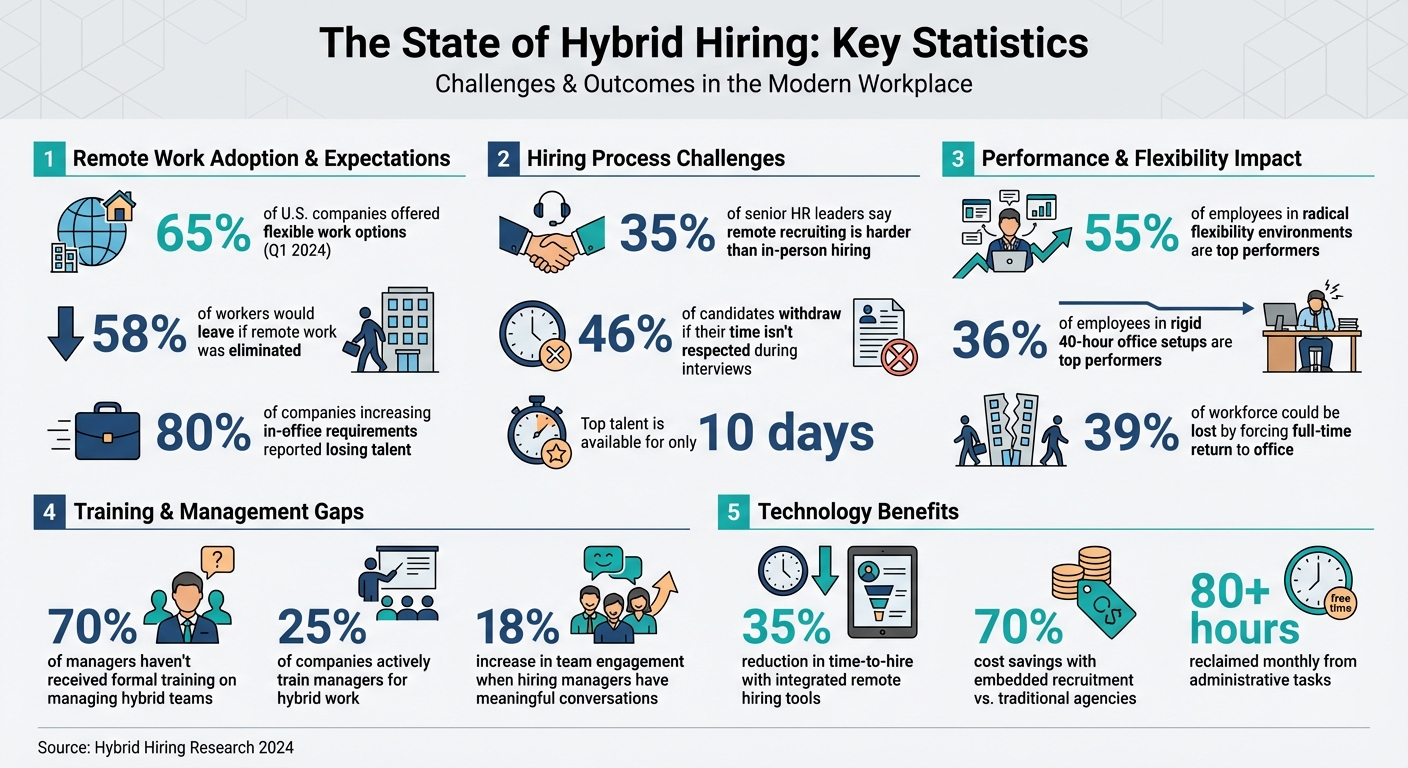
Hybrid Hiring Statistics: Remote Work Impact on Talent Retention and Performance
Hybrid hiring can stumble when candidates face unclear policies, disjointed interview processes, and uncertain role expectations. These pitfalls not only frustrate candidates but can also tarnish your reputation as an employer. Let’s break down the key issues that impact candidate experience in hybrid hiring.
Unclear Communication About Work Arrangements
What does "hybrid" actually mean? It’s a term that varies widely across organizations. In Q1 2024, 65% of U.S. companies offered flexible work options[8], but many fail to define what that flexibility looks like. Is it a fixed schedule with mandatory in-office days? Or is it entirely up to employees to decide? Candidates need specifics – like required in-office days, core working hours, geographic constraints, and how often travel is expected (e.g., two to three times per quarter). Without these details, confusion reigns.
The stakes are high: 58% of workers would leave if remote work was eliminated[8]. Worse, companies increasing in-office requirements reported losing talent in 80% of cases[8]. If you’re not upfront about your hybrid model, you risk alienating top candidates before they even join.
Disconnected Candidate Journeys
Communication gaps often snowball into larger issues during the hiring process. With hiring teams split between remote and on-site work, coordination can become a mess. Utilizing a flexible hiring model can help streamline these disjointed processes. 35% of senior HR leaders say remote recruiting is harder than in-person hiring[5]. The result? Redundant interviews, lost feedback, and scheduling nightmares that slow everything down.
Candidates stuck in this "hiring limbo" can lose trust in your company. Weeks without updates make them question your efficiency – and their decision to engage with you. As Carolyn Dugan, Head of Talent Acquisition at Model N, explains:
"People are connected to the work and to each other, but they don’t always feel connected to the company"[8].
This disconnect doesn’t just cost you candidates; it can lead to negative reviews on platforms like Glassdoor, damaging your ability to attract future talent.
Vague Role Expectations in Hybrid Models
Hybrid roles often come with a lack of clarity around performance expectations. Job descriptions frequently omit whether success will be judged based on in-office contributions, remote work, or both. They also fail to outline the digital tools employees need to thrive – like Slack, Zoom, or Asana – leaving candidates guessing about what’s required.
This lack of transparency can hurt your ability to attract high performers. Consider this: 55% of employees in environments with "radical flexibility" are top performers, compared to only 36% in rigid, 40-hour office setups[5]. If you want to secure top talent, you need to clearly define how success will be measured in your hybrid model.
How to Improve Candidate Experience in Hybrid Hiring
Navigating hybrid hiring challenges requires a thoughtful approach. Every interaction, from the job posting to the final interview, should be intentional. Here’s how to create a process that ensures clarity and consistency for candidates by implementing effective talent acquisition strategies.
Communicate Clear Role Expectations
Start by defining your hybrid work model – whether it’s scheduled, flexible, or results-focused – before writing the job description. Be upfront about office attendance requirements, core working hours, time zone expectations, and perks like home office stipends or coworking space access. This transparency helps candidates understand exactly what they’re stepping into.
For example, in May 2022, Slite founder Christophe Pasquier introduced a transparent pay structure where remote employees are compensated based on the "top percentiles of the capital of the employee’s residency" [8]. He explained:
"Remote employees should indeed be paid fairly, but not equally. The same work should be given a similar standard of living level" [8].
Use terms like "hybrid friendly", "flexible work", or "work from home" in job titles to boost visibility. During interviews, share a sample of a first-week schedule to show how the candidate would balance remote and in-office responsibilities. This eliminates uncertainty and sets clear expectations from the start.
Once role expectations are clear, the next step is ensuring a consistent interview process.
Standardize Hybrid Interview Processes
Consistency is critical to avoid confusion and bias. Once you’ve defined the role, make sure all interviews for that position follow the same format – either fully virtual or fully in-person – to address potential proximity bias. As Marisa Bryan, Global Vice President of Talent at Contentsquare, noted:
"The person you had the cup of coffee with and talked with about the football game last night, you’re going to have a much better personal contact and personal feeling with them than the person you looked at on a flat screen" [9].
Use structured interviews with job-relevant questions and objective evaluation rubrics to assess both technical and soft skills. Centralize interviewer feedback in your Applicant Tracking System (ATS) to keep everything organized and accessible.
For virtual candidates, assign an "interview escort" to manage the schedule, ensure breaks, and serve as a point of contact throughout the process. This attention to detail mirrors the hospitality of an on-site visit. Why does this matter? Nearly half of candidates (46%) withdraw from the process if they feel their time isn’t respected during interviews [10], and top talent is often available for just 10 days [10].
Train Distributed Hiring Teams
Many hiring teams lack training for hybrid environments. In fact, 70% of managers haven’t received formal training on managing hybrid teams, and only 25% of companies actively train their managers for this purpose [11]. Without preparation, teams may struggle to evaluate hybrid candidates fairly.
Train interviewers to approach every session with a remote-first mindset. This includes performing technical checks, maintaining professional virtual backgrounds, and making eye contact via the camera. Encourage hybrid-specific questions like, "How do you stay motivated when working remotely?" or "Can you share an example of solving a problem independently while remote?" [8].
Combat proximity bias by teaching teams to identify and counter any preference for on-site candidates. Provide written guidelines on response times, meeting etiquette, and collaboration practices to ensure every candidate is evaluated on the same criteria. When hiring managers engage in more meaningful conversations, team engagement can increase by up to 18% [11] – and it all starts with how you approach hiring.
Using Technology to Support Hybrid Hiring
Technology simplifies hybrid hiring by keeping team communication aligned and reducing the risk of candidates dropping out. Here’s how key tools can create a smoother experience for everyone involved.
Choose Browser-Based Interview Platforms
Ease of access matters. Browser-based platforms eliminate the need for frustrating downloads, which can discourage candidates from continuing the process. For high-volume roles, asynchronous video interviews are a game-changer. Candidates can record their responses at their convenience, avoiding time zone conflicts while ensuring consistent questioning for all applicants [12]. Always provide a backup contact option – like a phone number or email – in case technical issues disrupt live interviews [3].
Leverage Applicant Tracking Systems for Transparency
An Applicant Tracking System (ATS) serves as a central hub for tracking candidate progress and communication. It eliminates fragmented data by consolidating all interactions into one accessible platform. This ensures both remote recruiters and in-office managers stay updated on real-time feedback and candidate status. Companies using integrated remote hiring tools have seen a 35% reduction in time-to-hire [1][14].
Centralize Team Collaboration
A scattered tech stack can lead to lost information and inefficiency. Using a unified platform that combines ATS and CRM features ensures every interaction is stored in context [1]. AI tools can further enhance this by transcribing and summarizing interviews, providing consistent records for all team members, whether they’re remote or on-site [13]. Automated scheduling tools also help teams overcome time zone hurdles and stay aligned [13].
As hiring expert Mafiro explains:
"If every step of your hiring process requires different platforms or login credentials, it creates confusion for candidates and makes your organization appear disorganized." – Mafiro [14]
To maintain objectivity, digital scorecards can standardize feedback by rating specific attributes. This keeps evaluations fair and consistent, no matter where the interviewer is located [2].
Scalable, Cost-Effective Hiring with Rent a Recruiter
Recruitment isn’t just about technology – it’s about blending tools with the right people. That’s where Rent a Recruiter steps in, offering a human touch to streamline hiring.
Hybrid hiring introduces challenges that many internal teams find hard to navigate while maintaining a smooth candidate experience. Rent a Recruiter solves this by embedding skilled recruiters directly into your team. The result? A structured, consistent hiring process that elevates every stage of recruitment.
Embedded Recruitment Services
Instead of outsourcing to traditional agencies, embedded recruiters work as part of your team, managing the hiring process from start to finish. This ensures candidates experience a cohesive journey, whether during virtual interviews or face-to-face meetings. These recruiters rely on structured frameworks to align with hybrid work models like scheduled, flexible, or results-driven systems, making work expectations crystal clear [7]. They also bring in tools and policies that ensure compliance, giving your team the confidence to make informed hiring decisions [4].
Cost Savings and Efficiency Gains
With this model, companies can cut hiring costs by up to 70% compared to commission-based agency fees while reclaiming over 80 hours a month previously spent on administrative tasks. Beyond saving time and money, embedded recruiters help teams focus on strategic hiring goals. They take on high-volume initial screenings, freeing up internal resources to concentrate on long-term priorities.
This approach also strengthens retention. A better candidate experience leads to higher loyalty and reduced turnover, which means fewer replacement costs and a more stable workforce over time [15].
Flexible Support for High-Growth SMEs
Rent a Recruiter’s solutions are designed to meet the agility demands of high-growth SMEs.
Whether you’re scaling after securing funding, launching a new product, or managing a hiring surge, embedded recruitment adapts to your needs. Rent a Recruiter partners with SMEs across industries like technology, SaaS, fintech, engineering, and professional services. Choose short-term support to hit immediate hiring goals or long-term partnerships to build a scalable recruitment system.
Hybrid hiring also opens access to talent across broader regions, giving you a competitive edge in a tight labor market [6]. By embedding recruitment expertise, SMEs not only cut costs but also deliver a standout candidate experience – helping them stand out in competitive industries.
Conclusion
Key Takeaways for Decision-Makers
With the right strategies – like clear communication and the smart use of technology – your hiring process can become both efficient and engaging. Hybrid hiring, in particular, offers the potential for a smooth candidate experience when built on three core principles: transparency, consistency, and technology.
- Transparency: Clearly outline work arrangements in job postings. Whether it’s fully flexible or specific in-office days, candidates need clarity upfront.
- Consistency: Standardize your interview process so remote and in-person candidates receive the same high-quality experience.
- Technology: Use tools like reliable video platforms and Applicant Tracking Systems to keep the process aligned and organized.
These steps directly address the fragmented and unclear candidate journeys that many organizations struggle with.
The numbers speak for themselves: companies offering radical flexibility see 55% of employees performing at high levels, compared to just 36% in traditional office settings [5]. On the flip side, forcing a full-time return to the office could result in losing up to 39% of your workforce [5]. To stay competitive, focus on skills-based hiring, results-driven frameworks, and digital-first communication. Reliable interview platforms and centralized tracking systems not only streamline your operations but also leave candidates with a positive impression of your company.
Next Steps: Optimize Your Hiring Process
Now that you’re familiar with the core principles, it’s time to take action. Rent a Recruiter places experienced recruiters directly within your team, ensuring structure and consistency across every stage of your hiring process – whether candidates are remote, on-site, or somewhere in between.
Whether you’re scaling after funding, launching a new product, or handling a hiring surge, embedded recruitment offers flexibility without the delays or high costs of traditional agencies. Schedule a call with Rent a Recruiter today to create a scalable, cost-effective hiring function that consistently delivers an outstanding candidate experience.
FAQs
What should a hybrid job posting include?
A hybrid job posting needs to spell out the details of the work arrangement. Be clear about how much time is spent remote versus on-site, the expectations for in-person attendance, and any flexibility options available. This ensures you attract candidates who are genuinely aligned with your company’s hybrid work approach.
How do you avoid bias between remote and in-office candidates?
To ensure fairness between remote and in-office candidates, focus on structured interview processes, which standardize how all candidates are assessed. Additionally, provide training to address unconscious bias, helping interviewers recognize and mitigate any prejudices that could influence decisions. Treat all candidates equally, regardless of their work location, by maintaining consistent evaluation criteria. Adopting these practices for hybrid and remote hiring ensures a more balanced and fair experience for everyone.
What tech is essential for a smooth hybrid hiring process?
To make hybrid hiring smooth and efficient, certain tools are essential. Asynchronous video interview platforms allow candidates to record responses on their own time, making scheduling easier for everyone. AI-powered insights help hiring teams analyze candidate data and make more informed decisions. And integrated applicant tracking systems (ATS) keep everything organized, from applications to interview feedback.
Recruitment software that syncs with email and video platforms is another must-have. It simplifies interview scheduling and keeps communication flowing. On top of that, mobile apps give hiring teams the flexibility to manage tasks on the go, ensuring they stay connected and productive – whether they’re working virtually or meeting candidates in person. Together, these tools create a more efficient process and a better candidate experience.