Remote hiring breaks down when first contact takes too long, and virtual career fairs fix that by putting sourcing, screening, and first interviews into one event.
If you are hiring across the US, this can mean lower event spend, less recruiter time, and more screened candidates in a single session. The article shows why teams use virtual fairs to cut early hiring delays, how to run them well, which metrics to track, and when extra recruiter support makes sense.
At a glance:
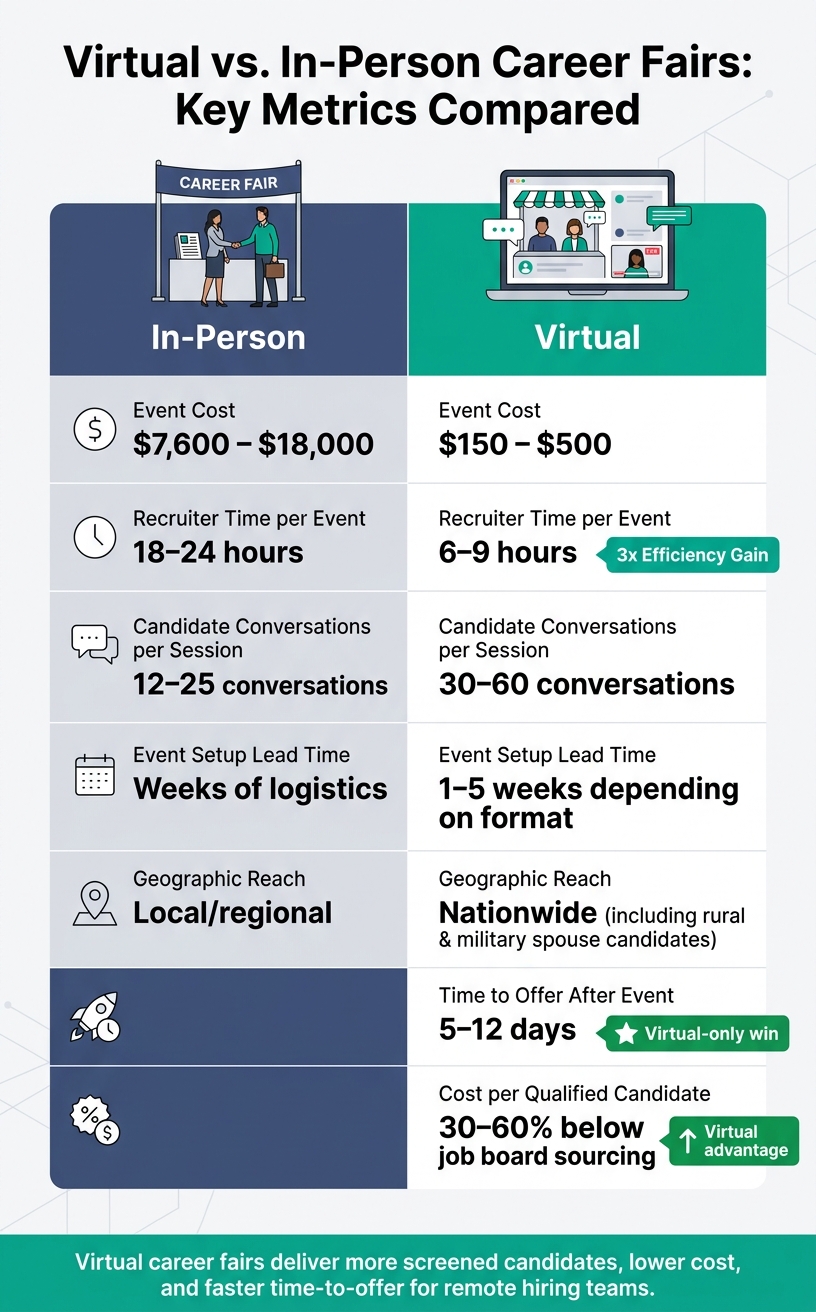
- In-person fair cost: about $7,600 to $18,000
- Virtual booth cost: about $150 to $500
- Recruiter time: 6 to 9 hours virtual vs 18 to 24 hours in person
- Time to offer after event: often 5 to 12 days
- Main risk: weak follow-up, not the format itself
If you need a simpler way to move remote hiring forward, this is the case for using virtual career fairs with clear process and enough recruiter capacity.
Virtual vs In-Person Career Fairs: Cost, Time & Efficiency Compared
Virtual Career Fair Best Practices & Brazen Walkthrough
sbb-itb-a23bd6a
How Virtual Career Fairs Fix Common Remote Hiring Problems
Virtual career fairs replace fragmented outreach with one structured event for sourcing, screening, and first-round interviews. That structure matters because it cuts wasted motion and gives you a cleaner path from first contact to shortlist.
More Reach, Less Cost and Logistics Than In-Person Events
In-person hiring events come with heavy overhead. Travel, lodging, booth fees, and event setup add up fast. A single in-person career fair can cost anywhere from $7,600 to $18,000 once you include those line items, while a similar virtual event will usually cost between $150 and $500 for a booth [2].
That gap is hard to ignore if you’re hiring at volume or across several markets.
Reach matters just as much as spend. In-person events tend to pull from a local talent pool. Virtual fairs open access across the country, including rural candidates and military spouses who may not be able to attend on-site events. For companies hiring across multiple locations, or filling several roles at once, that broader access can make a direct difference to pipeline quality and hiring speed [4][1].
There’s also the recruiter time involved. An in-person event usually takes 18 to 24 hours when you include travel and setup. A virtual fair needs about 6 to 9 hours of recruiter time, which gives you a 3x efficiency gain [2]. For hiring leaders, that means less admin drag and more recruiter capacity spent on live candidate evaluation.
Faster Screening and Better Candidate Routing at Scale
Virtual career fairs deal with one of the biggest remote hiring problems: too much friction between sourcing, screening, and handoff.
Before the event even starts, recruiters can review profiles and resumes and build a priority list. You’re not showing up cold. You’re walking in with a plan and a clearer sense of who should be screened first [5].
During the session, recruiters can run parallel chats, which lets a small team handle far more candidate conversations in the same time window. A focused recruiter can manage 30 to 60 qualified conversations in a 4-to-6-hour session, compared with 12 to 25 at an in-person fair [2]. That jump in volume matters because interest fades fast. If you can move good candidates forward while they’re still engaged, you reduce drop-off and shorten time-to-hire. This efficiency is a core part of how our fixed-cost recruitment model works to lower overhead.
Routing is cleaner too. Recruiters can tag strong candidates in real time and bring in hiring managers straight away while the conversation is still live [5]. Instead of messy notes and delayed follow-up, the platform records each interaction, including chat transcripts, resume downloads, booth visits, and recruiter notes. That data can then be exported straight into your ATS, so your post-event pipeline is already organised for follow-up [4][2].
Remote Hiring Problems vs. Virtual Fair Fixes: Expected Impact
The impact is easiest to see side by side.
| Problem | Virtual Career Fair Solution | Impact |
|---|---|---|
| Low geographic reach | Nationwide access | Access to national talent pools [6] |
| High admin load | Automated scheduling & pre-qualification | Up to 90% reduction in setup time [3] |
| Slow screening | Parallel recruiter chats & real-time candidate tagging | 4 to 5x increase in screening capacity [3] |
| Weak employer visibility | Branded virtual booths & video content | Stronger employer brand visibility [4] |
| Poor handoff between screening and next steps | Logged notes and direct ATS export | Cleaner post-event follow-up [1] |
The commercial upside is pretty clear. Lower event spend, less recruiter time, more screening capacity, and a cleaner handoff into your hiring process.
But none of that happens by accident. The event still needs to be built around the roles you’re hiring for, the number of recruiters available, and how fast your team can follow up after the session ends.
How to Run a Virtual Career Fair That Builds a Qualified Hiring Pipeline
A virtual career fair only helps remote hiring if it builds a qualified pipeline, not just a big attendance number. Once the event is locked in, the job is pretty simple: target the right roles, prep the booth properly, and follow up fast.
Plan the Event Around Roles, Hiring Goals, and Recruiter Capacity
Start with a clear hiring target before the event. For example, you might need 15 mid-level engineering hires in 60 days from priority regions. That target should shape your staffing plan, screening criteria, and invite strategy.
If your team is lean, a pre-scheduled interview format usually makes more sense. If you want more control over how your brand shows up, a marketplace format can work well, but it takes more planning. A match-and-schedule setup needs about 30 to 60 minutes of setup and roughly one week of lead time. A marketplace model needs 4 to 5 weeks and around 25 to 40 hours of prep [3].
Keep first conversations short, between 5 and 10 minutes. Use two recruiters per booth so they can run chats in parallel. That keeps things moving and can double total conversation volume without adding more event time [2].
Prepare Employer Branding, Candidate Communications, and Technical Workflows
Your booth profile should be short and clear. Use 150 to 300 words, add a 1 to 2-minute recruiter video, and make sure each job post includes:
- A one-line summary
- 3 to 5 bullet points
- A salary range
- Remote or hybrid terms [2]
Add pre-screening questions during registration so you can filter for the right experience level or required credentials before the event starts [7]. Also check that the platform can export candidate data straight into your ATS, so records move into your hiring funnel without manual re-entry [2] [7].
Run a 30-minute mock event the day before. Test the booth, video, chat, and data export flow [2]. It is a small step, but it can save your team from avoidable issues once the event goes live.
Run Structured Follow-Up Within 24 to 72 Hours
Once the booth is live, speed matters most. Your follow-up pace after the event has a direct effect on how much of the pipeline turns into interviews and hires. The 24-hour window is critical [2][1].
Tag every candidate as Hot, Warm, or Cold and act on those tags as soon as the session ends.
| Tag | Action After Event |
|---|---|
| Hot | Send a personalized booking link within 1 hour [2] |
| Warm | Send a booking link and job details within 24 hours [2] |
| Cold | Send a thank-you note and add to the talent pool [2] |
For Hot candidates, mention something specific from the conversation in your follow-up. That makes the message feel personal and shows the interaction was real, not templated [1]. Export all resume data into your ATS the next morning so the pipeline is clean, organised, and ready for the hiring team to move [2][3].
What Success Looks Like After the Event
Metrics That Show Hiring Efficiency and Pipeline Quality
Once follow-up is done, the next check is simple: did the event move the right people forward, fast?
Time to Offer is the clearest speed metric. Well-run virtual events usually hit a median time to offer of 5 to 12 days after the event [3]. If that number starts drifting, it often points to friction in screening, scheduling, or decision-making.
Qualified-to-Interview Conversion matters just as much. This is the share of booth conversations that move into a formal interview. It tells you whether the event brought in the right people, not just a lot of activity [3]. High traffic sounds good on paper, but if few candidates progress, your team is still burning time.
Recruiter efficiency also needs a close look. Track Recruiter Hours per Hire to see whether the event made hiring more efficient. Virtual events can drive a 3x to 5x efficiency multiplier [3][2], and that should show up directly in this number. If recruiter hours per hire are not dropping after your first event, the issue is often weak follow-up workflows or poor candidate tagging.
Use these metrics to judge both speed and pipeline quality.
| Metric | What It Measures | Target Range |
|---|---|---|
| Time to Offer | Speed from event to offer | 5 to 12 days [3] |
| Qualified-to-Interview Conversion | % of conversations reaching interview | Varies by role; track trend |
| Conversations per Hour | Recruiter throughput | 5 to 10 per hour [2] |
| Cost per Qualified Candidate | Event cost divided by candidates who advance | 30% to 60% below job board sourcing [3] |
| 90-Day Retention | Hire quality over time | Monitor per cohort [3] |
Business Outcomes for Scaling SMEs
For scaling SMEs, the business case comes down to two things: lower cost and faster movement to offer.
Well-targeted events can deliver a lower cost per qualified hire than broad-source channels. That matters when you’re hiring across several IT roles and need better output from the same budget.
The time savings on the team side are just as important. Recruiters usually spend 6 to 9 hours of total time on a virtual event from start to finish, compared with 18 to 24 hours for an in-person version [2]. For a lean hiring team, that gap is hard to ignore. It can mean the difference between keeping roles moving or letting hiring slip.
Recurring events also give you a steady inflow of candidates at a predictable, fixed cost [3]. That makes workforce planning easier by role and by month, especially when headcount plans are moving fast.
If these metrics start to stall, the problem is usually not the event itself. More often, it’s recruiter capacity or slow follow-up.
When Internal Teams Need Extra Capacity to Run Virtual Career Fairs
When event metrics stall, the issue is usually team capacity, not the format itself. Once candidate volume picks up, internal teams often hit a limit fast. Marketplace-style virtual fairs can take 25 to 40 hours of internal time to plan, promote, and staff [3].
In most cases, delays come from two pressure points: live candidate handling and follow-up. A good rule is one recruiter for every 10 registered candidates [8]. If follow-up slips, interest drops quickly, and that has a direct impact on conversion.
That is where embedded recruitment support helps.
How Rent a Recruiter Can Support Virtual Career Fair Delivery
Rent a Recruiter places experienced recruiters into your team within days to manage virtual career fair delivery from start to finish.
That support can include:
- Pre-event planning
- Sourcing coordination
- Live booth management
- Candidate tagging
- Structured follow-up
- Post-event reporting into your ATS
The commercial upside is simple. You keep the event moving without pulling internal recruiters away from live roles, hiring manager support, or pipeline work. That means less disruption, better follow-through, and a stronger return from the event itself.
Conclusion: Virtual Career Fairs Make Remote Hiring Faster, Leaner, and Easier to Scale
Virtual career fairs give remote hiring teams a clear edge. You can reach more talent, screen people faster, lower cost per qualified candidate, and build a pipeline that is easier to track and repeat.
But the format only works when delivery is tight. Without enough recruiter capacity, speed drops, follow-up suffers, and results flatten out.
For teams that need extra support, Rent a Recruiter embeds recruiters to run event delivery end to end.
FAQs
Are virtual career fairs right for every role?
Not always.
Virtual career fairs tend to work best when you need to hire at volume for roles with a clear, repeatable screening process. That often includes remote-first, entry-level, support, hospitality, and healthcare positions, where candidates can be assessed quickly and consistently.
For scaling companies, that can mean less time spent on early-stage screening and a faster route from applicant to interview, especially when hiring demand spikes.
They’re usually less effective for senior executive searches, highly specialised hires, or roles that need deep, multi-round assessment. The same goes for jobs where in-person culture fit carries more weight.
In those cases, a virtual fair can fill the top of the funnel, but it rarely replaces a more hands-on hiring process.
How many recruiters do we need for one event?
Plan for two to three recruiters to stay active throughout the virtual career fair. That gives you enough cover to handle parallel chats and shifts in traffic without letting response times slip.
During peak hours, usually the first two to three hours after opening, keep your full team online. That’s when candidate volume tends to spike, and slow replies can mean missed conversations.
If slots fill up, line up backup personnel ahead of time so you can add capacity fast. If you need extra support, Rent a Recruiter can provide embedded recruiter support to help you keep pace.
What causes virtual career fairs to underperform?
Virtual career fairs often fall flat when they’re not run as planned hiring events.
The pattern is pretty clear. Results tend to dip when there’s too little lead time, the format feels loose or unorganized, marketing is too broad instead of targeted, or follow-up slips past the 24- to 48-hour window.
That matters because weak execution doesn’t just hurt attendance. It slows your hiring pipeline, drags down application rates, and wastes team time.
Momentum also drops when there’s no clear curriculum or candidates don’t get direct next steps. If people leave the event unsure what happens next, many won’t apply at all. And when that happens, your event creates noise, not hires.