
When hiring volume jumps, poor process gets expensive fast. A bad hire can cost up to 30% of first-year salary, and 50% of people drop out when the hiring process feels too long or inefficient.
If I want to keep hiring quality steady during a spike, I focus on four things: clear hiring standards, a fixed process, tight communication, and extra recruiting capacity before the team gets overloaded. That protects time-to-fill, offer acceptance, 90-day retention, and manager time.
Here’s the short version:
- Set the hiring bar early so recruiters and managers assess people the same way
- Use scorecards and structured interviews to cut inconsistency at higher volume
- Track a small set of numbers weekly, not monthly, so quality drift shows up fast
- Keep communication moving to reduce drop-off and protect your employer brand
- Add support before recruiters are stretched too thin, not after service levels slip
For scaling teams in SaaS, IT, fintech, engineering, security, insurance, and professional services, the issue is simple: you do not just need more hiring activity, you need more control. That is what keeps cost, speed, and hiring outcomes on track when demand climbs.
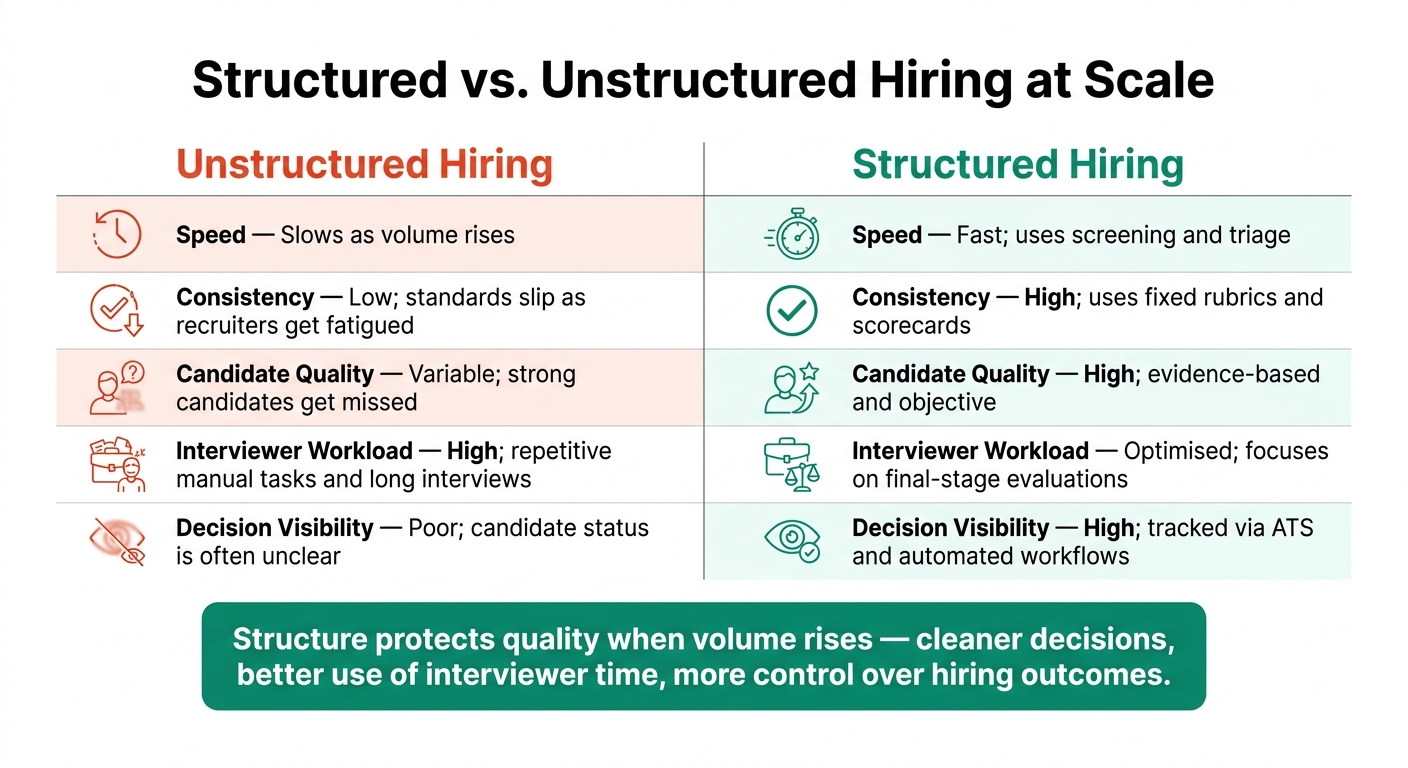
Structured vs. Unstructured Hiring at Scale: Key Differences
How to Measure Quality of Hire with a Manager Check-In Rubric in Excel | Analytics for HR
sbb-itb-a23bd6a
1. Define Hiring Standards Before Volume Increases
If hiring volume is about to climb, set your standards first.
That protects quality and your employer brand. If you skip this step, recruiters and hiring managers start using different yardsticks. That’s when decision-making gets messy, quality slips, and hiring slows down at the worst possible time.
Separate Must-Have Requirements from Nice-to-Haves
When a job description lumps core requirements together with preferences, screening becomes slower and less consistent.
The fix is simple. Before the hiring spike starts, sit down with the hiring manager and split every requirement into two columns: must-haves and nice-to-haves.
Must-haves are the skills, behaviors, or credentials a person needs to do the job. Nice-to-haves are useful, but not deal-breakers. If a requirement can’t be checked in an initial screen, it’s worth asking whether it belongs in the must-have column at all.
This also helps you open up the talent pool. In high-volume hiring periods, people with transferable skills or a bit less experience can still be strong hires if they meet the core requirements. Holding too tightly to nice-to-haves can shrink your funnel for no good reason [3].
Once you’ve agreed the non-negotiables, put them into a scorecard.
Build a Role Scorecard with First-Year Outcomes
A scorecard gives recruiters and hiring managers one shared standard for assessing candidates.
It doesn’t need to be complicated. Cover the core skills, the key behaviors, and the outcomes you expect in the first 90 days and first year [2]. Use a 1 to 4 scale so each interviewer is judging the same things in the same way [7].
Weighting can help as well. For a technical role, for example, you might score:
- Core skills at 60%
- Problem-solving at 25%
- Communication and fit at 15% [7]
Set out what rules a candidate out before hiring begins. When interviewers know the disqualifiers in advance, rejection decisions become faster and more consistent. That saves recruiter time and helps protect hiring quality [5].
Then use the scorecard to test whether those standards are leading to the right hires.
Pick a Small Set of Metrics
Track a small set of metrics that tells you whether faster hiring is still leading to strong hiring outcomes.
These aren’t just reporting lines for a dashboard. They’re your early warning system when volume starts to put pressure on quality.
Focus on:
- Time to full productivity
- 90-day retention
- Hiring manager satisfaction
- Interview-to-offer ratio
- Offer acceptance rate
If your interview-to-offer ratio starts climbing, screening may not be filtering well enough. If 90-day retention drops, that often points to rushed decisions made under pressure [1][2][5][9].
Review these weekly, not monthly. That gives you time to spot drift early and fix it before it turns into a bigger problem.
The aim is simple: enough visibility to catch quality drift early.
With standards in place, the next step is making the process repeatable at higher volume.
2. Build a Hiring Process That Holds Up at Higher Volume
When hiring volume goes up, quality tends to drop for one simple reason: people stop hiring the same way every time.
If one recruiter screens loosely, another screens tightly, and each interviewer uses their own yardstick, your process starts to wobble. Strong candidates get missed. Weak candidates drift through. Team time gets burned.
The fix is a repeatable process. That means structured screening, fixed interview criteria, and clear ownership at each stage. Your funnel should look the same for every candidate.
Standardize Screening, Interviews, and Assessment Criteria
Break the process into clear stages with named owners: who screens, who interviews, who scores. That way, no single recruiter is trying to carry the whole process alone.
Give each interviewer a structured kit. Keep it simple:
- Standardized questions
- The role scorecard from Section 1
- A shared 1 to 4 rubric tied directly to the outcomes defined upfront
This makes decisions easier to compare. It also cuts down on opinion-led hiring, which gets expensive fast when volume climbs.
One practical technique worth using is blocked interviewing. Schedule certain roles on set days, for example engineering interviews on Tuesdays and operations on Thursdays. This helps interviewers stay focused, cuts context switching, and makes side-by-side candidate comparison much easier [7].
A triage system also helps at screening stage. Sort incoming applicants into three buckets: Strong fit (meets all must-haves, move forward at once), Needs review (needs a closer look), and Not a fit (doesn’t meet core requirements, reject promptly) [1]. That keeps recruiter time pointed at qualified candidates and cuts wasted interviews.
Once the people-led steps are standardised, automate only the admin around them.
Use Automation for Admin Tasks, Not Final Hiring Decisions
Use automation for scheduling, reminders, status updates, and offer letters. Use it for initial knockout filters, not final hiring decisions.
That line matters. Admin automation saves time. Decision automation can create risk if you push it too far.
"Automating the screening process gives your team more time to focus on interviews and culture fit assessments, which are the real high-value tasks for recruiters." – Pete Newsome, President, 4 Corner Resources [3]
Unstructured vs. Structured Hiring at Scale: A Comparison
The difference is easiest to see side by side.
| Feature | Unstructured Hiring | Structured Hiring |
|---|---|---|
| Speed | Slows as volume rises | Fast; uses screening and triage |
| Consistency | Low; standards slip as recruiters get fatigued | High; uses fixed rubrics and scorecards |
| Candidate Quality | Variable; strong candidates get missed | High; evidence-based and objective |
| Interviewer Workload | High; repetitive manual tasks and long interviews | Optimised; focuses on final-stage evaluations |
| Decision Visibility | Poor; candidate status is often unclear | High; tracked via ATS and automated workflows |
Structure protects quality when volume rises. It gives you cleaner decisions, better use of interviewer time, and more control over hiring outcomes.
Next, protect the candidate experience that keeps strong applicants engaged.
3. Protect Candidate Experience and Employer Brand During High-Volume Hiring
A hiring spike is not a free pass for a poor candidate experience.
Candidates do not lower their standards because your team is under pressure. If people start dropping out, hiring quality drops with them. Over 40% of applicants abandon hiring processes due to poor communication or lack of updates [13], and 72% share their hiring experience online [13].
That has a direct business cost. You lose strong applicants, slow down hiring, and risk damage to your employer brand in a market where word spreads fast.
Once the process is in place, communication becomes the main tool for keeping top candidates engaged.
Set Clear Timelines and Communicate at Every Stage
Tell candidates what to expect from the start. Put the number of interview rounds, who they will meet, and the decision timeline in the job description [12]. Then attach a simple recruitment roadmap to the first acknowledgment email so people can see what happens next [13].
"Candidates want to know where they stand in the hiring process. In high-volume recruiting, keeping candidates informed at every stage is essential." – Matthew Deutsch, Top Echelon Recruiting Software [11]
Use your ATS to trigger stage updates, and use SMS for time-sensitive messages. SMS is hard to ignore, with a 98% open rate compared to standard email [2]. Even a short note like "We’re still reviewing applications and will be in touch by [date]" every 48 to 72 hours can stop the silence that weakens candidate trust [1].
This is not about saying more. It is about making sure candidates are never left guessing.
Keep the Process Efficient and Respectful of Candidate Time
50% of candidates drop out of hiring processes they perceive as too long [1]. In a hiring spike, every extra step can cost you people you want to hire.
Keep early-stage interviews to what the role actually needs. If a live phone screen adds little value, replace it with a one-way video or a short skills check. The goal is simple: get enough signal without wasting candidate time or your team’s time.
Realistic job previews help here too. Clear job ads and situational judgment tests give candidates a proper view of the role before they get deep into the process. That means people who are not a fit are more likely to opt out early, which cuts down on weak applications without adding extra work for recruiters.
And this matters when offers start going out. A positive candidate experience can increase offer acceptance rates by 38% [13]. If you are filling several roles at once, that can be the difference between hitting plan and missing it.
Common Candidate Experience Failures During Hiring Spikes
These issues are predictable. That means you can fix them before they start.
| Failure | Impact | Corrective Action |
|---|---|---|
| Long silences / ghosting | High drop-off; negative Glassdoor reviews | Automate "still reviewing" status updates every 48 to 72 hours via ATS or SMS |
| Unclear interview steps | Candidate anxiety; lower acceptance rates | Include a process roadmap in the initial invite email |
| Repetitive assessments | Candidate fatigue; loss of top talent | Use standardized scorecards and a single consolidated skills test |
| Slow offer approvals | Top candidates accept faster competitors’ offers | Pre-approve salary ranges and batch offer generation |
| Rushed or generic rejections | Poor market reputation | Use templates that provide brief, respectful context |
Most candidate experience failures during hiring spikes come from process gaps, not bad intent.
So do not leave this to recruiter memory. Build these steps into the workflow so they still hold when volume goes up.
4. Add Hiring Capacity Without Losing Control of the Process
When hiring as you scale moves past recruiter capacity, quality starts to slip unless you add bandwidth without easing standards.
Warning Signs That Your Internal Team Is Overstretched
If process discipline is already there, capacity usually becomes the next bottleneck.
Once recruiters are juggling more than 20 open roles at the same time, hiring can turn into short-term triage fast [4]. Screening calls get rushed. Feedback to hiring managers slows down. Shortlists start looking less like qualified pipelines and more like unchecked resume stacks [4]. At that point, hiring managers spend more time chasing updates and handling admin than making decisions [7].
That’s the tipping point. You need more capacity, but you can’t afford to lose control of the process.
How Embedded Recruiting Support Helps During Hiring Spikes
Embedded recruiting adds hiring capacity inside your current process, so higher volume does not force shortcuts.
Rent a Recruiter places experienced recruiters directly into your team to manage hiring end-to-end, from brief to offer. They work inside your process, not around it. That means you keep control, while adding structure, visibility, and consistency across the hiring cycle.
The commercial upside is clear. The model uses fixed monthly pricing, which gives you predictable costs. Companies typically cut hiring costs by up to 70% and save more than 80 hours per month in internal hiring and admin time [4].
Use the trade-off below to assess whether your team needs outside capacity now.
Overstretched Internal Team vs. Embedded Recruiting Capacity: A Comparison
| Factor | Overstretched Internal Team | Embedded Recruiting Capacity |
|---|---|---|
| Quality of Hire | Inconsistent; rushed decisions and dropped standards [14] | High; structured screening and curated shortlists [4] |
| Time-to-Fill | Slow; backlogs of unprocessed resumes and delayed feedback [4] | Fast; embedded recruiters move quickly without sacrificing standards [4] |
| Hiring Manager Workload | High; managers spend excessive time on coordination and admin [7] | Low; recruiters manage the process end-to-end from brief to offer [4] |
| Visibility | Low; reactive, fragmented, hard to track [4] | High; integrated into the team with structured reporting [4] |
| Hiring Cost | High; rising admin costs and the risk of a bad hire costing up to 30% of salary [2] | Lower; fixed monthly pricing and up to 70% cost reduction [4] |
Conclusion: Monitor results, refine weekly, and build a repeatable hiring spike playbook
Keeping quality steady during a hiring spike comes down to four things: clear standards, a structured process, strong candidate communication, and extra capacity before your team hits overload.
One strong hiring surge is not the same as a repeatable system. The teams that handle spikes well check funnel performance every week and make changes as they go.
Track the metrics that show whether quality is holding
Review funnel metrics weekly so you can spot drift before it starts hurting quality [1].
Use the data to see where the funnel is slipping, screening, speed, or the offer stage [1].
A simple dashboard is often enough. Focus on the numbers that tell you whether hiring quality is holding up and where time or money may be leaking.
| Metric | Target | Corrective Action if Missed |
|---|---|---|
| Time to First Contact | Under 24 hours [1] | Add screening capacity or increase sourcing automation |
| Time-to-Fill | Under 21 days [11] | Streamline interview stages or use group assessments |
| Offer Acceptance Rate | Over 80% [11] | Benchmark compensation and speed-to-offer |
| 90-Day Retention | Over 85% [6] | Review job description accuracy and culture fit filters |
| Hiring Manager Satisfaction | 4.0 / 5.0 or higher [6] | Realign on must-have vs. nice-to-have requirements |
Watch Day 1 no-show rates closely. They often point to a gap between offer acceptance and start date [8]. If that number climbs, you’re not just dealing with a process issue. You’re looking at wasted recruiter time, delayed productivity, and extra hiring cost.
Turn this hiring surge into a repeatable operating model
Once the spike passes, turn what worked into standard practice. Run a formal debrief with your hiring team and stakeholders. Write down the standards, steps, and triggers that delivered results [6].
Then roll that into a simple playbook your team can switch on the next time hiring ramps up. It should include approved role scorecards, standardized interview kits, automated communication templates, and clear capacity triggers that show when to add recruiting support [6] [1].
"High-volume hiring doesn’t reward good intentions. It rewards systems." – Abhishek Patel, Cadient Talent [10]
That kind of playbook saves time, cuts friction, and gives you a cleaner way to handle the next spike without rebuilding the process from scratch.
FAQs
How do I know when hiring quality is starting to slip?
Hiring quality usually doesn’t fall apart all at once. It slips in quietly, and you often won’t see the damage until 60 to 90 days later, when it starts showing up in performance data, absenteeism, and early attrition.
That’s why you need to track quality-of-hire early, not just time-to-fill. Focus on metrics like 30-, 60-, and 90-day retention, alongside early signs such as training completion and attendance.
If hiring gets faster but retention falls, that’s a red flag. For example, if retention drops from 72% to 58%, you’re not improving hiring, you’re trading quality for speed.
For CEOs, CFOs, and talent leaders, that trade-off gets expensive fast. A faster process means very little if new hires leave early, miss training milestones, or fail to reach the level the role needs.
What should I automate during a hiring spike?
Automate repetitive tasks to save time and keep the process consistent. Prioritize:
- Resume screening with AI-powered tools
- Self-service scheduling
- Communication templates
- Chatbots for initial engagement and FAQs
- Documentation workflows for interview feedback
This gives your team more time for interviews and final hiring decisions. It also helps you keep hiring moving without adding admin drag or process gaps.
When should I add recruiting support?
Bring in recruiting support when your internal team is stretched thin, close to burnout, or starting to slow the hiring process.
This matters most during periods of rapid growth, like after a funding round, around a major product launch, or during a seasonal hiring spike. At that point, delays get expensive. Open roles stay open longer, hiring managers lose time, and your team ends up firefighting instead of hiring well.
Rent a Recruiter can place experienced support directly into your team to increase capacity and add more structure to hiring.