
Embedded recruiters are transforming how scaling companies hire. Instead of relying on costly, commission-driven agencies or overburdening internal teams, embedded recruitment offers a better way to manage hiring.
Here’s why it works:
- Cost savings: Companies cut hiring costs by 40–70% compared to traditional agency fees.
- Faster hires: Time-to-fill reduces by up to 50%, helping you secure top candidates before competitors.
- Time saved: Internal teams reclaim over 80 hours per month previously spent on recruitment admin.
- Control: You retain hiring decisions while the embedded recruiter handles execution.
Embedded recruiters work directly within your team, using your tools and attending your meetings. They take full ownership of the hiring process, from sourcing to offer, while creating structured systems that scale with your business.
If hiring delays are holding back growth, embedded recruitment could be the solution you need.
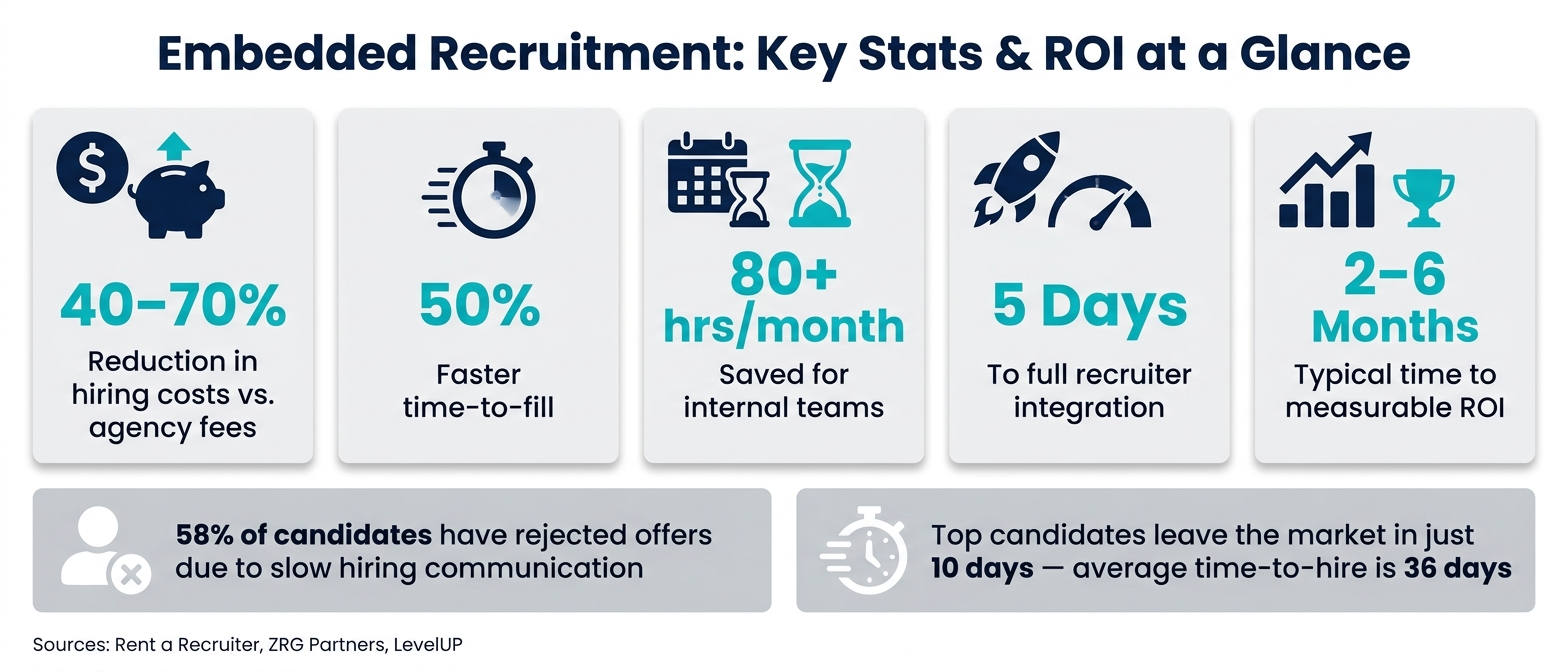
Embedded Recruitment: Key Stats & ROI at a Glance
Understanding Embedded Recruitment
What Is Embedded Recruitment?
Embedded recruitment places an external recruiter directly into your team. They use your tools, systems, and even your email domain, making them feel like an integral part of your company. This is a stark contrast to traditional recruitment agencies, which operate independently and charge fees per placement.
An embedded recruiter goes beyond just sourcing candidates. They immerse themselves in your company culture, take ownership of the hiring process, and handle everything from crafting job descriptions to negotiating offers.
"Embedded recruitment combines in-house alignment with external agility, offering flexible support and predictable costs for companies with evolving hiring needs." – Rent a Recruiter [1]
This setup is designed for adaptability. You can ramp up recruitment support during busy periods and scale back when hiring slows, all without increasing your permanent workforce. It’s a streamlined solution that tackles the challenges many high-growth SMEs face.
Why High-Growth SMEs Choose Embedded Recruiters
Fast-growing companies often encounter hiring spikes that overwhelm internal teams. Founders and managers end up drowning in CVs and stretched thin by recruitment tasks. In the U.S., the average time-to-hire is about 36 days, and for specialized roles, it can stretch beyond 60 days [3]. Meanwhile, top candidates are typically off the market in just 10 days [3].
This mismatch can lead to missed opportunities. For instance, 58% of candidates have turned down offers due to slow communication or delays in the hiring process [3]. Embedded recruiters solve this by becoming part of your team, ensuring smoother communication and faster decision-making.
"Embedded recruiters streamline decision-making from the inside. They’re not outsiders waiting for updates. They’re right there with your team, coaching hiring managers, clarifying requirements, and pushing through the process friction." – ZRG Partners [3]
Another advantage? Predictable costs. Instead of variable agency fees tied to each hire, Recruitment as a Service operates on a set monthly retainer. This means no surprise expenses and more consistent hiring outcomes.
How Embedded Recruitment Works with Rent a Recruiter
Rent a Recruiter has fine-tuned the embedded recruitment model to fit seamlessly into your operations. Within just 5 days of engagement [1], your embedded recruiter is fully integrated into your tech stack, joining team meetings, and collaborating with hiring managers to refine role requirements and improve the candidate experience.
You retain full control over hiring decisions and compensation approvals. As one perspective puts it:
"Embedded recruiters contribute execution, not authority. Think of it as expanding capacity, not delegating control." – LevelUP [2]
The impact is often immediate. Companies partnering with Rent a Recruiter typically see results within 2–6 months, including faster time-to-fill, reduced cost-per-hire, and significant time savings for internal teams. For example, during a 4-month engagement, Hertz worked with Rent a Recruiter to make 184 hires, including 18 senior roles. They processed over 5,000 applications and saved their HR team more than 600 hours of administrative work [4].
This approach doesn’t just fill roles – it transforms the way companies manage recruitment, delivering measurable results that align with business needs.
sbb-itb-a23bd6a
Building a Structured Hiring Process
To deliver consistent, high-quality hires quickly, embedded recruiters design a structured, data-focused hiring process.
Setting Hiring Goals and Metrics
Embedded recruiters move hiring decisions away from gut feelings and into the realm of data. Instead of relying on generic industry benchmarks, they establish targets based on your company’s past hiring performance. Key metrics like time-to-hire, time-in-stage, offer acceptance rate, and quality of hire are tracked using your ATS as the central hub for data.
"Taking a business-outcomes-first approach will likely reveal to your C-levels that recruiting has one of the highest business impacts in the organization." – Debra Teo, Covey [5]
These goals are tied directly to your business objectives, whether it’s launching a product, hitting a funding milestone, or entering a new market. With real-time tracking at every stage of the process, bottlenecks are identified as soon as they occur. Companies that adopt structured interview processes and review metrics weekly report 70% better hiring outcomes [6]. Once the metrics are set, they are seamlessly incorporated into your existing tools to ensure targets are met efficiently.
Integrating into Teams and Tools
Speed matters when embedding a recruiter into your team. They integrate directly into your existing systems – your ATS, HRIS, and communication tools like Slack or Microsoft Teams – avoiding the friction that comes with introducing new platforms. As one expert notes:
"If recruiters cannot operate inside your system, they cannot operate at your speed." – LevelUP [2]
From day one, they join your team’s communication channels and intake meetings, focusing on operational efficiency. They immerse themselves in your product roadmap, team culture, and employer brand to represent your company authentically to candidates.
Standardizing Hiring Workflows
Inconsistent hiring processes lead to delays, poor decisions, and wasted resources. Embedded recruiters tackle this by creating a single, repeatable workflow for all roles.
This involves defining clear pipeline stages – such as Screening, Technical Interview, Culture Fit, and Offer – and applying them consistently. Standardized scorecards ensure every interviewer evaluates candidates using the same criteria. For more insights on optimizing your talent strategy, explore our recruitment blog. Feedback SLAs are implemented to keep candidates informed and ensure hiring managers remain accountable. These workflows align with the data-driven goals set earlier, making results measurable and reporting more reliable.
"Embedded recruiting places recruiters inside your workflow: your tools, your cadence, your stakeholder reality, and your hiring standards." – Martin Bernard, Author [7]
Managing the Hiring Pipeline from Start to Finish
Once workflows are streamlined and goals are clearly defined, the next challenge is ensuring candidates move through the hiring process efficiently – without sacrificing quality.
Sourcing and Outreach Methods
Embedded recruiters don’t sit back and wait for applications to roll in. They actively build talent pipelines well before roles are officially open. This proactive approach is especially critical for hard-to-fill roles like AI/ML engineers, cybersecurity specialists, or data architects, where the pool of active candidates is small and competition is intense.
Because embedded recruiters work as part of your team, they represent your employer brand with genuine insight. They understand your company culture and the nuances of each role, which makes their outreach more authentic. That authenticity resonates with passive candidates, increasing engagement rates.
Take Glan Agua, for example. From January 2024 to May 2025, the water infrastructure company partnered with Rent a Recruiter to combat talent shortages across Ireland and the UK. In just 17 months, the embedded recruitment team engaged over 8,000 passive candidates and delivered 180 qualified applicants – results that would have been tough to achieve with a reactive, inbound-only approach [1].
Once the pipeline is built, the focus shifts to assessing candidates effectively.
Screening Candidates Consistently
With proactive sourcing in place, embedded recruiters ensure every candidate is evaluated through a consistent framework. Without structured screening, hiring decisions can become inconsistent and unreliable. Embedded recruiters solve this by using standardized scorecards tailored to each role. These scorecards assess technical skills, communication abilities, and alignment with company culture, ensuring every candidate is measured against the same criteria.
Additionally, embedded recruiters maintain strict feedback timelines, keeping the process moving and candidates informed. This consistency not only improves decision-making but also enhances the candidate experience.
Coordinating Interviews and Closing Offers
After screening, embedded recruiters handle one of the most tedious and time-sensitive aspects of hiring: interview coordination. Delays at this stage can be costly, especially since top candidates are often off the market within 10 days of starting their job search [3]. Embedded recruiters take care of scheduling within your existing systems – whether it’s your ATS, calendar tools, or communication platforms – eliminating the inefficiencies of working with external agencies.
Once interviews are complete, embedded recruiters consolidate feedback quickly, enabling faster decisions. When it comes to offers, the internal team retains control over compensation, but the embedded recruiter manages the process. They handle candidate conversations, present the offer in the context of the role and company, and address concerns early – reducing the risk of offer rejections.
Measuring Results and Scaling Hiring Over Time
Embedded recruiters don’t just set up workflows – they use data to refine and improve hiring processes continuously.
Tracking Metrics and Fixing Bottlenecks
Embedded recruiters centralize hiring data within your existing systems – whether it’s your ATS, Slack, or Teams – eliminating scattered inboxes and spreadsheets. From the start, they monitor key metrics like time-to-fill, cost-per-hire, interview-to-offer ratios, and candidate drop-off rates [2]. These metrics align with the structured hiring goals established earlier, ensuring the process keeps improving as your needs grow.
Real-time dashboards give hiring managers a clear view of every role’s progress. If candidates get stuck in a particular stage or feedback delays slow things down, these bottlenecks are identified and resolved quickly – often in days rather than weeks [2].
"Hiring faster doesn’t mean lowering the bar. It means removing the barriers, the miscommunications, the multiple layers of approval, and the lack of urgency." – ZRG Partners [3]
Building Playbooks for Consistent Hiring
As hiring ramps up, maintaining consistency across departments and with new hiring managers can become a challenge. Embedded recruiters address this by creating playbooks: tools like standardized intake templates, calibration guides for roles, interview scorecards, and clear feedback timelines [2].
These playbooks aren’t static. They grow and adapt as the company evolves, capturing best practices and eliminating inefficiencies. This ensures the hiring process doesn’t rely on any one person’s knowledge but is driven by a scalable system [3]. By standardizing practices, embedded recruiters lay the groundwork for measurable cost and time savings.
Cost Savings and Time Freed for Internal Teams
Embedded recruitment delivers clear ROI, cutting hiring costs by 40–70% and reducing time-to-fill by up to 50%. On top of that, internal teams save over 80 hours each month [1].
With embedded recruiters managing the hiring process, hiring managers can focus on their primary responsibilities instead of sifting through resumes, handling scheduling, or chasing feedback. While the embedded recruiter handles the logistics, the internal team remains in control of hiring decisions. This balance ensures recruitment success without overburdening internal resources.
"Most organisations see measurable ROI – reduced time‑to‑fill, better hiring outcomes – within the first 2–6 months of placement." – Rent a Recruiter [1]
Conclusion and Next Steps
Key Takeaways
Embedded recruitment offers high-growth SMEs a way to bring structure, speed, and cost efficiency to their hiring process. By embedding a recruiter directly into your team, you gain someone who manages hiring end-to-end while creating processes that can scale with your business.
The numbers back it up. Most companies see a clear return on investment within 2–6 months, as highlighted earlier [1]. Beyond financial savings, the real advantage lies in creating scalable hiring systems – standardized workflows and playbooks that ensure consistency as you grow.
Unlike traditional outsourcing, embedded recruitment keeps your team in control. While the recruiter handles execution, you retain ownership of the decisions and outcomes. This approach transforms recruitment into a function that drives growth, not delays it.
Call to Action
If hiring has become a bottleneck, now is the time to assess your process. Rent a Recruiter provides a free Recruitment Health Check, offering a detailed benchmarking report to pinpoint inefficiencies – whether it’s candidate drop-off points, wasted time, or hidden costs [8].
With Rent a Recruiter, an embedded recruiter can join your team in just 5 days. Support is flexible, scaling up or down as your needs change, and there are no long-term commitments [1]. Book a strategy call with Rent a Recruiter to get a tailored hiring plan and uncover potential savings for your business.
FAQs
What does an embedded recruiter do day to day?
An embedded recruiter becomes an integral part of your team, handling every aspect of the hiring process. They take charge of tasks like sourcing top candidates, screening applications, scheduling interviews, and managing recruitment workflows. By using your existing tools and systems, they align closely with your objectives, simplify the hiring process, and help cut costs. This approach ensures a seamless hiring experience that’s built to support your company during times of growth or increased hiring needs.
How fast can an embedded recruiter start and show results?
An embedded recruiter can start making an impact in as little as 14 to 21 days. Compare that to the 68-day average it takes to hire through traditional internal processes, and the difference is clear. This faster setup means your hiring needs are tackled promptly, avoiding the drawn-out delays that can slow down growth.
What should we track to know embedded recruitment is working?
To measure how well embedded recruitment is working, focus on tracking specific metrics:
- Quality of Hire: Look at new hire performance, retention rates, and how well they align with your team’s values and work environment.
- Time-to-Fill: Keep an eye on how quickly roles are being filled without sacrificing quality.
- Candidate Experience: Evaluate feedback from candidates to ensure a positive hiring journey.
- Diversity Metrics: Monitor progress in building a more inclusive workforce.
- Cost per Hire: Calculate the expenses associated with each hire to gauge cost-effectiveness.
The potential benefits include cutting hiring costs by up to 70% and reclaiming over 80 hours each month from administrative tasks. By consistently reviewing these metrics, you can stay on track with your hiring goals and make adjustments as needed.